Philippines Industrial Vacuum Cleaner Market Size, Share & Growth Rate
The Philippines Industrial Vacuum Cleaner Market was estimated at USD 145 Million in 2025 and is projected to reach USD 158 Million by 2032, growing at a CAGR of 1.2% from 2026 to 2032. This growth trajectory is largely driven by the heightened focus on workplace hygiene, spurred by stricter regulatory frameworks and increased awareness surrounding occupational health. Additionally, industries are turning to innovative cleaning technologies that offer improved efficiency and effectiveness in maintaining dust-free and safe environments.
Philippines Industrial Vacuum Cleaner Market Year-wise Growth Rate and Key Drivers
This graph highlights how the Philippines Industrial Vacuum Cleaner Market has steadily grown over the years, supported by major growth factors.
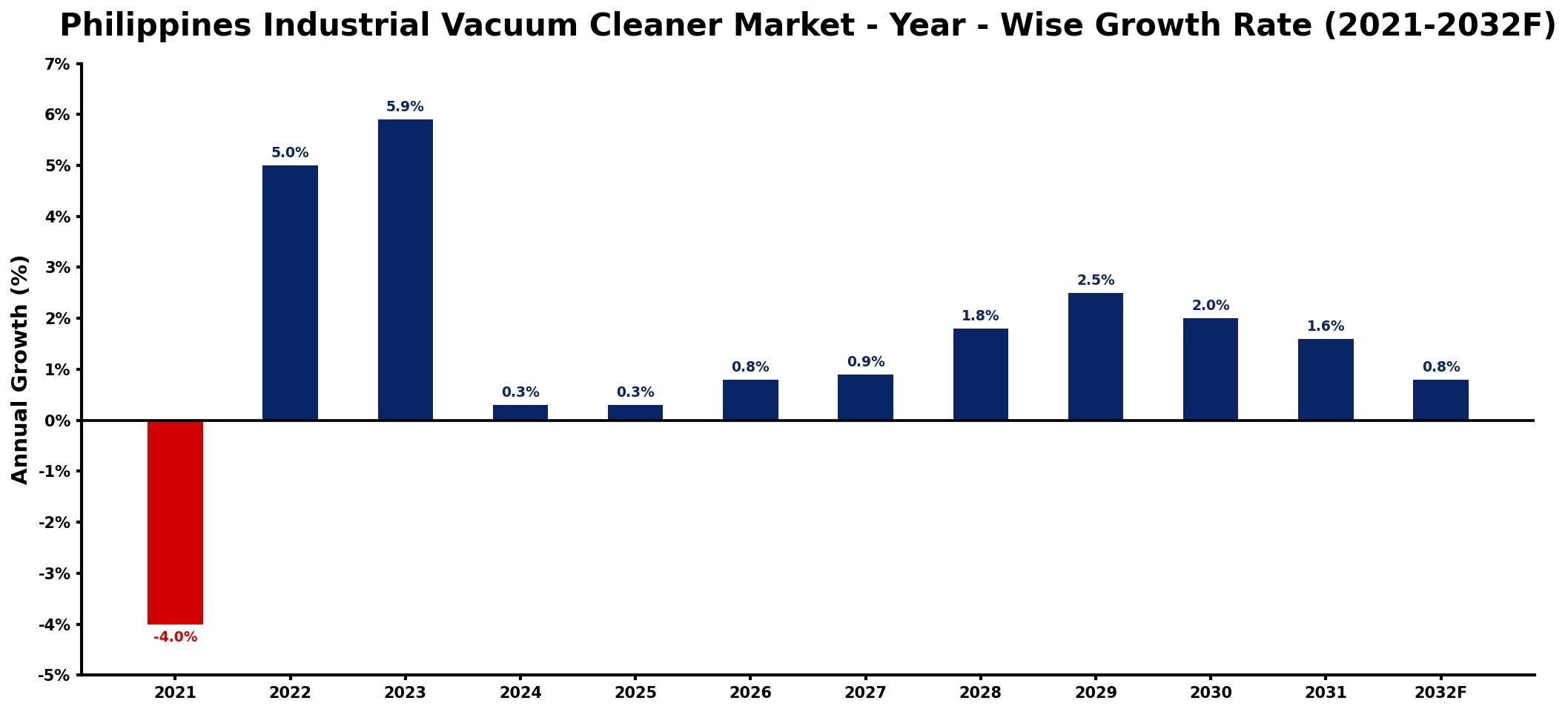
The table below presents the year‑wise growth rates along with the key drivers influencing the market
| Year | Growth Rate | Major Drivers |
| 2021 | -4.0% | decrease in manufacturing activities |
| 2022 | 5.0% | increased construction sector investments |
| 2023 | 5.9% | growing demand for automation solutions |
| 2024 | 0.3% | expansion of logistics companies operations |
| 2025 | 0.3% | rise in food processing facilities |
| 2026 | 0.8% | enhanced focus on workplace hygiene |
| 2027 | 0.9% | boost in healthcare facility upgrades |
| 2028 | 1.8% | growing awareness of environmental standards |
| 2029 | 2.5% | increased adoption of energy efficiency |
| 2030 | 2.0% | growing commercial sector adoption |
| 2031 | 1.6% | growing popularity of smart technology |
| 2032 | 0.8% | increased emphasis on safety regulations |
Note: Market size estimations and growth projections presented in this report are based on 6Wresearch's proprietary forecasting methodology, utilizing the latest available industry data, government publications, and primary research inputs.
Philippines Industrial Vacuum Cleaner Market Synopsis
The Philippines Industrial Vacuum Cleaner market has enjoyed steady momentum in recent years, reflecting an essential shift towards improved cleanliness and safety protocols across various sectors. Moving forward, the market is poised for sustained expansion as companies prioritize investment in advanced cleaning solutions to address stringent hygiene standards.
The demand for industrial vacuum cleaners is growing particularly in manufacturing, construction, and healthcare sectors, where dust and debris are prevalent. As industries adapt to evolving safety regulations and elevate hygiene practices, the market is set to evolve with innovations that cater to diverse cleaning needs, positioning it for a robust future.
Philippines Industrial Vacuum Cleaner Market Key Takeaways
- The market is expected to grow at a CAGR of 1.2% from 2026 to 2032, indicating consistent demand for efficient cleaning solutions.
- Heightened focus on workplace hygiene is a primary driver, leading industries to seek powerful vacuum systems.
- Healthcare and manufacturing sectors are particularly influential, given their strict cleanliness requirements.
- Technological advancements in vacuum design will enhance performance and maintenance efficiency.
- Increased investments in infrastructure development in the Philippines provide a growing market for industrial cleaning solutions.
Evaluation of Restraints in Philippines Industrial Vacuum Cleaner Market
Despite a promising growth trajectory, the Philippines Industrial Vacuum Cleaner market faces several restraints. A significant challenge is the need for tailored vacuum solutions that can effectively handle a range of industrial debris and materials, necessitating ongoing innovation in design. Additionally, the maintenance and operational costs associated with high-performance vacuum systems can pose barriers for smaller enterprises. These factors compel manufacturers to prioritize efficiency while maintaining competitive pricing, impacting overall market penetration and growth.
Philippines Industrial Vacuum Cleaner Market Trends
Current trends in the Philippines Industrial Vacuum Cleaner market reflect an increasing reliance on automation and smart technology. Integrating IoT capabilities into vacuum systems allows for real-time monitoring of performance and maintenance needs, enhancing efficiency and reducing downtime. Furthermore, the adoption of eco-friendly materials and energy-efficient models aligns with broader sustainability goals, appealing to environmentally-conscious industries.
Philippines Industrial Vacuum Cleaner Market Opportunities
Significant growth opportunities exist in the Philippines Industrial Vacuum Cleaner market, particularly within the expanding construction and manufacturing sectors. As these industries recover and expand post-pandemic, investments in advanced cleaning solutions will increase. Additionally, the ongoing push for enhanced workplace safety regulations presents a fertile ground for new market entrants, particularly those focusing on innovative and efficient cleaning technologies.
Government Initiatives in the Philippines Industrial Vacuum Cleaner Market
The Philippine government has implemented various initiatives aimed at promoting industrial safety and hygiene standards across sectors. Increased public spending on infrastructure development, coupled with supportive policies for health and safety, aligns closely with the needs of the industrial vacuum cleaner market. Programs that encourage compliance with international hygiene standards are also fostering growth within this sector, thereby enhancing overall workplace safety and environmental sustainability.
Future Insights of the Philippines Industrial Vacuum Cleaner Market
Looking ahead to 2026-2032, the Philippines Industrial Vacuum Cleaner market is likely to witness transformative changes driven by technological advancements and evolving industry needs. The integration of automation and AI in cleaning processes will not only improve efficiency but also reduce operational costs. Additionally, as workplace safety becomes an even higher priority, industries will increasingly adopt advanced cleaning solutions to meet stringent health regulations, ensuring the market's continued growth.
Philippines Industrial Vacuum Cleaner Market Latest Developments (2025 - 2026)
Recent developments in the Philippines Industrial Vacuum Cleaner market indicate a shift towards more technologically sophisticated products. Several manufacturers are launching new models equipped with smart technology to improve cleaning efficiency and ease of maintenance. Additionally, there is a growing emphasis on eco-friendly materials in vacuum designs, reflecting the industry's response to sustainability trends and regulatory pressures for greener solutions.
Philippines Industrial Vacuum Cleaner Market - Key Attractiveness of the Report
- 10 Years of Market Numbers
- Historical Data Starting from 2022 to 2025
- Base Year: 2025
- Forecast Data until 2032
- Key Performance Indicators Impacting the Market
- Major Upcoming Developments and Projects
Key Highlights of the Report:
- Philippines Industrial Vacuum Cleaner Market Outlook
- Market Size of Philippines Industrial Vacuum Cleaner Market, 2025
- Forecast of Philippines Industrial Vacuum Cleaner Market, 2032
- Historical Data and Forecast of Philippines Industrial Vacuum Cleaner Revenues & Volume for the Period 2022-2032F
- Philippines Industrial Vacuum Cleaner Market Trend Evolution
- Philippines Industrial Vacuum Cleaner Market Drivers and Challenges
- Philippines Industrial Vacuum Cleaner Price Trends
- Philippines Industrial Vacuum Cleaner Porter's Five Forces
- Philippines Industrial Vacuum Cleaner Industry Life Cycle
- Historical Data and Forecast of Philippines Industrial Vacuum Cleaner Market Revenues & Volume By Type for the Period 2022-2032F
- Historical Data and Forecast of Philippines Industrial Vacuum Cleaner Market Revenues & Volume By Dry for the Period 2022-2032F
- Historical Data and Forecast of Philippines Industrial Vacuum Cleaner Market Revenues & Volume By Wet & Dry for the Period 2022-2032F
- Historical Data and Forecast of Philippines Industrial Vacuum Cleaner Market Revenues & Volume By Power Source for the Period 2022-2032F
- Historical Data and Forecast of Philippines Industrial Vacuum Cleaner Market Revenues & Volume By Electric for the Period 2022-2032F
- Historical Data and Forecast of Philippines Industrial Vacuum Cleaner Market Revenues & Volume By Pneumatic for the Period 2022-2032F
- Historical Data and Forecast of Philippines Industrial Vacuum Cleaner Market Revenues & Volume By Industry for the Period 2022-2032F
- Historical Data and Forecast of Philippines Industrial Vacuum Cleaner Market Revenues & Volume By Food & Beverages for the Period 2022-2032F
- Historical Data and Forecast of Philippines Industrial Vacuum Cleaner Market Revenues & Volume By Metalworking for the Period 2022-2032F
- Historical Data and Forecast of Philippines Industrial Vacuum Cleaner Market Revenues & Volume By Pharmaceuticals for the Period 2022-2032F
- Historical Data and Forecast of Philippines Industrial Vacuum Cleaner Market Revenues & Volume By Manufacturing for the Period 2022-2032F
- Historical Data and Forecast of Philippines Industrial Vacuum Cleaner Market Revenues & Volume By Building & Construction for the Period 2022-2032F
- Historical Data and Forecast of Philippines Industrial Vacuum Cleaner Market Revenues & Volume By Others for the Period 2022-2032F
- Philippines Industrial Vacuum Cleaner Import Export Trade Statistics
- Market Opportunity Assessment By Type
- Market Opportunity Assessment By Power Source
- Market Opportunity Assessment By Industry
- Philippines Industrial Vacuum Cleaner Top Companies Market Share
- Philippines Industrial Vacuum Cleaner Competitive Benchmarking By Technical and Operational Parameters
- Philippines Industrial Vacuum Cleaner Company Profiles
- Philippines Industrial Vacuum Cleaner Key Strategic Recommendations






































