Philippines Infrared Imaging Market Size, Share & Growth Rate
The Philippines Infrared Imaging Market was estimated at USD 477 Million in 2025 and is projected to reach USD 644 Million by 2032, growing at a CAGR of 4.4% from 2026 to 2032. This steady growth trajectory is primarily driven by the increasing integration of infrared technology across diverse sectors such as healthcare, security, and manufacturing. The need for enhanced safety, efficiency, and non-destructive testing methods in industries like oil and gas and construction is further propelling this market forward.
Philippines Infrared Imaging Market Year-wise Growth Rate and Key Drivers
This graph highlights how the Philippines Infrared Imaging Market has steadily grown over the years, supported by major growth factors.
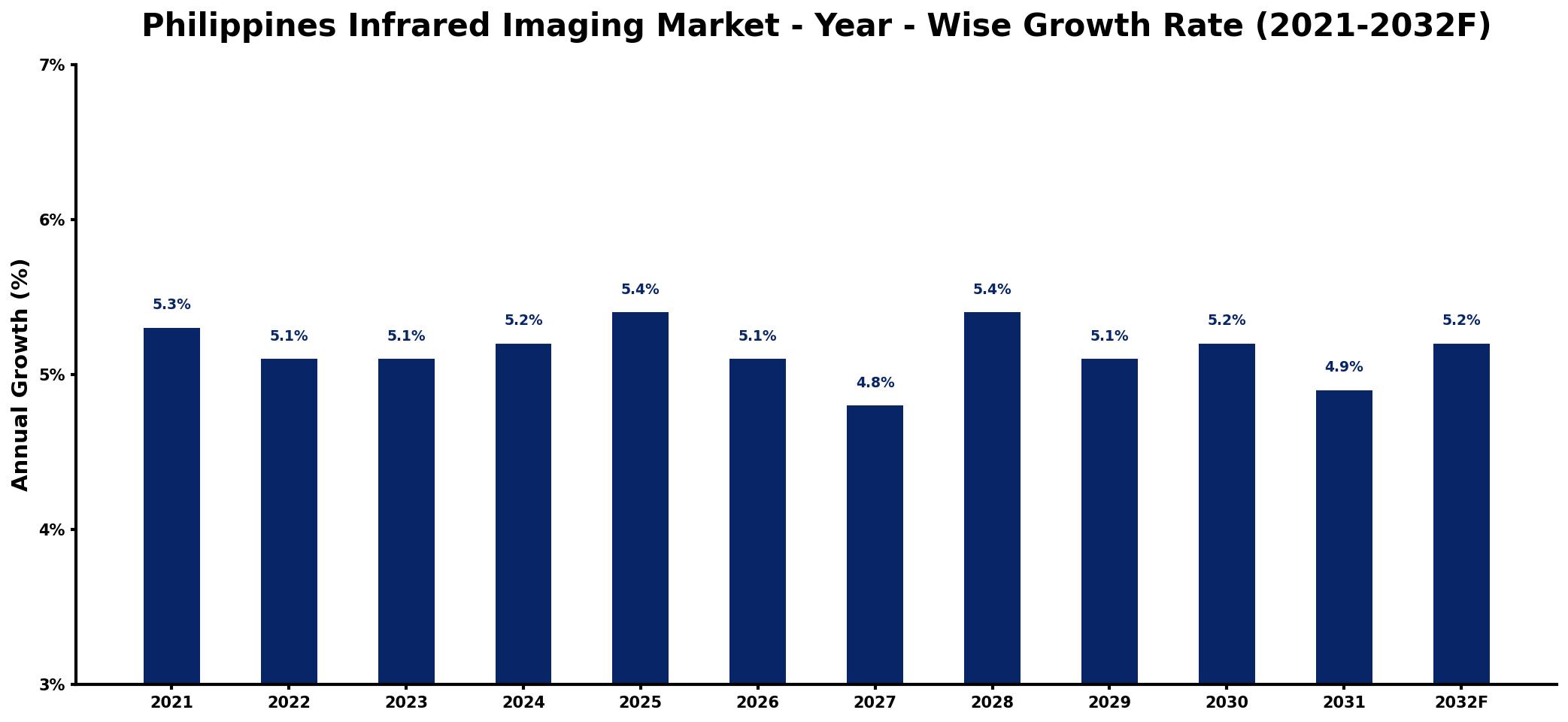
The table below presents the year‑wise growth rates along with the key drivers influencing the market
| Year | Growth Rate | Major Drivers |
| 2021 | 5.3% | Rising demand for thermal applications |
| 2022 | 5.1% | Increased investment in healthcare technologies |
| 2023 | 5.1% | Growing focus on energy efficiency |
| 2024 | 5.2% | Expansion of industrial automation systems |
| 2025 | 5.4% | Surge in construction safety regulations |
| 2026 | 5.1% | Advancements in research and development |
| 2027 | 4.8% | Declining interest in traditional methods |
| 2028 | 5.4% | Growth in environmental monitoring initiatives |
| 2029 | 5.1% | Heightened awareness of fire safety |
| 2030 | 5.2% | Increase in government infrastructure projects |
| 2031 | 4.9% | increased overall sector activity |
| 2032 | 5.2% | Growing integration with smart technologies |
Note: Market size estimations and growth projections presented in this report are based on 6Wresearch's proprietary forecasting methodology, utilizing the latest available industry data, government publications, and primary research inputs.
Philippines Infrared Imaging Market Synopsis
In recent years, the Philippines infrared imaging market has gained significant momentum, fueled by technological advancements and rising awareness about the benefits of thermal imaging. This growth reflects a shift toward modern solutions that enhance operational safety and quality control.
Looking ahead, the market is poised for notable expansion as more sectors recognize the advantages of infrared imaging. This includes not only traditional applications in security and surveillance but also emerging uses in healthcare and automotive, making the landscape increasingly competitive.
Philippines Infrared Imaging Market Key Takeaways
- The market is expected to be valued at USD 644 Million by 2032.
- Key growth drivers include advancements in sensor technology and regulatory safety standards.
- Industries such as healthcare and security are rapidly adopting infrared imaging solutions.
- The demand for non-destructive testing in oil and gas is a significant market influencer.
- Cost reductions in infrared devices are aiding widespread industry adoption.
Evaluation of Restraints in Philippines Infrared Imaging Market
Despite the promising growth, the Philippines infrared imaging market faces notable challenges. Limitations in image clarity under certain environmental conditions can hinder operational effectiveness. High upfront costs for advanced equipment often deter smaller enterprises from investing in infrared technology. Additionally, the necessity for specialized training to accurately interpret infrared data presents an obstacle to widespread adoption, slowing down the market's overall growth.
Philippines Infrared Imaging Market Trends
A significant trend in the Philippines infrared imaging market is the increasing focus on integrated solutions that combine thermal imaging with other advanced technologies. The convergence of IoT and AI with infrared imaging is set to revolutionize sectors such as security and healthcare, enabling real-time analytics and enhanced decision-making capabilities. Furthermore, there is a growing demand for portable and user-friendly infrared devices, which is likely to expand market accessibility.
Philippines Infrared Imaging Market Opportunities
The Philippines presents a wealth of opportunities for investment in infrared imaging technologies. The ongoing urbanization and infrastructure development projects offer significant potential in sectors such as construction and maintenance. Additionally, the rising emphasis on safety protocols, particularly in the wake of the pandemic, encourages greater integration of infrared imaging in health screenings and monitoring systems. These factors collectively create a fertile landscape for market players looking to innovate and expand.
Government Initiatives in the Philippines Infrared Imaging Market
The Philippine government has been proactive in fostering an environment conducive to the adoption of advanced technologies, including infrared imaging. Various public spending initiatives aim to modernize infrastructure and enhance safety in sectors such as construction and transportation. Additionally, regulatory frameworks are being developed to promote the use of non-destructive testing methods, ensuring that safety standards are maintained while encouraging the adoption of infrared imaging technologies.
Future Insights of the Philippines Infrared Imaging Market
From 2026 to 2032, the Philippines infrared imaging market is expected to witness substantial growth driven by innovation and the increasing need for efficiency across various sectors. The healthcare industry will likely see enhanced applications, particularly in diagnostics and preventive measures. Moreover, as industries increasingly prioritize safety and operational efficiency, the reliance on non-destructive testing methods will become even more pronounced. Overall, the future looks bright for infrared imaging in the Philippines.
Philippines Infrared Imaging Market Latest Developments (2025 - 2026)
Recent developments in the Philippines infrared imaging market indicate a growing interest in advanced thermal imaging technologies. Industries are ramping up investments in innovative solutions to improve operational safety and efficiency. Collaborative efforts between government bodies and private firms aim to enhance training programs and accessibility to infrared devices. Additionally, advancements in technology are paving the way for the introduction of more affordable and compact imaging systems.
Philippines Infrared Imaging Market - Key Attractiveness of the Report
- 10 Years of Market Numbers
- Historical Data Starting from 2022 to 2025
- Base Year: 2025
- Forecast Data until 2032
- Key Performance Indicators Impacting the Market
- Major Upcoming Developments and Projects
Key Highlights of the Report:
- Philippines Infrared Imaging Market Outlook
- Market Size of Philippines Infrared Imaging Market, 2025
- Forecast of Philippines Infrared Imaging Market, 2032
- Historical Data and Forecast of Philippines Infrared Imaging Revenues & Volume for the Period 2022-2032F
- Philippines Infrared Imaging Market Trend Evolution
- Philippines Infrared Imaging Market Drivers and Challenges
- Philippines Infrared Imaging Price Trends
- Philippines Infrared Imaging Porter's Five Forces
- Philippines Infrared Imaging Industry Life Cycle
- Historical Data and Forecast of Philippines Infrared Imaging Market Revenues & Volume By Technology for the Period 2022-2032F
- Historical Data and Forecast of Philippines Infrared Imaging Market Revenues & Volume By Cooled Infrared Imaging for the Period 2022-2032F
- Historical Data and Forecast of Philippines Infrared Imaging Market Revenues & Volume By Uncooled Infrared Imaging for the Period 2022-2032F
- Historical Data and Forecast of Philippines Infrared Imaging Market Revenues & Volume By Wavelength for the Period 2022-2032F
- Historical Data and Forecast of Philippines Infrared Imaging Market Revenues & Volume By Near Infrared for the Period 2022-2032F
- Historical Data and Forecast of Philippines Infrared Imaging Market Revenues & Volume By Shortwave Infrared for the Period 2022-2032F
- Historical Data and Forecast of Philippines Infrared Imaging Market Revenues & Volume By Mid-wave Infrared for the Period 2022-2032F
- Historical Data and Forecast of Philippines Infrared Imaging Market Revenues & Volume By Long-wave Infrared for the Period 2022-2032F
- Historical Data and Forecast of Philippines Infrared Imaging Market Revenues & Volume By Application for the Period 2022-2032F
- Historical Data and Forecast of Philippines Infrared Imaging Market Revenues & Volume By Security & Surveillance for the Period 2022-2032F
- Historical Data and Forecast of Philippines Infrared Imaging Market Revenues & Volume By Monitoring & Inspection for the Period 2022-2032F
- Historical Data and Forecast of Philippines Infrared Imaging Market Revenues & Volume By Detection for the Period 2022-2032F
- Historical Data and Forecast of Philippines Infrared Imaging Market Revenues & Volume By Vertical for the Period 2022-2032F
- Historical Data and Forecast of Philippines Infrared Imaging Market Revenues & Volume By Industrial for the Period 2022-2032F
- Historical Data and Forecast of Philippines Infrared Imaging Market Revenues & Volume By Nonindustrial for the Period 2022-2032F
- Philippines Infrared Imaging Import Export Trade Statistics
- Market Opportunity Assessment By Technology
- Market Opportunity Assessment By Wavelength
- Market Opportunity Assessment By Application
- Market Opportunity Assessment By Vertical
- Philippines Infrared Imaging Top Companies Market Share
- Philippines Infrared Imaging Competitive Benchmarking By Technical and Operational Parameters
- Philippines Infrared Imaging Company Profiles
- Philippines Infrared Imaging Key Strategic Recommendations






































