Philippines Inorganic Acids Market Size, Share & Growth Rate
The Philippines Inorganic Acids Market was estimated at USD 467 Million in 2025 and is projected to reach USD 630 Million by 2032, growing at a CAGR of 4.4% from 2026 to 2032. This growth trajectory is significantly influenced by the robust demand across various sectors, including agriculture, electronics, and pharmaceuticals. As industrial activities ramp up post-pandemic, the reliance on key inorganic acids such as sulfuric acid and hydrochloric acid is expected to remain steadfast, contributing to the market's upward momentum.
Philippines Inorganic Acids Market Year-wise Growth Rate and Key Drivers
This graph highlights how the Philippines Inorganic Acids Market has steadily grown over the years, supported by major growth factors.
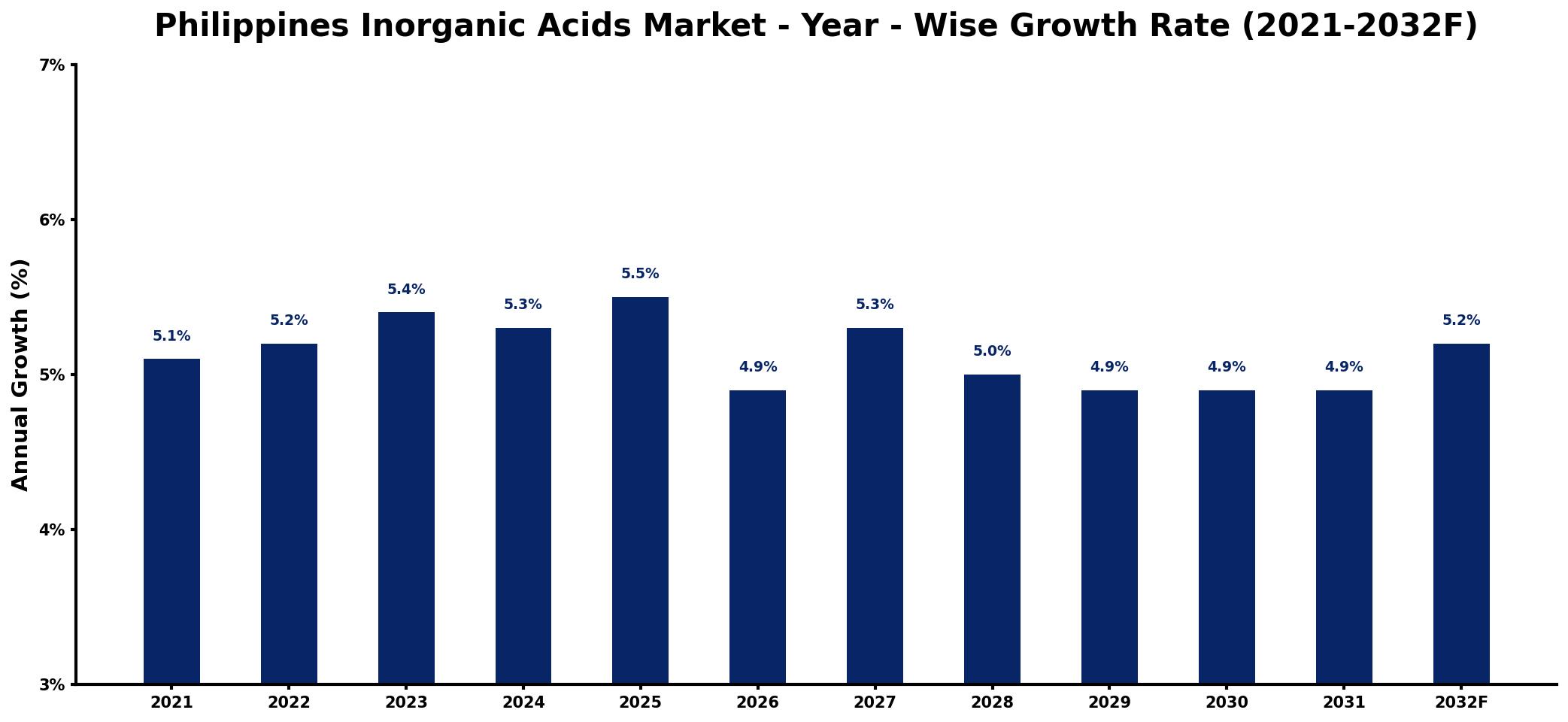
The table below presents the year‑wise growth rates along with the key drivers influencing the market
| Year | Growth Rate | Major Drivers |
| 2021 | 5.1% | Rising demand from manufacturing sector |
| 2022 | 5.2% | Increased investments in infrastructure projects |
| 2023 | 5.4% | Growth in pharmaceuticals and healthcare |
| 2024 | 5.3% | Expansion of agricultural applications |
| 2025 | 5.5% | Emergence of renewable energy initiatives |
| 2026 | 4.9% | Strengthening of chemical processing industries |
| 2027 | 5.3% | Boost in construction activities nationwide |
| 2028 | 5.0% | Surge in cleaning product formulations |
| 2029 | 4.9% | Advancements in water treatment technologies |
| 2030 | 4.9% | rising infrastructure development spending |
| 2031 | 4.9% | Increased focus on environmental regulations |
| 2032 | 5.2% | Rising interest in sustainable practices |
Note: Market size estimations and growth projections presented in this report are based on 6Wresearch's proprietary forecasting methodology, utilizing the latest available industry data, government publications, and primary research inputs.
Philippines Inorganic Acids Market Synopsis
The inorganic acids market in the Philippines is a critical component of the country's industrial landscape. With a wide range of applications, from metal processing to water treatment, these acids play a vital role in facilitating essential manufacturing processes across multiple sectors.
The market has been characterized by steady growth, driven by increasing industrialization and the ongoing expansion of sectors utilizing inorganic acids. As manufacturers adapt to changing demands and regulatory landscapes, the market is poised for further evolution, reflecting the dynamic nature of industrial chemistry.
Philippines Inorganic Acids Market Key Takeaways
- The market is witnessing a steady increase in demand due to industrial expansion and innovation.
- Major applications include agriculture, electronics, and pharmaceuticals, reinforcing the acids' significance in manufacturing.
- Market stability is challenged by strict safety regulations and varying demand cycles.
- Post-COVID recovery is expected to spur renewed growth in the coming years.
- The ongoing evolution of regulatory frameworks will shape operational strategies within the industry.
Evaluation of Restraints in Philippines Inorganic Acids Market
Despite the favorable growth prospects, the Philippines inorganic acids market is not without its challenges. Safety regulations are becoming increasingly stringent, demanding higher compliance from manufacturers and users. These regulations can complicate operational practices and increase costs, which may deter smaller players from entering the market. Additionally, the fluctuating demand arising from the cyclical nature of industries reliant on inorganic acids complicates market forecasting and operational planning. As companies navigate these challenges, a balanced approach that prioritizes safety and efficiency will be crucial for long-term success.
Philippines Inorganic Acids Market Trends
Current trends indicate a growing emphasis on sustainable practices within the inorganic acids market. Companies are increasingly focusing on waste minimization and the development of greener processes. Additionally, advancements in technology are leading to more efficient production methods, enabling manufacturers to reduce costs while maintaining product quality. The integration of digital solutions for monitoring and operational management is becoming more prevalent, driving efficiency gains across the supply chain.
Philippines Inorganic Acids Market Opportunities
There are substantial growth opportunities in the Philippines inorganic acids market, particularly in the realm of specialty applications. The demand for high-purity inorganic acids in electronics manufacturing, for instance, is set to rise, driven by the increasing complexity of electronic components. Moreover, investments in infrastructure development present avenues for expanding the market for inorganic acids in construction and water treatment applications. As the economy rebounds, industries will seek innovative solutions, fostering a fertile environment for expansion and investment.
Government Initiatives in the Philippines Inorganic Acids Market
The Philippine government is taking proactive steps to bolster the industrial sector, including initiatives aimed at enhancing production efficiency and compliance with international standards. Policies promoting green technology adoption and sustainable manufacturing practices are becoming more prominent. Furthermore, investment incentives are being introduced to attract foreign companies to establish operations in the country, potentially expanding the market for inorganic acids. The governments commitment to improving infrastructure also supports overall industrial growth, indirectly benefiting the inorganic acids market.
Future Insights of the Philippines Inorganic Acids Market
Looking ahead to 2026-2032, the Philippines inorganic acids market is expected to continue its upward trajectory. The anticipated growth in industrial applications, driven by technological advancements and increased production capacities, will be a major contributor to this expansion. As various sectors, such as agriculture and electronics, evolve, so too will the demands placed on inorganic acids, necessitating innovation and adaptation from manufacturers. The market's resilience, coupled with strategic investment and government support, positions it favorably for sustainable growth.
Philippines Inorganic Acids Market Latest Developments (2025 - 2026)
In recent months, the Philippines inorganic acids market has seen notable shifts, with manufacturers increasingly prioritizing compliance with evolving environmental regulations. Companies are also investing in research and development to innovate and enhance product offerings. There has been a marked increase in collaboration between industry players to address supply chain challenges. Furthermore, market players are exploring strategic partnerships to expand their reach within emerging industries, reflecting a proactive approach to capitalize on future growth opportunities.
Philippines Inorganic Acids Market - Key Attractiveness of the Report
- 10 Years of Market Numbers
- Historical Data Starting from 2022 to 2025
- Base Year: 2025
- Forecast Data until 2032
- Key Performance Indicators Impacting the Market
- Major Upcoming Developments and Projects
Key Highlights of the Report:
- Philippines Inorganic Acids Market Outlook
- Market Size of Philippines Inorganic Acids Market, 2025
- Forecast of Philippines Inorganic Acids Market, 2032
- Historical Data and Forecast of Philippines Inorganic Acids Revenues & Volume for the Period 2022-2032F
- Philippines Inorganic Acids Market Trend Evolution
- Philippines Inorganic Acids Market Drivers and Challenges
- Philippines Inorganic Acids Price Trends
- Philippines Inorganic Acids Porter's Five Forces
- Philippines Inorganic Acids Industry Life Cycle
- Historical Data and Forecast of Philippines Inorganic Acids Market Revenues & Volume By Type for the Period 2022-2032F
- Historical Data and Forecast of Philippines Inorganic Acids Market Revenues & Volume By Hydrochloric Acid for the Period 2022-2032F
- Historical Data and Forecast of Philippines Inorganic Acids Market Revenues & Volume By Sulfuric Acid for the Period 2022-2032F
- Historical Data and Forecast of Philippines Inorganic Acids Market Revenues & Volume By Nitric Acid for the Period 2022-2032F
- Historical Data and Forecast of Philippines Inorganic Acids Market Revenues & Volume By Phosphoric Acid for the Period 2022-2032F
- Historical Data and Forecast of Philippines Inorganic Acids Market Revenues & Volume By Boric Acid for the Period 2022-2032F
- Historical Data and Forecast of Philippines Inorganic Acids Market Revenues & Volume By Hydrofluoric Acid for the Period 2022-2032F
- Historical Data and Forecast of Philippines Inorganic Acids Market Revenues & Volume By Others for the Period 2022-2032F
- Historical Data and Forecast of Philippines Inorganic Acids Market Revenues & Volume By Application for the Period 2022-2032F
- Historical Data and Forecast of Philippines Inorganic Acids Market Revenues & Volume By Agrochemicals & Fertilizers for the Period 2022-2032F
- Historical Data and Forecast of Philippines Inorganic Acids Market Revenues & Volume By Pigments & Dyes for the Period 2022-2032F
- Historical Data and Forecast of Philippines Inorganic Acids Market Revenues & Volume By Pharmaceutical for the Period 2022-2032F
- Historical Data and Forecast of Philippines Inorganic Acids Market Revenues & Volume By Explosives for the Period 2022-2032F
- Historical Data and Forecast of Philippines Inorganic Acids Market Revenues & Volume By Others for the Period 2022-2032F
- Philippines Inorganic Acids Import Export Trade Statistics
- Market Opportunity Assessment By Type
- Market Opportunity Assessment By Application
- Philippines Inorganic Acids Top Companies Market Share
- Philippines Inorganic Acids Competitive Benchmarking By Technical and Operational Parameters
- Philippines Inorganic Acids Company Profiles
- Philippines Inorganic Acids Key Strategic Recommendations






































