Philippines Inorganic Pigments Market Size, Share & Growth Rate
The Philippines Inorganic Pigments Market was estimated at USD 154 Million in 2025 and is projected to reach USD 208 Million by 2032, growing at a CAGR of 4.4% from 2026 to 2032. This steady growth is underpinned by the relentless expansion of the construction sector and the ongoing demand for high-performance coatings, which continue to evolve alongside urbanization trends. As infrastructure investments rise, the market is likely to benefit from increased applications of inorganic pigments across various industries.
Philippines Inorganic Pigments Market Year-wise Growth Rate and Key Drivers
This graph highlights how the Philippines Inorganic Pigments Market has steadily grown over the years, supported by major growth factors.
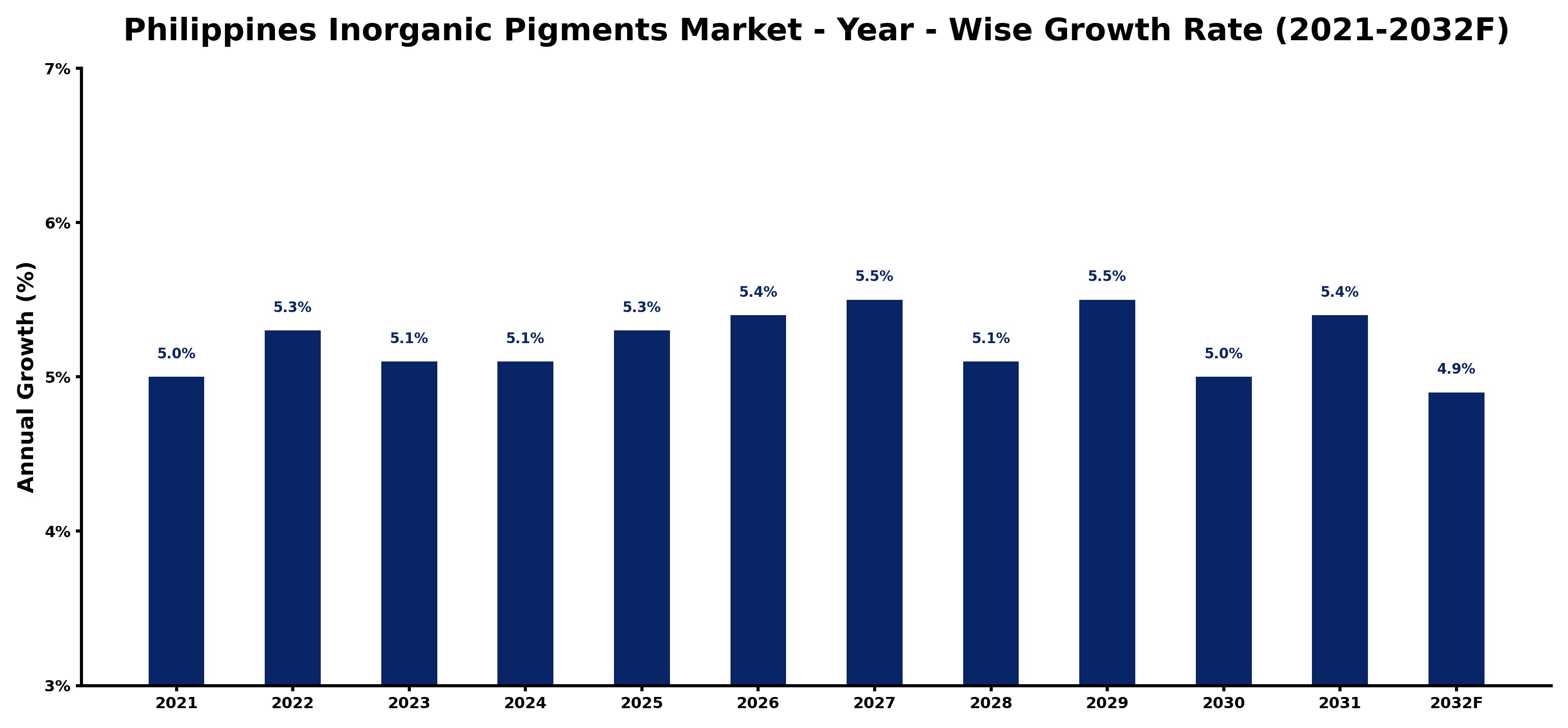
The table below presents the year‑wise growth rates along with the key drivers influencing the market
| Year | Growth Rate | Major Drivers |
| 2021 | 5.0% | Increased construction activities boosted demand |
| 2022 | 5.3% | Automotive sector growth drove consumption |
| 2023 | 5.1% | Paint industry expansion increased usage |
| 2024 | 5.1% | Packaging sector growth enhanced sales |
| 2025 | 5.3% | Electronics manufacturing raised pigment needs |
| 2026 | 5.4% | Textile industry growth spurred demand |
| 2027 | 5.5% | Infrastructure projects increased pigment usage |
| 2028 | 5.1% | Cosmetic industry expansion drove sales |
| 2029 | 5.5% | Agricultural applications enhanced market growth |
| 2030 | 5.0% | Renewable energy projects boosted demand |
| 2031 | 5.4% | Consumer goods sector expanded significantly |
| 2032 | 4.9% | Sustainable product trends increased interest |
Note - Market size estimations and growth projections presented in this report are based on 6Wresearch's advanced forecasting approach, validated with industry datasets as of June 2026.
Philippines Inorganic Pigments Market Synopsis
The inorganic pigments market in the Philippines is witnessing a transformation propelled by rapid urban development and industrial expansion. Recent trends indicate a significant shift towards durable and eco-friendly pigment solutions, reflecting growing consumer and regulatory demands for sustainability.
In 2022, the market reached an estimated value of USD 589.9 million, demonstrating the essential role of inorganic pigments in various applications such as automotive coatings, construction materials, and consumer goods. As the automotive sector continues to thrive, the market is positioned for further growth fueled by advancements in technology and increasing disposable income among consumers.
Philippines Inorganic Pigments Market Key Takeaways
- Demand for high-performance coatings is a primary driver of market growth.
- The construction sector contributes approximately 60% of total revenue generated.
- Metallic oxides dominate the market due to their desirable properties for outdoor applications.
- Eco-friendly pigments are gaining traction amid rising consumer awareness and regulatory pressures.
- The automotive industry's expansion significantly impacts the demand for vehicle coatings.
Evaluation of Restraints in Philippines Inorganic Pigments Market
Despite the robust growth potential, the Philippines inorganic pigments market faces several constraints. Heightened regulatory scrutiny regarding heavy metals and harmful chemicals poses challenges for manufacturers striving to meet evolving compliance standards. Additionally, the increasing consumer preference for vibrant yet non-toxic pigments necessitates a balancing act, compelling industry players to innovate while keeping costs manageable. These dynamics create a competitive landscape where agility and responsiveness to market trends are critical for sustained success.
Philippines Inorganic Pigments Market Trends
A notable trend in the Philippines inorganic pigments market is the growing emphasis on sustainability, pushing manufacturers to invest in the development of eco-friendly alternatives. Furthermore, advancements in pigment formulations are enhancing durability and performance, catering to the demands of various applications. The increasing influence of aesthetic appeal in product design is also driving demand, particularly in the cosmetics and packaging sectors. The intersection of these trends is creating opportunities for innovation and growth across the market.
Philippines Inorganic Pigments Market Opportunities
Investment opportunities in the Philippines inorganic pigments market abound as demand from both the construction and automotive sectors escalates. Companies can capitalize on the shift toward sustainable production methods, integrating greener practices to attract environmentally-conscious consumers. Moreover, the anticipated growth of the residential and commercial building sectors presents a ripe environment for new players to enter, further enriching the competitive landscape.
Government Initiatives in the Philippines Inorganic Pigments Market
The Philippine government has initiated several policies to foster growth in the construction and manufacturing sectors, which indirectly benefits the inorganic pigments market. Public spending on infrastructure projects has been prioritized, reflecting a commitment to enhancing urban development. Additionally, various programs aimed at promoting sustainable practices in manufacturing are paving the way for the adoption of eco-friendly pigment solutions, thereby aligning with both local and international environmental standards.
Future Insights of the Philippines Inorganic Pigments Market
Looking ahead to 2026-2032, the Philippines inorganic pigments market is poised for a period of dynamic growth driven by continuous urbanization and infrastructural development. The increasing adoption of innovative pigment technologies will likely enhance product performance and sustainability. As consumer preferences evolve toward aesthetically pleasing and eco-conscious products, the industry must remain agile to capitalize on these changing dynamics and harness new market opportunities.
Philippines Inorganic Pigments Market Latest Developments (May 2025 - June 2026)
In recent months, the Philippines inorganic pigments market has seen shifts in production strategies aimed at meeting sustainability goals. Companies have begun to roll out initiatives focusing on the development of biodegradable pigments and environmentally friendly production processes. Moreover, investments in research and development are increasingly focused on enhancing the performance characteristics of pigments, aiming to meet both aesthetic and functional requirements across diverse applications.
Philippines Inorganic Pigments Market - Key Attractiveness of the Report
- 10 Years of Market Numbers
- Historical Data Starting from 2022 to 2025
- Base Year: 2025
- Forecast Data until 2032
- Key Performance Indicators Impacting the Market
- Major Upcoming Developments and Projects
Key Highlights of the Report:
- Philippines Inorganic Pigments Market Outlook
- Market Size of Philippines Inorganic Pigments Market, 2025
- Forecast of Philippines Inorganic Pigments Market, 2032
- Historical Data and Forecast of Philippines Inorganic Pigments Revenues & Volume for the Period 2022-2032F
- Philippines Inorganic Pigments Market Trend Evolution
- Philippines Inorganic Pigments Market Drivers and Challenges
- Philippines Inorganic Pigments Price Trends
- Philippines Inorganic Pigments Porter's Five Forces
- Philippines Inorganic Pigments Industry Life Cycle
- Historical Data and Forecast of Philippines Inorganic Pigments Market Revenues & Volume By Type for the Period 2022-2032F
- Historical Data and Forecast of Philippines Inorganic Pigments Market Revenues & Volume By Titanium Dioxide for the Period 2022-2032F
- Historical Data and Forecast of Philippines Inorganic Pigments Market Revenues & Volume By Iron Oxide, Cadmium for the Period 2022-2032F
- Historical Data and Forecast of Philippines Inorganic Pigments Market Revenues & Volume By Carbon Blank for the Period 2022-2032F
- Historical Data and Forecast of Philippines Inorganic Pigments Market Revenues & Volume By Lead Chromate for the Period 2022-2032F
- Historical Data and Forecast of Philippines Inorganic Pigments Market Revenues & Volume By Chromium Oxide for the Period 2022-2032F
- Historical Data and Forecast of Philippines Inorganic Pigments Market Revenues & Volume By Others for the Period 2022-2032F
- Historical Data and Forecast of Philippines Inorganic Pigments Market Revenues & Volume By Colour for the Period 2022-2032F
- Historical Data and Forecast of Philippines Inorganic Pigments Market Revenues & Volume By Red for the Period 2022-2032F
- Historical Data and Forecast of Philippines Inorganic Pigments Market Revenues & Volume By Yellow for the Period 2022-2032F
- Historical Data and Forecast of Philippines Inorganic Pigments Market Revenues & Volume By Orange for the Period 2022-2032F
- Historical Data and Forecast of Philippines Inorganic Pigments Market Revenues & Volume By Green for the Period 2022-2032F
- Historical Data and Forecast of Philippines Inorganic Pigments Market Revenues & Volume By Blue for the Period 2022-2032F
- Historical Data and Forecast of Philippines Inorganic Pigments Market Revenues & Volume By Black for the Period 2022-2032F
- Historical Data and Forecast of Philippines Inorganic Pigments Market Revenues & Volume By White for the Period 2022-2032F
- Historical Data and Forecast of Philippines Inorganic Pigments Market Revenues & Volume By Others for the Period 2022-2032F
- Historical Data and Forecast of Philippines Inorganic Pigments Market Revenues & Volume By Chemistry for the Period 2022-2032F
- Historical Data and Forecast of Philippines Inorganic Pigments Market Revenues & Volume By Oxide for the Period 2022-2032F
- Historical Data and Forecast of Philippines Inorganic Pigments Market Revenues & Volume By Silicate for the Period 2022-2032F
- Historical Data and Forecast of Philippines Inorganic Pigments Market Revenues & Volume By Carbonate for the Period 2022-2032F
- Historical Data and Forecast of Philippines Inorganic Pigments Market Revenues & Volume By Sulphate for the Period 2022-2032F
- Historical Data and Forecast of Philippines Inorganic Pigments Market Revenues & Volume By Sulphide for the Period 2022-2032F
- Historical Data and Forecast of Philippines Inorganic Pigments Market Revenues & Volume By Others for the Period 2022-2032F
- Historical Data and Forecast of Philippines Inorganic Pigments Market Revenues & Volume By Grade for the Period 2022-2032F
- Historical Data and Forecast of Philippines Inorganic Pigments Market Revenues & Volume By Food Grade for the Period 2022-2032F
- Historical Data and Forecast of Philippines Inorganic Pigments Market Revenues & Volume By Pharmaceutical Grade for the Period 2022-2032F
- Historical Data and Forecast of Philippines Inorganic Pigments Market Revenues & Volume By Industrial Grade for the Period 2022-2032F
- Historical Data and Forecast of Philippines Inorganic Pigments Market Revenues & Volume By Others for the Period 2022-2032F
- Historical Data and Forecast of Philippines Inorganic Pigments Market Revenues & Volume By Form for the Period 2022-2032F
- Historical Data and Forecast of Philippines Inorganic Pigments Market Revenues & Volume By Powder for the Period 2022-2032F
- Historical Data and Forecast of Philippines Inorganic Pigments Market Revenues & Volume By Liquid for the Period 2022-2032F
- Historical Data and Forecast of Philippines Inorganic Pigments Market Revenues & Volume By Application for the Period 2022-2032F
- Historical Data and Forecast of Philippines Inorganic Pigments Market Revenues & Volume By Plastics for the Period 2022-2032F
- Historical Data and Forecast of Philippines Inorganic Pigments Market Revenues & Volume By Paints & Coatings for the Period 2022-2032F
- Historical Data and Forecast of Philippines Inorganic Pigments Market Revenues & Volume By Printing Inks for the Period 2022-2032F
- Historical Data and Forecast of Philippines Inorganic Pigments Market Revenues & Volume By Glass & Ceramics for the Period 2022-2032F
- Historical Data and Forecast of Philippines Inorganic Pigments Market Revenues & Volume By Cosmetics for the Period 2022-2032F
- Historical Data and Forecast of Philippines Inorganic Pigments Market Revenues & Volume By Paper Industry for the Period 2022-2032F
- Historical Data and Forecast of Philippines Inorganic Pigments Market Revenues & Volume By Food Industry for the Period 2022-2032F
- Historical Data and Forecast of Philippines Inorganic Pigments Market Revenues & Volume By Others for the Period 2022-2032F
- Philippines Inorganic Pigments Import Export Trade Statistics
- Market Opportunity Assessment By Type
- Market Opportunity Assessment By Colour
- Market Opportunity Assessment By Chemistry
- Market Opportunity Assessment By Grade
- Market Opportunity Assessment By Form
- Market Opportunity Assessment By Application
- Philippines Inorganic Pigments Top Companies Market Share
- Philippines Inorganic Pigments Competitive Benchmarking By Technical and Operational Parameters
- Philippines Inorganic Pigments Company Profiles
- Philippines Inorganic Pigments Key Strategic Recommendations






































