Philippines Insect Repellent Market Top 5 Importing Countries and Market Competition (HHI) Analysis
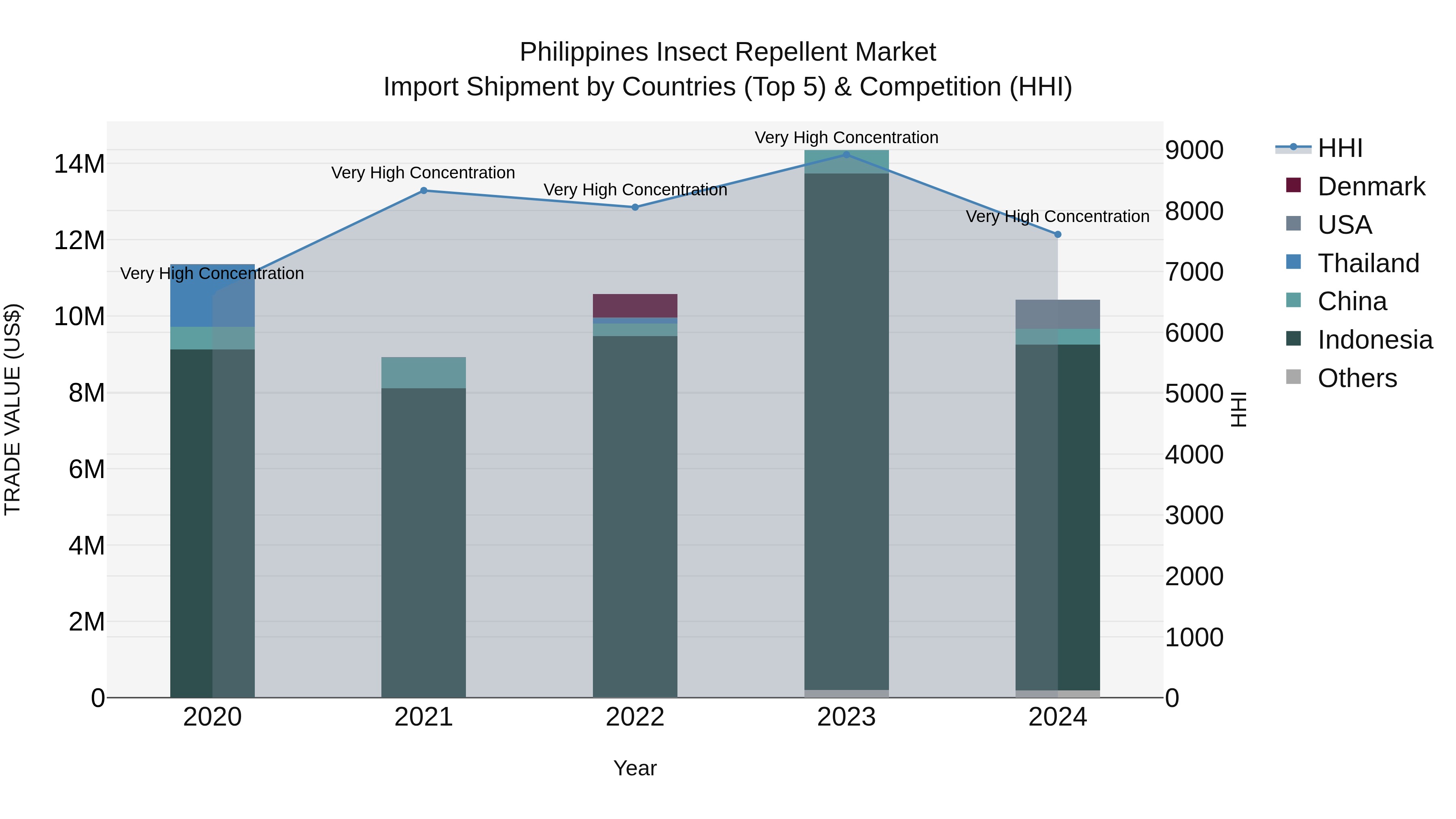
In 2024, the Philippines continued to heavily rely on imported insect repellents, with top suppliers being Indonesia, USA, China, India, and Germany. Despite a high concentration of supply from these countries, the market experienced a negative compound annual growth rate of -2.13% from 2020 to 2024. Furthermore, the growth rate in 2024 dropped significantly by -27.3% compared to the previous year. This indicates a challenging environment for the insect repellent import market in the Philippines, suggesting potential shifts in consumer preferences or market dynamics.
Philippines Insect Repellent Market Growth Rate
According to 6Wresearch internal database and industry insights, the Philippines Insect Repellent Market is projected to grow at a compound annual growth rate (CAGR) of 12.5% during the forecast period 2026–2032.
Topics Covered in the Philippines Insect Repellent Market Report
The Philippines Insect Repellent Market report thoroughly covers the market by type and product type. The report provides a detailed analysis of ongoing market trends, opportunities/high-growth areas, and market drivers, helping stakeholders devise and align their market strategies according to current and future market dynamics.
Philippines Insect Repellent Market Highlights
| Report Name | Philippines Insect Repellent Market |
| Forecast Period | 2026–2032 |
| CAGR | 12.5% |
| Growing Sector | Personal Care and Home Insecticides |
Philippines Insect Repellent Market Synopsis
The Philippines Insect Repellent Industry witness significant growth due to government policies preventing vector-borne diseases and consumers demanding safer long-lasting products. The market expands due to technological advancements which develop active ingredients and delivery systems that enhance repellent effectiveness and user experience. Another key growth driver include government policies supporting public health safety while consumers seek convenient methods to protect themselves.
Evaluation of Growth Drivers in the Philippines Insect Repellent Market
Below are some prominent drivers and their influence on the market dynamics:
| Drivers | Primary Segments Affected | Why It Matters |
| Government Initiatives | By Type (Mosquito Repellent, Bugs Repellent) | National health campaigns and localized insect control programs drive mass-market adoption of repellents. |
| Health Awareness | By Product Type (Spray, Cream, Vaporizers) | The public learns about Dengue and Zika diseases which leads to increased sales of daily protection products. |
| Technological Advancements | By Product Type (Vaporizers, Others) | The combination of smart-controlled vaporizers and micro-encapsulation technology give its users longer-lasting protection. |
| Urbanization | By Product Type (Vaporizers, Spray) | Densely populated urban environments in Metro Manila increase the need for effective indoor repellent solutions. |
| Outdoor Recreation | By Product Type (Spray, Cream, Others) | Rising interest in hiking, camping, and domestic tourism boosts the demand for portable and water-resistant repellents. |
The Philippines Insect Repellent Market Size is projected to grow at a CAGR of 12.5% from 2026 to 2032. There are many factors supporting the growth of the market. The key example is the growing government incentives for public health disease prevention. Furthermore, technological improvements in non-toxic formulations and the demand for eco-friendly repellents are increasing. This is further supported through e-commerce availability and localized product packaging. The popularity of insect repellents as a daily necessity is increasing with rising humidity and seasonal pest surges. In addition to this, the number of eco-conscious consumers are rising along with the need for specialized repellents for infants and children, further proliferating the demand for insect repellents.
Evaluation of Restraints in the Philippines Insect Repellent Market
Below are some prominent restraints and their influence on the market dynamics:
| Restraints | Primary Segments Affected | What This Means |
| High Initial Cost | By Product Type (Vaporizers, Others) | Premium automated or electronic repellent devices may be too expensive for low-income rural households. |
| Regulatory Challenges | By Type (Mosquito Repellent, Fly Repellent) | Strict FDA requirements for chemical safety and efficacy labeling can delay the launch of new innovative products. |
| Health Concerns | By Type (Mosquito Repellent, Bugs Repellent) | Negative perceptions of the lasting effects of synthetic chemicals such as DEET can impact product sales. |
| Seasonal Demand | By Product Type (Spray, Cream, Others) | The market demand significantly varies with the rainy season, generating inventory management issues for retailers. |
Philippines Insect Repellent Market Challenges
Buyers can feel reluctant to purchase premium repellents due to their high initial cost compared to traditional coils. In addition to this, the supply chain for natural active ingredients is also not fully developed, affecting the production costs of organic repellents. Along with this, the local restrictions on certain chemical concentrations in residential areas and regulatory hurdles influence market growth. Moreover, it will be difficult to change consumer perception regarding the safety and skin-friendliness of aerosol-based sprays.
Philippines Insect Repellent Market Trends
Some major trends contributing to the Philippines Insect Repellent Market growth are:
- Rise of Plant-Based Formulations: Consumers are switching to repellents which contain natural oils as they believe these products are safer for children and pets.
- Digitalization of Repellent Sales: E-commerce platforms enable customers to buy special repellent brands which they can have delivered to their homes through subscription refills for vaporizers.
- Development of Wearable Repellents: Active users who want to avoid direct skin contact with chemicals are increasingly adopting innovations that include repellent patches and wristbands and clips.
- Multi-Functional Personal Care: Outdoor enthusiasts and commuters increasingly prefer personal care products which combine insect-repelling features with their daily sunscreen and moisturizer use.
Investment Opportunities in the Philippines Insect Repellent Market
Some investment opportunities that will form the dynamics of the Philippines Insect Repellent Market are:
- R&D in Non-Toxic Active Ingredients: The research and development department requires financial backing to create efficient DEET substitutes to fulfill increasing demand for safe family defense products.
- Expansion of Specialized Retail Channels: Companies should allocate their resources to build pharmacy distribution networks and online health stores as these channels will help them reach customers who prefer premium and clinical-grade repellents.
- Local Manufacturing Units: Local production facilities in the Philippines will help companies’ lower transportation costs while producing products tailored to the local market with packaged goods capabilities.
- Smart Home Integration: The introduction of IoT-enabled vaporizers with mobile app scheduling features provides advanced technological solutions for modern urban consumers.
Top 5 Leading Players in the Philippines Insect Repellent Market
Below is the list of prominent companies leading the Philippines Insect Repellent Market Share:
1. S.C. Johnson & Son, Inc.
| Company Name | S.C. Johnson & Son, Inc. |
|---|---|
| Established Year | 1886 |
| Headquarters | Racine, Wisconsin, USA |
| Official Website | Click Here |
S.C. Johnson is a global leader in household insecticides, famously known for the "OFF!" brand, which holds a significant share of the personal repellent market in the Philippines.
2. Reckitt Benckiser Group plc
| Company Name | Reckitt Benckiser Group plc |
|---|---|
| Established Year | 1999 |
| Headquarters | Slough, England |
| Official Website | Click Here |
Reckitt produces the "Mortein" and "Raid" brands, offering a wide range of aerosols, coils, and vaporizers designed for comprehensive indoor and outdoor protection.
3. Godrej Consumer Products Limited
| Company Name | Godrej Consumer Products Limited |
|---|---|
| Established Year | 2001 |
| Headquarters | Mumbai, India |
| Official Website | Click Here |
Godrej is a key player in the Asian market with brands like "Goodknight," focusing on innovative and affordable repellent solutions such as paper-based repellents and liquid vaporizers.
4. Enesis Group
| Company Name | Enesis Group |
|---|---|
| Established Year | 1988 |
| Headquarters | Jakarta, Indonesia |
| Official Website | Click Here |
Enesis Group is the manufacturer of "Soffell," one of the most popular mosquito repellent lotions in Southeast Asia, known for its pleasant fragrance and skin-friendly formula.
5. Green Cross, Inc.
| Company Name | Green Cross, Inc. |
|---|---|
| Established Year | 1952 |
| Headquarters | Manila, Philippines |
| Official Website | Click Here |
A leading local manufacturer, Green Cross provides the "Sentinel" brand of insect repellents, leveraging strong local brand trust and extensive distribution across the archipelago.
Government Regulations in the Philippines Insect Repellent Market
According to Philippine government data, the implementation of insect control measures receives support from public health directives and safety standards through various existing policies. The "National Dengue Prevention and Control Program" works with the "4S" strategy, which includes finding and destroying breeding sites and using self-protection and finding early medical help while supporting fogging in areas with outbreaks. The Food and Drug Administration (FDA) in the Philippines conducts rigorous testing of repellents to ensure their safety.
Future Insights of the Philippines Insect Repellent Market
The Philippines Insect Repellent Market will witness continuous growth due to government health policies, technological advancements in safer chemicals, and surging requirement for portable protection solutions. Insect repellents will become a year-round household necessity as modern convenience stores expand, and retail infrastructure improves. Enhanced formulation stability and better scent profiles will drive growth in the personal care market in the Philippines.
Market Segmentation Analysis
The report offers a comprehensive study of the following market segments and their leading categories:
By Type – Mosquito Repellent to Lead the Market
According to Rashika, Senior Research Analyst, 6Wresearch, Mosquito Repellent will dominate the market according to the high prevalence of mosquito-borne diseases in the tropical climate of the Philippines.
By Product Type – Spray to Lead the Market
The market will see Sprays as the leading solution as they provide users immediate action, high portability, and ease of application for both skin and clothing. Sprays are the preferred choice for outdoor activities and travel, and their ability to cover large surface areas quickly makes them more versatile than creams or traditional coils.
Key Attractiveness of the Report
- 10 Years of Market Numbers
- Historical Data Starting from 2022 to 2025
- Base Year: 2025
- Forecast Data until 2032
- Key Performance Indicators Impacting the Market
- Major Upcoming Developments and Projects
Key Highlights of the Report:
- Philippines Insect Repellent Market Outlook
- Market Size of Philippines Insect Repellent Market, 2025
- Forecast of Philippines Insect Repellent Market, 2032
- Historical Data and Forecast of Philippines Insect Repellent Revenues & Volume for the Period 2022 - 2032
- Philippines Insect Repellent Market Trend Evolution
- Philippines Insect Repellent Market Drivers and Challenges
- Philippines Insect Repellent Price Trends
- Philippines Insect Repellent Porter's Five Forces
- Philippines Insect Repellent Industry Life Cycle
- Historical Data and Forecast of Philippines Insect Repellent Market Revenues & Volume By Type for the Period 2022 - 2032
- Historical Data and Forecast of Philippines Insect Repellent Market Revenues & Volume By Mosquito Repellent for the Period 2022 - 2032
- Historical Data and Forecast of Philippines Insect Repellent Market Revenues & Volume By Bugs Repellent for the Period 2022 - 2032
- Historical Data and Forecast of Philippines Insect Repellent Market Revenues & Volume By Fly Repellent for the Period 2022 - 2032
- Historical Data and Forecast of Philippines Insect Repellent Market Revenues & Volume By Others for the Period 2022 - 2032
- Historical Data and Forecast of Philippines Insect Repellent Market Revenues & Volume By Product Type for the Period 2022 - 2032
- Historical Data and Forecast of Philippines Insect Repellent Market Revenues & Volume By Vaporizers for the Period 2022 - 2032
- Historical Data and Forecast of Philippines Insect Repellent Market Revenues & Volume By Spray for the Period 2022 - 2032
- Historical Data and Forecast of Philippines Insect Repellent Market Revenues & Volume By Cream for the Period 2022 - 2032
- Historical Data and Forecast of Philippines Insect Repellent Market Revenues & Volume By Others for the Period 2022 - 2032
- Philippines Insect Repellent Import Export Trade Statistics
- Market Opportunity Assessment By Type
- Market Opportunity Assessment By Product Type
- Philippines Insect Repellent Top Companies Market Share
- Philippines Insect Repellent Competitive Benchmarking By Technical and Operational Parameters
- Philippines Insect Repellent Company Profiles
- Philippines Insect Repellent Key Strategic Recommendations
Market Covered
The report provides a detailed analysis of the following market segments and subsegments:
By Type:
- Mosquito Repellent
- Bugs Repellent
- Fly Repellent
- Others
By Product Type:
- Vaporizers
- Spray
- Cream
- Others






































