Philippines Insurance Telematics Market Size & Growth Rate (2026-2032)
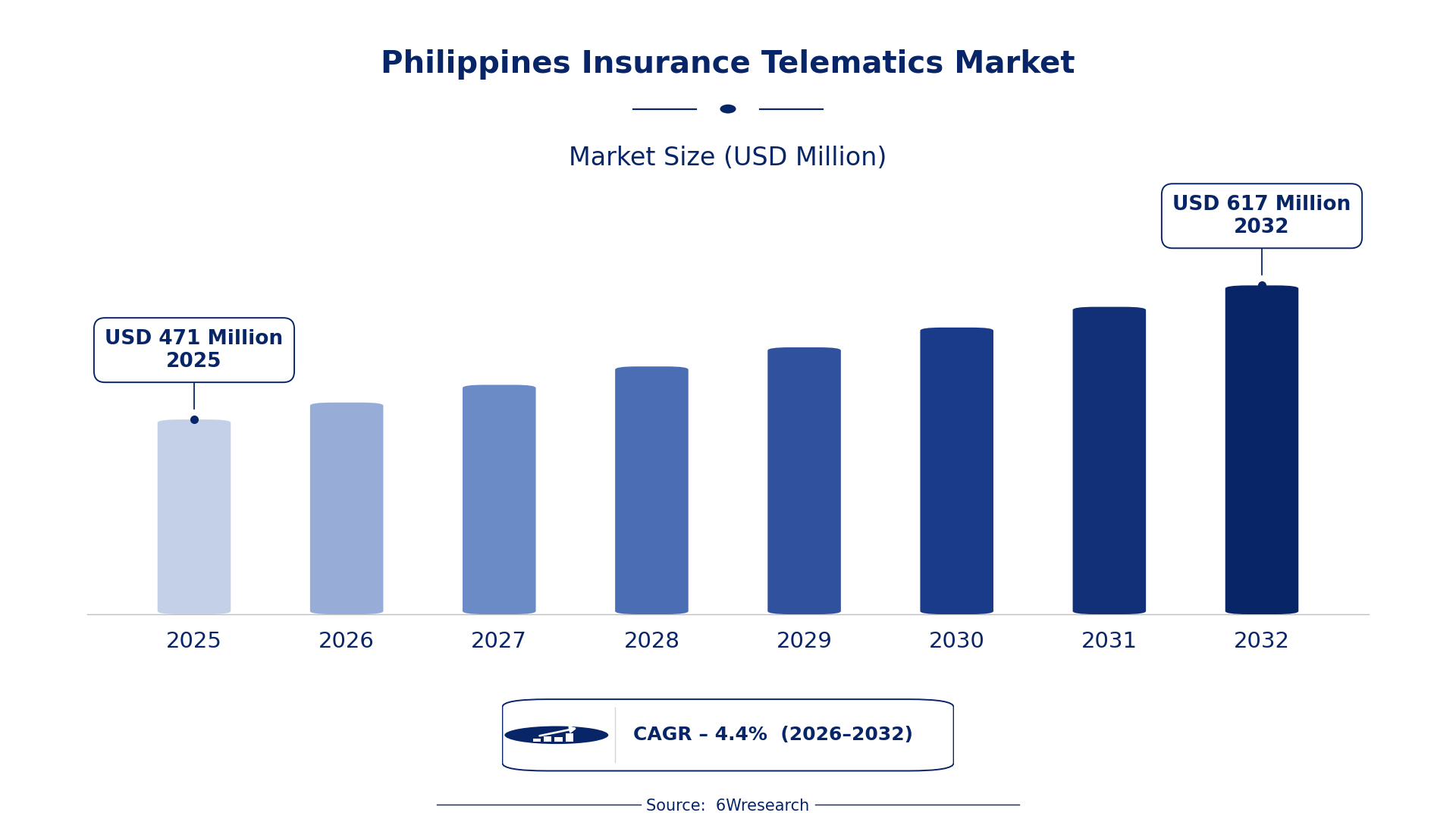
The Philippines Insurance Telematics Market was estimated at USD 471 Million in 2025 and is projected to reach USD 617 Million by 2032, growing at a CAGR of 4.4% from 2026 to 2032.
Philippines Insurance Telematics Market Synopsis
The integration of telematics technology into insurance offerings in the Philippines is not just a trend; it’s becoming a necessity. As insurers increasingly leverage telematics to gain insights into driver behavior, the demand for personalized insurance products is surging. This shift is particularly evident in urban areas where vehicle ownership continues to rise.
In this competitive environment, insurance providers are using data analytics to enhance risk assessment and pricing models. This not only improves customer satisfaction but also aids in reducing claims costs. However, this transformation comes with its own set of challenges, particularly in terms of data privacy and consumer trust.
Philippines Insurance Telematics Market Year-wise Growth Rate and Key Drivers
This graph illustrates the annual growth rates of the Philippines Insurance Telematics Market from 2021 to 2032, highlighting a steady upward trajectory and projected expansion over the forecast period.
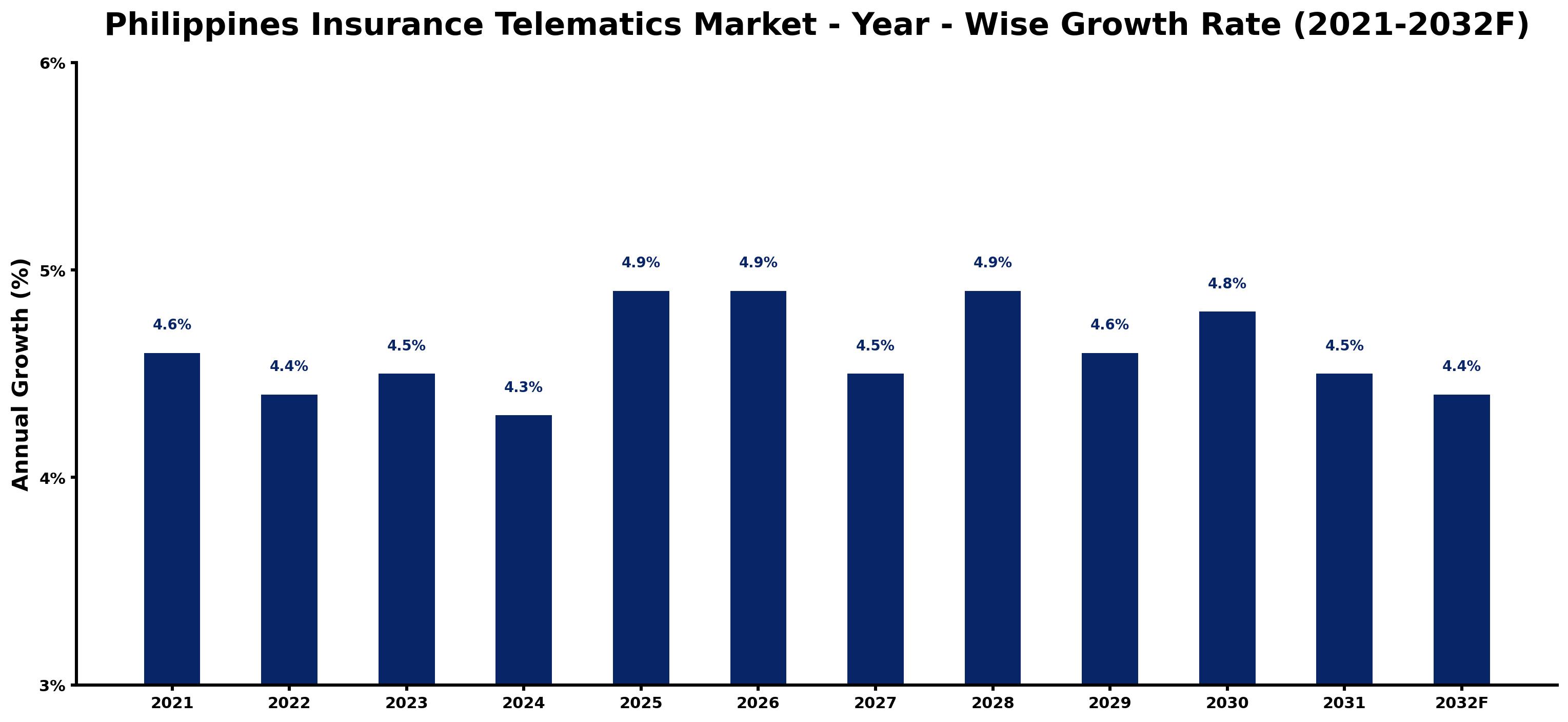
The table below presents the year‑wise growth rates along with the key drivers influencing the market
| Year | Growth Rate | Major Drivers |
| 2021 | 4.6% | Government support for digital insurance innovation initiatives |
| 2022 | 4.4% | Rising consumer interest in usage-based insurance models |
| 2023 | 4.5% | Increased smartphone penetration driving telematics adoption |
| 2024 | 4.3% | Regulatory push for enhanced road safety measures |
| 2025 | 4.9% | Growth in ride-sharing services needing telematics solutions |
| 2026 | 4.9% | Emergence of local telematics startups boosting market competition |
| 2027 | 4.5% | Integration of AI in telematics for pricing accuracy |
| 2028 | 4.9% | Increased awareness of insurance fraud prevention technologies |
| 2029 | 4.6% | Collaboration between insurers and automotive telematics providers |
| 2030 | 4.8% | Expanding urban population driving demand for insurance data |
| 2031 | 4.5% | Telematics data becoming crucial for risk assessment models |
| 2032 | 4.4% | Insurance companies offering incentives for safer driving habits |
Note: Market size estimations and growth projections presented in this report are based on 6Wresearch's proprietary forecasting methodology, utilizing the latest available industry data, government publications, and primary research inputs.
Philippines Insurance Telematics Market Key Takeaways
Below are some of the specific key takeaways from the market, including:
- Telematics adoption is accelerating among insurers as they aim to offer more tailored insurance solutions.
- The growing trend of vehicle ownership is directly impacting the demand for telematics-based insurance products.
- Data privacy concerns pose challenges that insurance companies must overcome to build trust with consumers.
- The COVID-19 pandemic has altered consumer behavior, prompting a shift towards cost-effective insurance solutions.
- Government initiatives are becoming more pronounced in shaping the regulatory framework around telematics technology.
Evaluation of Restraints in Philippines Insurance Telematics Market
The Philippines Insurance Telematics Market is being held back by a few key restraints. Chief among these are concerns surrounding data privacy. Many potential customers remain hesitant to embrace telematics due to fears about how their driving data will be used and shared. Additionally, the lack of widespread understanding of telematics technology among consumers complicates adoption efforts.
Insurers also face regulatory challenges as they navigate an evolving legal landscape. Without clear guidelines, companies may be hesitant to fully invest in telematics solutions. Building consumer trust through transparency in how data is collected and used will be essential for unlocking the market's potential.
Philippines Insurance Telematics Market Trends
One of the prominent trends in the Philippines Insurance Telematics Market is the rise of usage-based insurance (UBI) models. As insurers collect detailed data on driving habits, they can offer more competitive premiums based on actual driving behavior rather than traditional metrics.
on top of that, partnerships between insurance companies and technology firms are on the rise. This collaboration aims to enhance the technology behind telematics devices and improve data analytics capabilities. As consumers become more tech-savvy, the demand for mobile app integration with telematics solutions is also increasing.
Philippines Insurance Telematics Market Opportunities
The current environment presents various opportunities for growth within the Philippines Insurance Telematics Market. First, the increasing awareness of road safety and the benefits of responsible driving can drive consumer interest in telematics-based insurance solutions. Additionally, as smart city initiatives gain traction, there are ample opportunities for insurers to integrate telematics with urban infrastructure.
on top of that, the growing popularity of electric vehicles (EVs) could further expand the telematics market. Insurers can develop tailored products specifically for EV owners, taking into account their unique driving patterns and charging habits. This niche market segment is ripe for innovative insurance solutions.
Government Initiatives in the Philippines Insurance Telematics Market
Government policies are increasingly influencing the direction of the Philippines Insurance Telematics Market. With a focus on digital transformation and road safety, the government is actively working on regulations that support the integration of telematics technology into insurance frameworks. These initiatives aim to foster consumer trust while ensuring data privacy and security.
- A regulatory framework introduced in 2025 mandating data protection measures for telematics data collected by insurers.
- Currently underway is a public awareness campaign focused on the benefits of telematics, aimed at educating consumers about usage-based insurance.
- A planned public-private partnership expected to enhance telematics infrastructure by 2027, facilitating better data collection and analysis.
- A national road safety initiative launched in 2025 encouraging insurers to adopt telematics to promote safer driving habits.
- Legislation currently being drafted to streamline the approval process for telematics devices used in vehicles.
Future Insights of the Philippines Insurance Telematics Market
Looking ahead to 2026-2032, the Philippines Insurance Telematics Market is set for substantial growth. As consumer awareness increases and more people understand the benefits of telematics, adoption rates will likely rise significantly. Enhanced data analytics capabilities will allow insurers to refine their products continually, improving customer satisfaction.
on top of that, advancements in technology, such as artificial intelligence and machine learning, will refine risk assessment models, making telematics even more appealing. As the market matures, we can expect to see innovative insurance products that cater to specific demographics and driving behaviors.
Philippines Insurance Telematics Market Latest Developments
Recent developments in the Philippines Insurance Telematics Market indicate a growing momentum toward innovation and consumer engagement. Insurers are increasingly adopting advanced telematics solutions, which are helping to shape competitive offerings in a crowded market.
- A leading regional insurer launched a new telematics-based insurance product in Q1 2025, aimed at young drivers.
- Ongoing collaborations between technology firms and insurers are enhancing the accuracy of data analytics, which began in mid-2025.
- A pilot program initiated in late 2025 focuses on integrating telematics data with traffic management systems, currently underway.
- Plans for an expanded telematics device rollout are expected to commence in the second half of 2026, enhancing coverage across urban centers.
- A major technology vendor is set to release an upgraded telematics platform in early 2026, aimed at improving user experience.
Philippines Insurance Telematics Market - Key Attractiveness of the Report
- 10 Years of Market Numbers
- Historical Data Starting from 2022 to 2025
- Base Year: 2025
- Forecast Data until 2032
- Key Performance Indicators Impacting the Market
- Major Upcoming Developments and Projects
Key Highlights of the Report:
- Philippines Insurance Telematics Market Outlook
- Market Size of Philippines Insurance Telematics Market, 2025
- Forecast of Philippines Insurance Telematics Market, 2032
- Historical Data and Forecast of Philippines Insurance Telematics Revenues & Volume for the Period 2022-2032F
- Philippines Insurance Telematics Market Trend Evolution
- Philippines Insurance Telematics Market Drivers and Challenges
- Philippines Insurance Telematics Price Trends
- Philippines Insurance Telematics Porter's Five Forces
- Philippines Insurance Telematics Industry Life Cycle
- Historical Data and Forecast of Philippines Insurance Telematics Market Revenues & Volume By End User for the Period 2022-2032F
- Historical Data and Forecast of Philippines Insurance Telematics Market Revenues & Volume By Small for the Period 2022-2032F
- Historical Data and Forecast of Philippines Insurance Telematics Market Revenues & Volume By Medium Enterprises for the Period 2022-2032F
- Historical Data and Forecast of Philippines Insurance Telematics Market Revenues & Volume By Large Enterprises for the Period 2022-2032F
- Historical Data and Forecast of Philippines Insurance Telematics Market Revenues & Volume By Deployment Type for the Period 2022-2032F
- Historical Data and Forecast of Philippines Insurance Telematics Market Revenues & Volume By Cloud for the Period 2022-2032F
- Historical Data and Forecast of Philippines Insurance Telematics Market Revenues & Volume By On-Premises for the Period 2022-2032F
- Historical Data and Forecast of Philippines Insurance Telematics Market Revenues & Volume By Organization Size for the Period 2022-2032F
- Historical Data and Forecast of Philippines Insurance Telematics Market Revenues & Volume By Small and Medium Enterprises (SMEs) for the Period 2022-2032F
- Historical Data and Forecast of Philippines Insurance Telematics Market Revenues & Volume By Large Enterprises for the Period 2022-2032F
- Philippines Insurance Telematics Import Export Trade Statistics
- Market Opportunity Assessment By End User
- Market Opportunity Assessment By Deployment Type
- Market Opportunity Assessment By Organization Size
- Philippines Insurance Telematics Top Companies Market Share
- Philippines Insurance Telematics Competitive Benchmarking By Technical and Operational Parameters
- Philippines Insurance Telematics Company Profiles
- Philippines Insurance Telematics Key Strategic Recommendations






































