Philippines IoT Connectivity Market Size & Growth Rate (2026-2032)
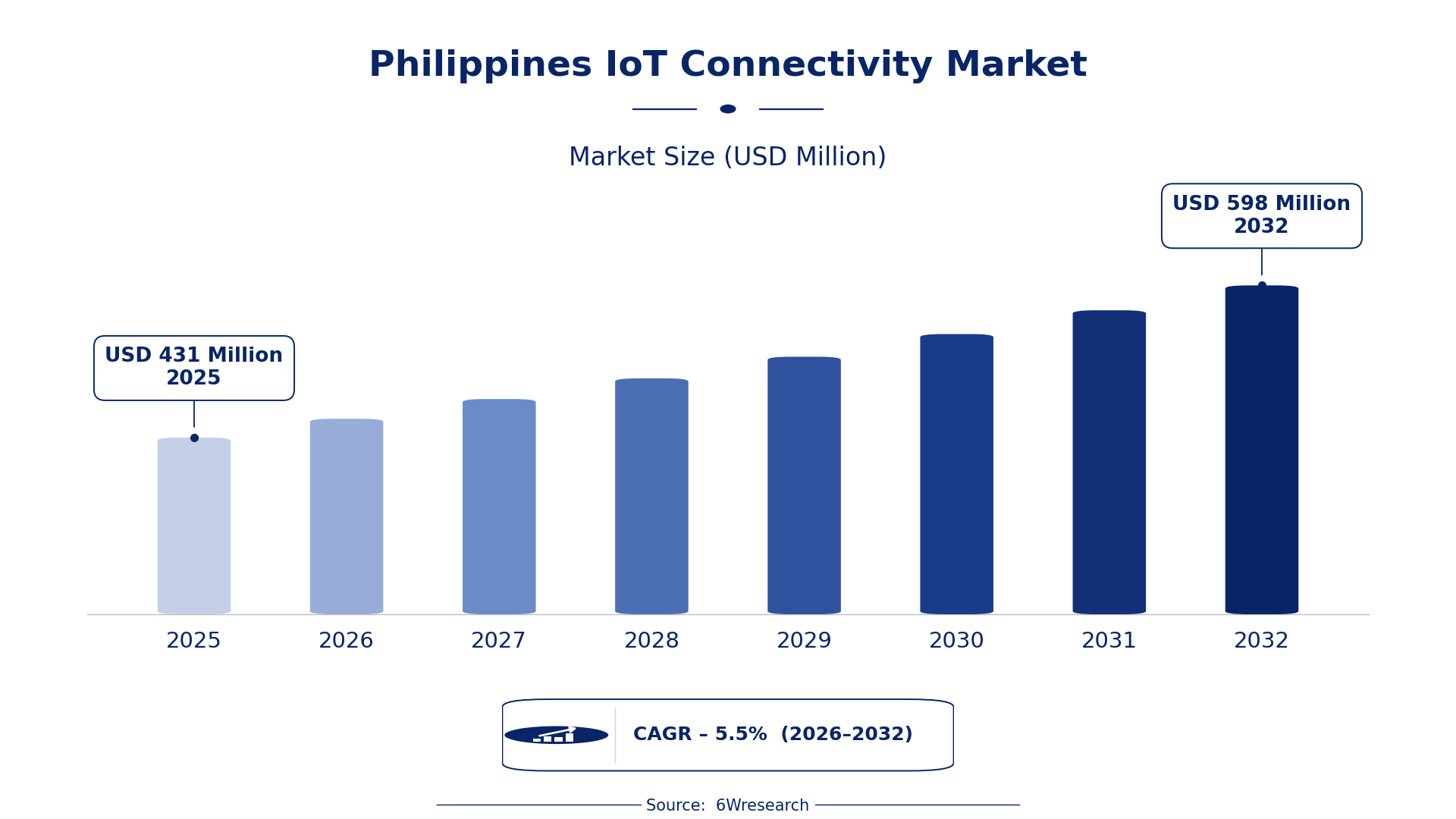
The Philippines IoT Connectivity Market was estimated at USD 431 Million in 2025 and is projected to reach USD 598 Million by 2032, growing at a CAGR of 5.5% from 2026 to 2032.
Philippines IoT Connectivity Market Synopsis
The demand for IoT connectivity in the Philippines is driven by rapid technological advancements and increasing adoption across various sectors, including agriculture, healthcare, and manufacturing. As local businesses seek to enhance operational efficiencies, the need for reliable and effective connectivity solutions becomes paramount.
Telecommunication infrastructure is evolving to meet the needs of an expanding IoT ecosystem. With the government and private sector investing in enhancing connectivity, the Philippines is steadily positioning itself as a hub for IoT innovations. This shift is critical for supporting emerging applications and ensuring comprehensive network coverage across the archipelago.
Philippines IoT Connectivity Market Year-wise Growth Rate and Key Drivers
This graph illustrates the annual growth rates of the Philippines IoT Connectivity Market from 2021 to 2032, highlighting a steady upward trajectory and projected expansion over the forecast period.
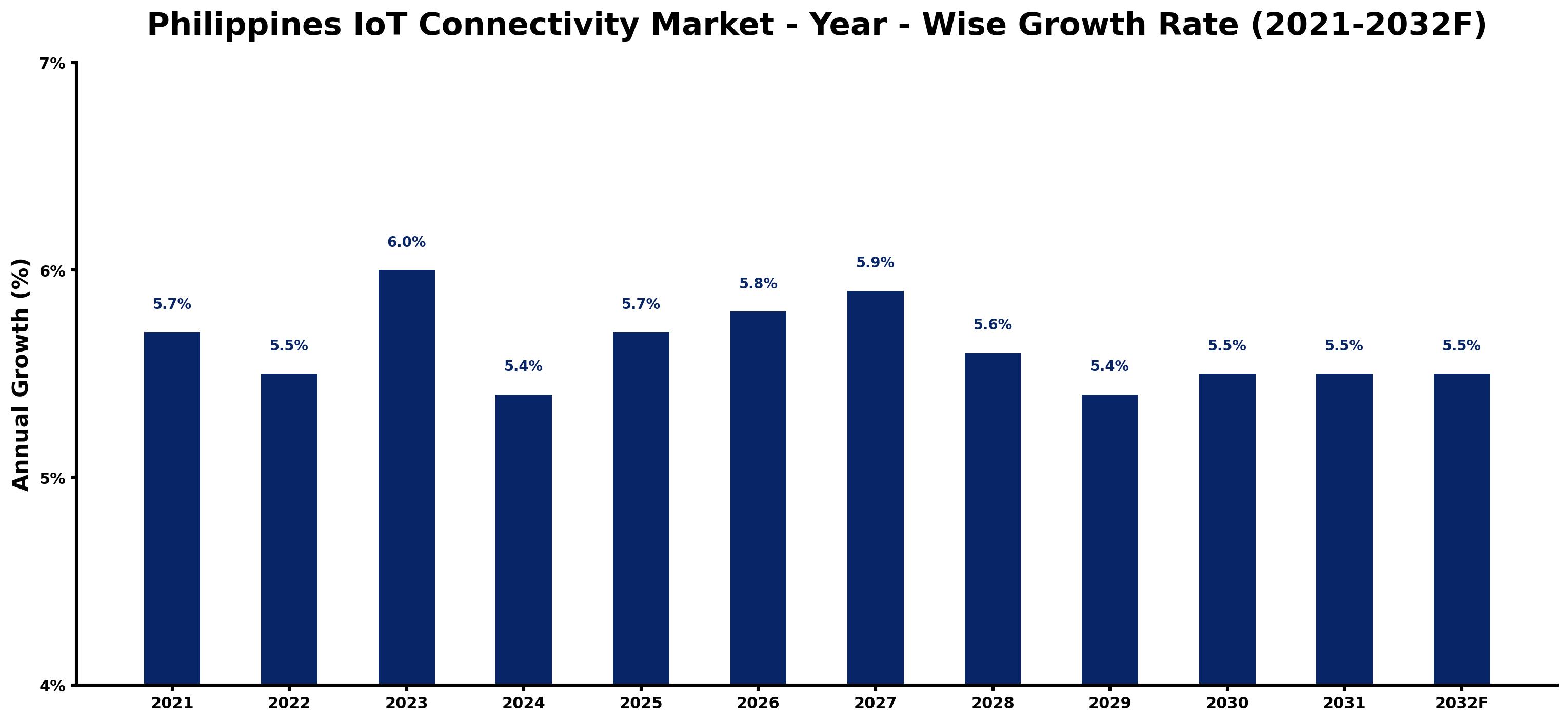
The table below presents the year‑wise growth rates along with the key drivers influencing the market
| Year | Growth Rate | Major Drivers |
| 2021 | 5.7% | Philippine government prioritizing IoT in Industry 4.0 roadmap. |
| 2022 | 5.5% | Growing smart agriculture projects adopting IoT solutions nationwide. |
| 2023 | 6.0% | Telecommunications Act amendments enhancing IoT service provisions. |
| 2024 | 5.4% | Increasing electric vehicle adoption driving smart charging IoT. |
| 2025 | 5.7% | Local startups innovating IoT applications for healthcare services. |
| 2026 | 5.8% | Philippine tech ecosystem nurturing IoT R&D collaborations. |
| 2027 | 5.9% | Rising interest in IoT-enabled disaster management technologies. |
| 2028 | 5.6% | Government support for IoT in logistics and supply chain. |
| 2029 | 5.4% | IoT solutions addressing urban congestion in metro areas. |
| 2030 | 5.5% | Demand for remote monitoring in healthcare settings growing. |
| 2031 | 5.5% | Adoption of smart city initiatives boosting IoT investments. |
| 2032 | 5.5% | Increased focus on IoT cybersecurity regulations enhancing market. |
Note: Market size estimations and growth projections presented in this report are based on 6Wresearch's proprietary forecasting methodology, utilizing the latest available industry data, government publications, and primary research inputs.
Philippines IoT Connectivity Market Key Takeaways
Below are some of the specific key takeaways from the market, including:
- The Philippines is experiencing a surge in IoT deployments, particularly in agriculture and healthcare sectors.
- Investment in telecommunications infrastructure is crucial for expanding IoT connectivity.
- Government initiatives are actively promoting IoT growth through regulatory frameworks and public-private partnerships.
- Challenges such as geographic diversity and rural connectivity continue to impede seamless IoT implementation.
- Emerging technologies, like 5G, are set to revolutionize IoT connectivity in the coming years.
Evaluation of Restraints in Philippines IoT Connectivity Market
Despite the promising growth trajectory, the Philippines IoT Connectivity Market faces substantial hurdles. A key issue is the country's geographic diversity, which complicates the establishment of extensive network coverage. Many areas remain underserved, leading to inconsistent connectivity that hampers the deployment of IoT solutions.
Additionally, compatibility among various IoT devices presents a challenge, as existing infrastructure often struggles to support the diverse range of technologies. Reliability is another concern, as intermittent service can undermine the effectiveness of IoT applications that require continuous data transmission.
Philippines IoT Connectivity Market Trends
A notable trend in the Philippines IoT Connectivity Market is the growing emphasis on smart city initiatives. Urban areas are increasingly adopting IoT solutions to enhance public services, improve traffic management, and optimize resource allocation. This trend is creating a ripple effect, encouraging further investment in IoT infrastructure.
on top of that, businesses are increasingly integrating IoT technologies into their operations, leading to a rise in demand for advanced connectivity solutions. The shift towards data-driven decision-making is prompting organizations to invest in IoT platforms that enhance operational insights and efficiency.
Philippines IoT Connectivity Market Opportunities
The landscape of the Philippines IoT Connectivity Market is rich with opportunities for growth and investment. As various sectors look to digitize their operations, there’s a clear demand for tailored connectivity solutions that address specific industry needs. For instance, agriculture is ripe for IoT adoption, with precision farming techniques becoming increasingly popular.
In healthcare, the rise of telemedicine and remote patient monitoring opens avenues for IoT-enabled devices, enhancing care delivery while reducing costs. Companies that can provide reliable connectivity solutions tailored to these sectors stand to gain a significant competitive advantage.
Government Initiatives in the Philippines IoT Connectivity Market
The Philippine government is actively involved in shaping the IoT connectivity landscape through various initiatives aimed at enhancing digital infrastructure and regulatory frameworks. These efforts are critical for fostering an environment conducive to IoT growth, promoting public-private partnerships, and ensuring nationwide connectivity.
- A national digital infrastructure upgrade programme now in its rollout phase aims to enhance connectivity across rural and urban areas.
- Regulatory frameworks introduced in 2025 mandating interoperability standards for IoT devices are currently underway.
- A planned public-private initiative is expected to expand telecom infrastructure access by 2028.
- Recently completed projects focused on improving 4G and 5G networks have begun to enhance IoT capabilities.
- The government is currently supporting initiatives to foster innovation through IoT hackathons and funding for tech startups.
Future Insights of the Philippines IoT Connectivity Market
Looking ahead to 2026-2032, the Philippines IoT Connectivity Market is expected to flourish as demand for connected devices continues to rise. With the anticipated rollout of 5G technology, the speed and reliability of IoT applications will significantly improve, fostering innovation across sectors.
Investment in infrastructure is set to be a key driver, as both the public and private sectors recognize the potential of IoT to transform industries. As connectivity issues are addressed and more devices come online, the market will likely witness an influx of innovative applications, further solidifying the Philippines' position as a regional player in the IoT space.
Philippines IoT Connectivity Market Latest Developments
Recent developments in the Philippines IoT Connectivity Market indicate a robust trajectory of growth and innovation. Over the past year, key stakeholders have ramped up efforts to enhance connectivity and broaden the scope of IoT applications across various sectors.
- A major technology vendor launched a new IoT platform in Q2 2025, aimed at streamlining device management for enterprises.
- An initiative that began in mid-2025 and remains underway is focused on developing IoT solutions for smart agriculture.
- In early 2025, a collaboration between telecom providers was established to enhance network sharing capabilities, improving service delivery.
- A rollout expected to begin in the second half of 2026 aims to introduce 5G connectivity in key urban centers across the country.
- Research initiatives that started in early 2025 are assessing the impact of IoT on supply chain efficiencies in various industries.
Philippines IoT Connectivity Market - Key Attractiveness of the Report
- 10 Years of Market Numbers
- Historical Data Starting from 2022 to 2025
- Base Year: 2025
- Forecast Data until 2032
- Key Performance Indicators Impacting the Market
- Major Upcoming Developments and Projects
Key Highlights of the Report:
- Philippines IoT Connectivity Market Outlook
- Market Size of Philippines IoT Connectivity Market, 2025
- Forecast of Philippines IoT Connectivity Market, 2032
- Historical Data and Forecast of Philippines IoT Connectivity Revenues & Volume for the Period 2022-2032F
- Philippines IoT Connectivity Market Trend Evolution
- Philippines IoT Connectivity Market Drivers and Challenges
- Philippines IoT Connectivity Price Trends
- Philippines IoT Connectivity Porter's Five Forces
- Philippines IoT Connectivity Industry Life Cycle
- Historical Data and Forecast of Philippines IoT Connectivity Market Revenues & Volume By Component for the Period 2022-2032F
- Historical Data and Forecast of Philippines IoT Connectivity Market Revenues & Volume By Platform for the Period 2022-2032F
- Historical Data and Forecast of Philippines IoT Connectivity Market Revenues & Volume By Services for the Period 2022-2032F
- Historical Data and Forecast of Philippines IoT Connectivity Market Revenues & Volume By Application Areas for the Period 2022-2032F
- Historical Data and Forecast of Philippines IoT Connectivity Market Revenues & Volume By Building & Home Automation for the Period 2022-2032F
- Historical Data and Forecast of Philippines IoT Connectivity Market Revenues & Volume By Smart Energy & Utility for the Period 2022-2032F
- Historical Data and Forecast of Philippines IoT Connectivity Market Revenues & Volume By Smart Manufacturing for the Period 2022-2032F
- Historical Data and Forecast of Philippines IoT Connectivity Market Revenues & Volume By Connected Health for the Period 2022-2032F
- Historical Data and Forecast of Philippines IoT Connectivity Market Revenues & Volume By Smart Retail for the Period 2022-2032F
- Historical Data and Forecast of Philippines IoT Connectivity Market Revenues & Volume By Smart Transportation for the Period 2022-2032F
- Historical Data and Forecast of Philippines IoT Connectivity Market Revenues & Volume By Others (Education and Agriculture) for the Period 2022-2032F
- Historical Data and Forecast of Philippines IoT Connectivity Market Revenues & Volume By Organization Size for the Period 2022-2032F
- Historical Data and Forecast of Philippines IoT Connectivity Market Revenues & Volume By Large Enterprises for the Period 2022-2032F
- Historical Data and Forecast of Philippines IoT Connectivity Market Revenues & Volume By SMEs for the Period 2022-2032F
- Philippines IoT Connectivity Import Export Trade Statistics
- Market Opportunity Assessment By Component
- Market Opportunity Assessment By Application Areas
- Market Opportunity Assessment By Organization Size
- Philippines IoT Connectivity Top Companies Market Share
- Philippines IoT Connectivity Competitive Benchmarking By Technical and Operational Parameters
- Philippines IoT Connectivity Company Profiles
- Philippines IoT Connectivity Key Strategic Recommendations






































