Philippines Iron chloride Market Size, Share & Growth Rate
The Philippines Iron chloride Market was estimated at USD 292 Million in 2025 and is projected to reach USD 386 Million by 2032, growing at a CAGR of 4.1% from 2026 to 2032. This growth is propelled by the increasing demand from sectors such as water treatment, agriculture, and electronics, all of which are essential for sustaining urban development and improving living standards. Moreover, ongoing investments in infrastructure and industrial projects foster a favorable environment for the expansion of the iron chloride market.
Philippines Iron chloride Market Year-wise Growth Rate and Key Drivers
This graph highlights how the Philippines Iron chloride Market has steadily grown over the years, supported by major growth factors.
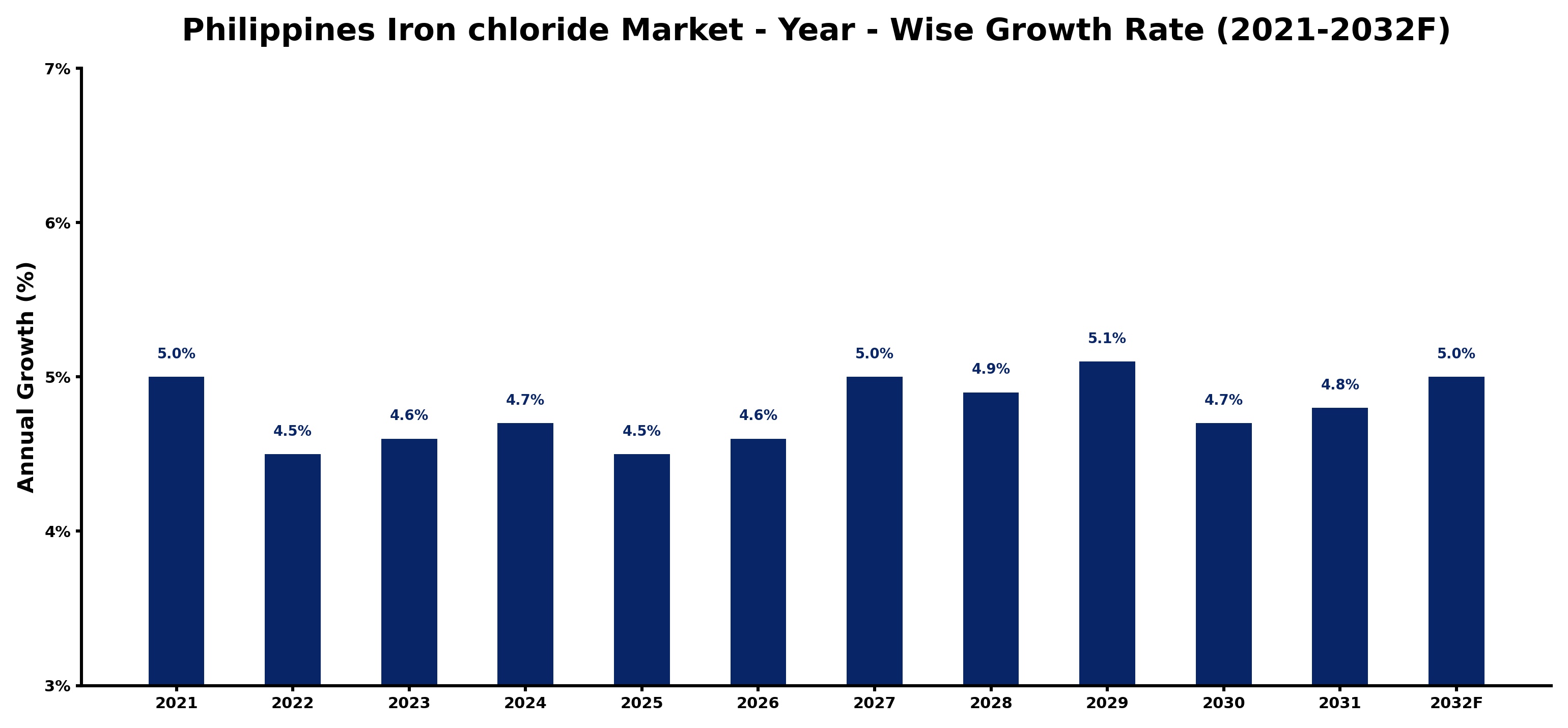
The table below presents the year‑wise growth rates along with the key drivers influencing the market
| Year | Growth Rate | Major Drivers |
| 2021 | 5.0% | Expanded mining operations boosted local iron chloride supply capabilities |
| 2022 | 4.5% | Domestic infrastructure projects boosted iron chloride procurement for water treatment |
| 2023 | 4.6% | Emerging water treatment regulations boost iron chloride production demand |
| 2024 | 4.7% | Domestic iron chloride production enhancements optimize water treatment processes |
| 2025 | 4.5% | Higher industrial demand drove investments in iron chloride production capacity |
| 2026 | 4.6% | Iron chloride production scale up aligns with infrastructure project demands |
| 2027 | 5.0% | Local mining investments boosted iron chloride supply chain resilience |
| 2028 | 4.9% | Technology adoption in iron chloride production improved processing efficiency |
| 2029 | 5.1% | Infrastructure development projects boosted iron chloride demand in construction |
| 2030 | 4.7% | Improved construction activity boosted iron chloride demand for water treatment |
| 2031 | 4.8% | Manufacturing investments in wastewater treatment enhance iron chloride demand |
| 2032 | 5.0% | Expansion of water treatment facilities drives iron chloride demand |
Note - Market size estimations and growth projections presented in this report are based on 6Wresearch's advanced forecasting approach, validated with industry datasets as of June 2026.
Philippines Iron chloride Market Synopsis
The demand for iron chloride in the Philippines is significantly influenced by its critical role in water purification processes, essential for addressing the nation's growing water quality challenges. Urbanization and a surge in industrial activities further contribute to the increasing requirement for effective wastewater treatment solutions, driving the market's growth.
In addition to water treatment, the agriculture sector is witnessing a rising need for iron chloride as a soil amendment, enhancing crop quality and yield. The synergistic impact of these applications positions the iron chloride market as a pivotal component in the Philippines' industrial landscape.
Philippines Iron chloride Market Key Takeaways
- The market is fueled by escalating demand in water treatment, electronics, and agriculture.
- Robust investments in infrastructure are key drivers of market growth.
- Compliance with environmental regulations presents an ongoing challenge.
- Emerging trends include an increased focus on sustainable production methods.
- Government initiatives are aimed at enhancing industrial output and supporting market expansion.
Evaluation of Restraints in Philippines Iron chloride Market
The Philippines Iron chloride market faces certain limitations primarily related to environmental sustainability and waste management. The production and utilization of iron chloride can generate waste byproducts that need careful handling to prevent ecological damage. Balancing the demand for iron chloride across various applications while adhering to increasingly stringent environmental regulations poses challenges. Ensuring sustainable sourcing of raw materials is vital to maintaining a continuous supply, further complicating production dynamics in this sector.
Philippines Iron chloride Market Trends
Current trends in the Philippines Iron chloride market showcase a shift towards sustainability and innovative production techniques. Companies are increasingly adopting greener practices to minimize environmental impact and improve the efficiency of iron chloride production. Additionally, advancements in technology are leading to more effective applications in water treatment processes, which enhances the appeal of iron chloride in industrial and municipal settings.
Philippines Iron chloride Market Opportunities
The Philippines Iron chloride market presents significant growth and investment opportunities, particularly within the water treatment and agricultural sectors. As the government intensifies its efforts toward infrastructure development, there is a burgeoning market for innovative solutions that leverage iron chloride's properties. Moreover, increasing awareness about sustainable agriculture opens avenues for expanding its application in soil improvement and crop enhancement, making it an attractive area for investment and development.
Government Initiatives in the Philippines Iron chloride Market
The Philippine government is actively promoting initiatives aimed at bolstering industrial growth and improving environmental standards. Programs such as the One Belt One Road initiative facilitate infrastructure projects that contribute to the development of various sectors, including water treatment and agriculture. Policies that focus on sustainable practices further create a conducive environment for the iron chloride market to thrive, aligning economic growth with environmental protection.
Future Insights of the Philippines Iron chloride Market
Looking ahead to 2026-2032, the Philippines Iron chloride market is poised for robust growth, driven by persistent urbanization and increased industrial demand. Enhanced focus on sustainable production and environmentally friendly practices will likely shape future market dynamics. As technology advances, the applications of iron chloride are expected to expand, particularly in sectors that require advanced water treatment solutions and high-performance materials.
Philippines Iron chloride Market Latest Developments (May 2025 - June 2026)
Recent developments in the Philippines Iron chloride market indicate a growing interest in sustainable manufacturing practices and innovations in water treatment technology. Various stakeholders are focusing on improving operational efficiencies and reducing the ecological footprint of iron chloride production. Additionally, collaborations between industry players and government bodies are emerging to address regulatory challenges while promoting market growth.
Philippines Iron chloride Market - Key Attractiveness of the Report
- 10 Years of Market Numbers
- Historical Data Starting from 2022 to 2025
- Base Year: 2025
- Forecast Data until 2032
- Key Performance Indicators Impacting the Market
- Major Upcoming Developments and Projects
Key Highlights of the Report:
- Philippines Iron chloride Market Outlook
- Market Size of Philippines Iron chloride Market, 2025
- Forecast of Philippines Iron chloride Market, 2032
- Historical Data and Forecast of Philippines Iron chloride Revenues & Volume for the Period 2022-2032F
- Philippines Iron chloride Market Trend Evolution
- Philippines Iron chloride Market Drivers and Challenges
- Philippines Iron chloride Price Trends
- Philippines Iron chloride Porter's Five Forces
- Philippines Iron chloride Industry Life Cycle
- Historical Data and Forecast of Philippines Iron chloride Market Revenues & Volume By Type for the Period 2022-2032F
- Historical Data and Forecast of Philippines Iron chloride Market Revenues & Volume By Ferric Chloride for the Period 2022-2032F
- Historical Data and Forecast of Philippines Iron chloride Market Revenues & Volume By Ferrous Chloride for the Period 2022-2032F
- Historical Data and Forecast of Philippines Iron chloride Market Revenues & Volume By Application for the Period 2022-2032F
- Historical Data and Forecast of Philippines Iron chloride Market Revenues & Volume By Water and Sewage Treatment Industry for the Period 2022-2032F
- Historical Data and Forecast of Philippines Iron chloride Market Revenues & Volume By Metal Surface Treatment Industry for the Period 2022-2032F
- Historical Data and Forecast of Philippines Iron chloride Market Revenues & Volume By PCB Industry for the Period 2022-2032F
- Historical Data and Forecast of Philippines Iron chloride Market Revenues & Volume By Pigment Industry for the Period 2022-2032F
- Philippines Iron chloride Import Export Trade Statistics
- Market Opportunity Assessment By Type
- Market Opportunity Assessment By Application
- Philippines Iron chloride Top Companies Market Share
- Philippines Iron chloride Competitive Benchmarking By Technical and Operational Parameters
- Philippines Iron chloride Company Profiles
- Philippines Iron chloride Key Strategic Recommendations






































