Philippines Lead Chemicals Market Size, Share & Growth Rate
The Philippines Lead Chemicals Market was estimated at USD 300 Million in 2025 and is projected to reach USD 410 Million by 2032, growing at a CAGR of 4.6% from 2026 to 2032. This growth trajectory is primarily driven by the burgeoning automotive and electronics sectors, which significantly rely on lead-based compounds for batteries and electronic components. Additionally, the construction industry's expansion contributes to the rising demand for lead chemicals in paints, coatings, and pigments, underscoring the market's robust growth potential.
Philippines Lead Chemicals Market Year-wise Growth Rate and Key Drivers
This graph highlights how the Philippines Lead Chemicals Market has steadily grown over the years, supported by major growth factors.
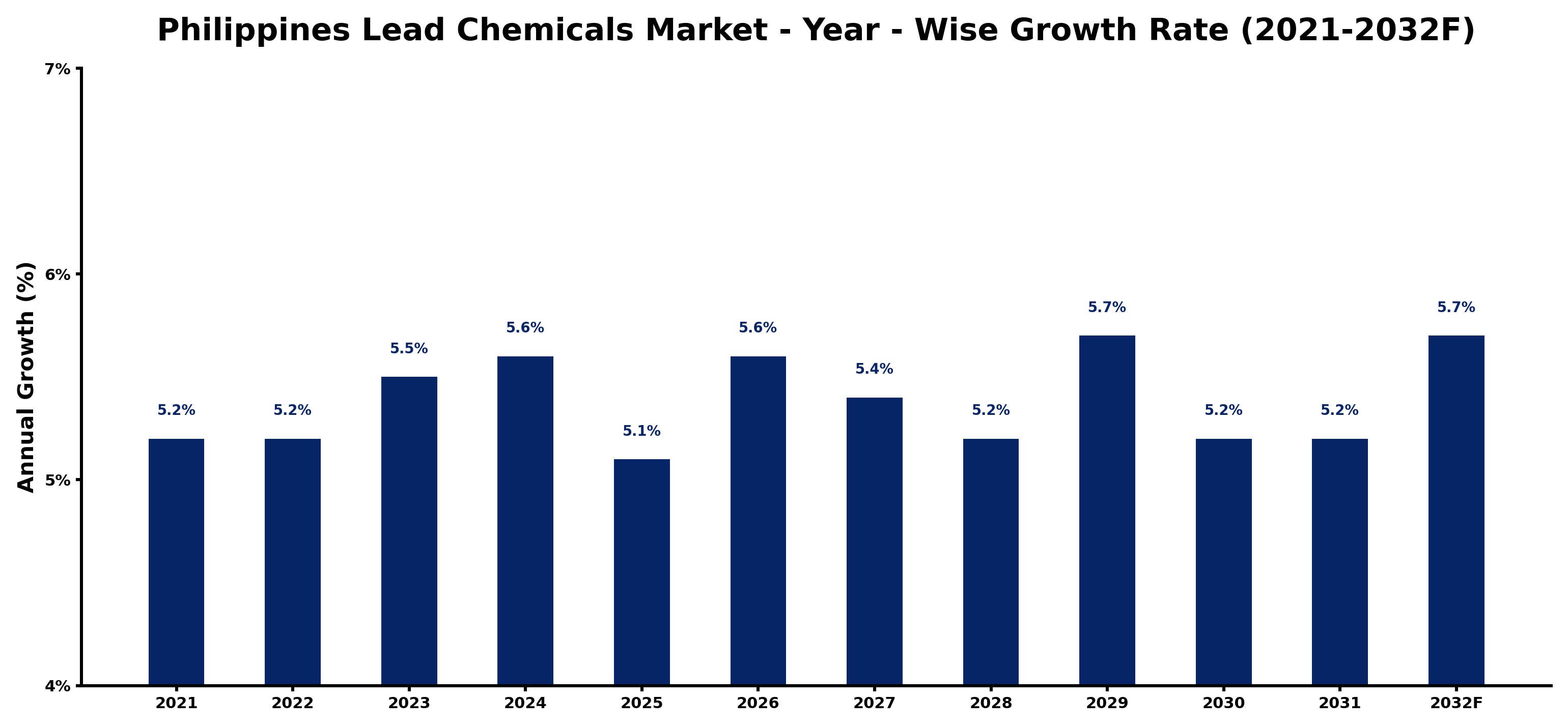
The table below presents the year‑wise growth rates along with the key drivers influencing the market
| Year | Growth Rate | Major Drivers |
| 2021 | 5.2% | Infrastructure projects increased demand |
| 2022 | 5.2% | Automotive sector expansion drove growth |
| 2023 | 5.5% | Construction activities boosted consumption |
| 2024 | 5.6% | Renewable energy initiatives spurred usage |
| 2025 | 5.1% | Electronics manufacturing saw growth |
| 2026 | 5.6% | Agricultural innovations increased applications |
| 2027 | 5.4% | Pharmaceutical advancements drove usage |
| 2028 | 5.2% | Consumer electronics demand surged |
| 2029 | 5.7% | Sustainable practices enhanced market appeal |
| 2030 | 5.2% | Urbanization trends increased consumption |
| 2031 | 5.2% | Export opportunities expanded significantly |
| 2032 | 5.7% | Technological advancements improved efficiency |
Note - Market size estimations and growth projections presented in this report are based on 6Wresearch's advanced forecasting approach, validated with industry datasets as of June 2026.
Philippines Lead Chemicals Market Synopsis
Recently, the Philippines Lead Chemicals market has experienced increased demand, particularly in the automotive and industrial applications. However, the outlook is tempered by a slight decline in exports, affected by fluctuating international prices and broader economic uncertainties. As industries adapt to evolving regulatory landscapes and shifting market dynamics, the future landscape of lead chemicals appears to be in transition.
The market is poised at a crucial juncture, where the traditional reliance on lead compounds is being challenged by environmental concerns and the growing prevalence of lead-free alternatives. Despite these pressures, lead chemicals remain integral to several key industries, indicating a complex yet promising future for the Philippines Lead Chemicals market.
Philippines Lead Chemicals Market Key Takeaways
- The market is projected to grow from USD 300 Million in 2025 to USD 410 Million by 2032.
- Automotive and electronics sectors are the primary drivers of lead chemical demand.
- Regulatory pressures are pushing industries to explore lead-free alternatives.
- The recovery post-COVID-19 is contingent on the revitalization of industrial operations.
- Key applications include batteries, pigments, and coatings, vital to various manufacturing sectors.
Evaluation of Restraints in Philippines Lead Chemicals Market
The Philippines Lead Chemicals market faces notable restraints stemming from environmental and health concerns linked to lead compounds. These issues have prompted stringent regulations that impose compliance challenges for manufacturers. Companies must invest significantly in R&D to develop lead-free alternatives, which requires substantial resources and shifts in production processes. Moreover, complexities associated with recycling and the safe disposal of lead products create operational hurdles, further impacting market growth.
Philippines Lead Chemicals Market Trends
Current trends within the Philippines Lead Chemicals market reflect a dual focus: the ongoing use of lead-based materials alongside an increasing push for sustainability. Innovations in lead-free technologies are gaining traction as industries seek to comply with stricter environmental standards. Furthermore, as the construction sector expands, there is a growing demand for high-performance coatings and paints, which are currently reliant on lead-based formulations. This juxtaposition presents a unique dynamic, influencing manufacturers' strategic decisions.
Philippines Lead Chemicals Market Opportunities
Despite the challenges, significant opportunities are emerging within the Philippines Lead Chemicals market. The transition towards sustainable practices offers avenues for companies to invest in the development of lead-free alternatives, potentially capturing a market share that increasingly values environmental responsibility. Additionally, the anticipated growth in infrastructure projects presents a robust avenue for lead chemicals, particularly in construction-related applications, ensuring continued demand in the coming years.
Government Initiatives in the Philippines Lead Chemicals Market
The Philippine government has enacted various policies to address environmental and health risks associated with lead chemicals. Public spending has shifted toward initiatives that promote research into safer alternatives and the development of sustainable materials. Programs encouraging recycling and responsible disposal of lead-containing products are also being implemented to mitigate the environmental impact, indicating a proactive stance towards balancing industrial growth with health and safety standards.
Future Insights of the Philippines Lead Chemicals Market
Looking ahead, the Philippines Lead Chemicals market is expected to navigate a transformative phase from 2026 to 2032. As industries respond to regulatory pressures and evolving consumer expectations, the market is likely to witness a gradual shift toward innovative, sustainable solutions. The interplay between lead-based products and their alternatives will shape strategic decisions across sectors, ensuring that while demand for lead chemicals persists, the path forward prioritizes environmental and health considerations.
Philippines Lead Chemicals Market Latest Developments (May 2025 - June 2026)
In recent months, the Philippines Lead Chemicals market has seen a renewed focus on innovation, with several companies ramping up research efforts aimed at lead-free alternatives. The construction industry's recovery post-pandemic has started to regain momentum, boosting demand for lead-containing paints and coatings. Additionally, there has been an emphasis on sustainability, prompting stakeholders to reevaluate their product lines in light of new environmental regulations. This evolving landscape suggests a continued adaptation among industry players to meet both consumer and regulatory demands.
Philippines Lead Chemicals Market - Key Attractiveness of the Report
- 10 Years of Market Numbers
- Historical Data Starting from 2022 to 2025
- Base Year: 2025
- Forecast Data until 2032
- Key Performance Indicators Impacting the Market
- Major Upcoming Developments and Projects
Key Highlights of the Report:
- Philippines Lead Chemicals Market Outlook
- Market Size of Philippines Lead Chemicals Market, 2025
- Forecast of Philippines Lead Chemicals Market, 2032
- Historical Data and Forecast of Philippines Lead Chemicals Revenues & Volume for the Period 2022-2032F
- Philippines Lead Chemicals Market Trend Evolution
- Philippines Lead Chemicals Market Drivers and Challenges
- Philippines Lead Chemicals Price Trends
- Philippines Lead Chemicals Porter's Five Forces
- Philippines Lead Chemicals Industry Life Cycle
- Historical Data and Forecast of Philippines Lead Chemicals Market Revenues & Volume By Types for the Period 2022-2032F
- Historical Data and Forecast of Philippines Lead Chemicals Market Revenues & Volume By Lead Nitrate for the Period 2022-2032F
- Historical Data and Forecast of Philippines Lead Chemicals Market Revenues & Volume By Lead Acetate for the Period 2022-2032F
- Historical Data and Forecast of Philippines Lead Chemicals Market Revenues & Volume By Lead Stabilizers for the Period 2022-2032F
- Historical Data and Forecast of Philippines Lead Chemicals Market Revenues & Volume By Lead Chloride for the Period 2022-2032F
- Historical Data and Forecast of Philippines Lead Chemicals Market Revenues & Volume By Others for the Period 2022-2032F
- Historical Data and Forecast of Philippines Lead Chemicals Market Revenues & Volume By Applications for the Period 2022-2032F
- Historical Data and Forecast of Philippines Lead Chemicals Market Revenues & Volume By Mining for the Period 2022-2032F
- Historical Data and Forecast of Philippines Lead Chemicals Market Revenues & Volume By PVC Stabilizers for the Period 2022-2032F
- Historical Data and Forecast of Philippines Lead Chemicals Market Revenues & Volume By Dyes for the Period 2022-2032F
- Historical Data and Forecast of Philippines Lead Chemicals Market Revenues & Volume By Pigment for the Period 2022-2032F
- Historical Data and Forecast of Philippines Lead Chemicals Market Revenues & Volume By Others for the Period 2022-2032F
- Philippines Lead Chemicals Import Export Trade Statistics
- Market Opportunity Assessment By Types
- Market Opportunity Assessment By Applications
- Philippines Lead Chemicals Top Companies Market Share
- Philippines Lead Chemicals Competitive Benchmarking By Technical and Operational Parameters
- Philippines Lead Chemicals Company Profiles
- Philippines Lead Chemicals Key Strategic Recommendations






































