Philippines LED Traffic Signs and Signals Market Size, Share & Growth Rate
The Philippines LED Traffic Signs and Signals Market was estimated at USD 396 Million in 2025 and is projected to reach USD 516 Million by 2032, growing at a CAGR of 3.9% from 2026 to 2032. This growth trajectory can be attributed to the increasing demand for smarter traffic management solutions, coupled with ongoing urbanization and the need for improved road safety measures. Furthermore, government initiatives aimed at enhancing infrastructure are expected to provide additional momentum to the market.
Philippines LED Traffic Signs and Signals Market Year-wise Growth Rate and Key Drivers
This graph highlights how the Philippines LED Traffic Signs and Signals Market has steadily grown over the years, supported by major growth factors.
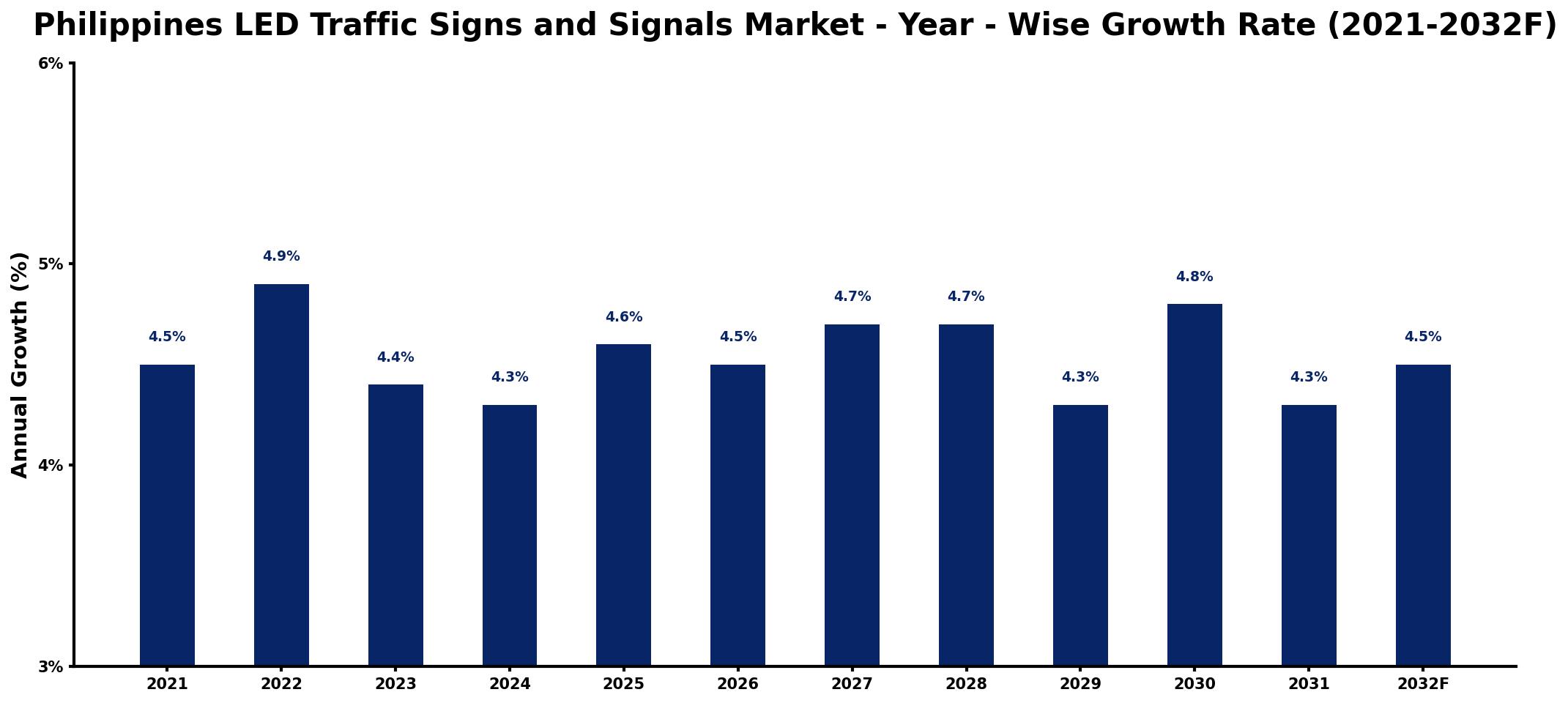
The table below presents the year‑wise growth rates along with the key drivers influencing the market
| Year | Growth Rate | Major Drivers |
| 2021 | 4.5% | Rising urbanization driving demand |
| 2022 | 4.9% | Increased government infrastructure investments |
| 2023 | 4.4% | Growing focus on road safety |
| 2024 | 4.3% | Expansion of smart city initiatives |
| 2025 | 4.6% | Surge in renewable energy adoption |
| 2026 | 4.5% | Technological advancements in automation |
| 2027 | 4.7% | Enhanced public transportation systems |
| 2028 | 4.7% | Growing awareness of environmental sustainability |
| 2029 | 4.3% | Increase in urban population density |
| 2030 | 4.8% | Rising investments in smart mobility |
| 2031 | 4.3% | expanding manufacturing base activity |
| 2032 | 4.5% | Strengthened regulations for road safety |
Note: Market size estimations and growth projections presented in this report are based on 6Wresearch's proprietary forecasting methodology, utilizing the latest available industry data, government publications, and primary research inputs.
Philippines LED Traffic Signs and Signals Market Synopsis
The adoption of LED traffic signs and signals in the Philippines is witnessing a notable uptick, driven by the growing emphasis on efficient traffic management systems. As urban areas expand and vehicle ownership rises, the necessity for clear and reliable traffic signage becomes paramount.
Recent advancements in LED technology have not only enhanced the visibility and durability of traffic signs but have also led to greater energy efficiency and reduced maintenance costs. As municipalities and transportation agencies look to modernize their infrastructure, LED solutions are increasingly seen as a long-term investment.
Philippines LED Traffic Signs and Signals Market Key Takeaways
- The market is on a steady growth path, driven by urbanization and smart city initiatives.
- Technological advancements are resulting in more energy-efficient and durable traffic signage.
- Government infrastructure investments are enhancing the market's appeal.
- Growing public awareness of road safety is boosting demand for reliable traffic management solutions.
- Local manufacturing opportunities may reduce costs and improve market penetration.
Evaluation of Restraints in Philippines LED Traffic Signs and Signals Market
Despite the positive outlook, several constraints hinder the robust growth of the Philippines LED Traffic Signs and Signals Market. A significant challenge is the limited budget allocations for infrastructure development at the local government level, which can restrict the implementation of modern traffic solutions. Additionally, the presence of substandard or counterfeit products in the market can undermine trust in LED technology, leading to concerns over quality and reliability. Furthermore, the initial investment costs associated with LED systems, while decreasing, remain a barrier for many municipalities operating under tight financial constraints.
Philippines LED Traffic Signs and Signals Market Trends
Several trends are shaping the Philippines LED Traffic Signs and Signals Market. The integration of smart technologies is increasingly prevalent, with the incorporation of IoT devices allowing for real-time traffic monitoring and adaptive signaling. Moreover, the shift toward sustainable development is driving demand for eco-friendly LED solutions that align with global environmental goals. Additionally, there is a noticeable increase in public-private partnerships aimed at funding infrastructure upgrades, enabling broader access to advanced traffic management systems.
Philippines LED Traffic Signs and Signals Market Opportunities
Opportunities abound for stakeholders in the Philippines LED Traffic Signs and Signals Market. With ongoing urban development projects and an increase in road traffic, there is a pressing need for enhanced signage and signals. Additionally, expanding tourism and transportation networks create openings for innovative solutions tailored to specific locales. Investment in research and development of next-generation LED technology, including smart signaling systems, presents a chance for companies to distinguish themselves in a competitive landscape.
Government Initiatives in the Philippines LED Traffic Signs and Signals Market
The Philippine government is actively promoting infrastructure improvements as part of its national development agenda. Policies emphasizing road safety and modernization are leading to the adoption of LED traffic signage. Initiatives like the "Build, Build, Build" program aim to enhance transportation infrastructure, including the installation of smarter traffic systems. Furthermore, funding through local government budgets and national grants is increasingly directed towards projects that integrate advanced technologies, thereby promoting the widespread use of LED traffic signs and signals.
Future Insights of the Philippines LED Traffic Signs and Signals Market
Looking ahead to the years 2026-2032, the Philippines LED Traffic Signs and Signals Market is poised for significant transformation. As cities become smarter, the demand for integrated traffic systems that leverage data analytics and connectivity will rise. The potential for automated traffic management solutions—enhanced by AI and machine learning—suggests a shift towards proactive traffic control methods. Additionally, increasing consumer awareness about road safety and environmental sustainability will further fuel investments in LED technologies, making this market ripe for innovation and growth.
Philippines LED Traffic Signs and Signals Market Latest Developments (2025 - 2026)
Recent developments in the Philippines LED Traffic Signs and Signals Market indicate a growing trend toward modernization. Local authorities are increasingly adopting intelligent traffic systems that incorporate LED technology, aimed at improving urban mobility and road safety. Furthermore, collaborations between public agencies and private sector firms are emerging, focusing on the deployment of innovative traffic management solutions. This collective momentum reflects an overarching commitment to upgrading infrastructure and enhancing the efficiency of urban traffic systems.
Philippines LED Traffic Signs and Signals Market - Key Attractiveness of the Report
- 10 Years of Market Numbers
- Historical Data Starting from 2022 to 2025
- Base Year: 2025
- Forecast Data until 2032
- Key Performance Indicators Impacting the Market
- Major Upcoming Developments and Projects
Key Highlights of the Report:
- Philippines LED Traffic Signs and Signals Market Outlook
- Market Size of Philippines LED Traffic Signs and Signals Market, 2025
- Forecast of Philippines LED Traffic Signs and Signals Market, 2032
- Historical Data and Forecast of Philippines LED Traffic Signs and Signals Revenues & Volume for the Period 2022-2032F
- Philippines LED Traffic Signs and Signals Market Trend Evolution
- Philippines LED Traffic Signs and Signals Market Drivers and Challenges
- Philippines LED Traffic Signs and Signals Price Trends
- Philippines LED Traffic Signs and Signals Porter's Five Forces
- Philippines LED Traffic Signs and Signals Industry Life Cycle
- Historical Data and Forecast of Philippines LED Traffic Signs and Signals Market Revenues & Volume By Product for the Period 2022-2032F
- Historical Data and Forecast of Philippines LED Traffic Signs and Signals Market Revenues & Volume By LED Traffic Signals for the Period 2022-2032F
- Historical Data and Forecast of Philippines LED Traffic Signs and Signals Market Revenues & Volume By LED Traffic Signs for the Period 2022-2032F
- Philippines LED Traffic Signs and Signals Import Export Trade Statistics
- Market Opportunity Assessment By Product
- Philippines LED Traffic Signs and Signals Top Companies Market Share
- Philippines LED Traffic Signs and Signals Competitive Benchmarking By Technical and Operational Parameters
- Philippines LED Traffic Signs and Signals Company Profiles
- Philippines LED Traffic Signs and Signals Key Strategic Recommendations






































