Philippines Lemon Essential Oil Market Top 5 Importing Countries and Market Competition (HHI) Analysis
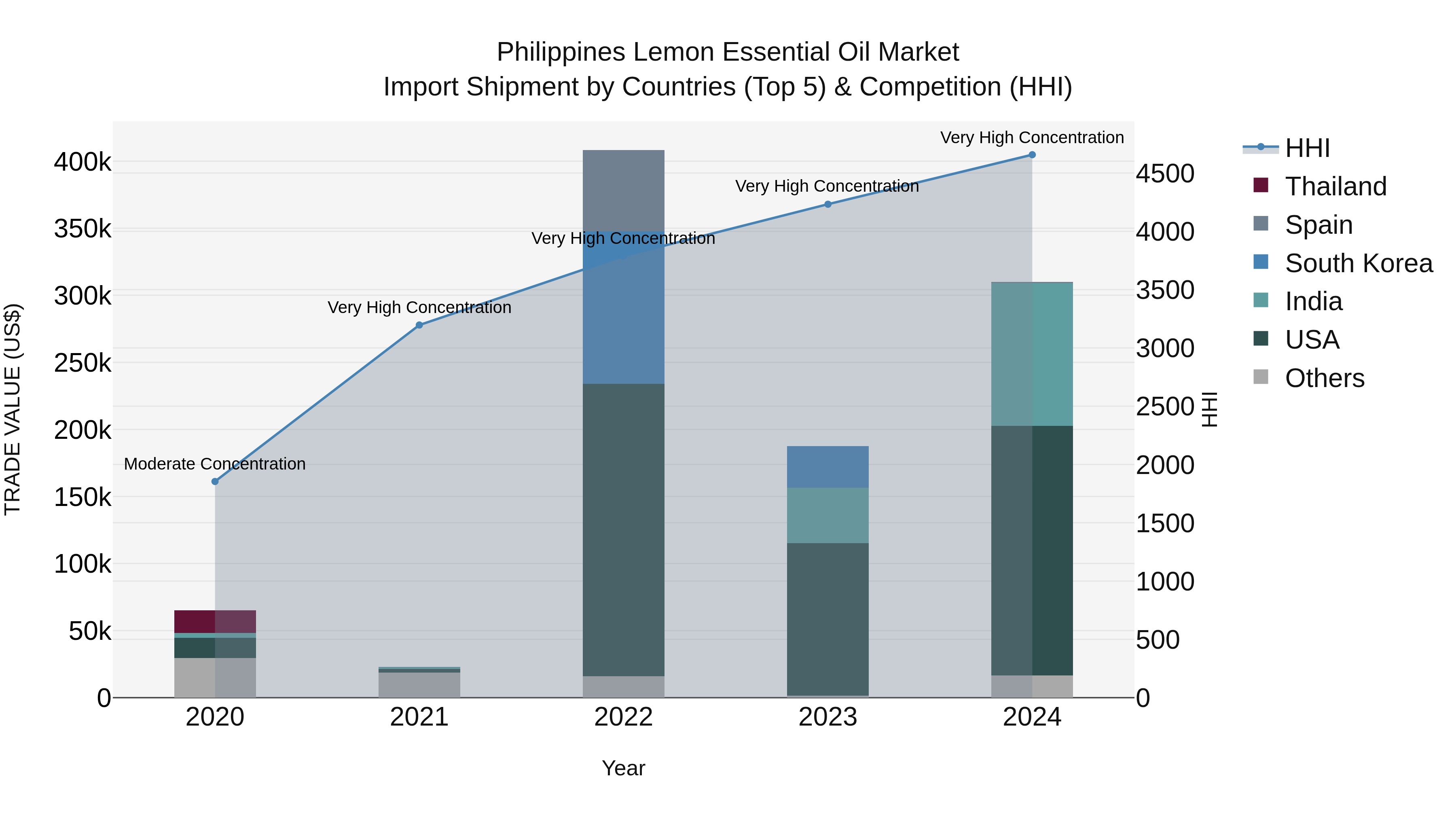
The Philippines lemon essential oil import market saw impressive growth in 2024, with top exporting countries including the USA, India, Singapore, Germany, and Spain. The market remains highly concentrated, as indicated by the high Herfindahl-Hirschman Index (HHI). The compound annual growth rate (CAGR) for the period 2020-2024 was a robust 47.71%, showcasing the increasing demand for lemon essential oil in the Philippines. Moreover, the growth rate from 2023 to 2024 spiked significantly at 65.2%, indicating a potential upward trend in the importation of this product.
Philippines Lemon Essential Oil Market Overview
The lemon essential oil market in the Philippines is expanding due to increasing demand in aromatherapy, cosmetics, and natural cleaning products. Consumers are seeking organic and therapeutic alternatives to synthetic fragrances. Local production and importation contribute to market growth. However, price fluctuations and quality concerns affect consumer trust.
Drivers of the market
The growing demand for natural and organic products in the personal care, food, and pharmaceutical industries is driving the lemon essential oil market in the Philippines. Consumers are increasingly favoring essential oils for their therapeutic and aromatic benefits, particularly in aromatherapy and skincare applications. The expansion of the wellness and spa industry is further boosting demand. Additionally, increasing awareness of the antibacterial and antioxidant properties of lemon essential oil is fueling its use in household cleaning products and natural medicine.
Challenges of the market
The lemon essential oil market faces supply chain disruptions, price volatility in raw materials, and increasing competition from synthetic alternatives. Additionally, regulatory issues regarding the purity and labeling of essential oils create market challenges.
Investment opportunities in the Market
The rising demand for natural and organic products is driving the growth of the lemon essential oil market in the Philippines. Investors can capitalize on essential oil extraction, processing, and retailing through wellness brands. Expanding exports and partnerships with skincare, aromatherapy, and food industries further enhance profitability in this sector.
Government Policy of the market
The Philippine government supports the production and export of essential oils, including lemon essential oil, through the Department of Agriculture (DA) and the Department of Trade and Industry (DTI). Policies encourage the cultivation of lemon and citrus fruits to boost raw material supply. Quality control measures under the Food and Drug Administration (FDA) regulate the safety and efficacy of essential oil products. Incentives for organic and sustainable farming practices are provided to ensure high-quality production. Additionally, export promotion programs help local producers expand their market reach internationally.
Key Highlights of the Report:
- Philippines Lemon Essential Oil Market Outlook
- Market Size of Philippines Lemon Essential Oil Market, 2024
- Forecast of Philippines Lemon Essential Oil Market, 2031
- Historical Data and Forecast of Philippines Lemon Essential Oil Revenues & Volume for the Period 2021- 2031
- Philippines Lemon Essential Oil Market Trend Evolution
- Philippines Lemon Essential Oil Market Drivers and Challenges
- Philippines Lemon Essential Oil Price Trends
- Philippines Lemon Essential Oil Porter's Five Forces
- Philippines Lemon Essential Oil Industry Life Cycle
- Historical Data and Forecast of Philippines Lemon Essential Oil Market Revenues & Volume By Nature for the Period 2021- 2031
- Historical Data and Forecast of Philippines Lemon Essential Oil Market Revenues & Volume By Organic for the Period 2021- 2031
- Historical Data and Forecast of Philippines Lemon Essential Oil Market Revenues & Volume By Conventional for the Period 2021- 2031
- Historical Data and Forecast of Philippines Lemon Essential Oil Market Revenues & Volume By End-use for the Period 2021- 2031
- Historical Data and Forecast of Philippines Lemon Essential Oil Market Revenues & Volume By Food & Beverages for the Period 2021- 2031
- Historical Data and Forecast of Philippines Lemon Essential Oil Market Revenues & Volume By Pharmaceuticals for the Period 2021- 2031
- Historical Data and Forecast of Philippines Lemon Essential Oil Market Revenues & Volume By Aromatherapy for the Period 2021- 2031
- Historical Data and Forecast of Philippines Lemon Essential Oil Market Revenues & Volume By Cosmetics & Personal Care for the Period 2021- 2031
- Historical Data and Forecast of Philippines Lemon Essential Oil Market Revenues & Volume By Households for the Period 2021- 2031
- Philippines Lemon Essential Oil Import Export Trade Statistics
- Market Opportunity Assessment By Nature
- Market Opportunity Assessment By End-use
- Philippines Lemon Essential Oil Top Companies Market Share
- Philippines Lemon Essential Oil Competitive Benchmarking By Technical and Operational Parameters
- Philippines Lemon Essential Oil Company Profiles
- Philippines Lemon Essential Oil Key Strategic Recommendations






































