Philippines Letterpress Printing Machinery Market Size, Share & Growth Rate
The Philippines Letterpress Printing Machinery Market was estimated at USD 468 Million in 2025 and is projected to reach USD 649 Million by 2032, growing at a CAGR of 4.8% from 2026 to 2032. This growth trajectory reflects a renewed consumer interest in artisanal printing methods, with letterpress products being highly valued for their tactile quality and aesthetic appeal. Furthermore, as businesses seek unique branding solutions, the demand for letterpress machinery is anticipated to thrive across packaging, invitations, and bespoke printing services.
Philippines Letterpress Printing Machinery Market Year-wise Growth Rate and Key Drivers
This graph highlights how the Philippines Letterpress Printing Machinery Market has steadily grown over the years, supported by major growth factors.
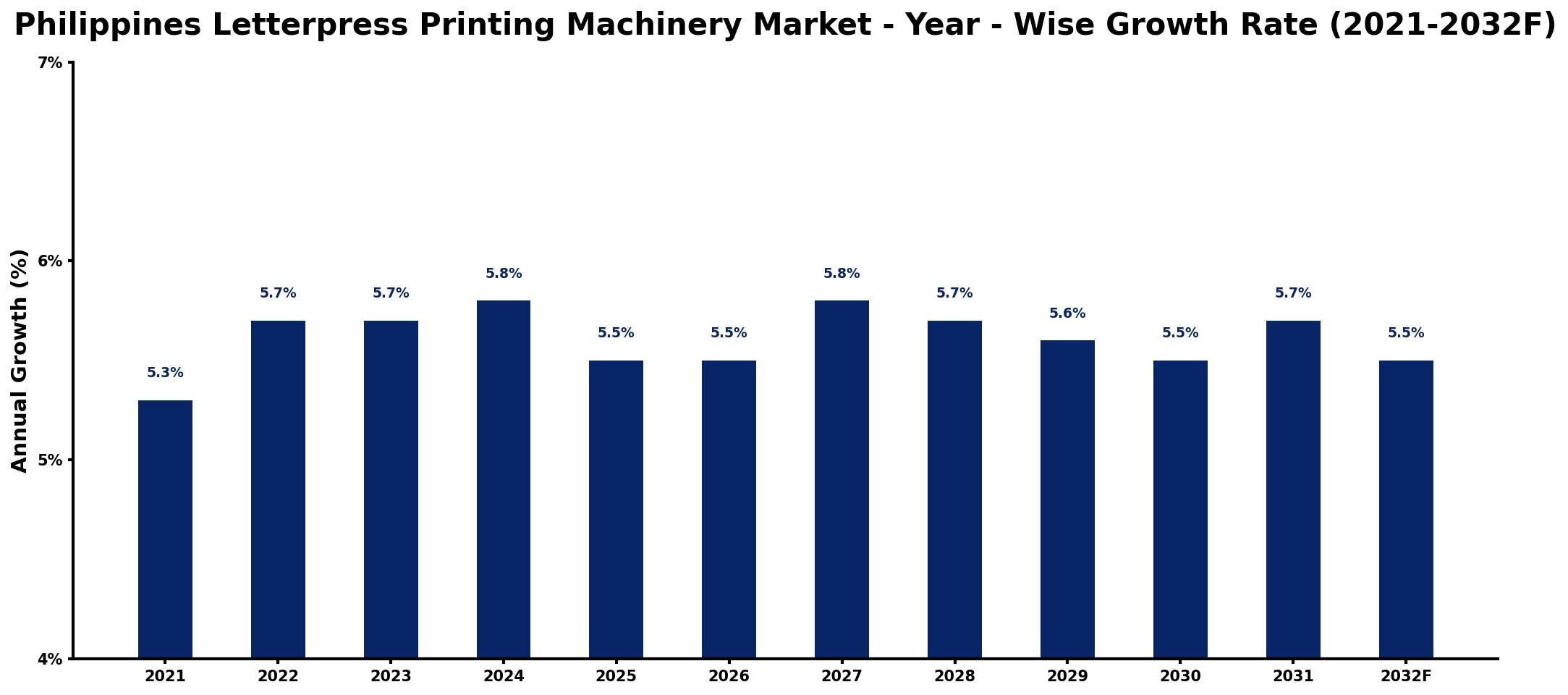
The table below presents the year‑wise growth rates along with the key drivers influencing the market
| Year | Growth Rate | Major Drivers |
| 2021 | 5.3% | Rising demand for custom designs |
| 2022 | 5.7% | Increase in small business startups |
| 2023 | 5.7% | Growth in eco-friendly packaging |
| 2024 | 5.8% | Expansion of local art communities |
| 2025 | 5.5% | Surge in online retail platforms |
| 2026 | 5.5% | Investments in artisanal production |
| 2027 | 5.8% | Boost in educational workshops |
| 2028 | 5.7% | Growing trend of DIY projects |
| 2029 | 5.6% | Increased focus on sustainability practices |
| 2030 | 5.5% | Demand for personalized products rises |
| 2031 | 5.7% | Emergence of niche market segments |
| 2032 | 5.5% | Strengthening of community-based initiatives |
Note: Market size estimations and growth projections presented in this report are based on 6Wresearch's proprietary forecasting methodology, utilizing the latest available industry data, government publications, and primary research inputs.
Philippines Letterpress Printing Machinery Market Synopsis
In the Philippines, the letterpress printing machinery market is witnessing a renaissance. Despite the prevailing digital printing solutions, the allure of letterpress endures, especially among niche markets that prioritize craftsmanship and exclusivity.
The rise in eco-conscious consumerism and appreciation for traditional crafts further bolster this market. As creative industries gain traction, government initiatives to support cultural heritage are also creating a favorable environment for the growth of letterpress printing machinery.
Philippines Letterpress Printing Machinery Market Key Takeaways
- Letterpress printing maintains its position in the market due to its unique quality and appeal.
- The market is benefitting from the rise of artisanal and specialty printing demands.
- Government support for creative industries is positively influencing market growth.
- Despite challenges from digital alternatives, the market is poised for steady expansion.
- Increasing interest in premium printed materials is fueling investment in letterpress technology.
Evaluation of Restraints in Philippines Letterpress Printing Machinery Market
While the letterpress printing machinery market in the Philippines displays notable growth potential, it faces substantial restraints. The increasing efficiency and cost-effectiveness of digital printing alternatives pose significant competition, threatening traditional printing methods market share. Manufacturers must therefore innovate and emphasize the distinct characteristics of letterpress printing, aiming to capture the attention of discerning consumers who prioritize quality and uniqueness. Furthermore, fluctuations in consumer spending patterns, influenced by economic conditions, can impact demand for premium printing solutions.
Philippines Letterpress Printing Machinery Market Trends
Emerging trends indicate a growing inclination towards sustainable printing practices, with letterpress printing frequently seen as a more eco-friendly option. Additionally, the integration of technology with traditional methods is gaining popularity, allowing for enhanced personalization and customization in printing services. The revival of local arts and crafts is also sparking renewed interest in letterpress printing, particularly among younger generations keen on unique and creative expressions.
Philippines Letterpress Printing Machinery Market Opportunities
Significant opportunities lie within the growing sectors of custom packaging and artisanal product lines. As consumers increasingly seek authentic and handcrafted items, businesses can capitalize on this trend by investing in letterpress technology. The expansion of e-commerce also presents avenues for companies to offer personalized printed goods, amplifying demand for high-quality printing machinery. Furthermore, initiatives aimed at fostering innovation in traditional crafts can open new markets for letterpress applications.
Government Initiatives in the Philippines Letterpress Printing Machinery Market
The Philippine government has introduced various initiatives to support the arts and creative industries, aiming to promote cultural heritage and innovation. Policies aimed at encouraging local craftsmanship not only enhance the visibility of traditional printing methods but also provide financial assistance and training programs for aspiring artisans. Additionally, collaborations between governmental bodies and private sectors are fostering an environment conducive to growth and investment in the letterpress printing domain.
Future Insights of the Philippines Letterpress Printing Machinery Market
Looking ahead, the Philippines letterpress printing machinery market is expected to continue its upward trajectory, with growth fueled by the ongoing appreciation for quality and craftsmanship. The transition towards sustainability in printing practices will likely drive innovation, encouraging manufacturers to explore eco-friendly materials and processes. As the demand for personalized and unique printed products increases, the market is poised to adapt and thrive, ensuring letterpress printing maintains its relevance in a digitally dominated landscape.
Philippines Letterpress Printing Machinery Market Latest Developments (2025 - 2026)
Recent developments in the letterpress printing machinery market reflect a shift towards enhanced customization and sustainable practices. Innovations in machinery are being introduced, focusing on energy efficiency and waste reduction. Additionally, there has been a noticeable increase in collaborations between letterpress printers and local artists, further enhancing the creative potential and market visibility of letterpress products. These movements signal a vibrant future for traditional printing methods in the Philippines.
Philippines Letterpress Printing Machinery Market - Key Attractiveness of the Report
- 10 Years of Market Numbers
- Historical Data Starting from 2022 to 2025
- Base Year: 2025
- Forecast Data until 2032
- Key Performance Indicators Impacting the Market
- Major Upcoming Developments and Projects
Key Highlights of the Report:
- Philippines Letterpress Printing Machinery Market Outlook
- Market Size of Philippines Letterpress Printing Machinery Market, 2025
- Forecast of Philippines Letterpress Printing Machinery Market, 2032
- Historical Data and Forecast of Philippines Letterpress Printing Machinery Revenues & Volume for the Period 2022-2032F
- Philippines Letterpress Printing Machinery Market Trend Evolution
- Philippines Letterpress Printing Machinery Market Drivers and Challenges
- Philippines Letterpress Printing Machinery Price Trends
- Philippines Letterpress Printing Machinery Porter's Five Forces
- Philippines Letterpress Printing Machinery Industry Life Cycle
- Historical Data and Forecast of Philippines Letterpress Printing Machinery Market Revenues & Volume By Type for the Period 2022-2032F
- Historical Data and Forecast of Philippines Letterpress Printing Machinery Market Revenues & Volume By Rotary Letterpress Machine for the Period 2022-2032F
- Historical Data and Forecast of Philippines Letterpress Printing Machinery Market Revenues & Volume By Other for the Period 2022-2032F
- Historical Data and Forecast of Philippines Letterpress Printing Machinery Market Revenues & Volume By Application for the Period 2022-2032F
- Historical Data and Forecast of Philippines Letterpress Printing Machinery Market Revenues & Volume By Securities for the Period 2022-2032F
- Historical Data and Forecast of Philippines Letterpress Printing Machinery Market Revenues & Volume By Invitation Card for the Period 2022-2032F
- Historical Data and Forecast of Philippines Letterpress Printing Machinery Market Revenues & Volume By Other for the Period 2022-2032F
- Philippines Letterpress Printing Machinery Import Export Trade Statistics
- Market Opportunity Assessment By Type
- Market Opportunity Assessment By Application
- Philippines Letterpress Printing Machinery Top Companies Market Share
- Philippines Letterpress Printing Machinery Competitive Benchmarking By Technical and Operational Parameters
- Philippines Letterpress Printing Machinery Company Profiles
- Philippines Letterpress Printing Machinery Key Strategic Recommendations






































