Philippines Life Science Reagents Market Size, Share & Growth Rate
The Philippines Life Science Reagents Market was estimated at USD 345 Million in 2025 and is projected to reach USD 497 Million by 2032, growing at a CAGR of 5.4% from 2026 to 2032. This steady growth is primarily fueled by advancements in biotechnology and the increasing focus on drug discovery, genomics, and disease research, underscoring the pivotal role that life science reagents play in laboratory settings. As the demand for high-quality reagents escalates, the market trajectory remains promising.
Philippines Life Science Reagents Market Year-wise Growth Rate and Key Drivers
This graph highlights how the Philippines Life Science Reagents Market has steadily grown over the years, supported by major growth factors.
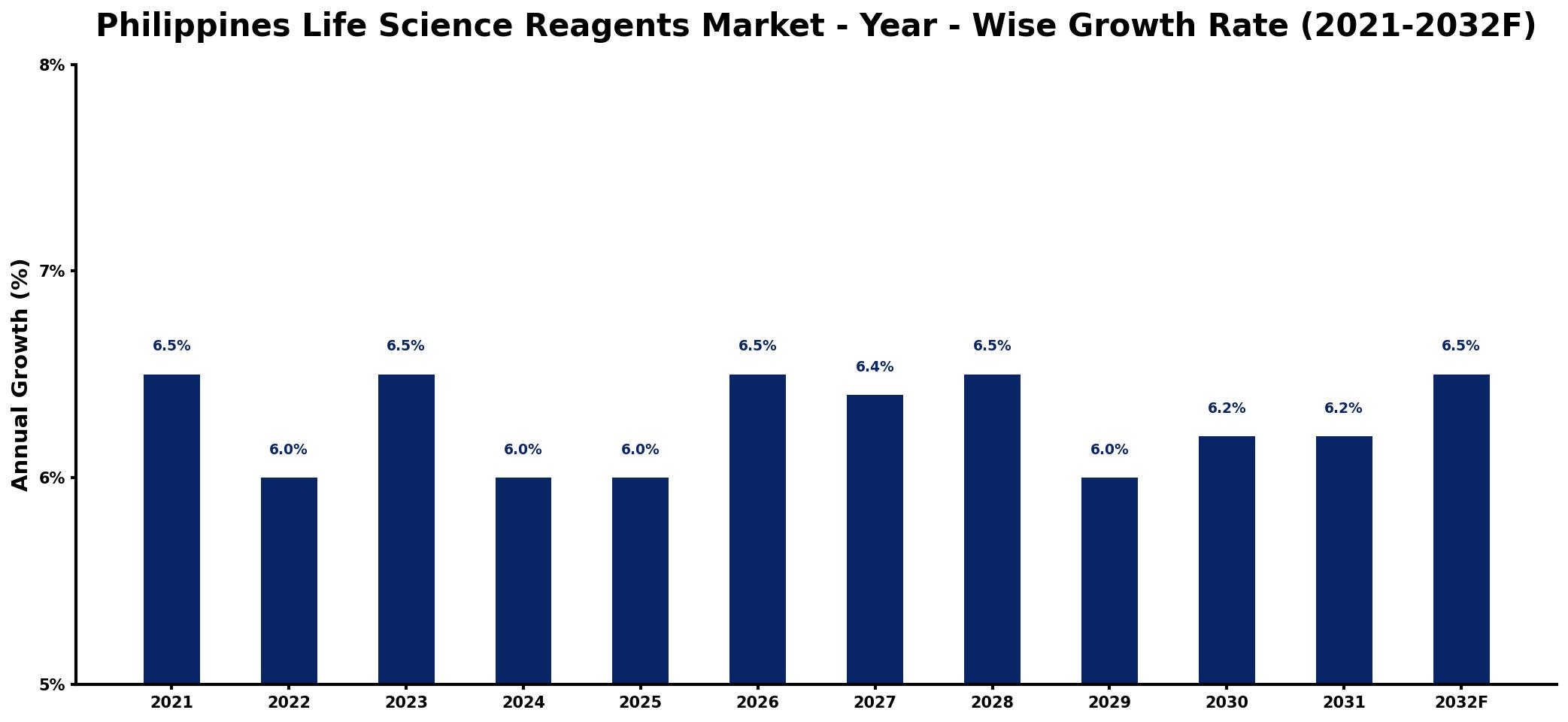
The table below presents the year‑wise growth rates along with the key drivers influencing the market
| Year | Growth Rate | Major Drivers |
| 2021 | 6.5% | Increased research funding allocations |
| 2022 | 6.0% | Surge in biotechnology applications |
| 2023 | 6.5% | Expansion of healthcare investments |
| 2024 | 6.0% | Growing demand for diagnostics |
| 2025 | 6.0% | Rising interest in academic research |
| 2026 | 6.5% | Advancements in pharmaceutical development |
| 2027 | 6.4% | Emergence of innovative startups |
| 2028 | 6.5% | Increased focus on personalized medicine |
| 2029 | 6.0% | Growth in clinical trial activities |
| 2030 | 6.2% | Enhanced regulatory support frameworks |
| 2031 | 6.2% | Boost in agricultural research initiatives |
| 2032 | 6.5% | Strengthening of global collaborations |
Note: Market size estimations and growth projections presented in this report are based on 6Wresearch's proprietary forecasting methodology, utilizing the latest available industry data, government publications, and primary research inputs.
Philippines Life Science Reagents Market Synopsis
Recent momentum in the Philippines life science reagents market signals a bright future, characterized by a growing emphasis on biopharmaceutical research and innovation. As laboratory needs expand, fueled by cutting-edge genomic studies and proteomics, the market is poised for substantial growth.
However, the market's path is not without its challenges. Inadequate research infrastructure and regulatory hurdles may pose obstacles to the full adoption of advanced reagents and technologies. Nevertheless, ongoing developments and investments suggest a resilience in market dynamics, paving the way for future opportunities.
Philippines Life Science Reagents Market Key Takeaways
- The market is projected to grow significantly, with a forecasted CAGR of 5.4% from 2026 to 2032.
- Key applications include genomics, proteomics, and drug discovery, driven by increasing research activities.
- Challenges such as limited research infrastructure and regulatory complexities may restrain growth.
- The impact of COVID-19 has shifted research priorities, but recovery is anticipated as activities normalize.
- Investment in high-quality reagents remains critical for advancements in laboratory research and diagnostics.
Evaluation of Restraints in Philippines Life Science Reagents Market
Despite the optimistic growth outlook, the Philippines Life Science Reagents Market contends with several restraints that may impede its full potential. Limited research infrastructure remains a significant barrier, often resulting in a reliance on imported reagents and technologies. Furthermore, the regulatory landscape can complicate the approval and distribution of advanced products, impacting the speed at which innovations reach the market. Quality control issues also pose challenges, as inconsistent standards can affect both the reliability of research outcomes and the reputation of the reagents available in the local market.
Philippines Life Science Reagents Market Trends
Current trends in the Philippines Life Science Reagents Market showcase a shift towards high-quality, customizable reagents tailored to specific research needs. The integration of digital technologies in laboratory processes is also gaining traction, facilitating better data management and analysis in research environments. Additionally, an increasing focus on personalized medicine is fostering demand for reagents that support genetic and molecular analyses, emphasizing the need for innovation in product offerings. Environmental sustainability is becoming a consideration, with companies exploring eco-friendly reagents to meet evolving consumer preferences.
Philippines Life Science Reagents Market Opportunities
There are significant growth and investment opportunities within the Philippines Life Science Reagents Market. As research institutions and laboratories seek to enhance their capabilities, partnerships with global suppliers can provide access to state-of-the-art reagents and technologies. Furthermore, the increasing focus on health research initiatives and public health challenges presents avenues for new reagent developments, particularly in areas like infectious disease research and genetic studies. With the government's push towards strengthening the local biotech sector, opportunities for funding and collaboration are expected to expand.
Government Initiatives in the Philippines Life Science Reagents Market
The Philippine government has recognized the importance of bolstering the life sciences sector, implementing several initiatives aimed at enhancing research capabilities and infrastructure. Public spending on health research has been prioritized to encourage innovation and improve outcomes in healthcare. Additionally, various programs are designed to attract foreign investments in biotechnology, fostering an environment conducive to the growth of life science reagent development and distribution.
Future Insights of the Philippines Life Science Reagents Market
Looking ahead to the years 2026-2032, the Philippines Life Science Reagents Market is expected to undergo transformative changes, driven by continuous advancements in biotechnology and increasing collaborations between public and private sectors. The demand for highly specialized and innovative reagents will likely surge, particularly in genomics and molecular diagnostics, as researchers strive to meet evolving healthcare challenges. Furthermore, as the market stabilizes post-COVID-19, a resurgence in research funding and international partnerships could lead to enhanced growth trajectories, reinforcing the Philippines' position in the global life science landscape.
Philippines Life Science Reagents Market Latest Developments (2025 - 2026)
In the recent period, significant shifts in the Philippines Life Science Reagents Market have been observed, primarily focused on increased R&D efforts following the pandemic. There has been a notable rise in partnerships between academic institutions and private entities aimed at driving innovation in reagent development. Moreover, trends indicate a growing interest in sustainable practices within the market, with some companies beginning to explore greener alternatives in reagent formulation.
Philippines Life Science Reagents Market - Key Attractiveness of the Report
- 10 Years of Market Numbers
- Historical Data Starting from 2022 to 2025
- Base Year: 2025
- Forecast Data until 2032
- Key Performance Indicators Impacting the Market
- Major Upcoming Developments and Projects
Key Highlights of the Report:
- Philippines Life Science Reagents Market Outlook
- Market Size of Philippines Life Science Reagents Market, 2025
- Forecast of Philippines Life Science Reagents Market, 2032
- Historical Data and Forecast of Philippines Life Science Reagents Revenues & Volume for the Period 2022-2032F
- Philippines Life Science Reagents Market Trend Evolution
- Philippines Life Science Reagents Market Drivers and Challenges
- Philippines Life Science Reagents Price Trends
- Philippines Life Science Reagents Porter's Five Forces
- Philippines Life Science Reagents Industry Life Cycle
- Historical Data and Forecast of Philippines Life Science Reagents Market Revenues & Volume By Product for the Period 2022-2032F
- Historical Data and Forecast of Philippines Life Science Reagents Market Revenues & Volume By Chromatography Reagents for the Period 2022-2032F
- Historical Data and Forecast of Philippines Life Science Reagents Market Revenues & Volume By Molecular Diagnostics Reagents for the Period 2022-2032F
- Historical Data and Forecast of Philippines Life Science Reagents Market Revenues & Volume By Immunoassay Reagents for the Period 2022-2032F
- Historical Data and Forecast of Philippines Life Science Reagents Market Revenues & Volume By Clinical Chemistry Reagents for the Period 2022-2032F
- Historical Data and Forecast of Philippines Life Science Reagents Market Revenues & Volume By Flow Cytometry Reagents for the Period 2022-2032F
- Historical Data and Forecast of Philippines Life Science Reagents Market Revenues & Volume By Cell & Tissue Culture Reagents for the Period 2022-2032F
- Historical Data and Forecast of Philippines Life Science Reagents Market Revenues & Volume By Hematology & Hemostasis Reagents for the Period 2022-2032F
- Historical Data and Forecast of Philippines Chromatography Reagents Life Science Reagents Market Revenues & Volume By Microbiology Reagents for the Period 2022-2032F
- Historical Data and Forecast of Philippines Life Science Reagents Market Revenues & Volume By End-user for the Period 2022-2032F
- Historical Data and Forecast of Philippines Life Science Reagents Market Revenues & Volume By Hospitals & Diagnostics Laboratories for the Period 2022-2032F
- Historical Data and Forecast of Philippines Life Science Reagents Market Revenues & Volume By Commercial & Contract Research Manufacturers for the Period 2022-2032F
- Historical Data and Forecast of Philippines Life Science Reagents Market Revenues & Volume By Academic & Research Institutes for the Period 2022-2032F
- Historical Data and Forecast of Philippines Life Science Reagents Market Revenues & Volume By Others for the Period 2022-2032F
- Philippines Life Science Reagents Import Export Trade Statistics
- Market Opportunity Assessment By Product
- Market Opportunity Assessment By End-user
- Philippines Life Science Reagents Top Companies Market Share
- Philippines Life Science Reagents Competitive Benchmarking By Technical and Operational Parameters
- Philippines Life Science Reagents Company Profiles
- Philippines Life Science Reagents Key Strategic Recommendations






































