Philippines Low Power Wide Area Network Market Size & Growth Rate (2026-2032)
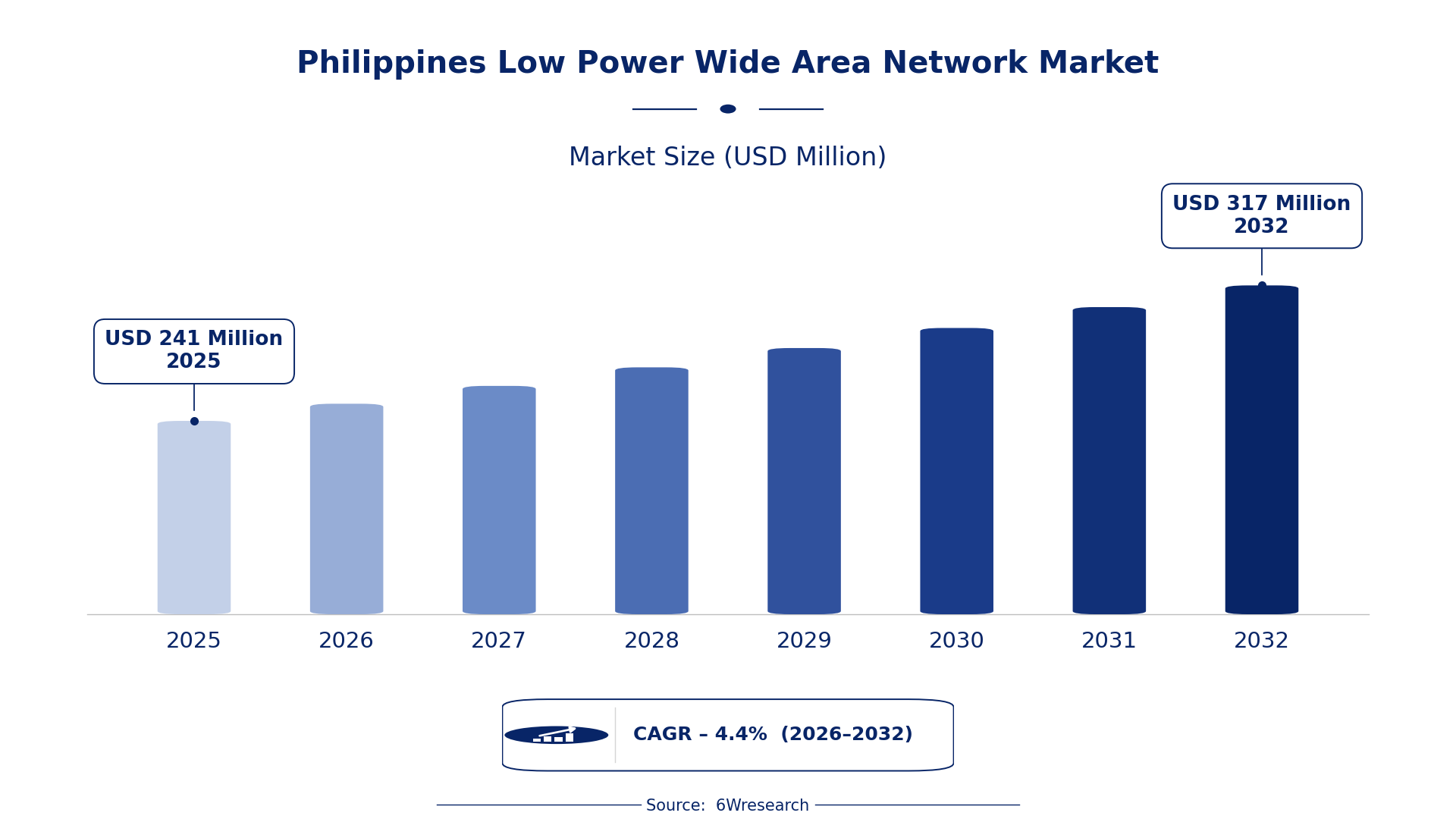
The Philippines Low Power Wide Area Network Market was estimated at USD 241 Million in 2025 and is projected to reach USD 317 Million by 2032, growing at a CAGR of 4.4% from 2026 to 2032.
Philippines Low Power Wide Area Network Market Synopsis
The Philippines Low Power Wide Area Network (LPWAN) Market has seen significant growth recently, as industries and sectors increasingly adopt IoT technologies. With a focus on expanding connectivity, the market is shifting toward more integrated solutions that provide seamless communication across various applications.
Looking ahead, the LPWAN market is set to mature, driven by advancements in technology and regulatory support. As the demand for efficient, low-power connectivity rises, we can expect a surge in innovative applications tailored to the unique challenges and opportunities present in the Philippines.
Philippines Low Power Wide Area Network Market Year-wise Growth Rate and Key Drivers
This graph illustrates the annual growth rates of the Philippines Low Power Wide Area Network Market from 2021 to 2032, highlighting a steady upward trajectory and projected expansion over the forecast period.
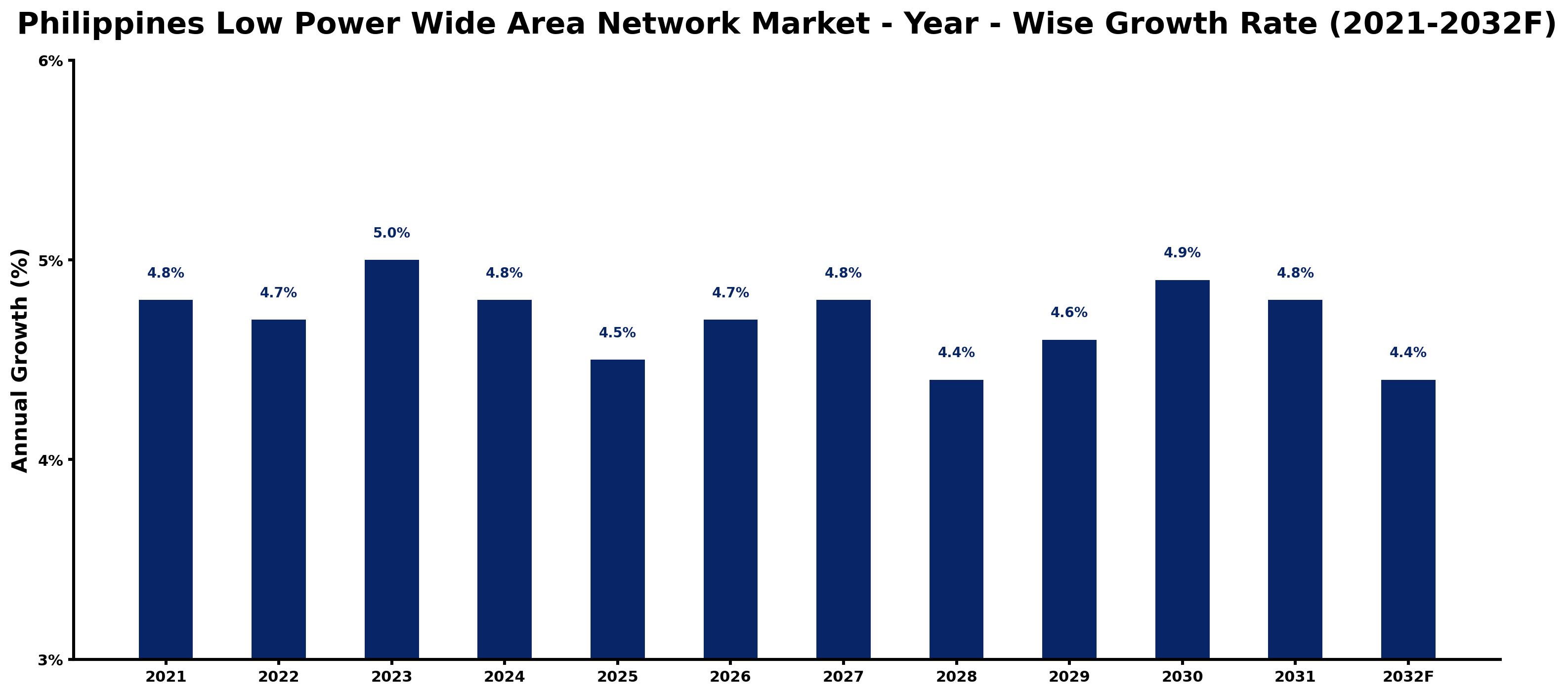
The table below presents the year‑wise growth rates along with the key drivers influencing the market
| Year | Growth Rate | Major Drivers |
| 2021 | 4.8% | Philippine government supports IoT initiatives through DICT. |
| 2022 | 4.7% | Surge in agriculture technology adoption drives LPWAN interest. |
| 2023 | 5.0% | Regulatory framework encourages smart city implementations nationwide. |
| 2024 | 4.8% | Increased investment in environmental monitoring technologies. |
| 2025 | 4.5% | Telecom infrastructure upgrades boost LPWAN network deployments. |
| 2026 | 4.7% | Deployment of smart metering solutions in energy sector. |
| 2027 | 4.8% | Growth in logistics requiring real-time tracking solutions. |
| 2028 | 4.4% | Public safety applications fueled by disaster monitoring needs. |
| 2029 | 4.6% | Rise in fintech solutions necessitates secure data connections. |
| 2030 | 4.9% | Local businesses adopting smart agriculture for increased yields. |
| 2031 | 4.8% | Heightened demand for remote health diagnostics in rural areas. |
| 2032 | 4.4% | Government partnerships stimulate research on LPWAN applications. |
Note: Market size estimations and growth projections presented in this report are based on 6Wresearch's proprietary forecasting methodology, utilizing the latest available industry data, government publications, and primary research inputs.
Philippines Low Power Wide Area Network Market Key Takeaways
Below are some of the specific key takeaways from the market, including:
- The market is expected to reach USD 317 Million by 2032, reflecting a solid growth trajectory.
- Growing investments in IoT and smart city initiatives are expected to drive demand for LPWAN solutions.
- Technologies like LoRaWAN and Sigfox are crucial for long-range, low-power applications.
- Challenges related to network coverage, particularly in rural areas, must be addressed for further expansion.
- The pandemic highlighted the essential nature of LPWAN for applications such as remote sensing and asset tracking.
Evaluation of Restraints in Philippines Low Power Wide Area Network Market
Several factors currently restrain the Philippines LPWAN market. A major concern is the geographical diversity of the country, which complicates the extension of network coverage into rural and hard-to-reach areas. Additionally, the lack of interoperability among devices from different manufacturers poses challenges for widespread adoption. Companies in the sector must focus on collaboration to enhance compatibility, ensuring a more cohesive LPWAN ecosystem. Furthermore, the initial infrastructure investment required for establishing LPWAN networks can be a deterrent for many smaller players.
Philippines Low Power Wide Area Network Market Trends
There are several noteworthy trends influencing the Philippines LPWAN market. First, an increased focus on sustainability is driving demand for energy-efficient communication technologies. Second, industries are adopting LPWAN as a foundational component for smart city developments, encompassing everything from traffic management to waste management. Furthermore, collaboration among telecom providers and technology vendors is becoming more common, fostering an environment conducive to innovation.
Philippines Low Power Wide Area Network Market Opportunities
Opportunities abound in the Philippines LPWAN market as businesses seek to capitalize on IoT applications. Key growth areas include smart agriculture, where LPWAN can facilitate real-time monitoring of crop conditions, and the logistics sector, where it enhances supply chain visibility. Government initiatives aimed at improving digital infrastructure present further avenues for investment and development, especially in underserved regions.
Government Initiatives in the Philippines Low Power Wide Area Network Market
Government policy plays a crucial role in shaping the Philippines LPWAN market. Regulatory frameworks are increasingly supportive of digital transformation, emphasizing the need for improved connectivity across urban and rural areas. Ongoing initiatives focus on enhancing the overall technological landscape, ensuring that public and private sectors can collaborate effectively to achieve universal access to LPWAN technologies.
- A recently completed national digital infrastructure upgrade program has significantly improved connectivity in urban centers.
- A current initiative aims to extend LPWAN coverage to rural areas, focusing on building partnerships between government and telecom providers.
- Planned regulatory reforms are expected to streamline the deployment of LPWAN technologies across various sectors by 2026.
- In 2025, the government launched a smart city initiative targeting metropolitan areas, utilizing LPWAN for traffic and resource management.
- A pilot project in mid-2025 focused on deploying LPWAN solutions in agricultural settings, promoting tech-driven farming practices.
Future Insights of the Philippines Low Power Wide Area Network Market
The Philippines LPWAN market is on track for continued expansion through 2032. Anticipated advancements in technology will open up new applications, making the sector increasingly attractive to investors. As competition intensifies, companies will need to innovate while adapting to regulatory changes that support LPWAN growth. The shift toward smart cities will also fuel demand, as urban planners and local governments seek effective solutions for managing resources more efficiently.
Philippines Low Power Wide Area Network Market Latest Developments
In the past year, the Philippines LPWAN market has experienced a surge in activity, as companies and government entities work together to enhance connectivity. Initiatives aimed at developing the necessary infrastructure have gained traction, alongside efforts to promote LPWAN technologies across various sectors. As interest grows, the market is witnessing a diversification of applications, further driving demand for LPWAN solutions.
- An ongoing partnership between local telecom providers is focused on expanding LPWAN coverage into remote areas, which began in early 2025.
- A major technology vendor announced plans for a new LPWAN platform, expected to launch by late 2025, targeting smart city applications.
- In 2025, a trial implementation of LPWAN in logistics and supply chain management was completed, demonstrating improved efficiency.
- Upcoming workshops aimed at educating small businesses on LPWAN capabilities are scheduled for the second half of 2026.
- A collaborative project involving government and private sector stakeholders to enhance rural connectivity is currently underway, launched in Q1 2025.
Philippines Low Power Wide Area Network Market - Key Attractiveness of the Report
- 10 Years of Market Numbers
- Historical Data Starting from 2022 to 2025
- Base Year: 2025
- Forecast Data until 2032
- Key Performance Indicators Impacting the Market
- Major Upcoming Developments and Projects
Key Highlights of the Report:
- Philippines Low Power Wide Area Network Market Outlook
- Market Size of Philippines Low Power Wide Area Network Market, 2025
- Forecast of Philippines Low Power Wide Area Network Market, 2032
- Historical Data and Forecast of Philippines Low Power Wide Area Network Revenues & Volume for the Period 2022-2032F
- Philippines Low Power Wide Area Network Market Trend Evolution
- Philippines Low Power Wide Area Network Market Drivers and Challenges
- Philippines Low Power Wide Area Network Price Trends
- Philippines Low Power Wide Area Network Porter's Five Forces
- Philippines Low Power Wide Area Network Industry Life Cycle
- Historical Data and Forecast of Philippines Low Power Wide Area Network Market Revenues & Volume By Connectivity Technology for the Period 2022-2032F
- Historical Data and Forecast of Philippines Low Power Wide Area Network Market Revenues & Volume By SIGFOX for the Period 2022-2032F
- Historical Data and Forecast of Philippines Low Power Wide Area Network Market Revenues & Volume By LoRaWAN for the Period 2022-2032F
- Historical Data and Forecast of Philippines Low Power Wide Area Network Market Revenues & Volume By Weigthless for the Period 2022-2032F
- Historical Data and Forecast of Philippines Low Power Wide Area Network Market Revenues & Volume By Others for the Period 2022-2032F
- Historical Data and Forecast of Philippines Low Power Wide Area Network Market Revenues & Volume By Verticals for the Period 2022-2032F
- Historical Data and Forecast of Philippines Low Power Wide Area Network Market Revenues & Volume By Agriculture for the Period 2022-2032F
- Historical Data and Forecast of Philippines Low Power Wide Area Network Market Revenues & Volume By Smart Logistic and Transportation for the Period 2022-2032F
- Historical Data and Forecast of Philippines Low Power Wide Area Network Market Revenues & Volume By Healthcare for the Period 2022-2032F
- Historical Data and Forecast of Philippines Low Power Wide Area Network Market Revenues & Volume By Industrial Manufacturing for the Period 2022-2032F
- Historical Data and Forecast of Philippines Low Power Wide Area Network Market Revenues & Volume By Oil and Gas for the Period 2022-2032F
- Historical Data and Forecast of Philippines Low Power Wide Area Network Market Revenues & Volume By Consumer Electronics for the Period 2022-2032F
- Historical Data and Forecast of Philippines Low Power Wide Area Network Market Revenues & Volume By Others for the Period 2022-2032F
- Historical Data and Forecast of Philippines Low Power Wide Area Network Market Revenues & Volume By Application for the Period 2022-2032F
- Historical Data and Forecast of Philippines Low Power Wide Area Network Market Revenues & Volume By Smart Waste Management for the Period 2022-2032F
- Historical Data and Forecast of Philippines Low Power Wide Area Network Market Revenues & Volume By Smart Buildings for the Period 2022-2032F
- Historical Data and Forecast of Philippines Low Power Wide Area Network Market Revenues & Volume By Smart Gas and Water Metering for the Period 2022-2032F
- Historical Data and Forecast of Philippines Low Power Wide Area Network Market Revenues & Volume By Smart Streetlights for the Period 2022-2032F
- Historical Data and Forecast of Philippines Low Power Wide Area Network Market Revenues & Volume By Smart Parking for the Period 2022-2032F
- Historical Data and Forecast of Philippines Low Power Wide Area Network Market Revenues & Volume By Livestock Monitoring for the Period 2022-2032F
- Historical Data and Forecast of Philippines Low Power Wide Area Network Market Revenues & Volume By Others for the Period 2022-2032F
- Historical Data and Forecast of Philippines Low Power Wide Area Network Market Revenues & Volume By Network Deployment for the Period 2022-2032F
- Historical Data and Forecast of Philippines Low Power Wide Area Network Market Revenues & Volume By Public Sector for the Period 2022-2032F
- Historical Data and Forecast of Philippines Low Power Wide Area Network Market Revenues & Volume By Private Sector for the Period 2022-2032F
- Historical Data and Forecast of Philippines Low Power Wide Area Network Market Revenues & Volume By Technology Service for the Period 2022-2032F
- Historical Data and Forecast of Philippines Low Power Wide Area Network Market Revenues & Volume By Managed Services for the Period 2022-2032F
- Historical Data and Forecast of Philippines Low Power Wide Area Network Market Revenues & Volume By Professional Services for the Period 2022-2032F
- Philippines Low Power Wide Area Network Import Export Trade Statistics
- Market Opportunity Assessment By Connectivity Technology
- Market Opportunity Assessment By Verticals
- Market Opportunity Assessment By Application
- Market Opportunity Assessment By Network Deployment
- Market Opportunity Assessment By Technology Service
- Philippines Low Power Wide Area Network Top Companies Market Share
- Philippines Low Power Wide Area Network Competitive Benchmarking By Technical and Operational Parameters
- Philippines Low Power Wide Area Network Company Profiles
- Philippines Low Power Wide Area Network Key Strategic Recommendations






































