Philippines Managed Print Services Market Size, Share & Growth Rate
The Philippines Managed Print Services Market was estimated at USD 456 Million in 2025 and is projected to reach USD 599 Million by 2032, growing at a CAGR of 4.0% from 2026 to 2032. This positive trajectory is fueled by organizations increasingly seeking cost-effective print management solutions that not only streamline operations but also align with sustainable practices. The ongoing shift toward digitalization and hybrid work models is further enhancing the demand for managed print services, as companies recognize the value in optimizing their printing environments.
Philippines Managed Print Services Market Year-wise Growth Rate and Key Drivers
This graph highlights how the Philippines Managed Print Services Market has steadily grown over the years, supported by major growth factors.
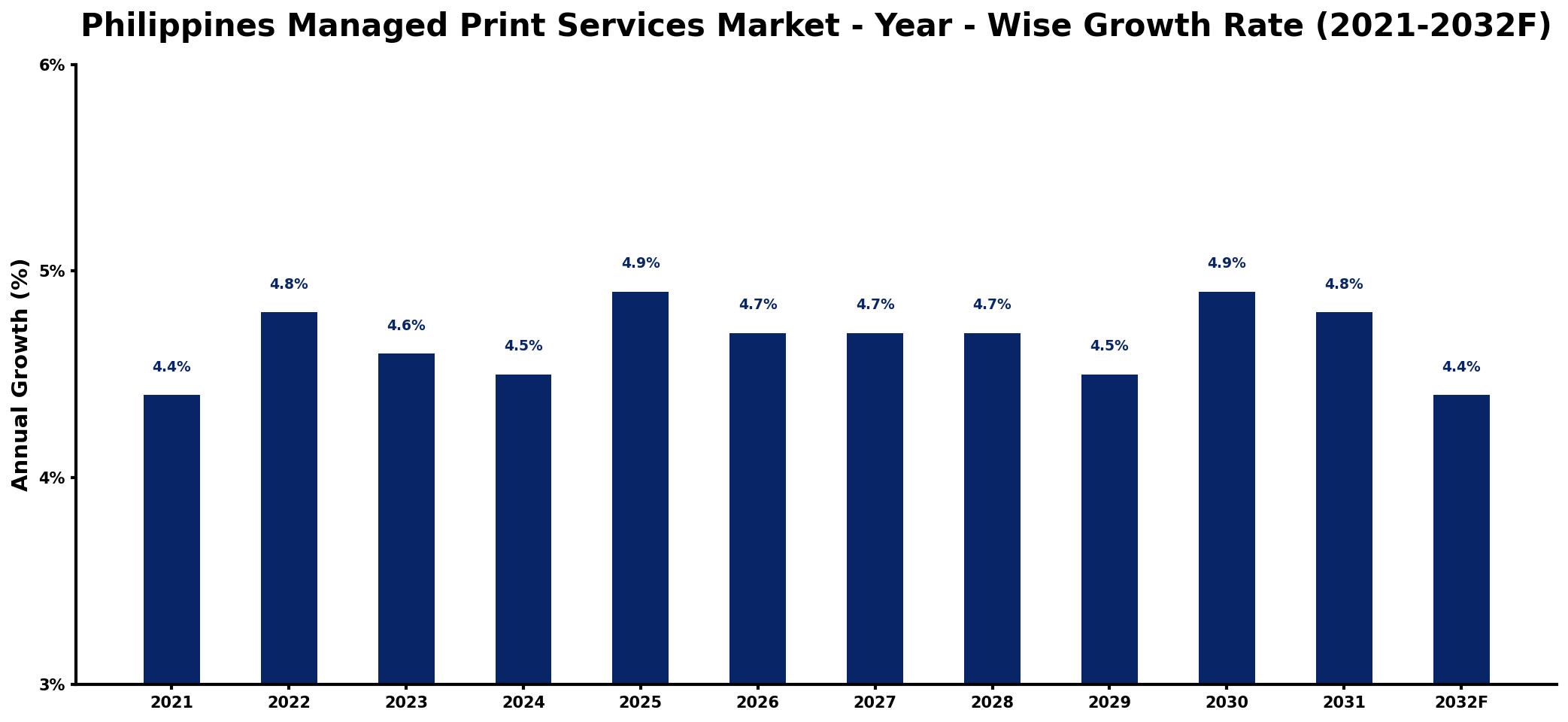
The table below presents the year‑wise growth rates along with the key drivers influencing the market
| Year | Growth Rate | Major Drivers |
| 2021 | 4.4% | Rising corporate sustainability initiatives |
| 2022 | 4.8% | Increased automation in workplaces |
| 2023 | 4.6% | Growing remote work adoption |
| 2024 | 4.5% | Expansion of digital transformation |
| 2025 | 4.9% | Investments in cloud technologies |
| 2026 | 4.7% | Demand for cost efficiency solutions |
| 2027 | 4.7% | Focus on data security protocols |
| 2028 | 4.7% | Enhanced collaboration tools development |
| 2029 | 4.5% | Shift towards eco-friendly practices |
| 2030 | 4.9% | Technological advancements in infrastructure |
| 2031 | 4.8% | Growing need for operational efficiency |
| 2032 | 4.4% | Emerging trends in hybrid workplaces |
Note: Market size estimations and growth projections presented in this report are based on 6Wresearch's proprietary forecasting methodology, utilizing the latest available industry data, government publications, and primary research inputs.
Philippines Managed Print Services Market Synopsis
In the Philippines, the managed print services market is evolving rapidly, largely due to the heightened focus on efficiency and sustainability in business practices. As companies look to reduce costs and enhance productivity, many are turning to specialized providers to manage their printing needs.
With a growing awareness of environmental responsibility, businesses are not only seeking financial savings but are also committed to minimizing their carbon footprint. Managed print services facilitate this transition by offering strategies for paper reduction and energy conservation, thereby aligning with the eco-conscious initiatives prevalent in today's corporate landscape.
Philippines Managed Print Services Market Key Takeaways
- The market is poised for robust growth driven by cost optimization and sustainability.
- Transitioning to digital workflows presents both challenges and opportunities for service providers.
- Organizations are increasingly outsourcing print management to enhance productivity.
- Security concerns related to data management are critical in the evolving print landscape.
- Flexibility in service offerings is essential as businesses adapt to hybrid work environments.
Evaluation of Restraints in Philippines Managed Print Services Market
Despite its growth prospects, the managed print services market in the Philippines faces notable restraints. One significant hurdle is the pace of technological advancement, which necessitates that service providers continuously evolve their offerings to keep up with digital trends. Organizations often express concerns regarding data security and compliance in a landscape increasingly reliant on digital solutions. Additionally, the pressure to maintain competitive pricing in a cost-sensitive market further complicates providers ability to convey the unique value of managed print services.
Philippines Managed Print Services Market Trends
Several key trends are shaping the managed print services landscape in the Philippines. A marked increase in demand for integrated solutions that encompass both physical and digital document management is being observed, driven by businesses striving for operational efficiency. Furthermore, the focus on sustainability is leading organizations to seek providers that prioritize eco-friendly practices. The adoption of advanced technologies, such as cloud computing and artificial intelligence, is also transforming traditional print management models, enabling enhanced security and streamlined workflows.
Philippines Managed Print Services Market Opportunities
The evolving business environment in the Philippines presents significant opportunities for managed print services providers. Companies are increasingly looking for customized solutions that cater to their unique operational needs, particularly in the context of hybrid work models. As organizations invest in technology that promotes efficiency, those offering innovative and adaptive print management solutions stand to gain a substantial competitive edge. Additionally, the growing emphasis on sustainability provides a platform for providers to showcase their eco-friendly practices, attracting clients that prioritize environmental responsibility.
Government Initiatives in the Philippines Managed Print Services Market
The Philippine government is increasingly recognizing the importance of sustainable business practices and is implementing various initiatives to support this transition. Policies encouraging digitalization and innovation in the business sector are paving the way for improved efficiency and reduced resource consumption. Moreover, public spending on technology and infrastructure development enhances the ecosystem in which managed print services can thrive, fostering a conducive environment for growth in this market.
Future Insights of the Philippines Managed Print Services Market
Looking ahead to the period from 2026 to 2032, the managed print services market in the Philippines is expected to continue its upward trajectory. As businesses increasingly prioritize operational efficiency and sustainability, the demand for tailored managed print solutions will likely grow. Furthermore, the integration of emerging technologies will redefine service delivery, emphasizing security and adaptability. The continuous evolution of the corporate landscape, driven by hybrid work arrangements and digital transformation, will further accelerate this growth.
Philippines Managed Print Services Market Latest Developments (2025 - 2026)
In the last year, the managed print services market in the Philippines has experienced a shift towards more integrated solutions that address the dual needs of cost efficiency and environmental sustainability. Providers are increasingly focusing on offering digital document management alongside traditional print services. There is also a notable emphasis on enhancing security features to protect sensitive information in a predominantly remote work setting. These developments reflect the market's adaptability to changing business dynamics.
Philippines Managed Print Services Market - Key Attractiveness of the Report
- 10 Years of Market Numbers
- Historical Data Starting from 2022 to 2025
- Base Year: 2025
- Forecast Data until 2032
- Key Performance Indicators Impacting the Market
- Major Upcoming Developments and Projects
Key Highlights of the Report:
- Philippines ManagedPrint Services Market Outlook
- Market Size of Philippines ManagedPrint Services Market, 2025
- Forecast of Philippines ManagedPrint Services Market, 2032
- Historical Data and Forecast of Philippines ManagedPrint Services Revenues & Volume for the Period 2022-2032F
- Philippines ManagedPrint Services Market Trend Evolution
- Philippines ManagedPrint Services Market Drivers and Challenges
- Philippines ManagedPrint Services Price Trends
- Philippines ManagedPrint Services Porter's Five Forces
- Philippines ManagedPrint Services Industry Life Cycle
- Historical Data and Forecast of Philippines ManagedPrint Services Market Revenues & Volume By Type for the Period 2022-2032F
- Historical Data and Forecast of Philippines ManagedPrint Services Market Revenues & Volume By Print Management for the Period 2022-2032F
- Historical Data and Forecast of Philippines ManagedPrint Services Market Revenues & Volume By Device Management for the Period 2022-2032F
- Historical Data and Forecast of Philippines ManagedPrint Services Market Revenues & Volume By Discovery and Design for the Period 2022-2032F
- Historical Data and Forecast of Philippines ManagedPrint Services Market Revenues & Volume By Document Imaging for the Period 2022-2032F
- Historical Data and Forecast of Philippines ManagedPrint Services Market Revenues & Volume By Deployment Mode for the Period 2022-2032F
- Historical Data and Forecast of Philippines ManagedPrint Services Market Revenues & Volume By Hybrid Cloud for the Period 2022-2032F
- Historical Data and Forecast of Philippines ManagedPrint Services Market Revenues & Volume By On-Premise for the Period 2022-2032F
- Historical Data and Forecast of Philippines ManagedPrint Services Market Revenues & Volume By Organization Size for the Period 2022-2032F
- Historical Data and Forecast of Philippines ManagedPrint Services Market Revenues & Volume By Large Enterprises for the Period 2022-2032F
- Historical Data and Forecast of Philippines ManagedPrint Services Market Revenues & Volume By Medium Enterprises for the Period 2022-2032F
- Historical Data and Forecast of Philippines ManagedPrint Services Market Revenues & Volume By Small Enterprises for the Period 2022-2032F
- Historical Data and Forecast of Philippines ManagedPrint Services Market Revenues & Volume By Industry Vertical for the Period 2022-2032F
- Historical Data and Forecast of Philippines ManagedPrint Services Market Revenues & Volume By BFSI for the Period 2022-2032F
- Historical Data and Forecast of Philippines ManagedPrint Services Market Revenues & Volume By Government for the Period 2022-2032F
- Historical Data and Forecast of Philippines ManagedPrint Services Market Revenues & Volume By Healthcare for the Period 2022-2032F
- Historical Data and Forecast of Philippines ManagedPrint Services Market Revenues & Volume By Education for the Period 2022-2032F
- Historical Data and Forecast of Philippines ManagedPrint Services Market Revenues & Volume By Industrial Manufacturing for the Period 2022-2032F
- Historical Data and Forecast of Philippines ManagedPrint Services Market Revenues & Volume By Retail for the Period 2022-2032F
- Historical Data and Forecast of Philippines ManagedPrint Services Market Revenues & Volume By Food & Beverages for the Period 2022-2032F
- Historical Data and Forecast of Philippines ManagedPrint Services Market Revenues & Volume By Others for the Period 2022-2032F
- Philippines ManagedPrint Services Import Export Trade Statistics
- Market Opportunity Assessment By Type
- Market Opportunity Assessment By Deployment Mode
- Market Opportunity Assessment By Organization Size
- Market Opportunity Assessment By Industry Vertical
- Philippines ManagedPrint Services Top Companies Market Share
- Philippines ManagedPrint Services Competitive Benchmarking By Technical and Operational Parameters
- Philippines ManagedPrint Services Company Profiles
- Philippines ManagedPrint Services Key Strategic Recommendations






































