Philippines Medical Tubing Market Top 5 Importing Countries and Market Competition (HHI) Analysis
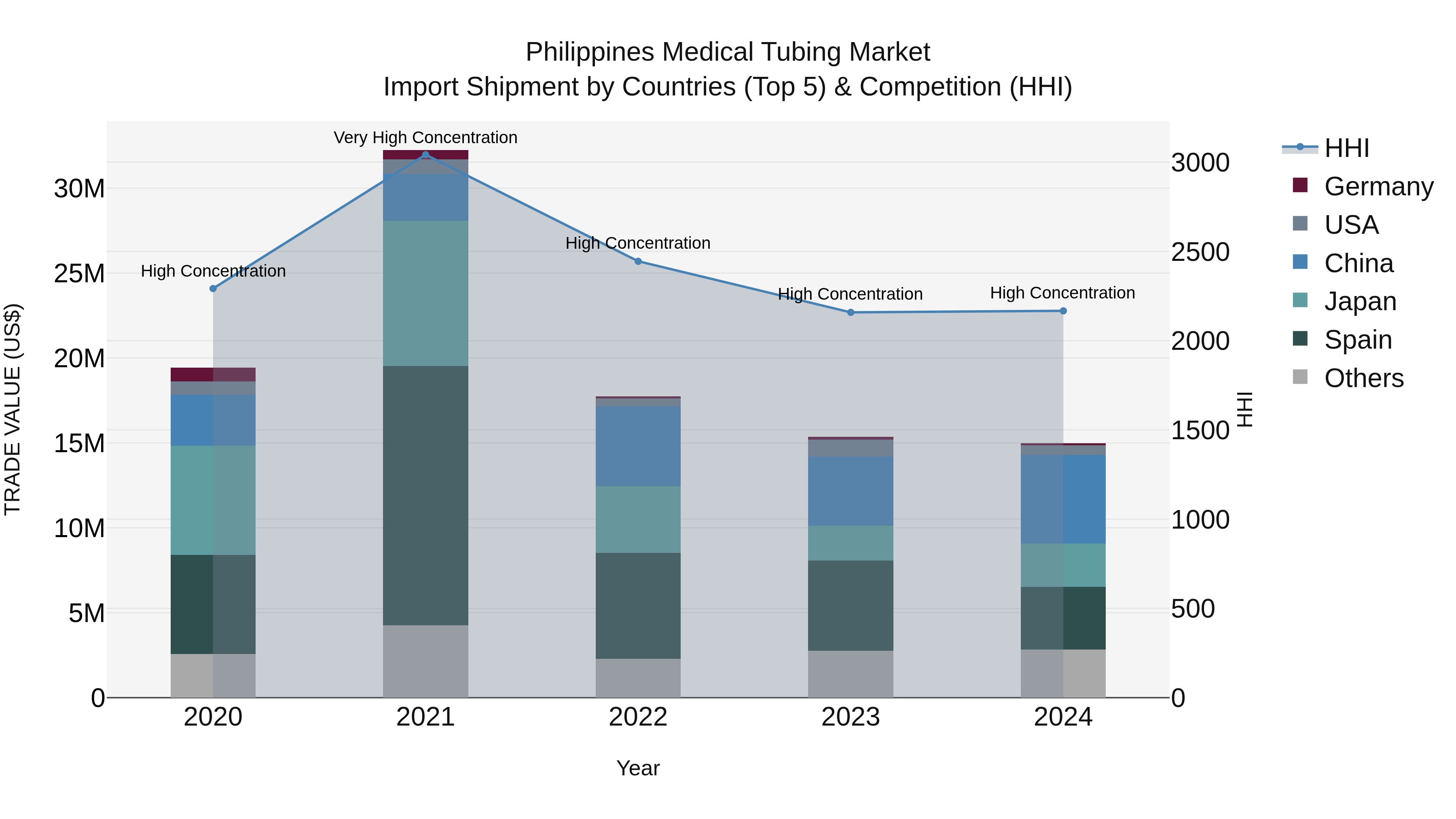
Despite a negative compound annual growth rate (CAGR) of -6.3% from 2020 to 2024, the Philippines medical tubing import market continued to show high concentration with top exporters being China, Spain, Japan, Poland, and the USA. The slight decline in growth rate from 2023 to 2024 at -2.48% indicates a challenging market environment. It will be crucial for market players to adapt strategies to navigate the competitive landscape and potentially explore opportunities for growth and innovation in the coming years.
philippines medical tubing market Synopsis
The medical tubing market in the Philippines is estimated to be worth USD 21 million in 2018 and is expected to grow at a compound annual growth rate (CAGR) of 12. 3% during the forecast period, reaching USD 45 million by 2025. The main driver for this growth is increasing demand for minimally invasive treatments that require specialized tubing. Additionally, rising health care expenditure and growing awareness regarding healthcare have also driven the market?s growth.
Drivers of the Market
The Philippines medical tubing market is expected to grow as healthcare facilities demand high-quality tubing for various medical applications, including intravenous therapy, catheterization, and respiratory care. The market`s growth is influenced by advancements in medical technology and an increasing focus on patient comfort and safety.
Challenges of the Market
In the Philippines, the medical tubing market encounters challenges tied to stringent regulations and quality assurance. Medical tubing must meet rigorous safety and hygiene standards, which can pose difficulties for manufacturers in terms of production processes and material sourcing. Ensuring a consistent supply of high-quality medical tubing that adheres to international regulations is a key challenge.
COVID-19 Impact on the Market
The Philippines medical tubing market experienced significant disruptions due to the COVID-19 pandemic. The demand for medical tubing, especially for applications like intravenous catheters and respiratory equipment, witnessed fluctuations as healthcare facilities focused on treating COVID-19 patients. Supply chain interruptions, restrictions on non-essential medical procedures, and the diversion of resources towards pandemic response all contributed to market challenges. Despite these setbacks, the market showed resilience, with an increased emphasis on local production and diversified sourcing strategies to mitigate future disruptions.
Key Players in the Market
The Philippines stainless steel pipes and tubes market is led by key players like XYZ Steelworks and ABC Piping Solutions. These companies are renowned for their extensive product portfolios that encompass a wide range of stainless steel pipes and tubes for industrial, construction, and architectural applications. Their emphasis on durability, corrosion resistance, and adherence to international standards has positioned them as preferred suppliers. Through collaborations with engineering firms and construction projects, they have contributed significantly to the modernization of the Philippines` infrastructure.
Key Highlights of the Report:
- Philippines Medical Tubing Market Outlook
- Market Size of Philippines Medical Tubing Market, 2024
- Forecast of Philippines Medical Tubing Market, 2031
- Historical Data and Forecast of Philippines Medical Tubing Revenues & Volume for the Period 2021-2031
- Philippines Medical Tubing Market Trend Evolution
- Philippines Medical Tubing Market Drivers and Challenges
- Philippines Medical Tubing Price Trends
- Philippines Medical Tubing Porter's Five Forces
- Philippines Medical Tubing Industry Life Cycle
- Historical Data and Forecast of Philippines Medical Tubing Market Revenues & Volume By Material for the Period 2021-2031
- Historical Data and Forecast of Philippines Medical Tubing Market Revenues & Volume By Plastics for the Period 2021-2031
- Historical Data and Forecast of Philippines Medical Tubing Market Revenues & Volume By Rubbers for the Period 2021-2031
- Historical Data and Forecast of Philippines Medical Tubing Market Revenues & Volume By Specialty Polymers for the Period 2021-2031
- Historical Data and Forecast of Philippines Medical Tubing Market Revenues & Volume By Structure for the Period 2021-2031
- Historical Data and Forecast of Philippines Medical Tubing Market Revenues & Volume By Single-lumen for the Period 2021-2031
- Historical Data and Forecast of Philippines Medical Tubing Market Revenues & Volume By Co-extruded for the Period 2021-2031
- Historical Data and Forecast of Philippines Medical Tubing Market Revenues & Volume By Multi-lumen for the Period 2021-2031
- Historical Data and Forecast of Philippines Medical Tubing Market Revenues & Volume By Tapered Or Bump Tubing for the Period 2021-2031
- Historical Data and Forecast of Philippines Medical Tubing Market Revenues & Volume By Braided Tubing for the Period 2021-2031
- Historical Data and Forecast of Philippines Medical Tubing Market Revenues & Volume By Application for the Period 2021-2031
- Historical Data and Forecast of Philippines Medical Tubing Market Revenues & Volume By Bulk Disposable Tubing for the Period 2021-2031
- Historical Data and Forecast of Philippines Medical Tubing Market Revenues & Volume By Catheters & Cannulas for the Period 2021-2031
- Historical Data and Forecast of Philippines Medical Tubing Market Revenues & Volume By Drug Delivery System for the Period 2021-2031
- Historical Data and Forecast of Philippines Medical Tubing Market Revenues & Volume By Special Applications for the Period 2021-2031
- Philippines Medical Tubing Import Export Trade Statistics
- Market Opportunity Assessment By Material
- Market Opportunity Assessment By Structure
- Market Opportunity Assessment By Application
- Philippines Medical Tubing Top Companies Market Share
- Philippines Medical Tubing Competitive Benchmarking By Technical and Operational Parameters
- Philippines Medical Tubing Company Profiles
- Philippines Medical Tubing Key Strategic Recommendations






































