Philippines Medical X-Ray Market Size Growth Rate
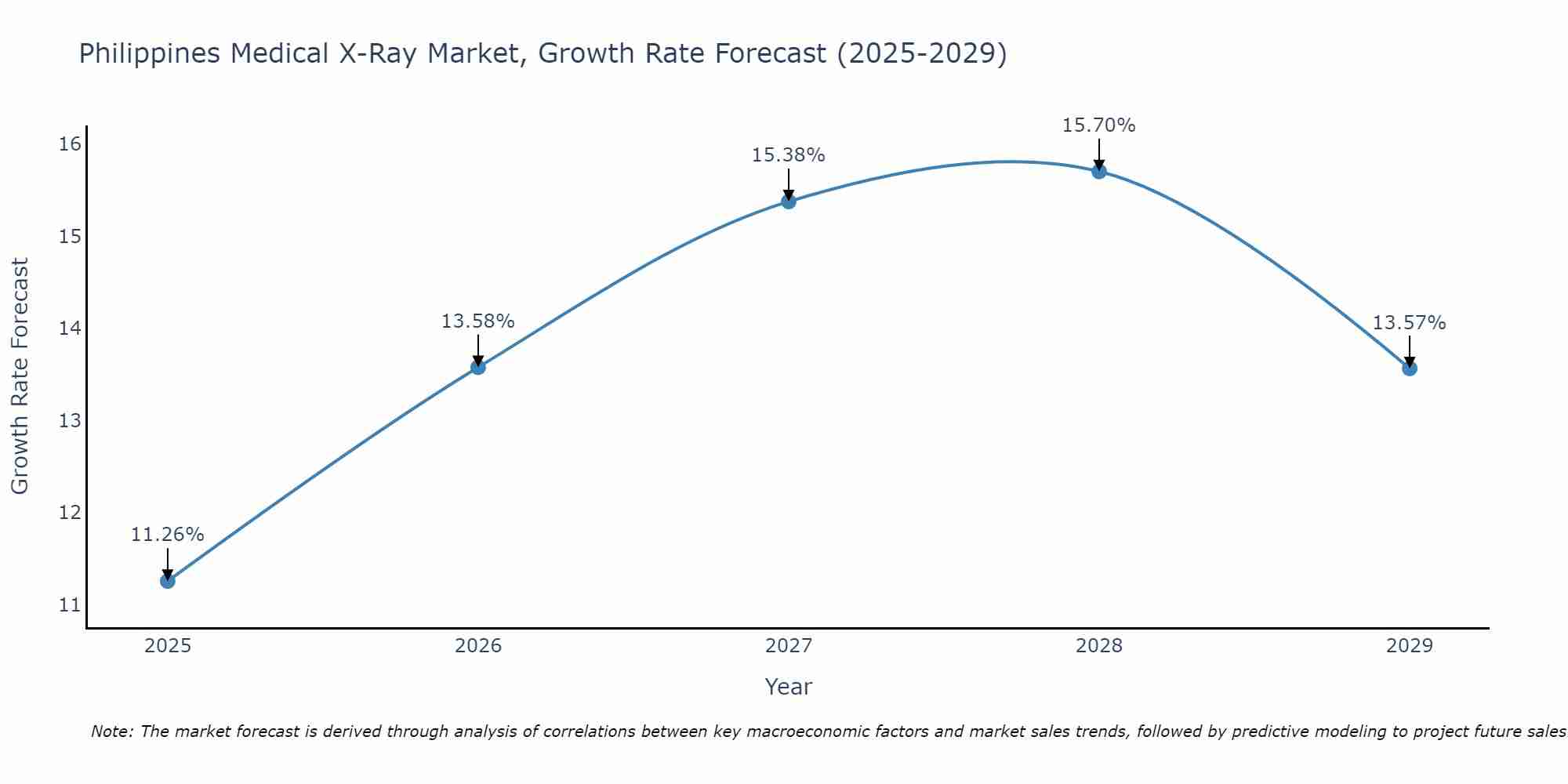
The Philippines Medical X-Ray Market is projected to witness mixed growth rate patterns during 2025 to 2029. The growth rate begins at 11.26% in 2025, climbs to a high of 15.70% in 2028, and moderates to 13.57% by 2029.
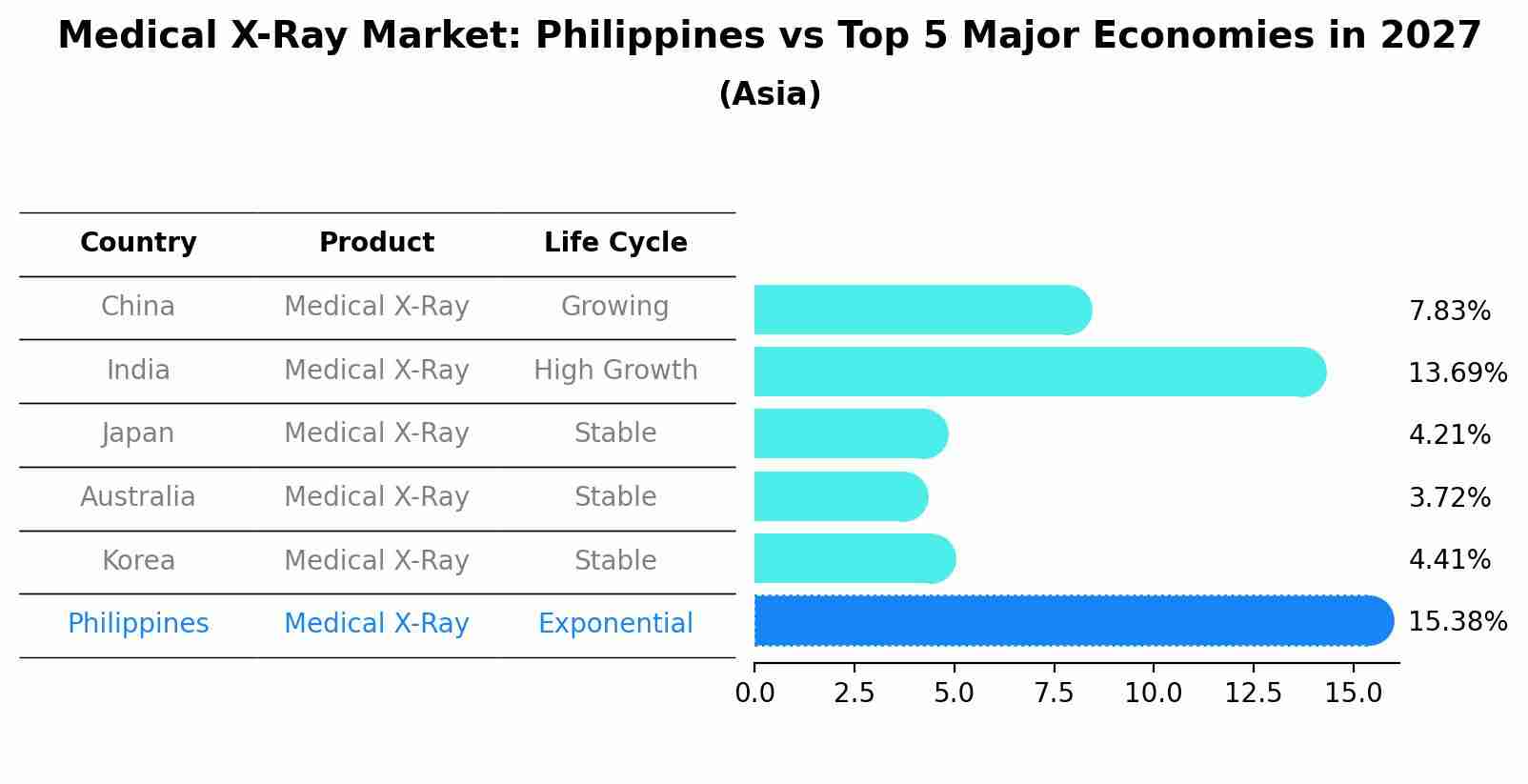
Medical X-Ray Market: Philippines vs Top 5 Major Economies in 2027 (Asia)
By 2027, the Medical X-Ray market in Philippines is anticipated to reach a growth rate of 15.38%, as part of an increasingly competitive Asia region, where China remains at the forefront, supported by India, Japan, Australia and South Korea, driving innovations and market adoption across sectors.
philippines medical x ray market Synopsis
The Philippines medical X-ray market has experienced consistent growth, with a CAGR of around 5. 7% in recent years. The need for diagnostic imaging in healthcare, coupled with technological advancements in X-ray systems, has fueled market demand. The increasing healthcare infrastructure and the requirement for accurate and efficient diagnostic tools have contributed to market expansion.
Drivers of the Market
The medical X-ray market involves equipment used for medical imaging through X-ray technology. Market growth is driven by the increasing demand for diagnostic imaging, technological advancements in X-ray equipment, and the growing need for non-invasive diagnostic procedures.
Challenges of the Market
Challenges exist, including the need for skilled radiologists to interpret X-ray images accurately and the importance of maintaining stringent radiation safety protocols. Furthermore, as other advanced imaging technologies like MRI and CT scans gain prominence, the X-ray market may face competition in terms of comprehensive diagnostic capabilities.
COVID-19 Impact on the Market
The pandemic had varying effects on the market. Elective procedures and routine check-ups were postponed due to healthcare system strains, affecting the demand for certain types of medical equipment, including X-ray systems. Adoption of safety protocols and the integration of digital solutions likely became more important during this time.
Key Players in the Market
Key players in this market might include Siemens Healthineers, GE Healthcare, Canon Medical Systems, and Shimadzu.
Key Highlights of the Report:
- Philippines Medical X-Ray Market Outlook
- Market Size of Philippines Medical X-Ray Market, 2024
- Forecast of Philippines Medical X-Ray Market, 2031
- Historical Data and Forecast of Philippines Medical X-Ray Revenues & Volume for the Period 2021-2031
- Philippines Medical X-Ray Market Trend Evolution
- Philippines Medical X-Ray Market Drivers and Challenges
- Philippines Medical X-Ray Price Trends
- Philippines Medical X-Ray Porter's Five Forces
- Philippines Medical X-Ray Industry Life Cycle
- Historical Data and Forecast of Philippines Medical X-Ray Market Revenues & Volume By Type for the Period 2021-2031
- Historical Data and Forecast of Philippines Medical X-Ray Market Revenues & Volume By Digital for the Period 2021-2031
- Historical Data and Forecast of Philippines Medical X-Ray Market Revenues & Volume By Analog for the Period 2021-2031
- Historical Data and Forecast of Philippines Medical X-Ray Market Revenues & Volume By Technology for the Period 2021-2031
- Historical Data and Forecast of Philippines Medical X-Ray Market Revenues & Volume By Film-based radiography for the Period 2021-2031
- Historical Data and Forecast of Philippines Medical X-Ray Market Revenues & Volume By Computed radiography (CR) for the Period 2021-2031
- Historical Data and Forecast of Philippines Medical X-Ray Market Revenues & Volume By Direct radiography (DR) for the Period 2021-2031
- Historical Data and Forecast of Philippines Medical X-Ray Market Revenues & Volume By Portability for the Period 2021-2031
- Historical Data and Forecast of Philippines Medical X-Ray Market Revenues & Volume By Fixed for the Period 2021-2031
- Historical Data and Forecast of Philippines Medical X-Ray Market Revenues & Volume By Portable for the Period 2021-2031
- Historical Data and Forecast of Philippines Medical X-Ray Market Revenues & Volume By Application for the Period 2021-2031
- Historical Data and Forecast of Philippines Medical X-Ray Market Revenues & Volume By Dental for the Period 2021-2031
- Historical Data and Forecast of Philippines Medical X-Ray Market Revenues & Volume By Veterinary for the Period 2021-2031
- Historical Data and Forecast of Philippines Medical X-Ray Market Revenues & Volume By Mammography for the Period 2021-2031
- Historical Data and Forecast of Philippines Medical X-Ray Market Revenues & Volume By Chest for the Period 2021-2031
- Historical Data and Forecast of Philippines Medical X-Ray Market Revenues & Volume By Cardiovascular for the Period 2021-2031
- Historical Data and Forecast of Philippines Medical X-Ray Market Revenues & Volume By Orthopedics for the Period 2021-2031
- Historical Data and Forecast of Philippines Medical X-Ray Market Revenues & Volume By Others for the Period 2021-2031
- Historical Data and Forecast of Philippines Medical X-Ray Market Revenues & Volume By End-use for the Period 2021-2031
- Historical Data and Forecast of Philippines Medical X-Ray Market Revenues & Volume By Hospitals for the Period 2021-2031
- Historical Data and Forecast of Philippines Medical X-Ray Market Revenues & Volume By Diagnostic centers for the Period 2021-2031
- Historical Data and Forecast of Philippines Medical X-Ray Market Revenues & Volume By Others for the Period 2021-2031
- Philippines Medical X-Ray Import Export Trade Statistics
- Market Opportunity Assessment By Type
- Market Opportunity Assessment By Technology
- Market Opportunity Assessment By Portability
- Market Opportunity Assessment By Application
- Market Opportunity Assessment By End-use
- Philippines Medical X-Ray Top Companies Market Share
- Philippines Medical X-Ray Competitive Benchmarking By Technical and Operational Parameters
- Philippines Medical X-Ray Company Profiles
- Philippines Medical X-Ray Key Strategic Recommendations






































