Philippines Mega Data Center Market Size & Growth Rate (2026-2032)
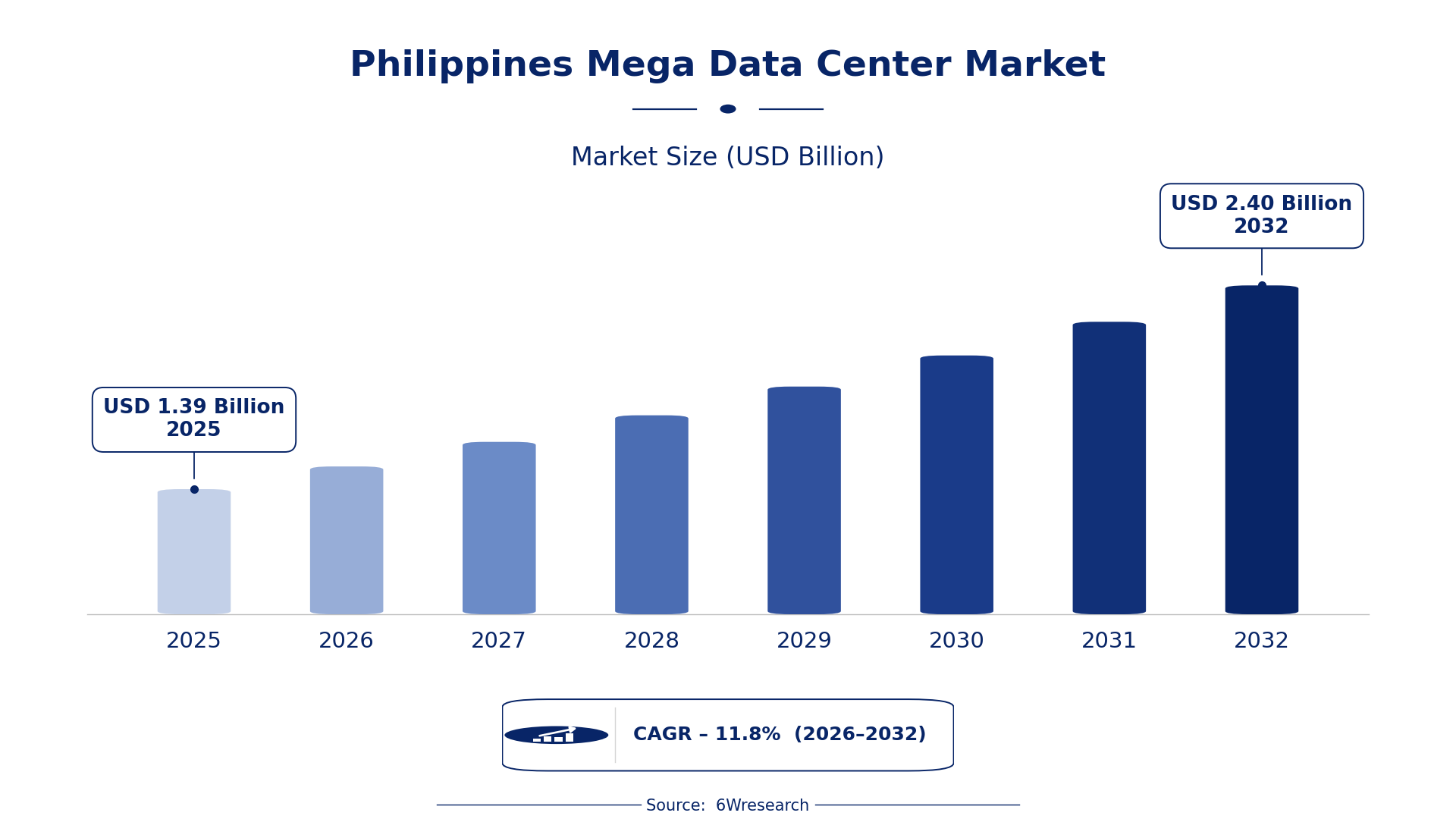
The Philippines Mega Data Center Market was estimated at USD 1386 Million in 2025 and is projected to reach USD 2402 Million by 2032, growing at a CAGR of 11.8% from 2026 to 2032.
Philippines Mega Data Center Market Synopsis
The surge in demand for cloud services is the strongest force currently shaping the Philippines Mega Data Center Market. Enterprises across various sectors are increasingly reliant on cloud infrastructure for data storage, processing, and analytics, spurring the need for larger, more efficient data centers.
As businesses continue to digitize their operations, the Philippines is emerging as a key player in the region's data center space. This growth is fueled by the influx of major global technology firms establishing their presence in the country, further enhancing the market's potential.
Philippines Mega Data Center Market Year-wise Growth Rate and Key Drivers
This graph illustrates the annual growth rates of the Philippines Mega Data Center Market from 2021 to 2032, highlighting a steady upward trajectory and projected expansion over the forecast period.
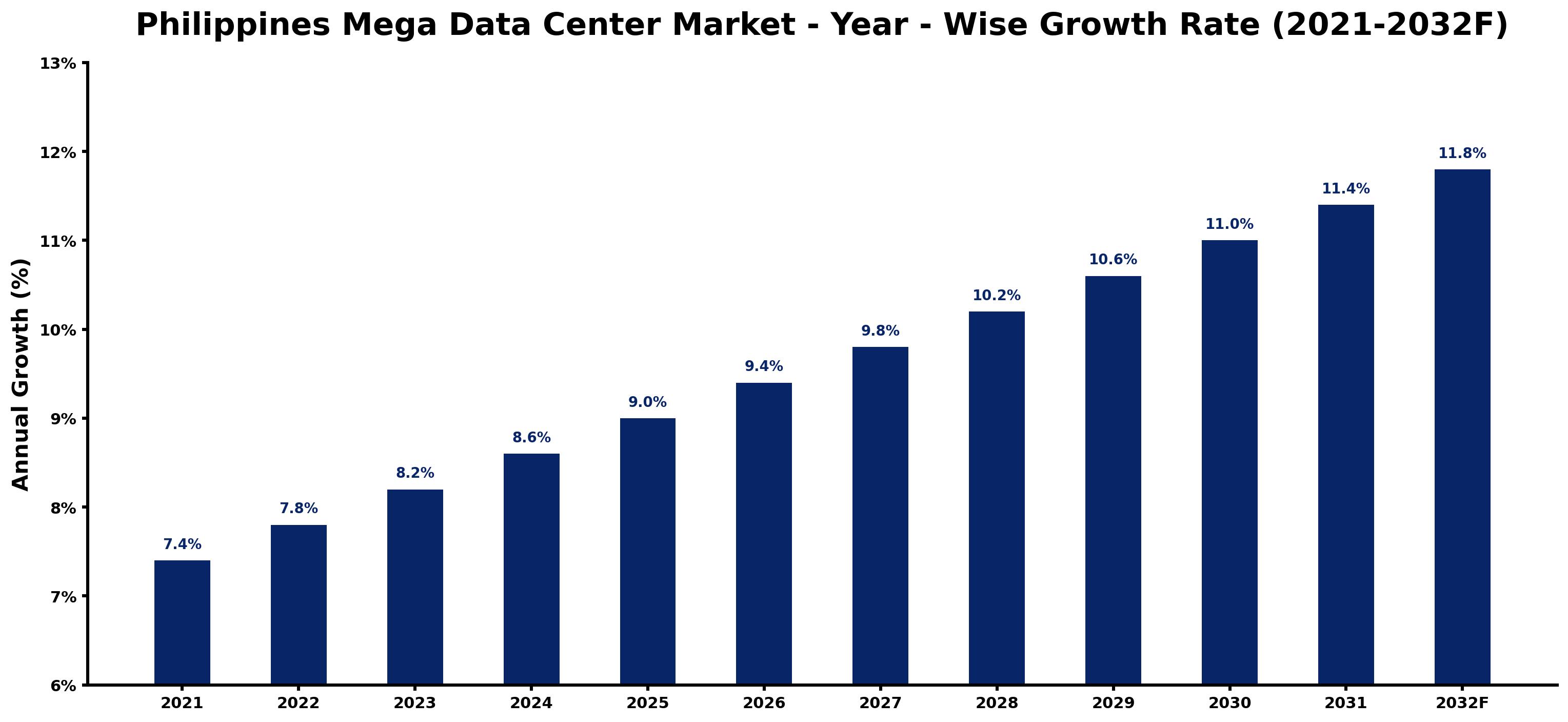
The table below presents the year‑wise growth rates along with the key drivers influencing the market
| Year | Growth Rate | Major Drivers |
| 2021 | 7.4% | Data Privacy Act boosting demand for secure data centers. |
| 2022 | 7.8% | Philippine Economic Zone Authority incentivizing data center investments. |
| 2023 | 8.2% | Increased online learning volumes driving data storage needs. |
| 2024 | 8.6% | Telecom connectivity improvements enhancing data center accessibility. |
| 2025 | 9.0% | Government's Digital Transformation Strategy fueling data service expansion. |
| 2026 | 9.4% | Local banks increasing digital transactions requiring robust infrastructure. |
| 2027 | 9.8% | Emerging AI applications need extensive data processing capabilities. |
| 2028 | 10.2% | E-commerce boom heightening demand for data storage solutions. |
| 2029 | 10.6% | Local startups increasing cloud adoption for business agility. |
| 2030 | 11.0% | Fiber optic infrastructure rollout accelerating data transfer speeds. |
| 2031 | 11.4% | Foreign investment tax breaks attracting international data firms. |
| 2032 | 11.8% | Remote work trends necessitating enhanced data management systems. |
Note: Market size estimations and growth projections presented in this report are based on 6Wresearch's proprietary forecasting methodology, utilizing the latest available industry data, government publications, and primary research inputs.
Philippines Mega Data Center Market Key Takeaways
Below are some of the specific key takeaways from the market, including:
- The Philippines is witnessing a rapid increase in data center investments driven by cloud adoption.
- Robust power infrastructure remains a critical requirement for the successful operation of mega data centers.
- COVID-19 has accelerated the demand for remote work solutions, further increasing data center significance.
- Government initiatives are beginning to create a more favorable environment for data center growth.
- Major global technology firms are making substantial investments in the local data center market.
Evaluation of Restraints in Philippines Mega Data Center Market
Despite its growth trajectory, the Philippines Mega Data Center Market faces notable constraints. One of the most pressing issues is the reliability of power supply. Frequent outages and fluctuations in electricity can severely impact the operations of large-scale data centers, posing a risk to data integrity and service availability. on top of that, the regulatory environment, while improving, still presents hurdles that can slow down the deployment of new facilities and technology.
Philippines Mega Data Center Market Trends
A key trend in the Philippines Mega Data Center Market is the increasing shift towards sustainable energy solutions. Data center operators are investing in renewable energy sources to meet both regulatory requirements and corporate sustainability goals. Additionally, the rise of edge computing is prompting new facility designs closer to end-users, enhancing data processing speed and reducing latency.
Philippines Mega Data Center Market Opportunities
Opportunities abound in the Philippines Mega Data Center Market, particularly in the area of public-private partnerships aimed at improving infrastructure. Investments in fiber optic networks and other connectivity enhancements are critical. Companies that can innovate around energy efficiency and sustainability will find a receptive market, as both government and consumers increasingly prioritize environmentally friendly practices.
Government Initiatives in the Philippines Mega Data Center Market
The Philippine government is actively working to foster a supportive environment for the Mega Data Center Market. Recent policies focus on enhancing digital infrastructure, providing incentives for investment, and addressing the power supply challenges faced by data centers. This proactive approach is essential for ensuring that the country can compete effectively on the global stage.
- A national digital infrastructure upgrade programme now in its rollout phase aims to enhance connectivity and access to data services across the archipelago.
- A regulatory framework introduced in 2025 mandating billing transparency for utilities is currently being enforced, improving operational predictability for data center operators.
- A planned public-private initiative expected to expand telecom infrastructure access by 2028 is underway, promising better connectivity for mega data centers.
- The government has recently launched a green energy policy promoting renewable energy use in data centers, contributing to sustainability goals.
Future Insights of the Philippines Mega Data Center Market
Looking ahead to 2026-2032, the Philippines Mega Data Center Market is set for substantial growth. As cloud services become ubiquitous, the demand for data storage and processing will only escalate. Enhanced government support and infrastructure improvements will play pivotal roles in attracting further investments, making the Philippines a favorable location for mega data center operations in Southeast Asia.
Philippines Mega Data Center Market Latest Developments
In recent months, the Philippines Mega Data Center Market has seen a flurry of activities that signal positive momentum. The government’s commitment to enhancing digital infrastructure, combined with increasing investments from technology firms, is reshaping the market dynamics. This trend is expected to continue as firms seek to capitalize on the growing demand for cloud services.
- A major technology vendor announced plans for a large-scale data center project in late 2025, set to focus on green energy solutions.
- An initiative that began in mid-2025 and remains underway aims to improve the power supply stability for data centers across key regions.
- A partnership between local telecom providers and a leading cloud service operator is currently in development to enhance connectivity options.
- A rollout expected to begin in the second half of 2026 will introduce advanced cooling technologies to local data centers.
Philippines Mega Data Center Market - Key Attractiveness of the Report
- 10 Years of Market Numbers
- Historical Data Starting from 2022 to 2025
- Base Year: 2025
- Forecast Data until 2032
- Key Performance Indicators Impacting the Market
- Major Upcoming Developments and Projects
Key Highlights of the Report:
- Philippines Mega Data Center Market Outlook
- Market Size of Philippines Mega Data Center Market, 2025
- Forecast of Philippines Mega Data Center Market, 2032
- Historical Data and Forecast of Philippines Mega Data Center Revenues & Volume for the Period 2022-2032F
- Philippines Mega Data Center Market Trend Evolution
- Philippines Mega Data Center Market Drivers and Challenges
- Philippines Mega Data Center Price Trends
- Philippines Mega Data Center Porter's Five Forces
- Philippines Mega Data Center Industry Life Cycle
- Historical Data and Forecast of Philippines Mega Data Center Market Revenues & Volume By Solutions Infrastructure for the Period 2022-2032F
- Historical Data and Forecast of Philippines Mega Data Center Market Revenues & Volume By IT infrastructure solutions for the Period 2022-2032F
- Historical Data and Forecast of Philippines Mega Data Center Market Revenues & Volume By Support infrastructure solutions for the Period 2022-2032F
- Historical Data and Forecast of Philippines Mega Data Center Market Revenues & Volume By Power solutions for the Period 2022-2032F
- Historical Data and Forecast of Philippines Mega Data Center Market Revenues & Volume By Cooling solutions for the Period 2022-2032F
- Historical Data and Forecast of Philippines Mega Data Center Market Revenues & Volume By Security solutions for the Period 2022-2032F
- Historical Data and Forecast of Philippines Mega Data Center Market Revenues & Volume By Management software for the Period 2022-2032F
- Historical Data and Forecast of Philippines Mega Data Center Market Revenues & Volume By Services for the Period 2022-2032F
- Historical Data and Forecast of Philippines Mega Data Center Market Revenues & Volume By System integration for the Period 2022-2032F
- Historical Data and Forecast of Philippines Mega Data Center Market Revenues & Volume By Monitoring services for the Period 2022-2032F
- Historical Data and Forecast of Philippines Mega Data Center Market Revenues & Volume By Professional services for the Period 2022-2032F
- Historical Data and Forecast of Philippines Mega Data Center Market Revenues & Volume By Support for the Period 2022-2032F
- Historical Data and Forecast of Philippines Mega Data Center Market Revenues & Volume By Power for the Period 2022-2032F
- Historical Data and Forecast of Philippines Mega Data Center Market Revenues & Volume By Cooling for the Period 2022-2032F
- Historical Data and Forecast of Philippines Mega Data Center Market Revenues & Volume By Security for the Period 2022-2032F
- Historical Data and Forecast of Philippines Mega Data Center Market Revenues & Volume By Verticals for the Period 2022-2032F
- Historical Data and Forecast of Philippines Mega Data Center Market Revenues & Volume By Banking, Financial Services and Insurance (BFSI) for the Period 2022-2032F
- Historical Data and Forecast of Philippines Mega Data Center Market Revenues & Volume By Telecom and IT for the Period 2022-2032F
- Historical Data and Forecast of Philippines Mega Data Center Market Revenues & Volume By Media and entertainment for the Period 2022-2032F
- Historical Data and Forecast of Philippines Mega Data Center Market Revenues & Volume By Government and public for the Period 2022-2032F
- Historical Data and Forecast of Philippines Mega Data Center Market Revenues & Volume By Others for the Period 2022-2032F
- Philippines Mega Data Center Import Export Trade Statistics
- Market Opportunity Assessment By Solutions Infrastructure
- Market Opportunity Assessment By Services
- Market Opportunity Assessment By Support
- Market Opportunity Assessment By Verticals
- Philippines Mega Data Center Top Companies Market Share
- Philippines Mega Data Center Competitive Benchmarking By Technical and Operational Parameters
- Philippines Mega Data Center Company Profiles
- Philippines Mega Data Center Key Strategic Recommendations






































