Philippines Metal Forming Tools Market Top 5 Importing Countries and Market Competition (HHI) Analysis
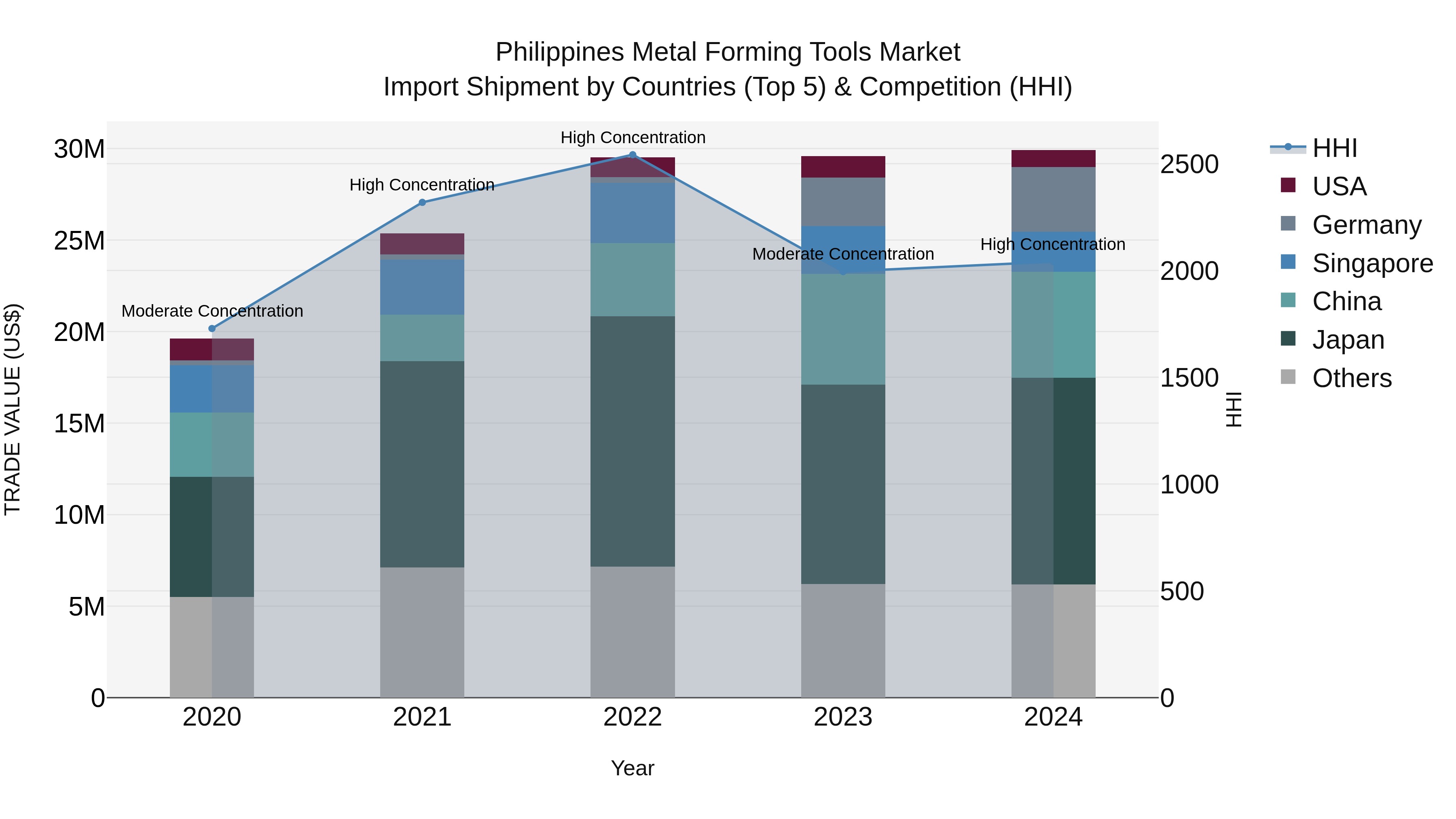
The Philippines` metal forming tools import market experienced significant growth in 2024, with top exporting countries including Japan, China, Germany, Singapore, and South Korea. The market concentration, as measured by the Herfindahl-Hirschman Index (HHI), shifted from moderate to high in just one year, indicating a more consolidated market landscape. The compound annual growth rate (CAGR) from 2020 to 2024 stood at an impressive 11.11%, with a steady growth rate of 1.12% from 2023 to 2024, showcasing a positive trajectory for the industry.
Philippines Metal Forming Tools Market Synopsis
The Philippines metal forming tools market is expected to register a CAGR of 3.1% during the forecast period 2025-2031 (2025-2031). The increasing demand for automotive components and electrical parts in the country is driving the growth of this market. Moreover, stringent environmental regulations are also supporting the development of green materials, which is further pushing up the demand for metal forming tools in the country. Additionally, growing industrialization due to government initiatives such as Go Negosyo Act and Start Up Nation will support industry growth over the forecast period 2025-2031 (2025-2031)
Key Growth Drivers of the Market
The automotive industry is growing rapidly in Philippine owing to increased investments from foreign companies as well as domestic players. This has created an impetus on investment on related machinery including forming tools used for production process across various segments like powertrain systems components, chassis & body parts etc., resulting into overall growth of market studied during predicted timeframe. Additionally, government policies such as start up nation program act have enabled local entrepreneurs to access resources necessary for setting up their own business or manufacturing units leading to increase in industrialization activities thus augmenting overall sales revenue generated through forged products produced with help of metal forming equipment???s across Philippine region.
Key Highlights of the Report:
- Philippines Metal Forming Tools Market Outlook
- Market Size of Philippines Metal Forming Tools Market, 2024
- Forecast of Philippines Metal Forming Tools Market, 2031
- Historical Data and Forecast of Philippines Metal Forming Tools Revenues & Volume for the Period 2021-2031
- Philippines Metal Forming Tools Market Trend Evolution
- Philippines Metal Forming Tools Market Drivers and Challenges
- Philippines Metal Forming Tools Price Trends
- Philippines Metal Forming Tools Porter's Five Forces
- Philippines Metal Forming Tools Industry Life Cycle
- Historical Data and Forecast of Philippines Metal Forming Tools Market Revenues & Volume By Technology for the Period 2021-2031
- Historical Data and Forecast of Philippines Metal Forming Tools Market Revenues & Volume By Computerized Numerical Control (CNC) for the Period 2021-2031
- Historical Data and Forecast of Philippines Metal Forming Tools Market Revenues & Volume By Conventional for the Period 2021-2031
- Historical Data and Forecast of Philippines Metal Forming Tools Market Revenues & Volume By Product Type for the Period 2021-2031
- Historical Data and Forecast of Philippines Metal Forming Tools Market Revenues & Volume By Rolling Mill Machine for the Period 2021-2031
- Historical Data and Forecast of Philippines Metal Forming Tools Market Revenues & Volume By Bending Machines for the Period 2021-2031
- Historical Data and Forecast of Philippines Metal Forming Tools Market Revenues & Volume By Hydraulic Presses for the Period 2021-2031
- Historical Data and Forecast of Philippines Metal Forming Tools Market Revenues & Volume By Mechanical Presses for the Period 2021-2031
- Historical Data and Forecast of Philippines Metal Forming Tools Market Revenues & Volume By Shearing Machines for the Period 2021-2031
- Historical Data and Forecast of Philippines Metal Forming Tools Market Revenues & Volume By Forging Machines for the Period 2021-2031
- Historical Data and Forecast of Philippines Metal Forming Tools Market Revenues & Volume By Wire Forming Machines for the Period 2021-2031
- Historical Data and Forecast of Philippines Metal Forming Tools Market Revenues & Volume By Others for the Period 2021-2031
- Historical Data and Forecast of Philippines Metal Forming Tools Market Revenues & Volume By End-user for the Period 2021-2031
- Historical Data and Forecast of Philippines Metal Forming Tools Market Revenues & Volume By Automotive for the Period 2021-2031
- Historical Data and Forecast of Philippines Metal Forming Tools Market Revenues & Volume By Industrial machinery for the Period 2021-2031
- Historical Data and Forecast of Philippines Metal Forming Tools Market Revenues & Volume By Transportation for the Period 2021-2031
- Historical Data and Forecast of Philippines Metal Forming Tools Market Revenues & Volume By Precision engineering for the Period 2021-2031
- Historical Data and Forecast of Philippines Metal Forming Tools Market Revenues & Volume By Others for the Period 2021-2031
- Philippines Metal Forming Tools Import Export Trade Statistics
- Market Opportunity Assessment By Technology
- Market Opportunity Assessment By Product Type
- Market Opportunity Assessment By End-user
- Philippines Metal Forming Tools Top Companies Market Share
- Philippines Metal Forming Tools Competitive Benchmarking By Technical and Operational Parameters
- Philippines Metal Forming Tools Company Profiles
- Philippines Metal Forming Tools Key Strategic Recommendations






































