Philippines Microalgae Market Top 5 Importing Countries and Market Competition (HHI) Analysis
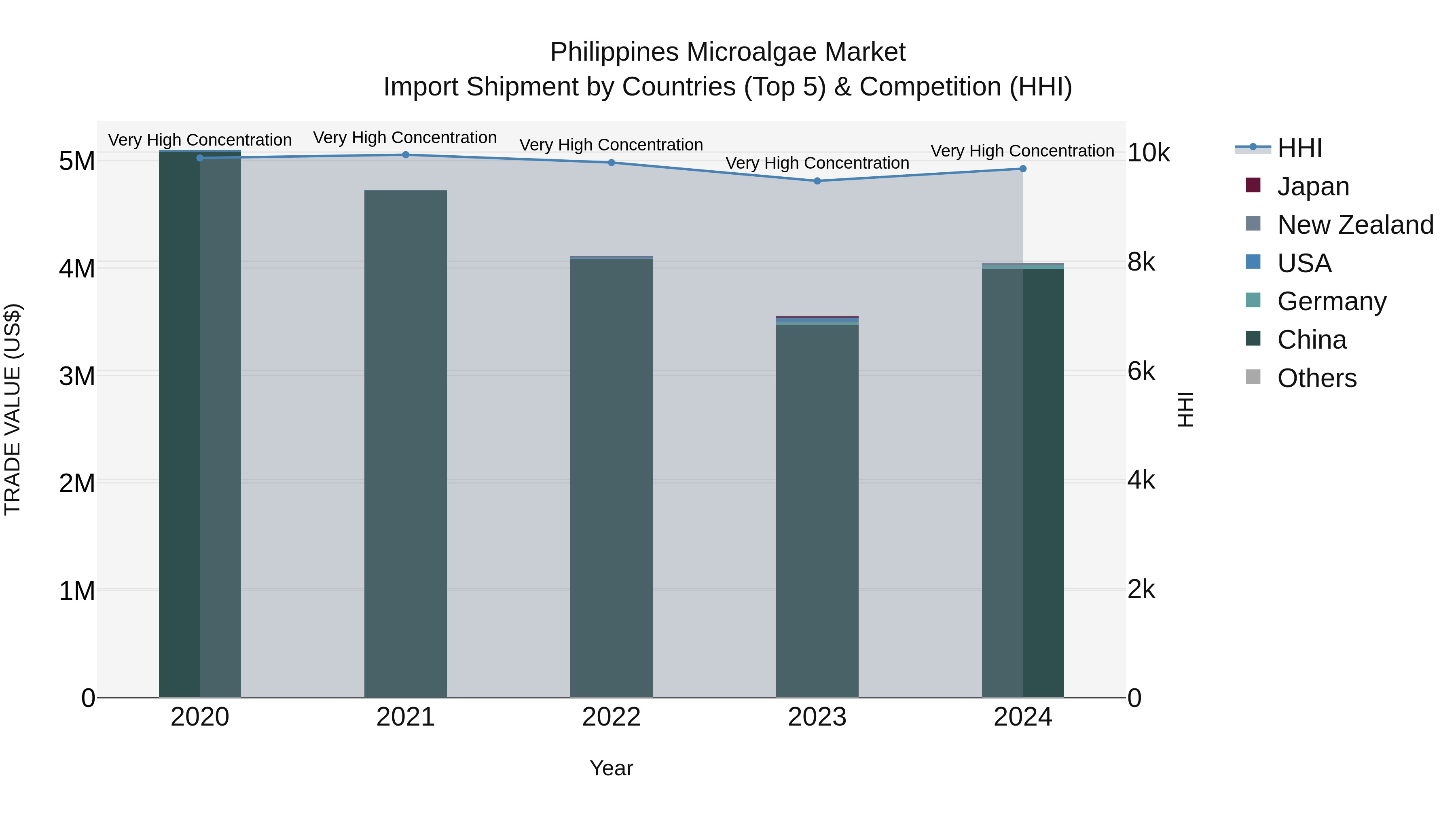
Despite a declining CAGR from 2020 to 2024, the Philippines saw a notable growth rate of 13.89% in microalgae imports in 2024. The top exporting countries were China, Germany, New Zealand, Thailand, and the USA, indicating a diverse source of imports. However, the high Herfindahl-Hirschman Index (HHI) suggests a concentrated market, potentially impacting competition and pricing dynamics within the industry. The positive growth rate in 2024 highlights the potential for further expansion and development in the microalgae import market in the Philippines.
Philippines Microalgae Market Overview
The microalgae market in the Philippines is witnessing growth due to its applications in food, biofuels, pharmaceuticals, and cosmetics. As the demand for sustainable and plant-based nutrition rises, microalgae-derived products are gaining popularity. The country`s rich marine biodiversity and favorable climate conditions support the cultivation of various microalgae species.
Drivers of the market
The increasing demand for sustainable food, feed, and biofuel sources is fueling the growth of the microalgae market. Microalgae are rich in proteins, lipids, and bioactive compounds, making them valuable for nutrition and pharmaceutical applications. Government support for renewable energy and the growing awareness of algae-based dietary supplements are further boosting market expansion.
Challenges of the market
The microalgae market in the Philippines faces difficulties related to high production costs and the need for advanced cultivation technologies. Limited awareness about the nutritional and industrial benefits of microalgae slows market adoption. Additionally, challenges in scaling up production while maintaining cost efficiency hinder commercial expansion.
Investment opportunities in the Market
The Philippines` growing interest in sustainable and nutrient-rich food sources is driving demand in the microalgae market. With applications in food, pharmaceuticals, cosmetics, and biofuel production, investors can explore opportunities in large-scale cultivation, processing technologies, and high-value extracts like spirulina and chlorella. Government initiatives supporting sustainable agriculture further enhance the potential for expansion in this sector.
Government Policy of the market
The Philippine government recognizes the potential of microalgae for food, pharmaceuticals, and biofuel applications. The Department of Science and Technology (DOST) and the Department of Agriculture (DA) support research and development initiatives to improve microalgae cultivation and processing technologies. The Bureau of Fisheries and Aquatic Resources (BFAR) regulates the production of microalgae used in aquaculture, ensuring compliance with environmental and food safety standards. Importation and commercialization of microalgae products must adhere to the regulations set by the Food and Drug Administration (FDA) and the Bureau of Plant Industry (BPI).
Key Highlights of the Report:
- Philippines Microalgae Market Outlook
- Market Size of Philippines Microalgae Market, 2024
- Forecast of Philippines Microalgae Market, 2031
- Historical Data and Forecast of Philippines Microalgae Revenues & Volume for the Period 2021- 2031
- Philippines Microalgae Market Trend Evolution
- Philippines Microalgae Market Drivers and Challenges
- Philippines Microalgae Price Trends
- Philippines Microalgae Porter's Five Forces
- Philippines Microalgae Industry Life Cycle
- Historical Data and Forecast of Philippines Microalgae Market Revenues & Volume By Type for the Period 2021- 2031
- Historical Data and Forecast of Philippines Microalgae Market Revenues & Volume By Spirulina for the Period 2021- 2031
- Historical Data and Forecast of Philippines Microalgae Market Revenues & Volume By Chlorella for the Period 2021- 2031
- Historical Data and Forecast of Philippines Microalgae Market Revenues & Volume By Haematococcus Pluvialis for the Period 2021- 2031
- Historical Data and Forecast of Philippines Microalgae Market Revenues & Volume By Others for the Period 2021- 2031
- Historical Data and Forecast of Philippines Microalgae Market Revenues & Volume By Form for the Period 2021- 2031
- Historical Data and Forecast of Philippines Microalgae Market Revenues & Volume By Dry for the Period 2021- 2031
- Historical Data and Forecast of Philippines Microalgae Market Revenues & Volume By Liquid for the Period 2021- 2031
- Historical Data and Forecast of Philippines Microalgae Market Revenues & Volume By Application for the Period 2021- 2031
- Historical Data and Forecast of Philippines Microalgae Market Revenues & Volume By Dietary Supplements for the Period 2021- 2031
- Historical Data and Forecast of Philippines Microalgae Market Revenues & Volume By Cosmetics & Personal for the Period 2021- 2031
- Historical Data and Forecast of Philippines Microalgae Market Revenues & Volume By Food & Beverages for the Period 2021- 2031
- Historical Data and Forecast of Philippines Microalgae Market Revenues & Volume By Pharmaceuticals for the Period 2021- 2031
- Historical Data and Forecast of Philippines Microalgae Market Revenues & Volume By Animal Feed for the Period 2021- 2031
- Historical Data and Forecast of Philippines Microalgae Market Revenues & Volume By Bio-Fuel for the Period 2021- 2031
- Historical Data and Forecast of Philippines Microalgae Market Revenues & Volume By Inks for the Period 2021- 2031
- Historical Data and Forecast of Philippines Microalgae Market Revenues & Volume By Others for the Period 2021- 2031
- Philippines Microalgae Import Export Trade Statistics
- Market Opportunity Assessment By Type
- Market Opportunity Assessment By Form
- Market Opportunity Assessment By Application
- Philippines Microalgae Top Companies Market Share
- Philippines Microalgae Competitive Benchmarking By Technical and Operational Parameters
- Philippines Microalgae Company Profiles
- Philippines Microalgae Key Strategic Recommendations






































