Philippines Microcars Market Top 5 Importing Countries and Market Competition (HHI) Analysis
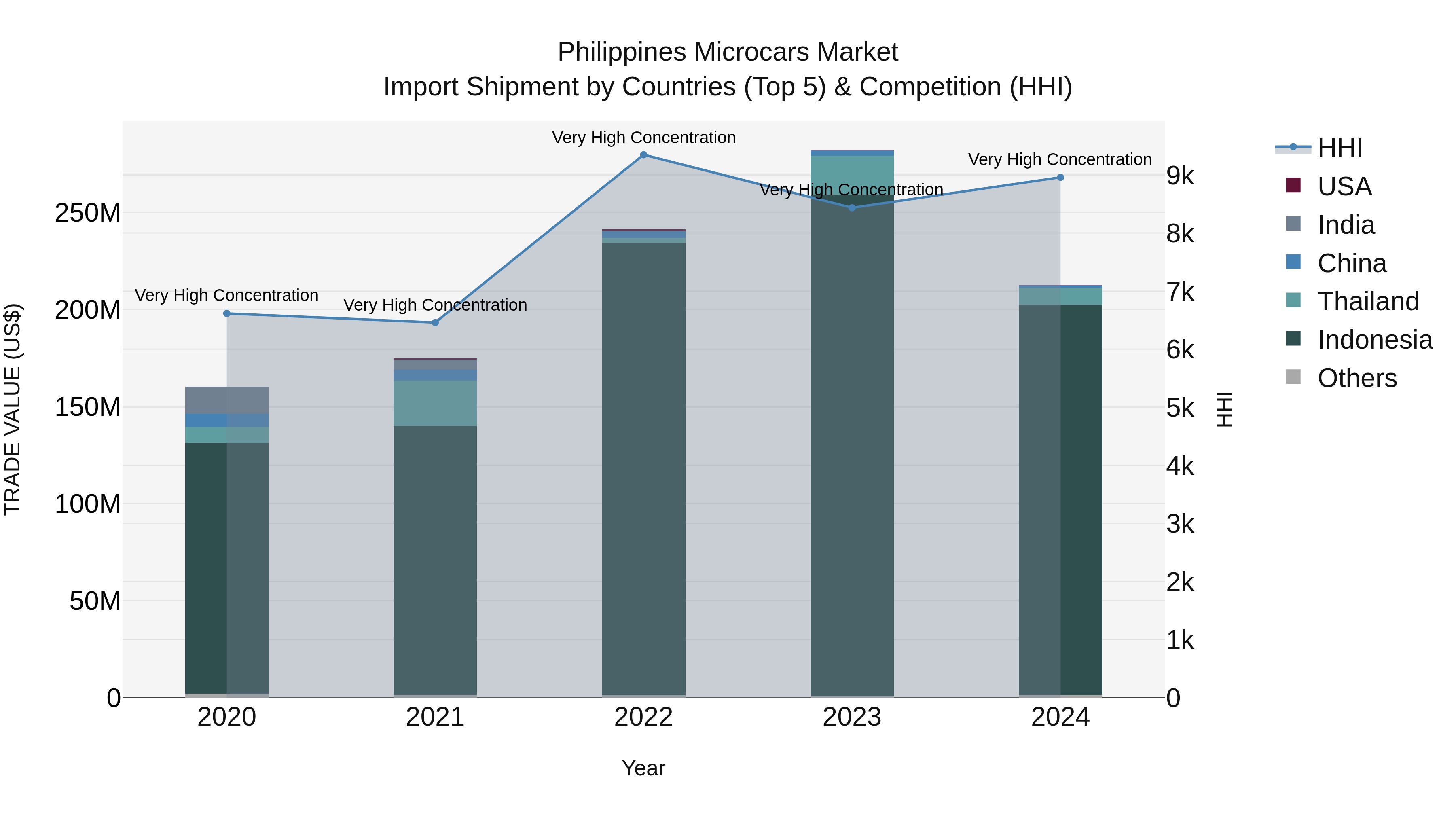
In 2024, the Philippines saw a notable increase in microcars import shipments, with top exporters being Indonesia, Thailand, China, South Korea, and the USA. Despite the high concentration in the market, indicated by the high HHI, the industry demonstrated a strong CAGR of 7.33% from 2020 to 2024. However, there was a sharp decline in growth rate from 2023 to 2024 at -24.58%, suggesting potential challenges or shifts in the market dynamics during that period. Monitoring these trends closely will be crucial for stakeholders in the microcars import sector.
Philippines Microcars Market Overview
The microcars market in the Philippines is gaining traction due to the rising need for fuel-efficient, compact, and affordable transportation solutions. Urban congestion and increasing fuel prices are driving the popularity of microcars. Government incentives promoting eco-friendly vehicles, including electric microcars, are further stimulating market growth. Consumers seeking cost-effective and convenient mobility solutions are fueling demand for microcars, making it an emerging segment in the automotive industry.
Drivers of the market
The rising urban congestion and increasing fuel prices are driving the demand for microcars in the Philippines. Consumers are looking for compact, fuel-efficient, and affordable vehicles that are easy to maneuver in crowded city streets. The push towards sustainable transportation and government initiatives promoting electric and low-emission vehicles are also contributing to the growth of this market. Additionally, advancements in battery technology and the expansion of charging infrastructure are making electric microcars more viable for Filipino consumers.
Challenges of the market
The microcars market in the Philippines struggles with limited consumer awareness and infrastructure support. High import taxes and registration restrictions make these vehicles less competitive against traditional cars. Additionally, the lack of charging infrastructure for electric microcars and concerns over safety regulations hinder market expansion.
Investment opportunities in the Market
The microcars market in the Philippines is gaining traction due to increasing urbanization, traffic congestion, and the rising demand for affordable and fuel-efficient transportation. Investment opportunities exist in manufacturing, distribution, and electric microcars, aligning with the countrys growing interest in sustainable mobility solutions. Government incentives for electric vehicles (EVs) and rising fuel prices further enhance the attractiveness of this market.
Government Policy of the market
Microcars in the Philippines fall under the regulation of the Land Transportation Office (LTO) and the Department of Trade and Industry (DTI). The government provides incentives for electric and fuel-efficient microcars through the Electric Vehicle Industry Development Act (EVIDA) to promote sustainability. Import duties on microcars are regulated to encourage local production while ensuring compliance with emission and road safety standards.
Key Highlights of the Report:
- Philippines Microcars Market Outlook
- Market Size of Philippines Microcars Market, 2024
- Forecast of Philippines Microcars Market, 2031
- Historical Data and Forecast of Philippines Microcars Revenues & Volume for the Period 2021- 2031
- Philippines Microcars Market Trend Evolution
- Philippines Microcars Market Drivers and Challenges
- Philippines Microcars Price Trends
- Philippines Microcars Porter's Five Forces
- Philippines Microcars Industry Life Cycle
- Historical Data and Forecast of Philippines Microcars Market Revenues & Volume By Type for the Period 2021- 2031
- Historical Data and Forecast of Philippines Microcars Market Revenues & Volume By One Wheel Drive for the Period 2021- 2031
- Historical Data and Forecast of Philippines Microcars Market Revenues & Volume By Two Wheel Drive for the Period 2021- 2031
- Historical Data and Forecast of Philippines Microcars Market Revenues & Volume By All Wheel Drive for the Period 2021- 2031
- Historical Data and Forecast of Philippines Microcars Market Revenues & Volume By Application for the Period 2021- 2031
- Historical Data and Forecast of Philippines Microcars Market Revenues & Volume By Passenger for the Period 2021- 2031
- Historical Data and Forecast of Philippines Microcars Market Revenues & Volume By Commercial for the Period 2021- 2031
- Historical Data and Forecast of Philippines Microcars Market Revenues & Volume By Engine Capacity for the Period 2021- 2031
- Historical Data and Forecast of Philippines Microcars Market Revenues & Volume By 100cc-250cc for the Period 2021- 2031
- Historical Data and Forecast of Philippines Microcars Market Revenues & Volume By 251cc-500cc for the Period 2021- 2031
- Historical Data and Forecast of Philippines Microcars Market Revenues & Volume By 501cc-700cc for the Period 2021- 2031
- Philippines Microcars Import Export Trade Statistics
- Market Opportunity Assessment By Type
- Market Opportunity Assessment By Application
- Market Opportunity Assessment By Engine Capacity
- Philippines Microcars Top Companies Market Share
- Philippines Microcars Competitive Benchmarking By Technical and Operational Parameters
- Philippines Microcars Company Profiles
- Philippines Microcars Key Strategic Recommendations






































