Philippines Microlearning Market Size & Growth Rate (2026-2032)
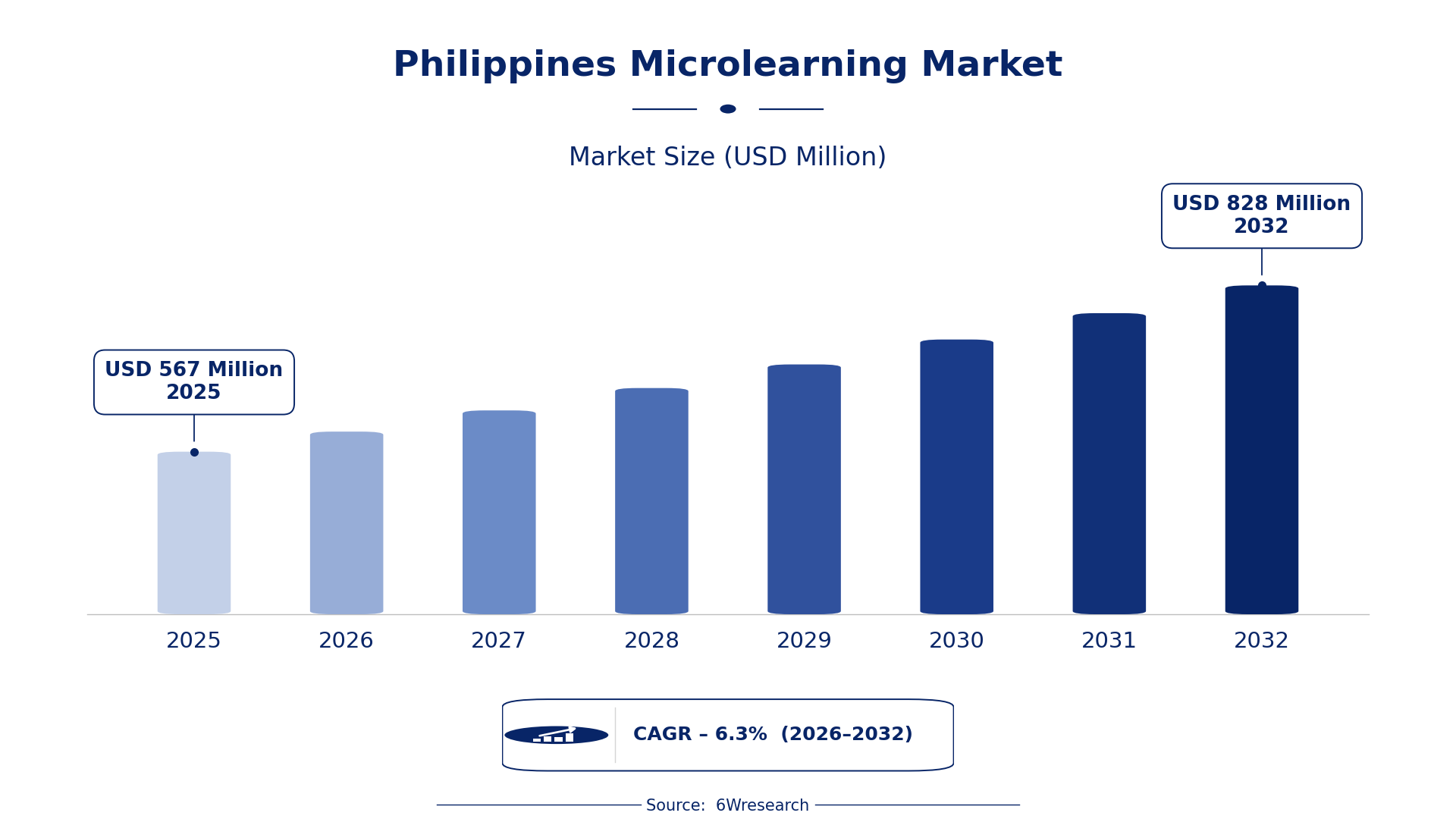
The Philippines Microlearning Market was estimated at USD 567 Million in 2025 and is projected to reach USD 828 Million by 2032, growing at a CAGR of 6.3% from 2026 to 2032.
Philippines Microlearning Market Synopsis
The rapid shift towards remote work and digital learning has become the strongest force shaping the Philippines Microlearning Market. Organizations across various sectors are increasingly adopting microlearning as a strategic approach to meet their training needs, especially in an era where time and attention are at a premium.
As a result, microlearning is being leveraged for both employee upskilling and student engagement. This method of training allows for immediate application of knowledge, which is essential in a competitive job market where continuous learning is key to success.
Philippines Microlearning Market Year-wise Growth Rate and Key Drivers
This graph illustrates the annual growth rates of the Philippines Microlearning Market from 2021 to 2032, highlighting a steady upward trajectory and projected expansion over the forecast period.
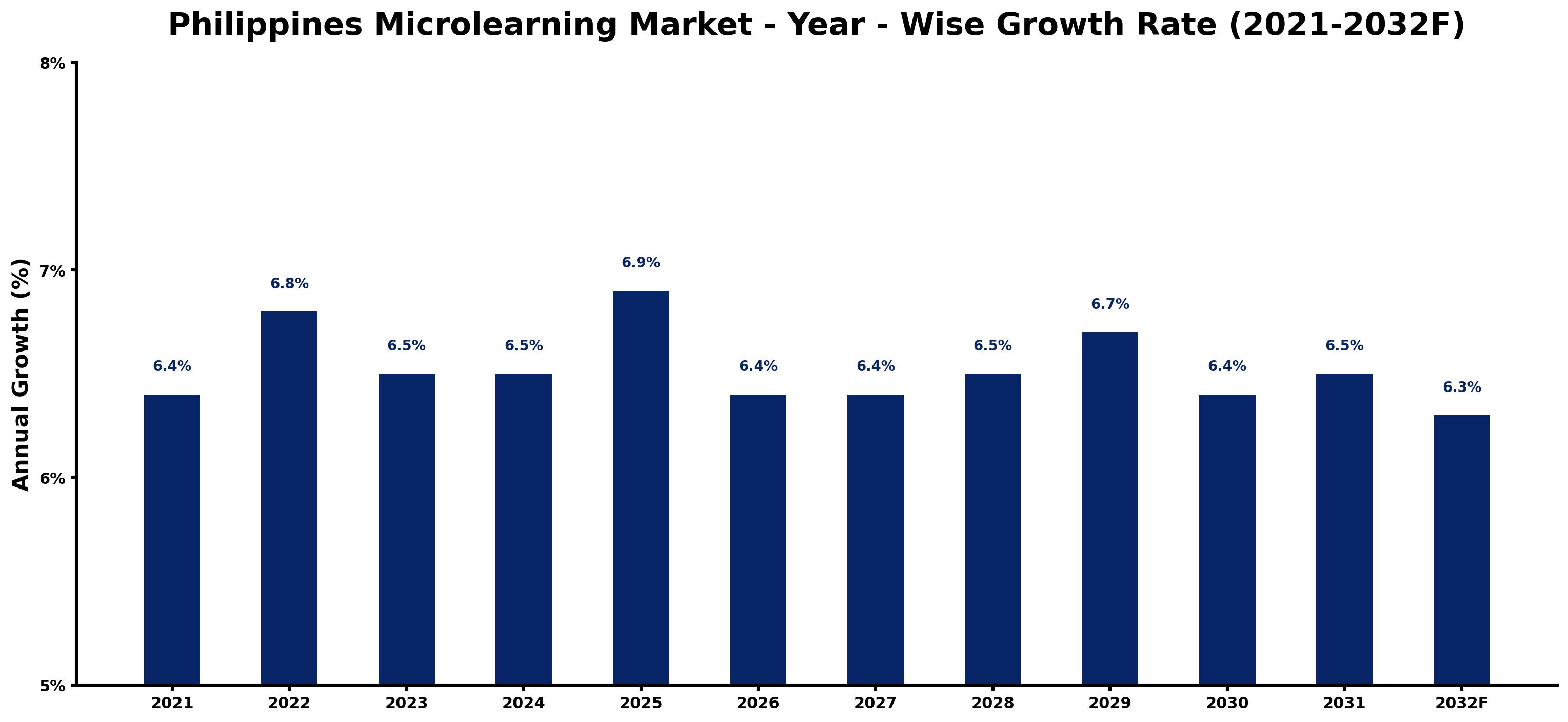
The table below presents the year‑wise growth rates along with the key drivers influencing the market
| Year | Growth Rate | Major Drivers |
| 2021 | 6.4% | Increased smartphone penetration among Filipino learners. |
| 2022 | 6.8% | Government's push for digital learning in schools. |
| 2023 | 6.5% | Emergence of local microlearning platforms addressing skills gap. |
| 2024 | 6.5% | Strong growth in online content consumption trends. |
| 2025 | 6.9% | Partnerships between universities and e-learning providers. |
| 2026 | 6.4% | Corporate training programs adopting microlearning strategies. |
| 2027 | 6.4% | Focus on reskilling due to economic recovery post-pandemic. |
| 2028 | 6.5% | Rising popularity of gamified learning experiences. |
| 2029 | 6.7% | Increase in remote work driving digital learning adoption. |
| 2030 | 6.4% | Support from Department of Education for microlearning initiatives. |
| 2031 | 6.5% | Growing collaboration with international edtech firms. |
| 2032 | 6.3% | Youth demographic driving demand for flexible learning options. |
Note: Market size estimations and growth projections presented in this report are based on 6Wresearch's proprietary forecasting methodology, utilizing the latest available industry data, government publications, and primary research inputs.
Philippines Microlearning Market Key Takeaways
Below are some of the specific key takeaways from the market, including:
- The growing preference for bite-sized learning modules is driving demand across industries.
- Accessibility and quality of content remain crucial factors for successful microlearning implementations.
- Investments in technology and digital infrastructure are facilitating the expansion of microlearning platforms.
- Collaboration between educational institutions and businesses is enhancing the effectiveness of training programs.
- The COVID-19 pandemic has accelerated the shift towards online learning solutions, strengthening the microlearning trend.
Evaluation of Restraints in Philippines Microlearning Market
Despite its rapid growth, the Philippines Microlearning Market faces notable challenges. A primary concern is the quality of content. Many organizations struggle to create engaging and relevant material that resonates with the local workforce. This can lead to a lack of engagement and ineffective learning experiences. Additionally, accessibility issues pose a barrier, particularly for employees in remote areas with limited internet connectivity. Addressing these issues is essential for maximizing the potential of microlearning in the Philippines.
Philippines Microlearning Market Trends
A few trends are emerging that are shaping the future of microlearning in the Philippines. First, mobile learning is gaining traction as more employees prefer accessing training content on their smartphones. Second, the use of gamification techniques in microlearning is increasing, as organizations seek to enhance engagement through interactive and entertaining content. Lastly, data analytics are becoming more integral, allowing organizations to tailor learning experiences based on user performance and preferences.
Philippines Microlearning Market Opportunities
There are substantial opportunities for growth in the Philippines Microlearning Market. Companies can benefit from investing in customized microlearning solutions that cater to specific industry needs. Educational institutions can explore partnerships with technology providers to enhance their curricula with effective microlearning modules. on top of that, as remote work becomes more prevalent, the demand for flexible, on-the-go learning solutions will only intensify, presenting a ripe opportunity for market players.
Government Initiatives in the Philippines Microlearning Market
The Philippine government is actively promoting digital education and training initiatives, which significantly impacts the Microlearning Market. Current policies prioritize enhancing educational technology infrastructure and expanding access to digital learning resources. These initiatives are essential for creating a conducive environment for microlearning to thrive in various sectors.
- A recently completed initiative involved the rollout of digital learning resources in public schools to support remote education during the pandemic.
- Currently, the government is implementing a national digital skills training program aimed at equipping the workforce with necessary competencies in technology and online learning.
- Planned initiatives include the establishment of public-private partnerships to develop comprehensive training platforms that leverage microlearning techniques by 2026.
- A regulatory framework focused on enhancing data privacy and security in e-learning platforms is also in the works, expected to be introduced in 2025.
Future Insights of the Philippines Microlearning Market
Looking ahead to 2026-2032, the Philippines Microlearning Market is set for substantial growth. As organizations increasingly recognize the need for agile learning solutions, microlearning will likely become a standard approach in both corporate training and education. The integration of advanced technologies, such as artificial intelligence and adaptive learning systems, will further enhance the effectiveness of microlearning strategies, making them more personalized and impactful.
Philippines Microlearning Market Latest Developments
In the last 12-14 months, the Philippines Microlearning Market has seen a surge in activity driven by the demand for innovative training solutions. Organizations are rapidly adopting microlearning to adapt to evolving workforce needs and preferences. Key developments include partnerships between educational institutions and technology providers aimed at enhancing learning experiences through microlearning.
- A major technology vendor launched a new microlearning platform in Q3 2025, designed specifically for corporate training programs.
- In mid-2025, a leading regional operator initiated a project to integrate gamification elements into existing microlearning content, enhancing user engagement.
- A public-private initiative focused on digital literacy began in early 2025, aiming to provide targeted microlearning resources for underserved communities.
- Upcoming plans for late 2026 include a comprehensive training program aimed at upskilling employees in the hospitality sector using microlearning techniques.
Philippines Microlearning Market - Key Attractiveness of the Report
- 10 Years of Market Numbers
- Historical Data Starting from 2022 to 2025
- Base Year: 2025
- Forecast Data until 2032
- Key Performance Indicators Impacting the Market
- Major Upcoming Developments and Projects
Key Highlights of the Report:
- Philippines Microlearning Market Outlook
- Market Size of Philippines Microlearning Market, 2025
- Forecast of Philippines Microlearning Market, 2032
- Historical Data and Forecast of Philippines Microlearning Revenues & Volume for the Period 2022-2032F
- Philippines Microlearning Market Trend Evolution
- Philippines Microlearning Market Drivers and Challenges
- Philippines Microlearning Price Trends
- Philippines Microlearning Porter's Five Forces
- Philippines Microlearning Industry Life Cycle
- Historical Data and Forecast of Philippines Microlearning Market Revenues & Volume By Component for the Period 2022-2032F
- Historical Data and Forecast of Philippines Microlearning Market Revenues & Volume By Solution for the Period 2022-2032F
- Historical Data and Forecast of Philippines Microlearning Market Revenues & Volume By Services for the Period 2022-2032F
- Historical Data and Forecast of Philippines Microlearning Market Revenues & Volume By Industry for the Period 2022-2032F
- Historical Data and Forecast of Philippines Microlearning Market Revenues & Volume By Retail for the Period 2022-2032F
- Historical Data and Forecast of Philippines Microlearning Market Revenues & Volume By Manufacturing for the Period 2022-2032F
- Historical Data and Forecast of Philippines Microlearning Market Revenues & Volume By Logistics for the Period 2022-2032F
- Historical Data and Forecast of Philippines Microlearning Market Revenues & Volume By BFSI for the Period 2022-2032F
- Historical Data and Forecast of Philippines Microlearning Market Revenues & Volume By Telecom for the Period 2022-2032F
- Historical Data and Forecast of Philippines Microlearning Market Revenues & Volume By IT for the Period 2022-2032F
- Historical Data and Forecast of Philippines Microlearning Market Revenues & Volume By Healthcare for the Period 2022-2032F
- Historical Data and Forecast of Philippines Microlearning Market Revenues & Volume By Life Sciences for the Period 2022-2032F
- Historical Data and Forecast of Philippines Microlearning Market Revenues & Volume By Deployment Type for the Period 2022-2032F
- Historical Data and Forecast of Philippines Microlearning Market Revenues & Volume By On-Premises for the Period 2022-2032F
- Historical Data and Forecast of Philippines Microlearning Market Revenues & Volume By Cloud for the Period 2022-2032F
- Historical Data and Forecast of Philippines Microlearning Market Revenues & Volume By Organization Size for the Period 2022-2032F
- Historical Data and Forecast of Philippines Microlearning Market Revenues & Volume By SMEs for the Period 2022-2032F
- Historical Data and Forecast of Philippines Microlearning Market Revenues & Volume By Large Enterprises for the Period 2022-2032F
- Philippines Microlearning Import Export Trade Statistics
- Market Opportunity Assessment By Component
- Market Opportunity Assessment By Industry
- Market Opportunity Assessment By Deployment Type
- Market Opportunity Assessment By Organization Size
- Philippines Microlearning Top Companies Market Share
- Philippines Microlearning Competitive Benchmarking By Technical and Operational Parameters
- Philippines Microlearning Company Profiles
- Philippines Microlearning Key Strategic Recommendations






































