Philippines Monodose Packs Market Top 5 Importing Countries and Market Competition (HHI) Analysis
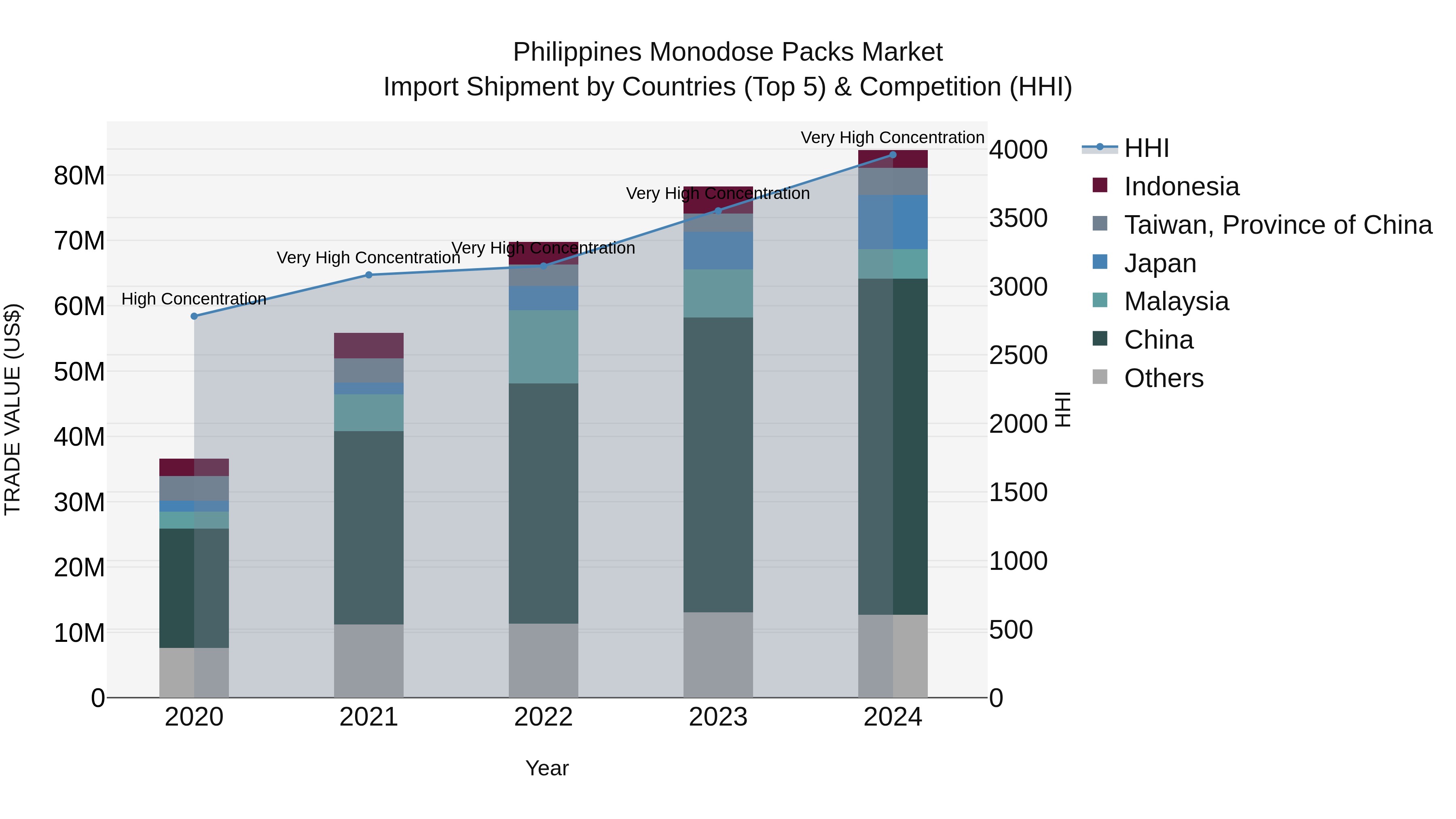
The Philippines continues to see a significant influx of monodose packs import shipments, with key exporters in 2024 including China, Japan, Malaysia, Taiwan, Province of China, and Indonesia. The high Herfindahl-Hirschman Index (HHI) indicates a concentrated market, emphasizing the dominance of these top exporting countries. The impressive compound annual growth rate (CAGR) of 23.0% from 2020 to 2024 highlights the robust expansion of this market segment. Moreover, the growth rate of 7.1% in 2024 suggests continued momentum and opportunities for stakeholders in the monodose packs sector.
Philippines Monodose Packs Market Overview
The demand for monodose packs in the Philippines is increasing, particularly in the pharmaceutical, personal care, and food & beverage industries. These single-use packaging solutions enhance product safety, convenience, and dosage accuracy. The rising trend of on-the-go consumption and consumer preference for hygienic packaging solutions contribute to market expansion.
Drivers of the market
The growing demand for convenient and single-use packaging solutions in pharmaceuticals, cosmetics, and food products is driving the monodose packs market. The rise of on-the-go consumption trends and increasing preference for hygienic packaging have fueled market expansion. Additionally, pharmaceutical companies are leveraging monodose formats to enhance patient compliance and dosage accuracy.
Challenges of the market
The Monodose Packs Market faces difficulties in terms of sustainability concerns, as single-use packaging is increasingly being discouraged. High production costs and the need for specialized machinery for filling and sealing monodose packs add to expenses. Additionally, competition from bulk and reusable packaging solutions poses a challenge to market growth.
Investment opportunities in the Market
The demand for convenient, single-use packaging solutions is increasing across pharmaceuticals, personal care, and food industries in the Philippines. Monodose packs offer advantages such as precise dosage, extended shelf life, and improved portability. Investors can explore manufacturing and distribution opportunities for monodose packaging solutions, particularly in sectors focusing on hygiene, travel, and medication compliance.
Government Policy of the market
The production and distribution of monodose packaging are regulated under the FDAs pharmaceutical and consumer goods standards. The government encourages the use of monodose packaging in healthcare settings to enhance drug administration accuracy and minimize contamination risks. Regulations are also in place to ensure the sustainability of packaging materials, aligning with environmental protection initiatives. Incentives for local manufacturers producing eco-friendly monodose packaging are being considered to support the domestic packaging industry.
Key Highlights of the Report:
- Philippines Monodose Packs Market Outlook
- Market Size of Philippines Monodose Packs Market, 2024
- Forecast of Philippines Monodose Packs Market, 2031
- Historical Data and Forecast of Philippines Monodose Packs Revenues & Volume for the Period 2021- 2031
- Philippines Monodose Packs Market Trend Evolution
- Philippines Monodose Packs Market Drivers and Challenges
- Philippines Monodose Packs Price Trends
- Philippines Monodose Packs Porter's Five Forces
- Philippines Monodose Packs Industry Life Cycle
- Historical Data and Forecast of Philippines Monodose Packs Market Revenues & Volume By Packaging Type for the Period 2021- 2031
- Historical Data and Forecast of Philippines Monodose Packs Market Revenues & Volume By Sachets for the Period 2021- 2031
- Historical Data and Forecast of Philippines Monodose Packs Market Revenues & Volume By Blister Packs for the Period 2021- 2031
- Historical Data and Forecast of Philippines Monodose Packs Market Revenues & Volume By Ampoules for the Period 2021- 2031
- Historical Data and Forecast of Philippines Monodose Packs Market Revenues & Volume By Mini-tubes & Mini-jars for the Period 2021- 2031
- Historical Data and Forecast of Philippines Monodose Packs Market Revenues & Volume By Stick Packs for the Period 2021- 2031
- Historical Data and Forecast of Philippines Monodose Packs Market Revenues & Volume By Vials for the Period 2021- 2031
- Historical Data and Forecast of Philippines Monodose Packs Market Revenues & Volume By Material for the Period 2021- 2031
- Historical Data and Forecast of Philippines Monodose Packs Market Revenues & Volume By Plastic for the Period 2021- 2031
- Historical Data and Forecast of Philippines Monodose Packs Market Revenues & Volume By Aluminium for the Period 2021- 2031
- Historical Data and Forecast of Philippines Monodose Packs Market Revenues & Volume By Glass for the Period 2021- 2031
- Historical Data and Forecast of Philippines Monodose Packs Market Revenues & Volume By Paper & Paperboard for the Period 2021- 2031
- Philippines Monodose Packs Import Export Trade Statistics
- Market Opportunity Assessment By Packaging Type
- Market Opportunity Assessment By Material
- Philippines Monodose Packs Top Companies Market Share
- Philippines Monodose Packs Competitive Benchmarking By Technical and Operational Parameters
- Philippines Monodose Packs Company Profiles
- Philippines Monodose Packs Key Strategic Recommendations






































