Philippines Music Toys Market Size, Share & Growth Rate
The Philippines Music Toys Market was estimated at USD 119 Million in 2025 and is projected to reach USD 129 Million by 2032, growing at a CAGR of 1.2% from 2026 to 2032. This growth trajectory is underpinned by the rising disposable income of Filipino families, coupled with a burgeoning middle class that increasingly values music education as part of quality upbringing. Urbanization plays a crucial role as well, with young consumers gravitating towards innovative, high-quality music toys that enhance their musical experiences.
Philippines Music Toys Market Year-wise Growth Rate and Key Drivers
This graph highlights how the Philippines Music Toys Market has steadily grown over the years, supported by major growth factors.
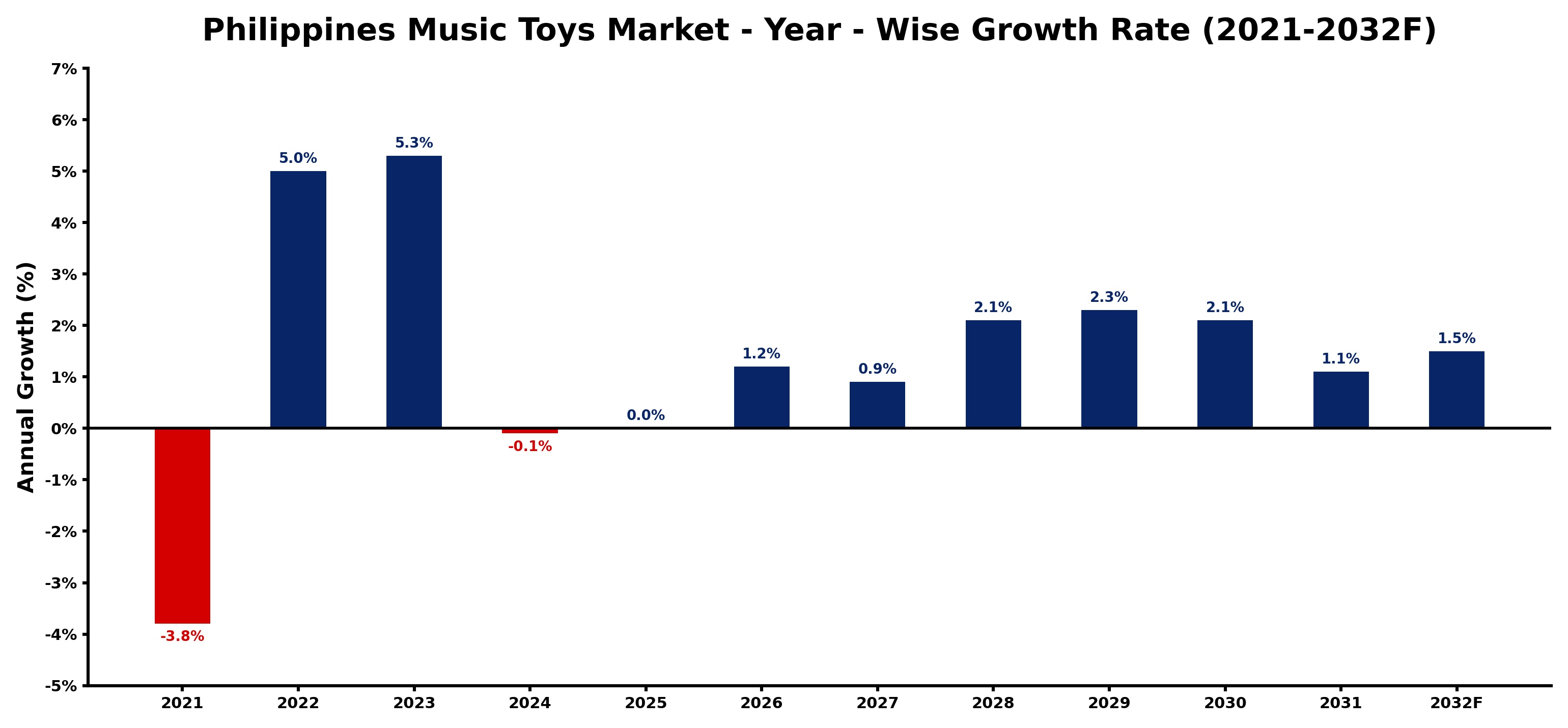
The table below presents the year‑wise growth rates along with the key drivers influencing the market
| Year | Growth Rate | Major Drivers |
| 2021 | -3.8% | Growing urbanization and commercial development |
| 2022 | 5.0% | Increasing industrial automation investments |
| 2023 | 5.3% | Growing renewable energy integration projects |
| 2024 | -0.1% | Increasing industrial infrastructure investments |
| 2025 | 0.0% | Increasing smart city development projects |
| 2026 | 1.2% | Rising electricity demand across industries |
| 2027 | 0.9% | Increasing smart city development projects |
| 2028 | 2.1% | Increasing smart city development projects |
| 2029 | 2.3% | Increasing industrial automation investments |
| 2030 | 2.1% | Rapid growth in telecom and data center sectors |
| 2031 | 1.1% | Rising electricity demand across industries |
| 2032 | 1.5% | Expansion of transportation and logistics networks |
Note - Market size estimations and growth projections presented in this report are based on 6Wresearch's advanced forecasting approach, validated with industry datasets as of June 2026.
Philippines Music Toys Market Synopsis
The growing popularity of musical instruments among children in the Philippines is noteworthy, with families emphasizing the benefits of music in early education. Music toys are not only fun but serve as tools for cognitive development, creativity, and social interaction among children, making them highly sought after.
Furthermore, manufacturers are responding to this demand with innovative designs and features that capture the attention of both children and parents. This trend indicates that the market is not only expanding but is also becoming increasingly sophisticated, catering to varied consumer preferences and aspirations.
Philippines Music Toys Market Key Takeaways
- Increasing disposable income is significantly driving the demand for music toys among Filipino families.
- Urbanization and a rising number of young consumers are key factors in the market's expansion.
- Innovation in product features and designs is enhancing consumer interest and engagement.
- Middle-class families prioritize music education, boosting the market for high-quality music toys.
- While there are growth drivers, affordability remains a crucial challenge for many potential buyers.
Evaluation of Restraints in Philippines Music Toys Market
Despite the optimistic growth outlook, the Philippines Music Toys Market faces significant restraints primarily related to affordability. The high cost of quality music toys can deter a considerable segment of the population, particularly in lower-income brackets. This affordability gap is compounded by limited access to financing options, which restricts purchasing capabilities. As a result, while the upper middle class may drive demand, a large portion of the market remains untapped due to economic constraints.
Philippines Music Toys Market Trends
Current trends in the Philippines Music Toys Market show a clear shift towards digital integration, with products that incorporate technology to enhance learning experiences. Interactive music toys, which provide feedback and promote active participation, are gaining traction. Additionally, eco-friendly and sustainable materials are becoming increasingly important to consumers who are conscious of environmental impacts. This focus on sustainability may offer a competitive advantage to manufacturers willing to innovate in this area.
Philippines Music Toys Market Opportunities
The market presents various opportunities for growth, particularly in developing educational toys that blend play with music education. Collaborations between toy manufacturers and educational institutions could yield products that align with learning objectives, potentially gaining traction in schools and extracurricular programs. Moreover, targeting digital platforms for marketing and sales can help reach a broader audience, tapping into the tech-savvy youth and their parents.
Government Initiatives in the Philippines Music Toys Market
The Philippine government has been actively promoting arts and culture, which extends to music education. Initiatives that support music programs in schools, as well as public spending on educational resources, are likely to benefit the music toys market. Additionally, policies encouraging the production of locally manufactured toys could boost industry growth and job creation, aligning with national economic goals.
Future Insights of the Philippines Music Toys Market
Looking ahead to 2026-2032, the Philippines Music Toys Market is poised for gradual expansion driven by increasing awareness of the importance of music in child development. As more families seek quality education for their children, the demand for music-related products is expected to rise. Additionally, innovations in product development, alongside shifts towards sustainability and technology integration, will likely shape the future landscape of this market, creating an ecosystem that supports both learning and fun.
Philippines Music Toys Market Latest Developments (May 2025 - June 2026)
Recent developments in the market indicate a heightened focus on eco-friendly materials, with several companies launching new lines that prioritize sustainability. Additionally, collaborations with educators are emerging, where manufacturers are designing toys that align with educational curricula, further bridging the gap between learning and play. Technological advancements are also being integrated into music toys, enhancing interactivity and user experience.
Philippines Music Toys Market - Key Attractiveness of the Report
- 10 Years of Market Numbers
- Historical Data Starting from 2022 to 2025
- Base Year: 2025
- Forecast Data until 2032
- Key Performance Indicators Impacting the Market
- Major Upcoming Developments and Projects
Key Highlights of the Report:
- Philippines Music Toys Market Outlook
- Market Size of Philippines Music Toys Market, 2025
- Forecast of Philippines Music Toys Market, 2032
- Historical Data and Forecast of Philippines Music Toys Revenues & Volume for the Period 2022-2032F
- Philippines Music Toys Market Trend Evolution
- Philippines Music Toys Market Drivers and Challenges
- Philippines Music Toys Price Trends
- Philippines Music Toys Porter's Five Forces
- Philippines Music Toys Industry Life Cycle
- Historical Data and Forecast of Philippines Music Toys Market Revenues & Volume By Type for the Period 2022-2032F
- Historical Data and Forecast of Philippines Music Toys Market Revenues & Volume By Drums & Percussion for the Period 2022-2032F
- Historical Data and Forecast of Philippines Music Toys Market Revenues & Volume By Guitars & Strings for the Period 2022-2032F
- Historical Data and Forecast of Philippines Music Toys Market Revenues & Volume By Pianos & Keyboards for the Period 2022-2032F
- Historical Data and Forecast of Philippines Music Toys Market Revenues & Volume By Wind & Brass for the Period 2022-2032F
- Historical Data and Forecast of Philippines Music Toys Market Revenues & Volume By Others for the Period 2022-2032F
- Historical Data and Forecast of Philippines Music Toys Market Revenues & Volume By Age for the Period 2022-2032F
- Historical Data and Forecast of Philippines Music Toys Market Revenues & Volume By Below 1 Year for the Period 2022-2032F
- Historical Data and Forecast of Philippines Music Toys Market Revenues & Volume By 1??3 Years for the Period 2022-2032F
- Historical Data and Forecast of Philippines Music Toys Market Revenues & Volume By 3??5 Year for the Period 2022-2032F
- Historical Data and Forecast of Philippines Music Toys Market Revenues & Volume By 5??7 Years for the Period 2022-2032F
- Historical Data and Forecast of Philippines Music Toys Market Revenues & Volume By 7??9 Years for the Period 2022-2032F
- Historical Data and Forecast of Philippines Music Toys Market Revenues & Volume By Above 9 Years for the Period 2022-2032F
- Historical Data and Forecast of Philippines Music Toys Market Revenues & Volume By Distribution Channel for the Period 2022-2032F
- Historical Data and Forecast of Philippines Music Toys Market Revenues & Volume By Online Channel for the Period 2022-2032F
- Historical Data and Forecast of Philippines Music Toys Market Revenues & Volume By Offline Channel for the Period 2022-2032F
- Philippines Music Toys Import Export Trade Statistics
- Market Opportunity Assessment By Type
- Market Opportunity Assessment By Age
- Market Opportunity Assessment By Distribution Channel
- Philippines Music Toys Top Companies Market Share
- Philippines Music Toys Competitive Benchmarking By Technical and Operational Parameters
- Philippines Music Toys Company Profiles
- Philippines Music Toys Key Strategic Recommendations






































