Philippines MVNO Market Size & Growth Rate (2026-2032)
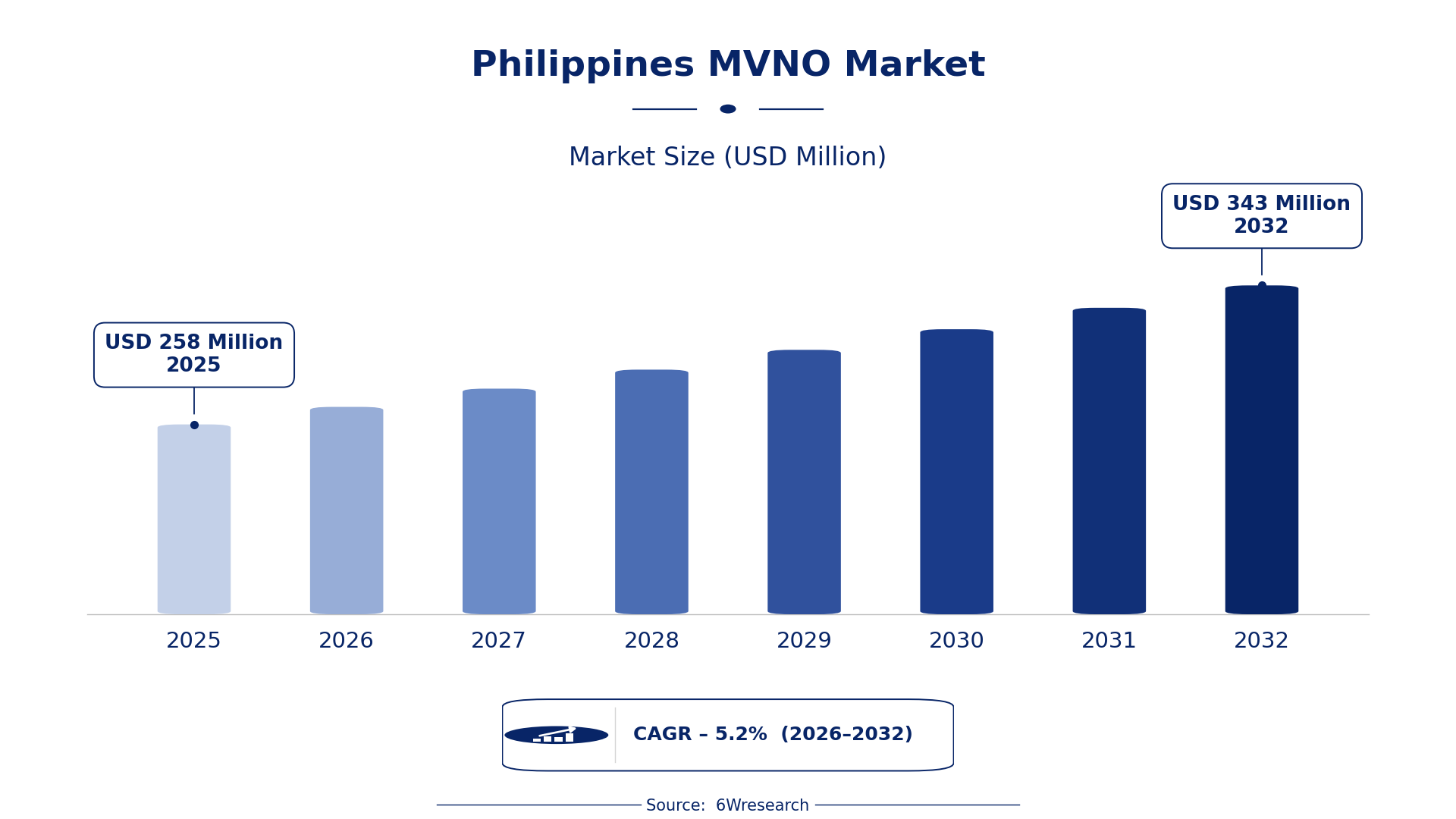
The Philippines MVNO Market was estimated at USD 258 Million in 2025 and is projected to reach USD 343 Million by 2032, growing at a CAGR of 5.2% from 2026 to 2032.
Philippines MVNO Market Synopsis
The Philippines MVNO Market is currently experiencing a surge as operators tap into the existing infrastructure of major telecommunications companies. This model enables new entrants to provide competitive pricing and tailored services without the hefty investment in physical network assets.
As digital consumption continues to rise, MVNOs are increasingly appealing to niche segments, offering specialized plans that cater to unique consumer needs. This adaptability is crucial in a market where consumer preferences are rapidly changing.
Philippines MVNO Market Year-wise Growth Rate and Key Drivers
This graph illustrates the annual growth rates of the Philippines MVNO Market from 2021 to 2032, highlighting a steady upward trajectory and projected expansion over the forecast period.
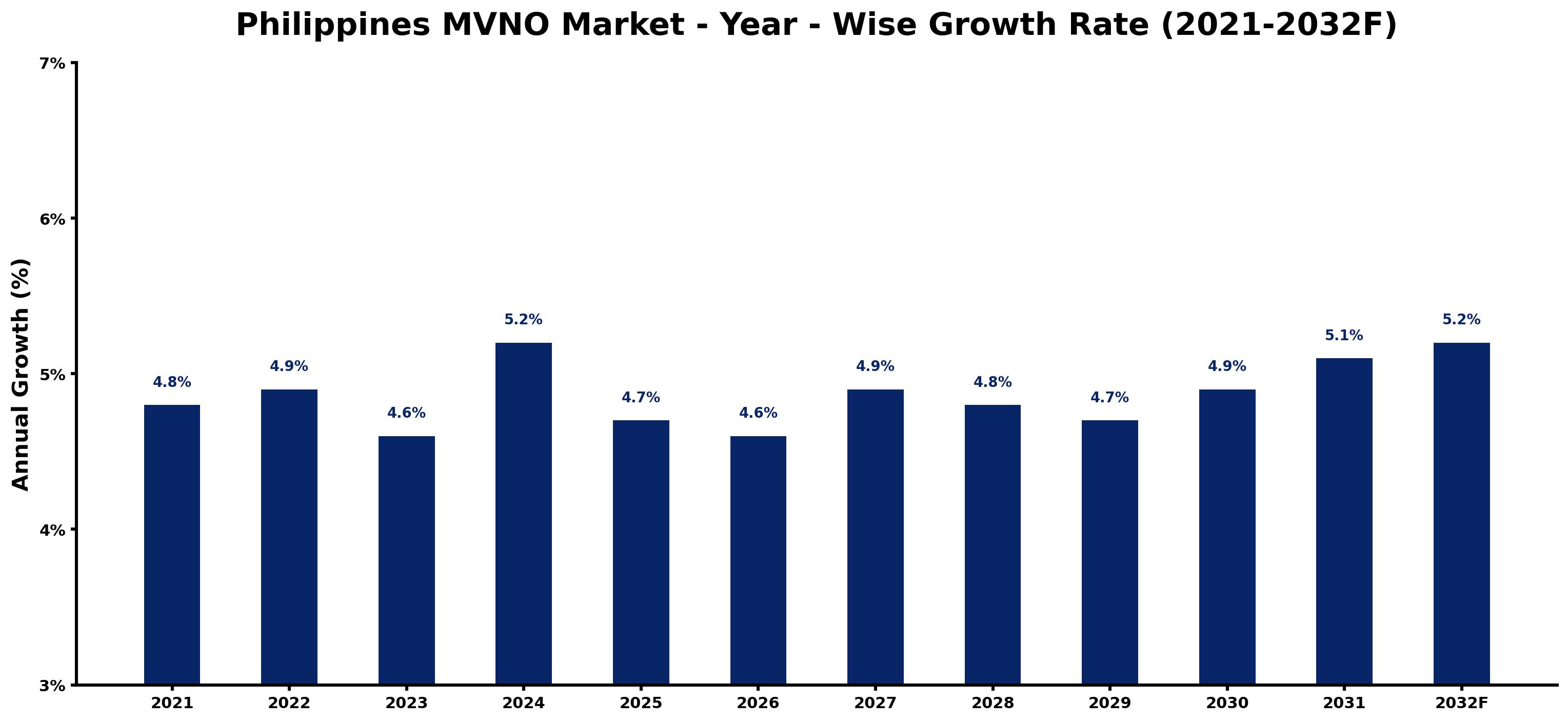
The table below presents the year‑wise growth rates along with the key drivers influencing the market
| Year | Growth Rate | Major Drivers |
| 2021 | 4.8% | Dito Telecommunity's launch increased competitive dynamics. |
| 2022 | 4.9% | Regulatory support for new entrants enhanced market accessibility. |
| 2023 | 4.6% | Rising mobile data consumption pushed demand for alternatives. |
| 2024 | 5.2% | Government initiatives promoted broadband access in underserved areas. |
| 2025 | 4.7% | Increased smartphone penetration drove user base expansion. |
| 2026 | 4.6% | New MVNO partnerships bolstered service offerings and reach. |
| 2027 | 4.9% | Growing youth demographic favored affordable mobile services. |
| 2028 | 4.8% | Enhanced digital payment solutions spurred MVNO uptake. |
| 2029 | 4.7% | 5G rollout created demand for innovative mobile plans. |
| 2030 | 4.9% | Effective consumer protection laws boosted market confidence. |
| 2031 | 5.1% | Shift towards flexible data plans attracted new subscribers. |
| 2032 | 5.2% | Increased e-commerce reliance stimulated mobile service growth. |
Note: Market size estimations and growth projections presented in this report are based on 6Wresearch's proprietary forecasting methodology, utilizing the latest available industry data, government publications, and primary research inputs.
Philippines MVNO Market Key Takeaways
Below are some of the specific key takeaways from the market, including:
- The entry of new MVNOs is intensifying competition among providers.
- Regulatory frameworks are evolving to better accommodate MVNO operations.
- Consumer demand for personalized mobile services is driving innovation.
- Partnerships between MVNOs and local businesses are on the rise.
- Technological advancements are enabling enhanced service offerings.
Evaluation of Restraints in Philippines MVNO Market
Despite the growth, the Philippines MVNO Market faces notable restraints. High competition presents challenges for differentiation among service offerings, particularly as new players enter the field. Regulatory complexities also pose hurdles, with MVNOs needing to navigate agreements with established MNOs while ensuring compliance with evolving policies. This environment can stifle rapid growth and innovation, creating uncertainty for newcomers looking to make an impact.
Philippines MVNO Market Trends
The shift toward digital services is reshaping the MVNO landscape in the Philippines. Consumers are gravitating towards flexible plans that allow them to customize their mobile experiences. Additionally, there is a growing trend of bundling services, where MVNOs offer value-added services alongside traditional mobile plans.
Sustainability is also gaining traction, with MVNOs exploring eco-friendly practices to appeal to environmentally conscious consumers. This trend not only enhances brand loyalty but positions MVNOs as responsible players in the telecommunications sector.
Philippines MVNO Market Opportunities
There are ample growth opportunities for MVNOs in the Philippines, particularly in underserved regions where access to mobile services is limited. Expanding into these markets can drive customer acquisition and revenue growth. on top of that, the rise of e-commerce provides a fertile ground for MVNOs to collaborate with online platforms, creating unique service bundles that cater to digital-savvy consumers.
The ongoing push for digital transformation in various sectors further opens doors for MVNOs to integrate their services into broader digital ecosystems, solidifying their role as essential players in the telecommunications market.
Government Initiatives in the Philippines MVNO Market
Government policies are increasingly shaping the dynamics of the Philippines MVNO Market. The regulatory framework is evolving to create a more conducive environment for MVNO operations, reflecting the government's commitment to enhancing telecommunications access. These initiatives are crucial for driving competition and improving service quality across the sector.
- A national digital infrastructure upgrade programme launched in 2024 aims to improve mobile connectivity nationwide.
- Currently, there is an ongoing initiative to streamline regulatory processes for MVNO licensing, expected to conclude in early 2025.
- A planned public-private partnership initiative is set to expand telecommunications infrastructure access by 2028.
- In 2023, the government introduced a regulatory framework mandating billing transparency, enhancing consumer trust.
Future Insights of the Philippines MVNO Market
Looking ahead to 2026-2032, the Philippines MVNO Market is likely to witness sustained growth as consumer demand for flexible and affordable mobile services continues. The interplay between technological advancements and evolving consumer preferences will dictate market dynamics. Additionally, as regulatory frameworks stabilize, new entrants will find it easier to establish themselves, fostering a competitive environment that benefits consumers.
Philippines MVNO Market Latest Developments
In the last year, the Philippines MVNO Market has seen a flurry of activities, with operators rolling out innovative services to capture market share. The focus has been on enhancing customer experience and expanding service offerings to meet diverse consumer needs.
- A major regional operator launched a new mobile plan in late 2023, targeting young professionals with tailored data packages.
- An ongoing partnership between an MVNO and a local fintech company aims to integrate mobile payments into their service offerings, enhancing convenience for users.
- A rollout expected in early 2025 will introduce 5G services by a key MVNO, positioning them as a leader in next-generation connectivity.
- A recent initiative announced in Q4 2023 focuses on improving customer support services through AI-driven chatbots, set to be implemented by mid-2024.
Philippines MVNO Market - Key Attractiveness of the Report
- 10 Years of Market Numbers
- Historical Data Starting from 2022 to 2025
- Base Year: 2025
- Forecast Data until 2032
- Key Performance Indicators Impacting the Market
- Major Upcoming Developments and Projects
Key Highlights of the Report:
- Philippines MVNO Market Outlook
- Market Size of Philippines MVNO Market, 2025
- Forecast of Philippines MVNO Market, 2032
- Historical Data and Forecast of Philippines MVNO Revenues & Volume for the Period 2022-2032F
- Philippines MVNO Market Trend Evolution
- Philippines MVNO Market Drivers and Challenges
- Philippines MVNO Price Trends
- Philippines MVNO Porter's Five Forces
- Philippines MVNO Industry Life Cycle
- Historical Data and Forecast of Philippines MVNO Market Revenues & Volume By Operational Model for the Period 2022-2032F
- Historical Data and Forecast of Philippines MVNO Market Revenues & Volume By Reseller for the Period 2022-2032F
- Historical Data and Forecast of Philippines MVNO Market Revenues & Volume By Service Operator for the Period 2022-2032F
- Historical Data and Forecast of Philippines MVNO Market Revenues & Volume By Full MVNO for the Period 2022-2032F
- Historical Data and Forecast of Philippines MVNO Market Revenues & Volume By Organization Size for the Period 2022-2032F
- Historical Data and Forecast of Philippines MVNO Market Revenues & Volume By SMES for the Period 2022-2032F
- Historical Data and Forecast of Philippines MVNO Market Revenues & Volume By Large Enterprise for the Period 2022-2032F
- Historical Data and Forecast of Philippines MVNO Market Revenues & Volume By Subscriber for the Period 2022-2032F
- Historical Data and Forecast of Philippines MVNO Market Revenues & Volume By Consumer for the Period 2022-2032F
- Historical Data and Forecast of Philippines MVNO Market Revenues & Volume By Enterprise for the Period 2022-2032F
- Philippines MVNO Import Export Trade Statistics
- Market Opportunity Assessment By Operational Model
- Market Opportunity Assessment By Organization Size
- Market Opportunity Assessment By Subscriber
- Philippines MVNO Top Companies Market Share
- Philippines MVNO Competitive Benchmarking By Technical and Operational Parameters
- Philippines MVNO Company Profiles
- Philippines MVNO Key Strategic Recommendations






































