Philippines Network as a Service Market Size & Growth Rate (2026-2032)
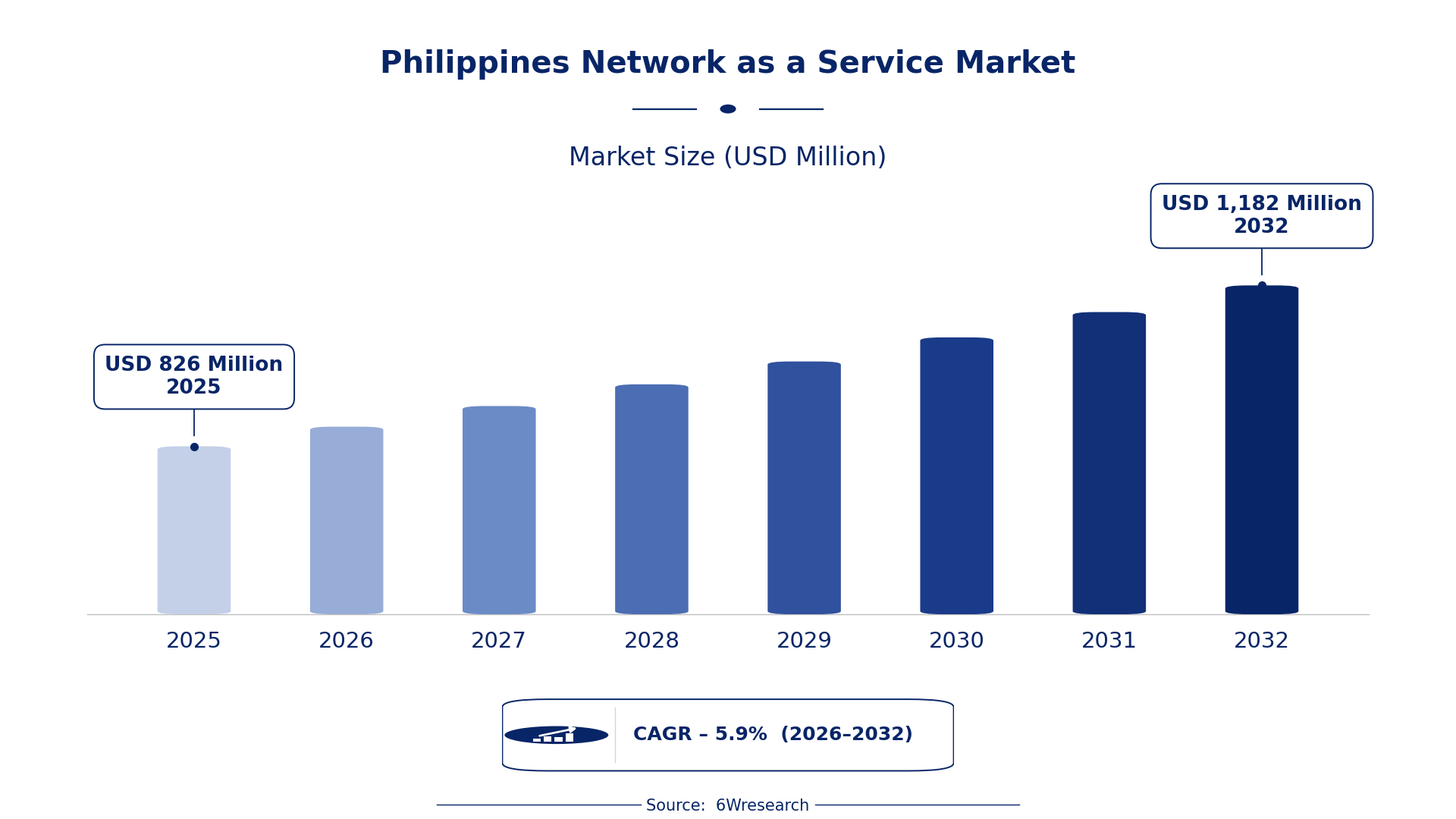
The Philippines Network as a Service Market was estimated at USD 826 Million in 2025 and is projected to reach USD 1182 Million by 2032, growing at a CAGR of 5.9% from 2026 to 2032.
Philippines Network as a Service Market Synopsis
The shift towards digital transformation across various sectors in the Philippines is driving a substantial demand for Network as a Service (NaaS). Businesses are increasingly recognizing the advantages of outsourcing network infrastructure, which allows them to focus on their core operations while enjoying scalable networking solutions.
As enterprises seek to optimize costs and enhance flexibility, NaaS has emerged as a compelling option. The appeal lies in its ability to provide on-demand network services without the burden of extensive capital investments, making it particularly attractive to small and medium-sized enterprises (SMEs) in the Philippines.
Philippines Network as a Service Market Year-wise Growth Rate and Key Drivers
This graph illustrates the annual growth rates of the Philippines Network as a Service Market from 2021 to 2032, highlighting a steady upward trajectory and projected expansion over the forecast period.
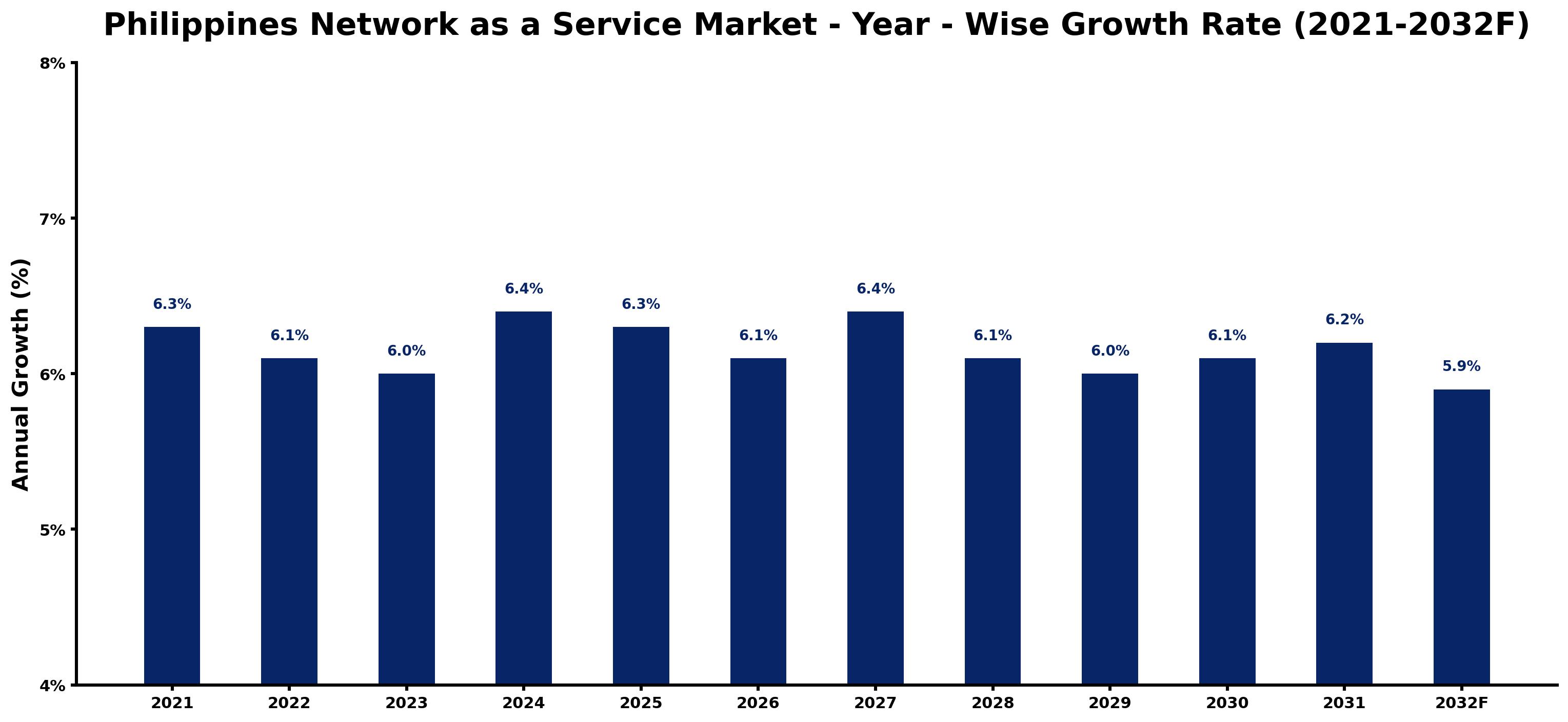
The table below presents the year‑wise growth rates along with the key drivers influencing the market
| Year | Growth Rate | Major Drivers |
| 2021 | 6.3% | Rapid digital transformation by Philippine businesses accelerates adoption. |
| 2022 | 6.1% | DICT initiatives promoting public access to high-speed internet. |
| 2023 | 6.0% | Increased mobile data penetration driving demand for flexible services. |
| 2024 | 6.4% | Government partnerships with telcos to expand fiber optic networks. |
| 2025 | 6.3% | Emergence of local startups enhancing network solutions availability. |
| 2026 | 6.1% | E-commerce growth boosting demand for reliable network infrastructure. |
| 2027 | 6.4% | Rising cybersecurity concerns prompting shift to managed services. |
| 2028 | 6.1% | Adoption of 5G technology enabling advanced network capabilities. |
| 2029 | 6.0% | Educational institutions increasing investments in cloud-based networking. |
| 2030 | 6.1% | SMEs seeking scalable network solutions to support growth. |
| 2031 | 6.2% | Telemedicine's rise driving need for secure network services. |
| 2032 | 5.9% | Regulatory pressure on connectivity standards improving industry reliability. |
Note: Market size estimations and growth projections presented in this report are based on 6Wresearch's proprietary forecasting methodology, utilizing the latest available industry data, government publications, and primary research inputs.
Philippines Network as a Service Market Key Takeaways
Below are some of the specific key takeaways from the market, including:
- The increasing demand for scalable and cost-effective networking solutions is propelling NaaS adoption.
- Businesses are prioritizing flexibility, as NaaS allows for quick adjustments to network capacity.
- Reliability remains a critical concern, pushing providers to enhance redundancy and disaster recovery measures.
- The COVID-19 pandemic accelerated interest in NaaS, highlighting the need for adaptable network solutions.
- Government initiatives supporting digital infrastructure are expected to further stimulate market growth.
Evaluation of Restraints in Philippines Network as a Service Market
Despite the promising growth trajectory, the Philippines Network as a Service Market faces notable challenges. One of the primary concerns is the reliability of network services. Downtime can result in significant financial losses for businesses that rely on NaaS solutions. Thus, service providers must invest in robust redundancy systems and effective disaster recovery protocols to ensure uninterrupted service. Additionally, the evolving regulatory landscape can present uncertainties, as companies navigate compliance while adopting NaaS solutions.
Philippines Network as a Service Market Trends
A few prominent trends are shaping the Philippines Network as a Service Market. The shift towards hybrid work models has increased the need for flexible networking solutions that can adapt to fluctuating demands. Additionally, advancements in cloud technologies are enabling more businesses to embrace NaaS, as they can now integrate these solutions with existing cloud services.
Another trend is the growing emphasis on cybersecurity within NaaS offerings. As cyber threats become more sophisticated, businesses are prioritizing secure network solutions that can safeguard their operations. Providers that incorporate advanced security measures into their NaaS offerings are likely to gain a competitive edge.
Philippines Network as a Service Market Opportunities
The Philippines presents several avenues for growth within the Network as a Service Market. As more enterprises digitize their operations, there’s a clear opportunity for NaaS providers to position themselves as strategic partners in this transformation. Companies can focus on tailoring their services to meet the unique needs of various sectors, particularly in finance, healthcare, and retail, where reliable network infrastructure is critical.
on top of that, the rise of IoT devices and applications will create additional demand for agile networking solutions. NaaS providers that can offer scalable services to accommodate the influx of connected devices will find a lucrative market in the Philippines.
Government Initiatives in the Philippines Network as a Service Market
The Philippine government is actively promoting the adoption of digital technologies, which is crucial for the growth of the Network as a Service Market. Regulatory frameworks are being established to facilitate the development of digital infrastructure and ensure that businesses have access to reliable and secure network services. This proactive approach is essential for fostering an environment conducive to NaaS expansion.
- A national digital infrastructure upgrade programme is currently underway, aimed at enhancing connectivity across urban and rural areas.
- A regulatory framework introduced in 2025 mandates billing transparency for NaaS providers, ensuring fair pricing for businesses.
- Ongoing initiatives focus on improving cybersecurity measures within the telecommunications sector, vital for NaaS reliability.
- Upcoming public-private partnerships are expected to boost telecommunications infrastructure, facilitating greater access to NaaS solutions by 2028.
Future Insights of the Philippines Network as a Service Market
Looking ahead, the Philippines Network as a Service Market is likely to experience substantial growth driven by ongoing digital transformation efforts. As enterprises continue to embrace cloud technologies and remote work, the demand for flexible, reliable networking solutions will remain strong. on top of that, with government initiatives supporting digital infrastructure, NaaS providers are well-positioned to expand their offerings and capture new market segments.
Philippines Network as a Service Market Latest Developments
In the past year, the Philippines Network as a Service Market has seen notable developments that reflect its dynamic growth trajectory. As companies increasingly prioritize digital solutions, NaaS providers are innovating to meet rising demands. The push for enhanced cybersecurity and reliability has prompted several service providers to launch new offerings that address these critical areas.
- A major technology vendor launched an advanced NaaS solution in Q2 2025, featuring enhanced security protocols and scalability options.
- An initiative that began in early 2025 focuses on expanding NaaS accessibility to underserved regions, with significant progress reported.
- A partnership between a leading telecom operator and a cloud service provider was formed in late 2025 to deliver integrated NaaS solutions.
- Upcoming plans for a nationwide NaaS service rollout are set to commence in Q3 2026, aimed at increasing service availability across the archipelago.
Philippines Network as a Service Market - Key Attractiveness of the Report
- 10 Years of Market Numbers
- Historical Data Starting from 2022 to 2025
- Base Year: 2025
- Forecast Data until 2032
- Key Performance Indicators Impacting the Market
- Major Upcoming Developments and Projects
Key Highlights of the Report:
- Philippines Network as a Service Market Outlook
- Market Size of Philippines Network as a Service Market, 2025
- Forecast of Philippines Network as a Service Market, 2032
- Historical Data and Forecast of Philippines Network as a Service Revenues & Volume for the Period 2022-2032F
- Philippines Network as a Service Market Trend Evolution
- Philippines Network as a Service Market Drivers and Challenges
- Philippines Network as a Service Price Trends
- Philippines Network as a Service Porter's Five Forces
- Philippines Network as a Service Industry Life Cycle
- Historical Data and Forecast of Philippines Network as a Service Market Revenues & Volume By Type for the Period 2022-2032F
- Historical Data and Forecast of Philippines Network as a Service Market Revenues & Volume By Local Area Network and Wireless Local Area Network for the Period 2022-2032F
- Historical Data and Forecast of Philippines Network as a Service Market Revenues & Volume By Wire Area Network for the Period 2022-2032F
- Historical Data and Forecast of Philippines Network as a Service Market Revenues & Volume By Communication and Collaboration for the Period 2022-2032F
- Historical Data and Forecast of Philippines Network as a Service Market Revenues & Volume By Network Security for the Period 2022-2032F
- Historical Data and Forecast of Philippines Network as a Service Market Revenues & Volume By End User for the Period 2022-2032F
- Historical Data and Forecast of Philippines Network as a Service Market Revenues & Volume By Banking, Financial, Services, and Insurance for the Period 2022-2032F
- Historical Data and Forecast of Philippines Network as a Service Market Revenues & Volume By Manufacturing for the Period 2022-2032F
- Historical Data and Forecast of Philippines Network as a Service Market Revenues & Volume By Retail and eCommerce for the Period 2022-2032F
- Historical Data and Forecast of Philippines Network as a Service Market Revenues & Volume By Software and Technology for the Period 2022-2032F
- Historical Data and Forecast of Philippines Network as a Service Market Revenues & Volume By Media and Entertainment for the Period 2022-2032F
- Historical Data and Forecast of Philippines Network as a Service Market Revenues & Volume By Healthcare for the Period 2022-2032F
- Historical Data and Forecast of Philippines Network as a Service Market Revenues & Volume By Education for the Period 2022-2032F
- Historical Data and Forecast of Philippines Network as a Service Market Revenues & Volume By Government for the Period 2022-2032F
- Historical Data and Forecast of Philippines Network as a Service Market Revenues & Volume By Organization Size for the Period 2022-2032F
- Historical Data and Forecast of Philippines Network as a Service Market Revenues & Volume By Large Enterprises for the Period 2022-2032F
- Historical Data and Forecast of Philippines Network as a Service Market Revenues & Volume By SMEs for the Period 2022-2032F
- Historical Data and Forecast of Philippines Network as a Service Market Revenues & Volume By Application for the Period 2022-2032F
- Historical Data and Forecast of Philippines Network as a Service Market Revenues & Volume By UCaaS/Video Conferencing for the Period 2022-2032F
- Historical Data and Forecast of Philippines Network as a Service Market Revenues & Volume By Virtual Private Network for the Period 2022-2032F
- Historical Data and Forecast of Philippines Network as a Service Market Revenues & Volume By Cloud and SaaS Connectivity for the Period 2022-2032F
- Historical Data and Forecast of Philippines Network as a Service Market Revenues & Volume By Bandwidth on Demand for the Period 2022-2032F
- Historical Data and Forecast of Philippines Network as a Service Market Revenues & Volume By Multi-Branch Connectivity for the Period 2022-2032F
- Historical Data and Forecast of Philippines Network as a Service Market Revenues & Volume By WAN Optimization for the Period 2022-2032F
- Historical Data and Forecast of Philippines Network as a Service Market Revenues & Volume By Secure Web Gateway for the Period 2022-2032F
- Philippines Network as a Service Import Export Trade Statistics
- Market Opportunity Assessment By Type
- Market Opportunity Assessment By End User
- Market Opportunity Assessment By Organization Size
- Market Opportunity Assessment By Application
- Philippines Network as a Service Top Companies Market Share
- Philippines Network as a Service Competitive Benchmarking By Technical and Operational Parameters
- Philippines Network as a Service Company Profiles
- Philippines Network as a Service Key Strategic Recommendations






































