Philippines Nuclear Medicine Radioisotopes Market Size, Share & Growth Rate
The Philippines Nuclear Medicine Radioisotopes Market was estimated at USD 636 Million in 2025 and is projected to reach USD 918 Million by 2032, growing at a CAGR of 5.4% from 2026 to 2032. This growth trajectory is primarily fueled by the rising demand for advanced diagnostic imaging techniques, particularly PET and SPECT scans, as healthcare providers increasingly adopt nuclear medicine procedures to enhance patient outcomes. As the prevalence of chronic diseases continues to rise, the market's reliance on non-invasive imaging technologies will further bolster its expansion.
Philippines Nuclear Medicine Radioisotopes Market Year-wise Growth Rate and Key Drivers
This graph highlights how the Philippines Nuclear Medicine Radioisotopes Market has steadily grown over the years, supported by major growth factors.
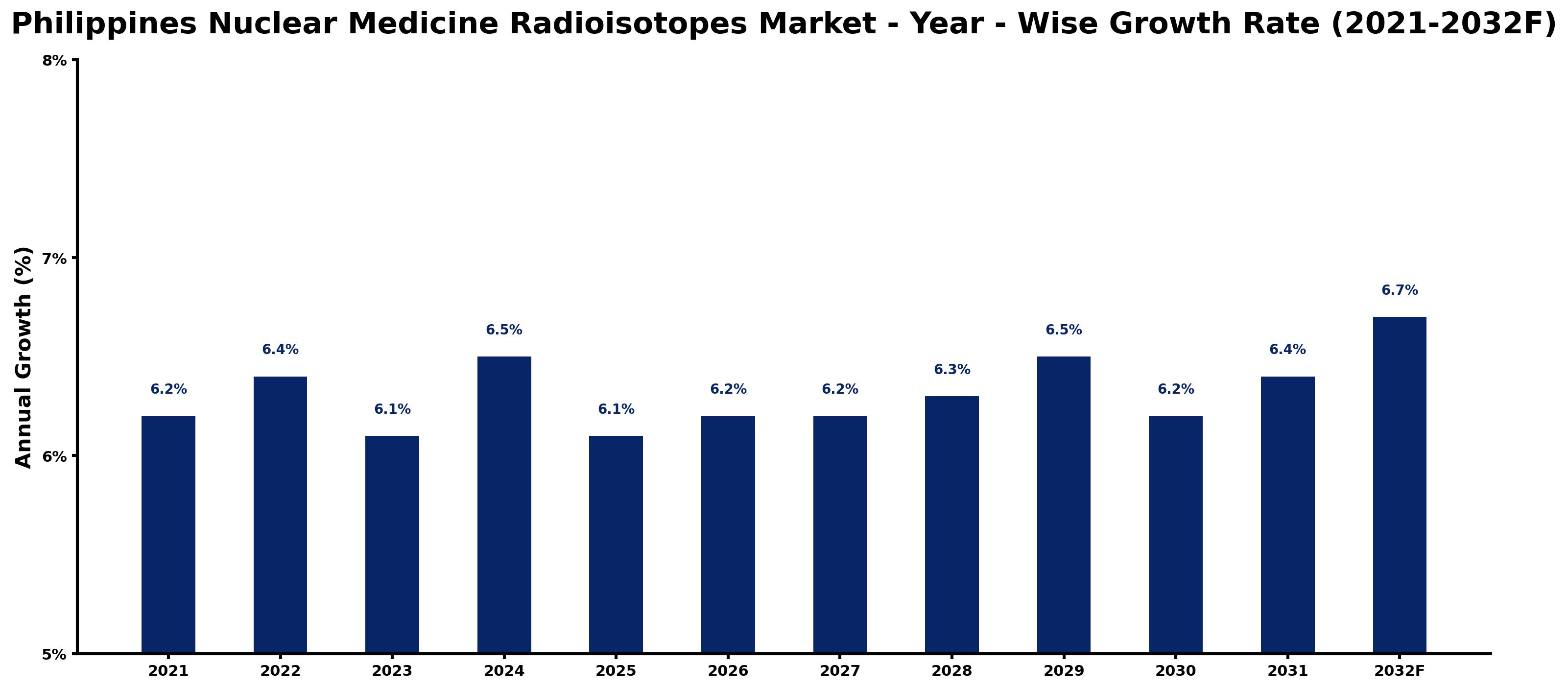
The table below presents the year‑wise growth rates along with the key drivers influencing the market
| Year | Growth Rate | Major Drivers |
| 2021 | 6.2% | Increased healthcare infrastructure investment |
| 2022 | 6.4% | Rising demand for diagnostic imaging |
| 2023 | 6.1% | Growth in oncology treatment options |
| 2024 | 6.5% | Expansion of research funding programs |
| 2025 | 6.1% | Technological advancements in imaging |
| 2026 | 6.2% | Higher prevalence of chronic diseases |
| 2027 | 6.2% | Emergence of new therapeutic applications |
| 2028 | 6.3% | Increased public health awareness campaigns |
| 2029 | 6.5% | Collaborations between research institutions |
| 2030 | 6.2% | growing commercial sector adoption |
| 2031 | 6.4% | Growing adoption of advanced therapies |
| 2032 | 6.7% | Strengthening regulatory frameworks supporting innovation |
Note: Market size estimations and growth projections presented in this report are based on 6Wresearch's proprietary forecasting methodology, utilizing the latest available industry data, government publications, and primary research inputs.
Philippines Nuclear Medicine Radioisotopes Market Synopsis
The Philippines Nuclear Medicine Radioisotopes Market is currently witnessing a pivotal transformation, driven by advancements in medical imaging technologies. With an increasing incidence of cancer and cardiac diseases, the adoption of radioisotopes for early detection and treatment has become a critical component of modern healthcare in the Philippines.
Hospitals are increasingly utilizing these radioisotopes not only for diagnostics but also for targeted therapies, enhancing the therapeutic landscape. However, navigating the complex regulatory framework for the production and distribution of these medical isotopes poses challenges that stakeholders must address to capitalize on the market's potential.
Philippines Nuclear Medicine Radioisotopes Market Key Takeaways
- The market is driven by the increasing use of radioisotopes in diagnostic imaging and treatment.
- Key applications include cancer and cardiac diagnostics, focusing on early-stage detection.
- COVID-19 disrupted the flow of services, impacting the overall demand but recovery is anticipated.
- Regulatory challenges remain significant, particularly around safety and quality standards.
- Growing investment in healthcare infrastructure is expected to enhance market access and growth.
Evaluation of Restraints in Philippines Nuclear Medicine Radioisotopes Market
The Philippines Nuclear Medicine Radioisotopes Market grapples with several restraints that could impede its growth. Stringent regulatory requirements pose significant hurdles, complicating the production and distribution processes. Compliance with safety standards is paramount, necessitating substantial investment in quality control and assurance protocols. Moreover, the technical complexities involved in handling radioactive materials demand specialized knowledge and training, which can limit the availability of skilled personnel in the sector. These challenges create a delicate balance for stakeholders striving to maintain supply chain stability while meeting high-quality standards.
Philippines Nuclear Medicine Radioisotopes Market Trends
Current trends in the Philippines Nuclear Medicine Radioisotopes Market reflect a broader global shift towards personalized medicine. Increased investment in research and development is driving innovations in radiopharmaceuticals, enhancing their effectiveness in targeting specific diseases. Additionally, digitalization and advancements in imaging technology are expanding the scope of nuclear medicine applications, enabling precise diagnostics and therapeutic interventions. Collaborative efforts between healthcare providers and research institutions further aim to streamline the integration of radioisotopes into clinical practice.
Philippines Nuclear Medicine Radioisotopes Market Opportunities
The Philippine market offers substantial growth opportunities, especially in the context of emerging healthcare needs. The expanding population and the rising incidence of chronic diseases present a pressing demand for advanced diagnostic tools. Furthermore, increasing awareness among healthcare professionals and patients regarding the benefits of nuclear medicine can enhance adoption rates. Investments in healthcare infrastructure, particularly in rural areas, can also boost accessibility to nuclear medicine services, creating untapped markets for radioisotope applications.
Government Initiatives in the Philippines Nuclear Medicine Radioisotopes Market
The Philippine government is actively supporting the nuclear medicine sector through various initiatives aimed at enhancing healthcare delivery. Investments in healthcare infrastructure and technology are prioritized to improve access to modern diagnostic tools, including nuclear medicine. Additionally, government policies focused on strengthening regulatory frameworks ensure that safety and quality standards are maintained throughout the supply chain. Public health programs emphasizing early detection and treatment of diseases are further driving the integration of nuclear medicine into mainstream healthcare.
Future Insights of the Philippines Nuclear Medicine Radioisotopes Market
Looking ahead to 2026-2032, the Philippines Nuclear Medicine Radioisotopes Market is poised for notable growth. As healthcare providers continue to recognize the efficacy of nuclear medicine in delivering precise diagnostics and treatment options, demand for radioisotopes is expected to escalate. The ongoing commitment to enhancing healthcare infrastructure, coupled with increasing public awareness and acceptance of nuclear medicine, sets a favorable stage for market expansion. Furthermore, advancements in technology will likely streamline processes, improve safety protocols, and foster innovation in treatment methodologies, solidifying the sector's integral role in modern healthcare.
Philippines Nuclear Medicine Radioisotopes Market Latest Developments (2025 - 2026)
Recent developments in the Philippines Nuclear Medicine Radioisotopes Market have indicated a shift towards more collaborative approaches among healthcare institutions. This includes partnerships aimed at enhancing research and development efforts for new radiopharmaceuticals. There has also been a concerted focus on upgrading existing facilities to ensure compliance with international standards, addressing both regulatory and safety concerns. Additionally, the integration of advanced imaging technologies has been prioritized to improve the diagnostic capabilities of healthcare providers.
Philippines Nuclear Medicine Radioisotopes Market - Key Attractiveness of the Report
- 10 Years of Market Numbers
- Historical Data Starting from 2022 to 2025
- Base Year: 2025
- Forecast Data until 2032
- Key Performance Indicators Impacting the Market
- Major Upcoming Developments and Projects
Key Highlights of the Report:
- Philippines Nuclear Medicine Radioisotopes Market Outlook
- Market Size of Philippines Nuclear Medicine Radioisotopes Market, 2025
- Forecast of Philippines Nuclear Medicine Radioisotopes Market, 2032
- Historical Data and Forecast of Philippines Nuclear Medicine Radioisotopes Revenues & Volume for the Period 2022-2032F
- Philippines Nuclear Medicine Radioisotopes Market Trend Evolution
- Philippines Nuclear Medicine Radioisotopes Market Drivers and Challenges
- Philippines Nuclear Medicine Radioisotopes Price Trends
- Philippines Nuclear Medicine Radioisotopes Porter's Five Forces
- Philippines Nuclear Medicine Radioisotopes Industry Life Cycle
- Historical Data and Forecast of Philippines Nuclear Medicine Radioisotopes Market Revenues & Volume By Types for the Period 2022-2032F
- Historical Data and Forecast of Philippines Nuclear Medicine Radioisotopes Market Revenues & Volume By Technetium-99m (Tc-99m) for the Period 2022-2032F
- Historical Data and Forecast of Philippines Nuclear Medicine Radioisotopes Market Revenues & Volume By Thallium-201 (Tl-201) for the Period 2022-2032F
- Historical Data and Forecast of Philippines Nuclear Medicine Radioisotopes Market Revenues & Volume By Iodine (I-123) for the Period 2022-2032F
- Historical Data and Forecast of Philippines Nuclear Medicine Radioisotopes Market Revenues & Volume By Fluorine-18 for the Period 2022-2032F
- Historical Data and Forecast of Philippines Nuclear Medicine Radioisotopes Market Revenues & Volume By Rubidium-82 (Rb-82) for the Period 2022-2032F
- Historical Data and Forecast of Philippines Nuclear Medicine Radioisotopes Market Revenues & Volume By Iodine-131 (I-131) for the Period 2022-2032F
- Historical Data and Forecast of Philippines Nuclear Medicine Radioisotopes Market Revenues & Volume By Actinium-225 (Ac-225) for the Period 2022-2032F
- Historical Data and Forecast of Philippines Technetium-99m (Tc-99m) Nuclear Medicine Radioisotopes Market Revenues & Volume By Others for the Period 2022-2032F
- Historical Data and Forecast of Philippines Nuclear Medicine Radioisotopes Market Revenues & Volume By Application for the Period 2022-2032F
- Historical Data and Forecast of Philippines Nuclear Medicine Radioisotopes Market Revenues & Volume By Oncology for the Period 2022-2032F
- Historical Data and Forecast of Philippines Nuclear Medicine Radioisotopes Market Revenues & Volume By Cardiology for the Period 2022-2032F
- Historical Data and Forecast of Philippines Nuclear Medicine Radioisotopes Market Revenues & Volume By Thyroid for the Period 2022-2032F
- Historical Data and Forecast of Philippines Nuclear Medicine Radioisotopes Market Revenues & Volume By Neurology for the Period 2022-2032F
- Historical Data and Forecast of Philippines Nuclear Medicine Radioisotopes Market Revenues & Volume By Others for the Period 2022-2032F
- Philippines Nuclear Medicine Radioisotopes Import Export Trade Statistics
- Market Opportunity Assessment By Types
- Market Opportunity Assessment By Application
- Philippines Nuclear Medicine Radioisotopes Top Companies Market Share
- Philippines Nuclear Medicine Radioisotopes Competitive Benchmarking By Technical and Operational Parameters
- Philippines Nuclear Medicine Radioisotopes Company Profiles
- Philippines Nuclear Medicine Radioisotopes Key Strategic Recommendations






































