Philippines Oil and Gas Hydraulic Equipment Market Size, Share & Growth Rate
The Philippines Oil and Gas Hydraulic Equipment Market was estimated at USD 380 Million in 2025 and is projected to reach USD 497 Million by 2032, growing at a CAGR of 3.9% from 2026 to 2032. This growth trajectory is propelled by the increasing oil and gas exploration and production activities in the Philippines, where hydraulic equipment is fundamental for operational efficiency. As the industry seeks to modernize and adopt cutting-edge technologies, the demand for high-performance hydraulic systems is expected to rise significantly, supporting the overall market expansion.
Philippines Oil and Gas Hydraulic Equipment Market Year-wise Growth Rate and Key Drivers
This graph highlights how the Philippines Oil and Gas Hydraulic Equipment Market has steadily grown over the years, supported by major growth factors.
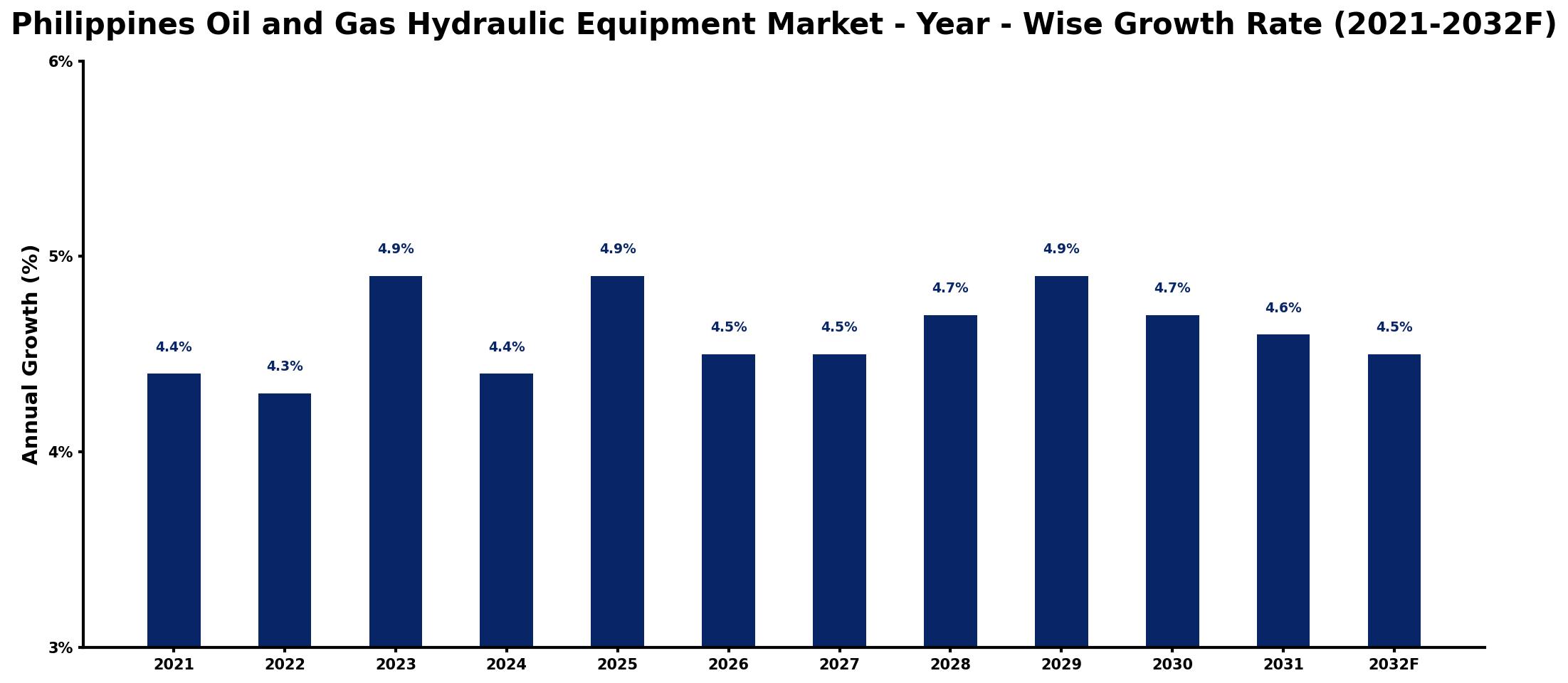
The table below presents the year‑wise growth rates along with the key drivers influencing the market
| Year | Growth Rate | Major Drivers |
| 2021 | 4.4% | Rising demand from construction sector |
| 2022 | 4.3% | Increased investments in infrastructure projects |
| 2023 | 4.9% | Expansion of renewable energy initiatives |
| 2024 | 4.4% | strengthening underlying market demand |
| 2025 | 4.9% | Surge in transportation sector projects |
| 2026 | 4.5% | Enhanced manufacturing capabilities in region |
| 2027 | 4.5% | Strengthened regional trade agreements |
| 2028 | 4.7% | Advancements in automation technologies |
| 2029 | 4.9% | Growing urbanization and population density |
| 2030 | 4.7% | Increased focus on sustainability practices |
| 2031 | 4.6% | Development of new industrial applications |
| 2032 | 4.5% | Rising global demand for energy |
Note: Market size estimations and growth projections presented in this report are based on 6Wresearch's proprietary forecasting methodology, utilizing the latest available industry data, government publications, and primary research inputs.
Philippines Oil and Gas Hydraulic Equipment Market Synopsis
Currently, the Philippines is witnessing a dynamic shift in its oil and gas sector, with hydraulic equipment playing an essential role in various operational facets. This critical infrastructure aids in drilling, well control, and pipeline maintenance, reflecting the market's indispensable connection to energy production.
In light of recent expansions in exploration activities, the hydraulic equipment market is poised for growth. The urgency for reliable and efficient hydraulic systems can be linked to the country's ambitions for energy independence and sustainable development.
Philippines Oil and Gas Hydraulic Equipment Market Key Takeaways
- The market is driven by rising exploration and production activities in the oil and gas sector.
- Hydraulic equipment is critical for various operational tasks, enhancing efficiency and safety.
- The shift towards innovative technologies fosters higher demand for advanced hydraulic systems.
- Market growth is challenged by the need for equipment durability and maintenance in harsh conditions.
- COVID-19 had a temporary impact, leading to strategic reassessments and potential diversification efforts.
Evaluation of Restraints in Philippines Oil and Gas Hydraulic Equipment Market
Despite the market's growth potential, several restraints hinder its full realization. The harsh operating conditions prevalent in the oil and gas industry, including extreme temperatures and corrosive environments, pose significant challenges for hydraulic equipment. These systems must be exceptionally durable and capable of withstanding high pressures, which can limit options for cost-effective solutions. Furthermore, the necessity for regular maintenance and inspections adds to operational costs and can result in downtime, affecting overall efficiency.
Philippines Oil and Gas Hydraulic Equipment Market Trends
Emerging trends in the Philippines Oil and Gas Hydraulic Equipment Market are heavily influenced by technological advancements and sustainability initiatives. The shift towards automation and remote operation technology is transforming traditional hydraulic systems into more efficient and versatile solutions. Additionally, the industry's increasing focus on environmental sustainability is driving demand for eco-friendly hydraulic fluids and systems designed to minimize environmental impact.
Philippines Oil and Gas Hydraulic Equipment Market Opportunities
Opportunities for growth in the Philippines Oil and Gas Hydraulic Equipment Market are abundant as the nation continues to invest in its energy infrastructure. The integration of renewable energy projects alongside traditional oil and gas activities presents avenues for innovation. There is a growing demand for hydraulic solutions that cater to both sectors, such as systems designed to support hybrid energy initiatives. Furthermore, collaborations between local firms and international technology providers could enhance market capabilities and broaden service offerings.
Government Initiatives in the Philippines Oil and Gas Hydraulic Equipment Market
The Philippine government has actively pursued initiatives to strengthen its energy sector, including policies aimed at enhancing oil and gas exploration and production. Various public spending programs are being implemented to upgrade the existing infrastructure, which includes hydraulic systems. These initiatives are often complemented by incentives for companies that invest in technology and workforce development, thereby promoting a robust environment for growth in the hydraulic equipment market.
Future Insights of the Philippines Oil and Gas Hydraulic Equipment Market
Looking ahead to the period from 2026 to 2032, the Philippines Oil and Gas Hydraulic Equipment Market is set to evolve significantly. As exploration activities ramp up, the demand for advanced hydraulic technologies will escalate. Companies are likely to focus on R&D to develop systems that are not only efficient but also sustainable. The market's growth will be further supported by the government's commitment to energy security and the integration of innovative practices, positioning the Philippines as a competitive player in the region.
Philippines Oil and Gas Hydraulic Equipment Market Latest Developments (2025 - 2026)
Recent developments in the Philippines Oil and Gas Hydraulic Equipment Market indicate a renewed focus on leveraging cutting-edge technologies to enhance operational efficiency. Industry players are exploring strategic partnerships and collaborations to bolster their offerings, particularly in automation and eco-friendly solutions. Additionally, there has been an increase in training and development programs aimed at upskilling the workforce in alignment with modern hydraulic technologies.
Philippines Oil and Gas Hydraulic Equipment Market - Key Attractiveness of the Report
- 10 Years of Market Numbers
- Historical Data Starting from 2022 to 2025
- Base Year: 2025
- Forecast Data until 2032
- Key Performance Indicators Impacting the Market
- Major Upcoming Developments and Projects
Key Highlights of the Report:
- Philippines Oil and Gas Hydraulic Equipment Market Outlook
- Market Size of Philippines Oil and Gas Hydraulic Equipment Market, 2025
- Forecast of Philippines Oil and Gas Hydraulic Equipment Market, 2032
- Historical Data and Forecast of Philippines Oil and Gas Hydraulic Equipment Revenues & Volume for the Period 2022-2032F
- Philippines Oil and Gas Hydraulic Equipment Market Trend Evolution
- Philippines Oil and Gas Hydraulic Equipment Market Drivers and Challenges
- Philippines Oil and Gas Hydraulic Equipment Price Trends
- Philippines Oil and Gas Hydraulic Equipment Porter's Five Forces
- Philippines Oil and Gas Hydraulic Equipment Industry Life Cycle
- Historical Data and Forecast of Philippines Oil and Gas Hydraulic Equipment Market Revenues & Volume By Sector for the Period 2022-2032F
- Historical Data and Forecast of Philippines Oil and Gas Hydraulic Equipment Market Revenues & Volume By Upstream for the Period 2022-2032F
- Historical Data and Forecast of Philippines Oil and Gas Hydraulic Equipment Market Revenues & Volume By Mid-stream for the Period 2022-2032F
- Historical Data and Forecast of Philippines Oil and Gas Hydraulic Equipment Market Revenues & Volume By Downstream for the Period 2022-2032F
- Historical Data and Forecast of Philippines Oil and Gas Hydraulic Equipment Market Revenues & Volume By Location for the Period 2022-2032F
- Historical Data and Forecast of Philippines Oil and Gas Hydraulic Equipment Market Revenues & Volume By Onshore for the Period 2022-2032F
- Historical Data and Forecast of Philippines Oil and Gas Hydraulic Equipment Market Revenues & Volume By Offshore for the Period 2022-2032F
- Historical Data and Forecast of Philippines Oil and Gas Hydraulic Equipment Market Revenues & Volume By Application for the Period 2022-2032F
- Historical Data and Forecast of Philippines Oil and Gas Hydraulic Equipment Market Revenues & Volume By Drill Floor Hydraulics for the Period 2022-2032F
- Historical Data and Forecast of Philippines Oil and Gas Hydraulic Equipment Market Revenues & Volume By Ballast Control System for the Period 2022-2032F
- Historical Data and Forecast of Philippines Oil and Gas Hydraulic Equipment Market Revenues & Volume By Deck Crane Systems for the Period 2022-2032F
- Historical Data and Forecast of Philippines Oil and Gas Hydraulic Equipment Market Revenues & Volume By Motion Compensation Systems for the Period 2022-2032F
- Historical Data and Forecast of Philippines Oil and Gas Hydraulic Equipment Market Revenues & Volume By Top Drives for the Period 2022-2032F
- Historical Data and Forecast of Philippines Oil and Gas Hydraulic Equipment Market Revenues & Volume By Manifolds for the Period 2022-2032F
- Historical Data and Forecast of Philippines Oil and Gas Hydraulic Equipment Market Revenues & Volume By Winches for the Period 2022-2032F
- Historical Data and Forecast of Philippines Oil and Gas Hydraulic Equipment Market Revenues & Volume By Others for the Period 2022-2032F
- Philippines Oil and Gas Hydraulic Equipment Import Export Trade Statistics
- Market Opportunity Assessment By Sector
- Market Opportunity Assessment By Location
- Market Opportunity Assessment By Application
- Philippines Oil and Gas Hydraulic Equipment Top Companies Market Share
- Philippines Oil and Gas Hydraulic Equipment Competitive Benchmarking By Technical and Operational Parameters
- Philippines Oil and Gas Hydraulic Equipment Company Profiles
- Philippines Oil and Gas Hydraulic Equipment Key Strategic Recommendations






































