Philippines Oilfield Air Drilling Market Size, Share & Growth Rate
The Philippines Oilfield Air Drilling Market was estimated at USD 880 Million in 2025 and is projected to reach USD 1500 Million by 2032, growing at a CAGR of 7.9% from 2026 to 2032. This growth trajectory is primarily driven by the increasing demand for efficient drilling methods in the country's oil and gas sector, as companies seek to optimize resource extraction amidst rising operational costs. The shift towards air drilling technologies, which promise enhanced drilling efficiency and reduced formation damage, is also bolstering market confidence.
Philippines Oilfield Air Drilling Market Year-wise Growth Rate and Key Drivers
This graph highlights how the Philippines Oilfield Air Drilling Market has steadily grown over the years, supported by major growth factors.
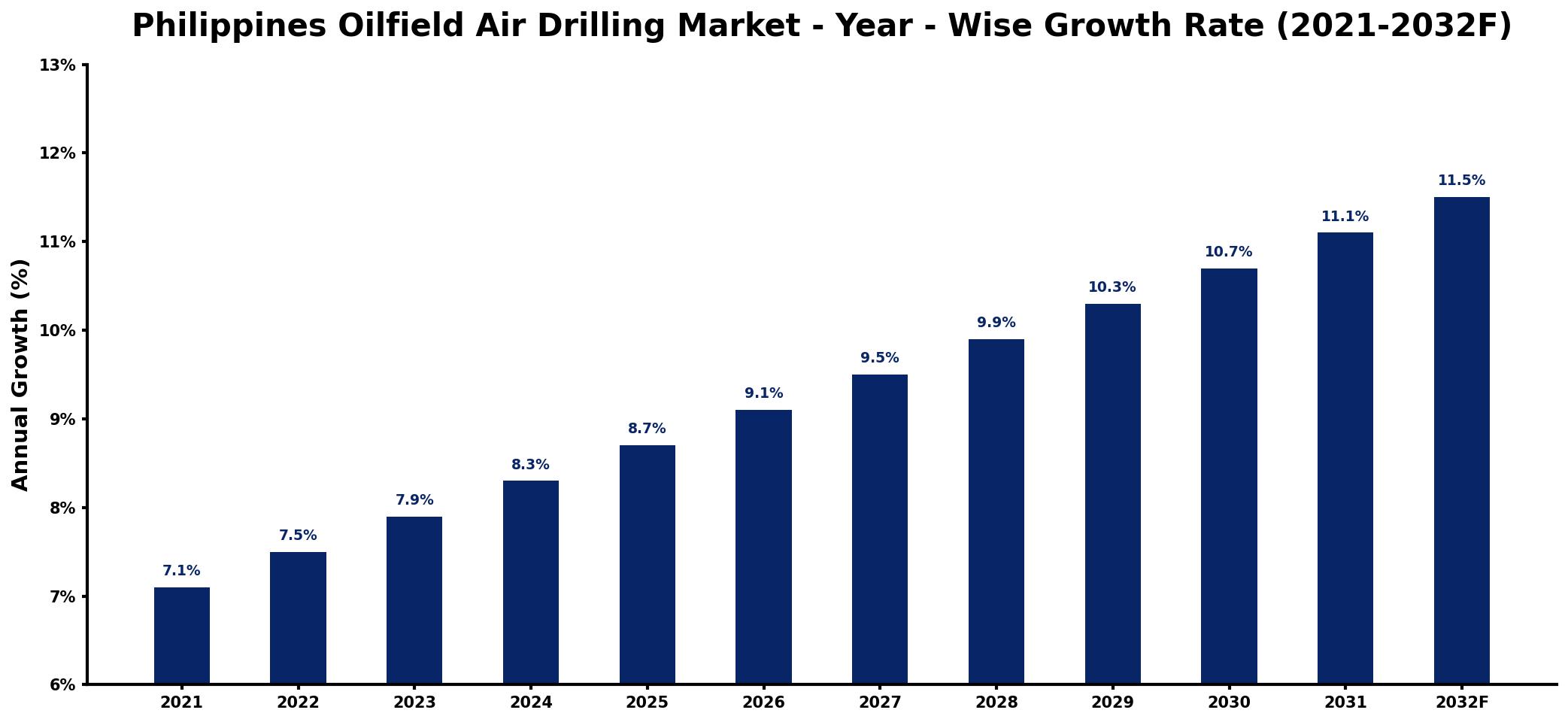
The table below presents the year‑wise growth rates along with the key drivers influencing the market
| Year | Growth Rate | Major Drivers |
| 2021 | 7.1% | Rising global energy demand |
| 2022 | 7.5% | Increased investment in exploration |
| 2023 | 7.9% | Expansion of renewable energy projects |
| 2024 | 8.3% | Technological advancements in extraction |
| 2025 | 8.7% | Growing offshore production activities |
| 2026 | 9.1% | Enhanced infrastructure for logistics |
| 2027 | 9.5% | Surge in foreign investments |
| 2028 | 9.9% | Strengthened regulatory support frameworks |
| 2029 | 10.3% | Emergence of new market players |
| 2030 | 10.7% | Increased focus on sustainability |
| 2031 | 11.1% | Growing partnerships in energy sector |
| 2032 | 11.5% | Rise in energy transition initiatives |
Note: Market size estimations and growth projections presented in this report are based on 6Wresearch's proprietary forecasting methodology, utilizing the latest available industry data, government publications, and primary research inputs.
Philippines Oilfield Air Drilling Market Synopsis
The most significant force currently shaping the Philippines Oilfield Air Drilling Market is the increasing emphasis on innovative drilling techniques to unlock untapped oil and gas reserves. As the nation strives for energy independence, the adoption of air drilling technologies has gained momentum, appealing to exploration firms eager to maximize operational success.
Air drilling technology not only facilitates faster drilling but also ensures more efficient cuttings removal, which minimizes geological impact. Companies engaged in oil and gas exploration are increasingly recognizing these advantages, further driving the market's growth as they prioritize sustainable and effective methods to enhance productivity.
Philippines Oilfield Air Drilling Market Key Takeaways
- Adoption of air drilling is on the rise, driven by the need for operational efficiency and lower drilling costs.
- The market is poised for substantial growth as the country focuses on energy resource utilization.
- Innovative drilling technologies are being prioritized amidst complex geological challenges.
- Regulatory frameworks are evolving, addressing both operational effectiveness and environmental impact.
- COVID-19 has temporarily slowed the market, but recovery is underway with renewed investments in technology.
Evaluation of Restraints in Philippines Oilfield Air Drilling Market
Despite promising growth, the Philippines Oilfield Air Drilling Market faces significant constraints. The complex geological formations present unique challenges, necessitating specialized air drilling equipment that can efficiently navigate these conditions. Furthermore, regulatory compliance and environmental considerations impose additional hurdles, as the industry must align efficient drilling practices with responsible ecological stewardship. The balance between advancing technology and maintaining environmental integrity remains a crucial factor affecting market dynamics.
Philippines Oilfield Air Drilling Market Trends
Current trends in the Philippines Oilfield Air Drilling Market indicate a marked shift toward digitalization and automation. Companies are increasingly leveraging advanced data analytics and real-time monitoring systems to optimize drilling operations. Additionally, there is growing interest in hybrid drilling approaches that combine air drilling with other methodologies, enhancing overall efficiency. Sustainability concerns are prompting firms to explore eco-friendly drilling practices, further shaping the future landscape of the market.
Philippines Oilfield Air Drilling Market Opportunities
Opportunities for growth and investment in the Philippines Oilfield Air Drilling Market lie in technology innovation and strategic partnerships. Collaborations between local and international firms can lead to the development of more efficient air drilling solutions. Additionally, investment in training programs to enhance workforce skills in advanced drilling technologies represents a significant opportunity. As regulatory frameworks evolve, companies that proactively align with new standards can position themselves favorably within the market.
Government Initiatives in the Philippines Oilfield Air Drilling Market
The Philippine government is actively supporting the oil and gas industry through various initiatives aimed at enhancing energy security and promoting sustainable exploration practices. Policymakers are focusing on regulatory reforms that encourage investment in advanced drilling technologies. Additionally, there are programs aimed at fostering collaboration between government agencies and private firms to drive innovation and efficiency in oilfield operations. Such initiatives are vital for positioning the Philippines as a competitive player in the global oil and gas landscape.
Future Insights of the Philippines Oilfield Air Drilling Market
Looking ahead to the period from 2026 to 2032, the Philippines Oilfield Air Drilling Market is expected to evolve rapidly, driven by advancements in drilling technologies and heightened demand for energy resources. The integration of smart technologies, such as IoT and AI in drilling operations, will likely enhance efficiency and safety standards. As regulatory frameworks continue to support innovation while addressing environmental concerns, the market is well-positioned for robust growth, attracting both local and foreign investments.
Philippines Oilfield Air Drilling Market Latest Developments (2025 - 2026)
Recent developments in the Philippines Oilfield Air Drilling Market reflect a shift toward more advanced technologies and sustainable practices. Companies are increasingly investing in state-of-the-art air drilling equipment and exploring hybrid drilling methods that combine efficiency with ecological responsibility. The industry is also witnessing renewed interest in public-private partnerships aimed at developing infrastructure and enhancing operational capabilities. As the market stabilizes post-COVID-19, there is a growing focus on leveraging technological advancements to boost productivity.
Philippines Oilfield Air Drilling Market - Key Attractiveness of the Report
- 10 Years of Market Numbers
- Historical Data Starting from 2022 to 2025
- Base Year: 2025
- Forecast Data until 2032
- Key Performance Indicators Impacting the Market
- Major Upcoming Developments and Projects
Key Highlights of the Report:
- Philippines Oilfield Air Drilling Market Outlook
- Market Size of Philippines Oilfield Air Drilling Market, 2025
- Forecast of Philippines Oilfield Air Drilling Market, 2032
- Historical Data and Forecast of Philippines Oilfield Air Drilling Revenues & Volume for the Period 2022-2032F
- Philippines Oilfield Air Drilling Market Trend Evolution
- Philippines Oilfield Air Drilling Market Drivers and Challenges
- Philippines Oilfield Air Drilling Price Trends
- Philippines Oilfield Air Drilling Porter's Five Forces
- Philippines Oilfield Air Drilling Industry Life Cycle
- Historical Data and Forecast of Philippines Oilfield Air Drilling Market Revenues & Volume By Type for the Period 2022-2032F
- Historical Data and Forecast of Philippines Oilfield Air Drilling Market Revenues & Volume By Dust for the Period 2022-2032F
- Historical Data and Forecast of Philippines Oilfield Air Drilling Market Revenues & Volume By Aerated fluid for the Period 2022-2032F
- Historical Data and Forecast of Philippines Oilfield Air Drilling Market Revenues & Volume By Foam for the Period 2022-2032F
- Historical Data and Forecast of Philippines Oilfield Air Drilling Market Revenues & Volume By Mist for the Period 2022-2032F
- Historical Data and Forecast of Philippines Oilfield Air Drilling Market Revenues & Volume By Nitrogen membrane for the Period 2022-2032F
- Philippines Oilfield Air Drilling Import Export Trade Statistics
- Market Opportunity Assessment By Type
- Philippines Oilfield Air Drilling Top Companies Market Share
- Philippines Oilfield Air Drilling Competitive Benchmarking By Technical and Operational Parameters
- Philippines Oilfield Air Drilling Company Profiles
- Philippines Oilfield Air Drilling Key Strategic Recommendations






































