Philippines Organic Fertilizer Market Top 5 Importing Countries and Market Competition (HHI) Analysis
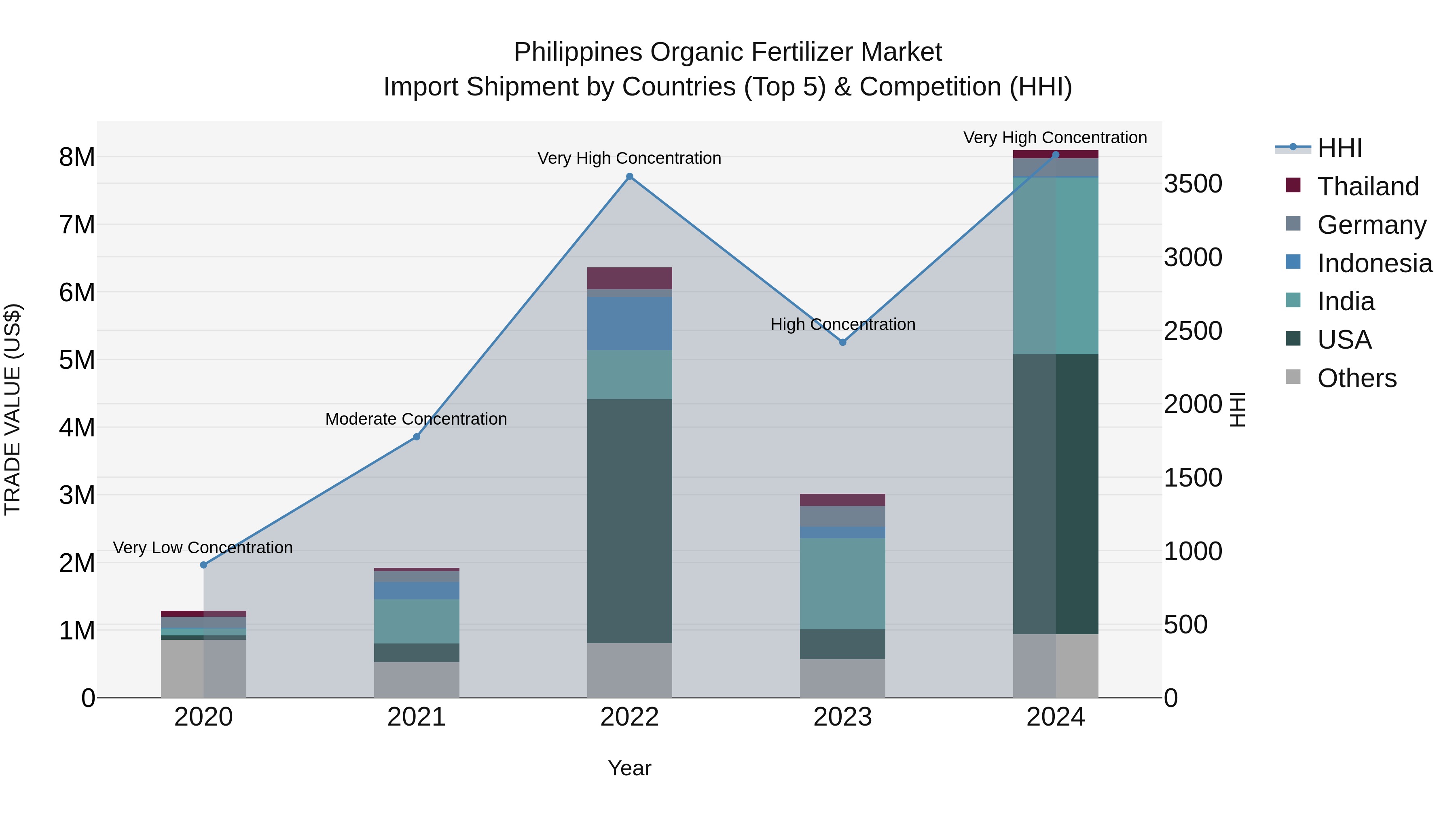
The Philippines organic fertilizer import market continues to surge with a remarkable CAGR of 58.32% from 2020 to 2024. In 2024, the growth rate skyrocketed to 168.44%, reflecting an increasing demand for organic fertilizers in the country. The market saw a shift in top exporting countries, with the USA, India, China, Germany, and Hong Kong dominating the shipments. The market concentration, as measured by the HHI, intensified from high in 2023 to very high in 2024, indicating a more consolidated market landscape. This trend suggests a competitive environment and potential strategic implications for stakeholders.
Philippines Organic Fertilizer Market Overview
The organic fertilizer market in the Philippines is expanding due to increasing demand for sustainable agricultural inputs. Organic fertilizers improve soil health and crop yield without harming the environment. Government initiatives promoting organic farming and eco-friendly alternatives to synthetic fertilizers are key market drivers. However, higher costs and logistical challenges affect market penetration. Ongoing research and farmer education programs are expected to strengthen the industry.
Drivers of the market
The increasing awareness of soil health and sustainable farming practices has driven the organic fertilizer market in the Philippines. Farmers are seeking alternatives to chemical fertilizers to enhance soil fertility and crop productivity without harming the environment. Government programs supporting organic farming, along with the growing consumer demand for organic produce, have contributed to market expansion. Additionally, rising concerns over chemical residues in food have encouraged the adoption of organic fertilizers in agricultural practices.
Challenges of the market
The organic fertilizer market in the Philippines faces obstacles in production scaling and farmer adoption. Many farmers prefer chemical fertilizers due to their quick effects and lower costs. Organic fertilizers take longer to show results, which discourages immediate adoption. Additionally, there is a lack of government incentives for organic farming, which limits market expansion. The high cost of organic certification and production also makes organic fertilizers more expensive than conventional ones.
Investment opportunities in the Market
With increasing awareness of sustainable agriculture, the organic fertilizer market in the Philippines offers promising investment opportunities. Investors can focus on the production and distribution of compost-based, biofertilizers, and organic soil enhancers. Government support for organic farming and the need for eco-friendly farming solutions make this a high-potential market.
Government Policy of the market
The Philippine government actively supports the organic fertilizer market through the DAs initiatives promoting sustainable agriculture. Farmers receive subsidies and technical assistance for producing and using organic fertilizers. The Fertilizer and Pesticide Authority (FPA) regulates the quality and distribution of organic fertilizers to ensure compliance with environmental and agricultural standards. Import restrictions on synthetic fertilizers further encourage local organic fertilizer production.
Key Highlights of the Report:
- Philippines Organic Fertilizer Market Outlook
- Market Size of Philippines Organic Fertilizer Market, 2024
- Forecast of Philippines Organic Fertilizer Market, 2031
- Historical Data and Forecast of Philippines Organic Fertilizer Revenues & Volume for the Period 2021- 2031
- Philippines Organic Fertilizer Market Trend Evolution
- Philippines Organic Fertilizer Market Drivers and Challenges
- Philippines Organic Fertilizer Price Trends
- Philippines Organic Fertilizer Porter's Five Forces
- Philippines Organic Fertilizer Industry Life Cycle
- Historical Data and Forecast of Philippines Organic Fertilizer Market Revenues & Volume By Form for the Period 2021- 2031
- Historical Data and Forecast of Philippines Organic Fertilizer Market Revenues & Volume By Manure for the Period 2021- 2031
- Historical Data and Forecast of Philippines Organic Fertilizer Market Revenues & Volume By Meal Based Fertilizers for the Period 2021- 2031
- Historical Data and Forecast of Philippines Organic Fertilizer Market Revenues & Volume By Oilcakes for the Period 2021- 2031
- Historical Data and Forecast of Philippines Organic Fertilizer Market Revenues & Volume By Crop Type for the Period 2021- 2031
- Historical Data and Forecast of Philippines Organic Fertilizer Market Revenues & Volume By Cash Crops for the Period 2021- 2031
- Historical Data and Forecast of Philippines Organic Fertilizer Market Revenues & Volume By Horticultural Crops for the Period 2021- 2031
- Historical Data and Forecast of Philippines Organic Fertilizer Market Revenues & Volume By Row Crops for the Period 2021- 2031
- Philippines Organic Fertilizer Import Export Trade Statistics
- Market Opportunity Assessment By Form
- Market Opportunity Assessment By Crop Type
- Philippines Organic Fertilizer Top Companies Market Share
- Philippines Organic Fertilizer Competitive Benchmarking By Technical and Operational Parameters
- Philippines Organic Fertilizer Company Profiles
- Philippines Organic Fertilizer Key Strategic Recommendations






































