Philippines Ornamental Fish Market Size, Share & Growth Rate
The Philippines Ornamental Fish Market was estimated at USD 368 Million in 2025 and is projected to reach USD 484 Million by 2032, growing at a CAGR of 4.0% from 2026 to 2032. This upward trajectory is driven by the increasing popularity of aquariums among both novice and experienced hobbyists, coupled with a growing awareness of unique aquatic species. Additionally, the rise of local breeding techniques is enhancing the availability of exotic fish, which in turn supports export opportunities and domestic demand.
Philippines Ornamental Fish Market Year-wise Growth Rate and Key Drivers
This graph highlights how the Philippines Ornamental Fish Market has steadily grown over the years, supported by major growth factors.
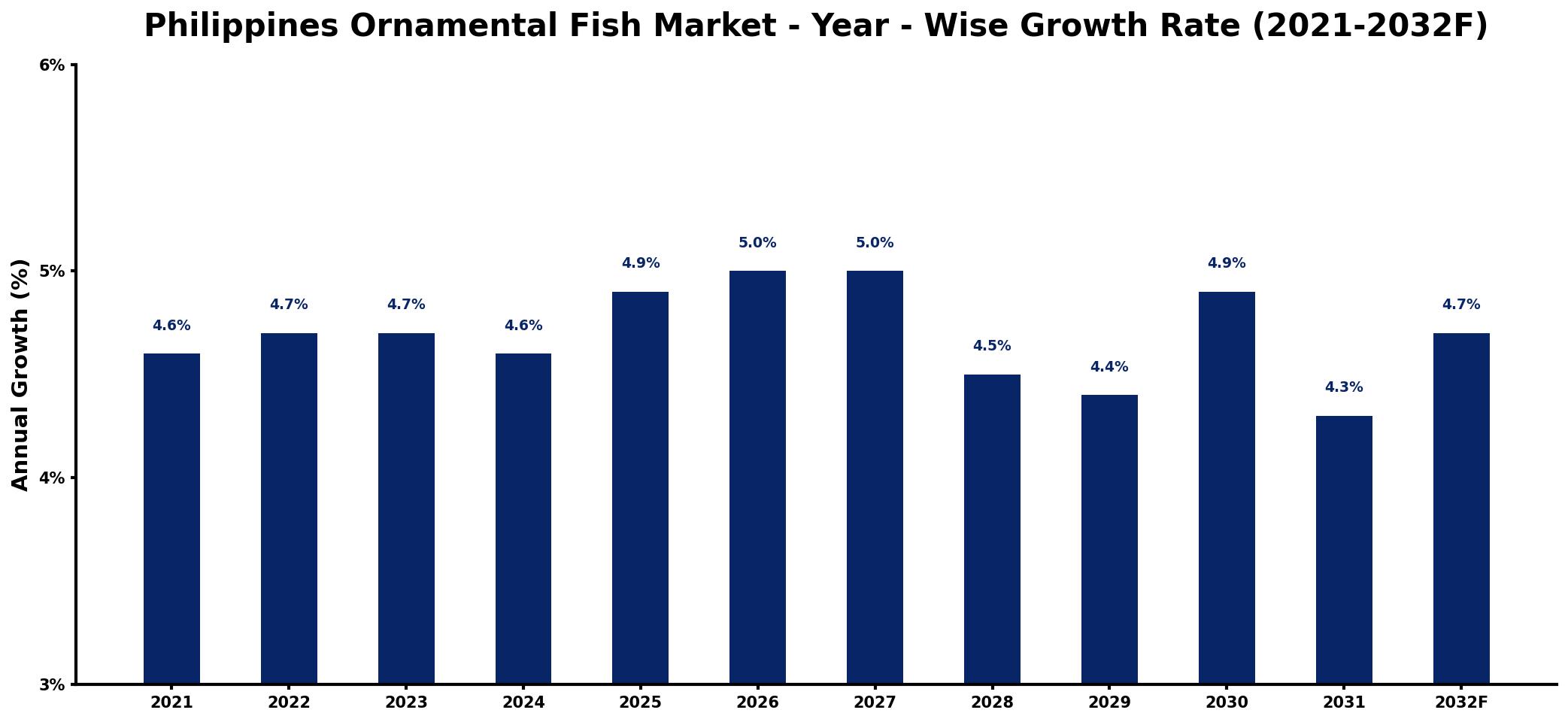
The table below presents the year‑wise growth rates along with the key drivers influencing the market
| Year | Growth Rate | Major Drivers |
| 2021 | 4.6% | Rising interest in aquascaping hobby |
| 2022 | 4.7% | Increased disposable income among consumers |
| 2023 | 4.7% | Growth in home aquarium installations |
| 2024 | 4.6% | Surge in online sales platforms |
| 2025 | 4.9% | Expansion of local breeding facilities |
| 2026 | 5.0% | Increased awareness of aquatic ecosystems |
| 2027 | 5.0% | Growing popularity of aquarium shows |
| 2028 | 4.5% | Investment in sustainable aquaculture practices |
| 2029 | 4.4% | Emergence of new decorative trends |
| 2030 | 4.9% | Enhanced marketing strategies for enthusiasts |
| 2031 | 4.3% | Rise in community aquarium clubs |
| 2032 | 4.7% | increased pharmaceutical industry usage |
Note: Market size estimations and growth projections presented in this report are based on 6Wresearch's proprietary forecasting methodology, utilizing the latest available industry data, government publications, and primary research inputs.
Philippines Ornamental Fish Market Synopsis
The ornamental fish market in the Philippines is thriving, thanks to its rich biodiversity and the enthusiasm of both local and international aquarists. With a diverse array of freshwater and marine species, the market positions the country as a key player in global ornamental fish trade. This vibrant landscape is met with a growing community of aquarium enthusiasts eager to discover the unique species native to the region.
However, this thriving industry is not without its challenges. Sustainable harvesting practices are increasingly critical to ensure that the delicate balance of local ecosystems is maintained. As awareness of environmental issues rises, the need for responsible sourcing and conservation efforts is becoming paramount to the industry's future.
Philippines Ornamental Fish Market Key Takeaways
- The market is experiencing robust growth fueled by an expanding base of aquarium enthusiasts.
- Local breeding initiatives are enhancing the availability of exotic species, bolstering export potential.
- Environmental sustainability and responsible practices are critical for long-term viability.
- Increasing disposable income among consumers is propelling demand for ornamental fish.
- The market is recovering from COVID-19 disruptions, with online sales playing a vital role.
Evaluation of Restraints in Philippines Ornamental Fish Market
While the Philippines ornamental fish market is poised for growth, it faces several significant restraints. Environmental degradation resulting from overharvesting threatens the sustainability of various species. Additionally, inadequate enforcement of regulations designed to prevent illegal trading poses risks to local ecosystems. The challenge lies in promoting sustainable practices that can coexist with economic benefits, necessitating the commitment of both stakeholders and consumers to prioritize the health of aquatic environments.
Philippines Ornamental Fish Market Trends
Recent trends in the Philippines ornamental fish market reveal a shift towards sustainable and eco-friendly practices. There is an increasing emphasis on breeding programs aimed at reducing reliance on wild populations. Furthermore, the integration of technology in aquarium design and maintenance is rising, enhancing hobbyists' experiences. Aquascaping, or the art of arranging aquatic plants and fish, is also gaining traction, inviting new enthusiasts into the fold.
Philippines Ornamental Fish Market Opportunities
Opportunities for growth within the Philippines ornamental fish market abound. The demand for locally bred fish species is on the rise as consumers become more conscious of sustainability. Moreover, leveraging online sales platforms provides an avenue for breeders and retailers to reach a broader audience. Investment in educational initiatives aimed at responsible aquarium keeping can also expand the market, encouraging more people to embrace this rewarding hobby.
Government Initiatives in the Philippines Ornamental Fish Market
The Philippine government has begun to recognize the importance of the ornamental fish industry, implementing various policies aimed at promoting sustainability. These include programs that encourage responsible breeding practices and initiatives to strengthen biodiversity conservation. Additionally, public awareness campaigns are being launched to educate consumers about the ecological impact of their choices, thereby fostering a more responsible market.
Future Insights of the Philippines Ornamental Fish Market
Looking ahead to 2026-2032, the Philippines ornamental fish market is set to evolve significantly. As sustainable practices become more ingrained within the industry, a robust regulatory framework will likely emerge, ensuring long-term ecological balance. Moreover, with technological advancements enhancing aquarium experiences, consumer engagement will likely deepen. The market is expected to thrive, provided it adapts effectively to changing environmental dynamics and consumer expectations.
Philippines Ornamental Fish Market Latest Developments (2025 - 2026)
Recent developments in the Philippines ornamental fish market indicate a positive shift towards recovery following pandemic-related disruptions. Innovations in online sales and marketing strategies have emerged, allowing retailers and breeders to connect with consumers more efficiently. Furthermore, breeding programs focused on local species are gaining traction, creating a buzz in the community and fueling both domestic and international interest.
Philippines Ornamental Fish Market - Key Attractiveness of the Report
- 10 Years of Market Numbers
- Historical Data Starting from 2022 to 2025
- Base Year: 2025
- Forecast Data until 2032
- Key Performance Indicators Impacting the Market
- Major Upcoming Developments and Projects
Key Highlights of the Report:
- Philippines Ornamental Fish Market Outlook
- Market Size of Philippines Ornamental Fish Market, 2025
- Forecast of Philippines Ornamental Fish Market, 2032
- Historical Data and Forecast of Philippines Ornamental Fish Revenues & Volume for the Period 2022-2032F
- Philippines Ornamental Fish Market Trend Evolution
- Philippines Ornamental Fish Market Drivers and Challenges
- Philippines Ornamental Fish Price Trends
- Philippines Ornamental Fish Porter's Five Forces
- Philippines Ornamental Fish Industry Life Cycle
- Historical Data and Forecast of Philippines Ornamental Fish Market Revenues & Volume By Product for the Period 2022-2032F
- Historical Data and Forecast of Philippines Ornamental Fish Market Revenues & Volume By Tropical Freshwater for the Period 2022-2032F
- Historical Data and Forecast of Philippines Ornamental Fish Market Revenues & Volume By Temperate for the Period 2022-2032F
- Historical Data and Forecast of Philippines Ornamental Fish Market Revenues & Volume By Marine for the Period 2022-2032F
- Historical Data and Forecast of Philippines Ornamental Fish Market Revenues & Volume By Application for the Period 2022-2032F
- Historical Data and Forecast of Philippines Ornamental Fish Market Revenues & Volume By Commercial for the Period 2022-2032F
- Historical Data and Forecast of Philippines Ornamental Fish Market Revenues & Volume By Household for the Period 2022-2032F
- Philippines Ornamental Fish Import Export Trade Statistics
- Market Opportunity Assessment By Product
- Market Opportunity Assessment By Application
- Philippines Ornamental Fish Top Companies Market Share
- Philippines Ornamental Fish Competitive Benchmarking By Technical and Operational Parameters
- Philippines Ornamental Fish Company Profiles
- Philippines Ornamental Fish Key Strategic Recommendations






































