Philippines Oscillograph Recorders Market Size, Share & Growth Rate
The Philippines Oscillograph Recorders Market was estimated at USD 408 Million in 2025 and is projected to reach USD 553 Million by 2032, growing at a CAGR of 4.4% from 2026 to 2032. This growth trajectory is primarily driven by the rapid expansion of the electronics manufacturing sector, which increasingly relies on precise waveform analysis for product quality assurance. Additionally, the energy sector's continuous focus on grid stability and fault detection further propels demand, reflecting the critical role of oscillograph recorders in both monitoring and research applications.
Philippines Oscillograph Recorders Market Year-wise Growth Rate and Key Drivers
This graph highlights how the Philippines Oscillograph Recorders Market has steadily grown over the years, supported by major growth factors.
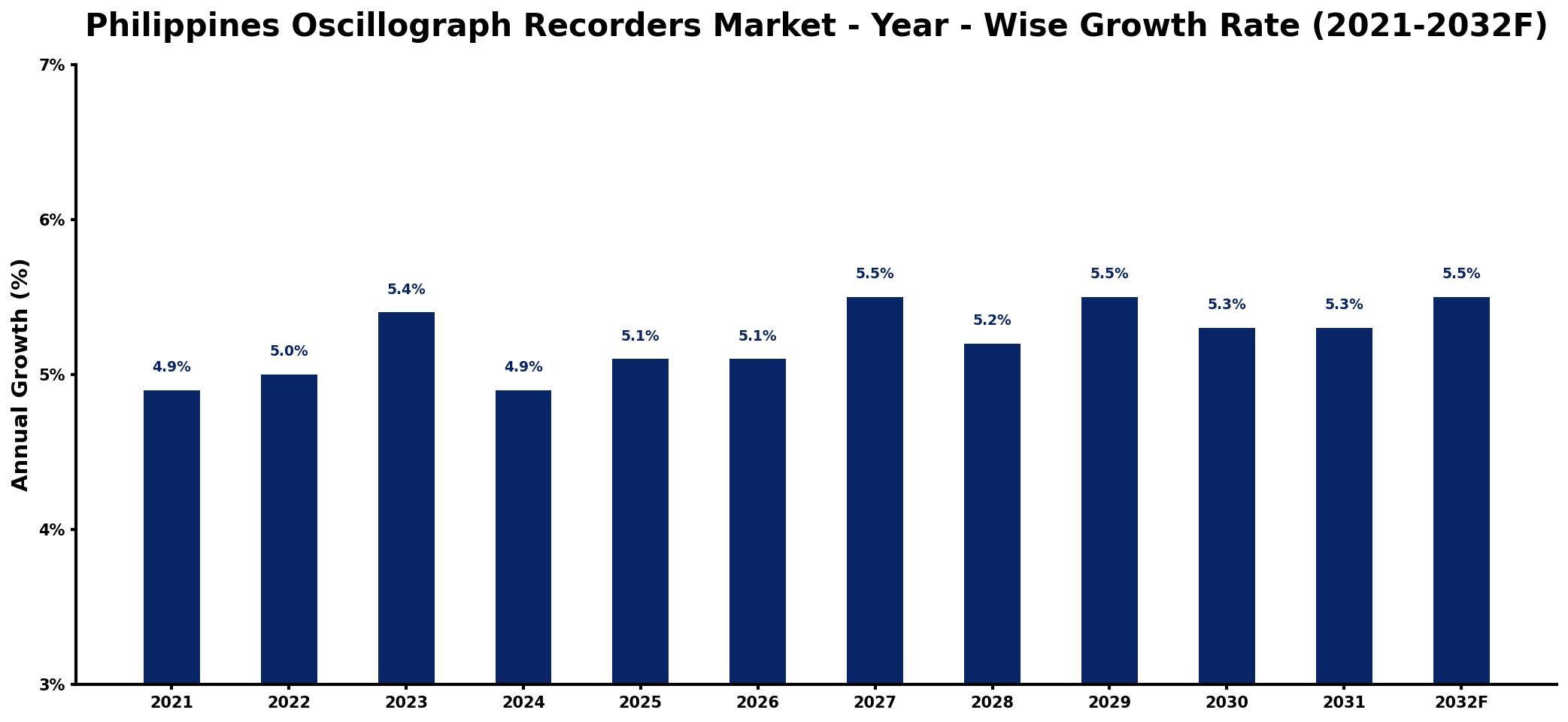
The table below presents the year‑wise growth rates along with the key drivers influencing the market
| Year | Growth Rate | Major Drivers |
| 2021 | 4.9% | Rising demand in healthcare sector |
| 2022 | 5.0% | Increased industrial automation investments |
| 2023 | 5.4% | Growing emphasis on data accuracy |
| 2024 | 4.9% | Expansion of renewable energy projects |
| 2025 | 5.1% | Advancements in research laboratories |
| 2026 | 5.1% | Strengthening environmental monitoring initiatives |
| 2027 | 5.5% | Surge in automotive testing requirements |
| 2028 | 5.2% | Boost in telecommunications infrastructure spending |
| 2029 | 5.5% | Growth in educational institutions funding |
| 2030 | 5.3% | Increased focus on smart cities |
| 2031 | 5.3% | Heightened interest in aerospace technologies |
| 2032 | 5.5% | Development of advanced manufacturing facilities |
Note: Market size estimations and growth projections presented in this report are based on 6Wresearch's proprietary forecasting methodology, utilizing the latest available industry data, government publications, and primary research inputs.
Philippines Oscillograph Recorders Market Synopsis
The oscillograph recorders market in the Philippines is experiencing a transformative phase, where advanced data measurement technologies are becoming indispensable. As industries evolve, the demand for sophisticated oscillograph solutions is evident across sectors such as electronics and power generation.
This growing reliance on detailed waveform analysis highlights the importance of oscillograph recorders in enhancing operational efficiency and ensuring high-quality outputs. Consequently, manufacturers are increasingly focusing on innovations that cater to the specific needs of various sectors, promising a dynamic market landscape.
Philippines Oscillograph Recorders Market Key Takeaways
- The market is characterized by a steady growth rate, fueled by increased demand from the electronics manufacturing and energy sectors.
- Technological advancements in oscillograph recorders are essential for meeting the evolving needs of diverse industries.
- The COVID-19 pandemic has underscored the significance of remote data collection and adaptability in measurement solutions.
- Ongoing innovations are vital to address challenges related to accuracy, signal integrity, and user interface efficiency.
- Key industry players are driving the market through advanced product offerings that cater to specific application needs.
Evaluation of Restraints in Philippines Oscillograph Recorders Market
Despite its growth potential, the oscillograph recorders market in the Philippines is not without its challenges. One notable restraint is the need for continuous innovation to keep pace with the rapidly evolving technological landscape. As industries diversify, oscillograph technologies must be adapted to meet unique requirements across various sectors. Moreover, ensuring the accuracy and integrity of the data captured remains a concern, as does the necessity for robust data storage solutions. Addressing these aspects requires ongoing investment in research and development, alongside improved technical support and user training, all of which are critical to enhancing operational efficiency and user satisfaction.
Philippines Oscillograph Recorders Market Trends
Current trends in the Philippines oscillograph recorders market indicate a notable shift towards integrating advanced digital technologies. With the growing adoption of IoT (Internet of Things) applications, oscillograph recorders are increasingly being designed to support remote monitoring and real-time data analysis. Additionally, the trend towards automation in industrial processes is driving demand for more precise and efficient measurement tools. As environmental regulations become stricter, the need for improved accuracy in waveform analysis will also play a pivotal role in shaping future product development.
Philippines Oscillograph Recorders Market Opportunities
The Philippines oscillograph recorders market presents significant opportunities for growth and investment. As the electronics manufacturing sector continues to expand, there is a burgeoning need for high-performance oscillograph solutions tailored to specific applications. Furthermore, the energy sector's focus on modernization and grid reliability opens doors for innovative measurement technologies that can address these challenges effectively. Research institutions and educational facilities also offer a platform for developing advanced oscillograph technologies, fostering collaboration that could lead to groundbreaking applications and improved measurement capabilities.
Government Initiatives in the Philippines Oscillograph Recorders Market
The Philippine government is actively promoting policies aimed at enhancing technological capabilities across various sectors. Public spending initiatives focused on the development of infrastructure for research and development are creating an environment conducive to innovation in measurement technologies. Additionally, programs aimed at boosting the electronics manufacturing sector include incentives for companies investing in advanced equipment and training. Such government support is instrumental in fostering a robust ecosystem for the oscillograph recorders market, facilitating growth and advancement.
Future Insights of the Philippines Oscillograph Recorders Market
Looking ahead to 2026-2032, the Philippines oscillograph recorders market is poised for substantial growth driven by continuous technological advancements and increasing market demand. The emphasis on precision in data collection and analysis is likely to stimulate the development of more sophisticated oscillograph solutions tailored to various applications. Moreover, as industries incorporate more digital technologies, the evolution of data analytics will create new opportunities for oscillograph recorders. The market is expected to adapt rapidly to these changes, leading to enhanced performance and broader applications in both established and emerging sectors.
Philippines Oscillograph Recorders Market Latest Developments (2025 - 2026)
In recent months, the Philippines oscillograph recorders market has seen a growing focus on the integration of AI and machine learning technologies into data analysis processes. There is an increasing demand for oscillograph recorders that can provide real-time insights and predictive analytics, streamlining operations across various industries. Furthermore, manufacturers are investing in enhanced training programs to ensure users can fully leverage the capabilities of these advanced instruments, thereby improving utilization rates and overall efficiency.
Philippines Oscillograph Recorders Market - Key Attractiveness of the Report
- 10 Years of Market Numbers
- Historical Data Starting from 2022 to 2025
- Base Year: 2025
- Forecast Data until 2032
- Key Performance Indicators Impacting the Market
- Major Upcoming Developments and Projects
Key Highlights of the Report:
- Philippines Oscillograph Recorders Market Outlook
- Market Size of Philippines Oscillograph Recorders Market, 2025
- Forecast of Philippines Oscillograph Recorders Market, 2032
- Historical Data and Forecast of Philippines Oscillograph Recorders Revenues & Volume for the Period 2022-2032F
- Philippines Oscillograph Recorders Market Trend Evolution
- Philippines Oscillograph Recorders Market Drivers and Challenges
- Philippines Oscillograph Recorders Price Trends
- Philippines Oscillograph Recorders Porter's Five Forces
- Philippines Oscillograph Recorders Industry Life Cycle
- Historical Data and Forecast of Philippines Oscillograph Recorders Market Revenues & Volume By Type for the Period 2022-2032F
- Historical Data and Forecast of Philippines Oscillograph Recorders Market Revenues & Volume By Desktop for the Period 2022-2032F
- Historical Data and Forecast of Philippines Oscillograph Recorders Market Revenues & Volume By Handheld for the Period 2022-2032F
- Historical Data and Forecast of Philippines Oscillograph Recorders Market Revenues & Volume By Portable for the Period 2022-2032F
- Historical Data and Forecast of Philippines Oscillograph Recorders Market Revenues & Volume By Application for the Period 2022-2032F
- Historical Data and Forecast of Philippines Oscillograph Recorders Market Revenues & Volume By Power Supply for the Period 2022-2032F
- Historical Data and Forecast of Philippines Oscillograph Recorders Market Revenues & Volume By Traffic Route for the Period 2022-2032F
- Historical Data and Forecast of Philippines Oscillograph Recorders Market Revenues & Volume By Others for the Period 2022-2032F
- Philippines Oscillograph Recorders Import Export Trade Statistics
- Market Opportunity Assessment By Type
- Market Opportunity Assessment By Application
- Philippines Oscillograph Recorders Top Companies Market Share
- Philippines Oscillograph Recorders Competitive Benchmarking By Technical and Operational Parameters
- Philippines Oscillograph Recorders Company Profiles
- Philippines Oscillograph Recorders Key Strategic Recommendations






































