Philippines Pearl Jewelry Market Size, Share & Growth Rate
The Philippines Pearl Jewelry Market was estimated at USD 338 Million in 2025 and is projected to reach USD 468 Million by 2032, growing at a CAGR of 4.8% from 2026 to 2032. This growth trajectory is primarily driven by the global demand for sustainable and ethically sourced jewelry, which aligns perfectly with the unique offerings of the Philippines. Additionally, the rich cultural heritage associated with pearl jewelry, coupled with the country's renowned pearl farming expertise, continues to enhance its market appeal.
Philippines Pearl Jewelry Market Year-wise Growth Rate and Key Drivers
This graph highlights how the Philippines Pearl Jewelry Market has steadily grown over the years, supported by major growth factors.
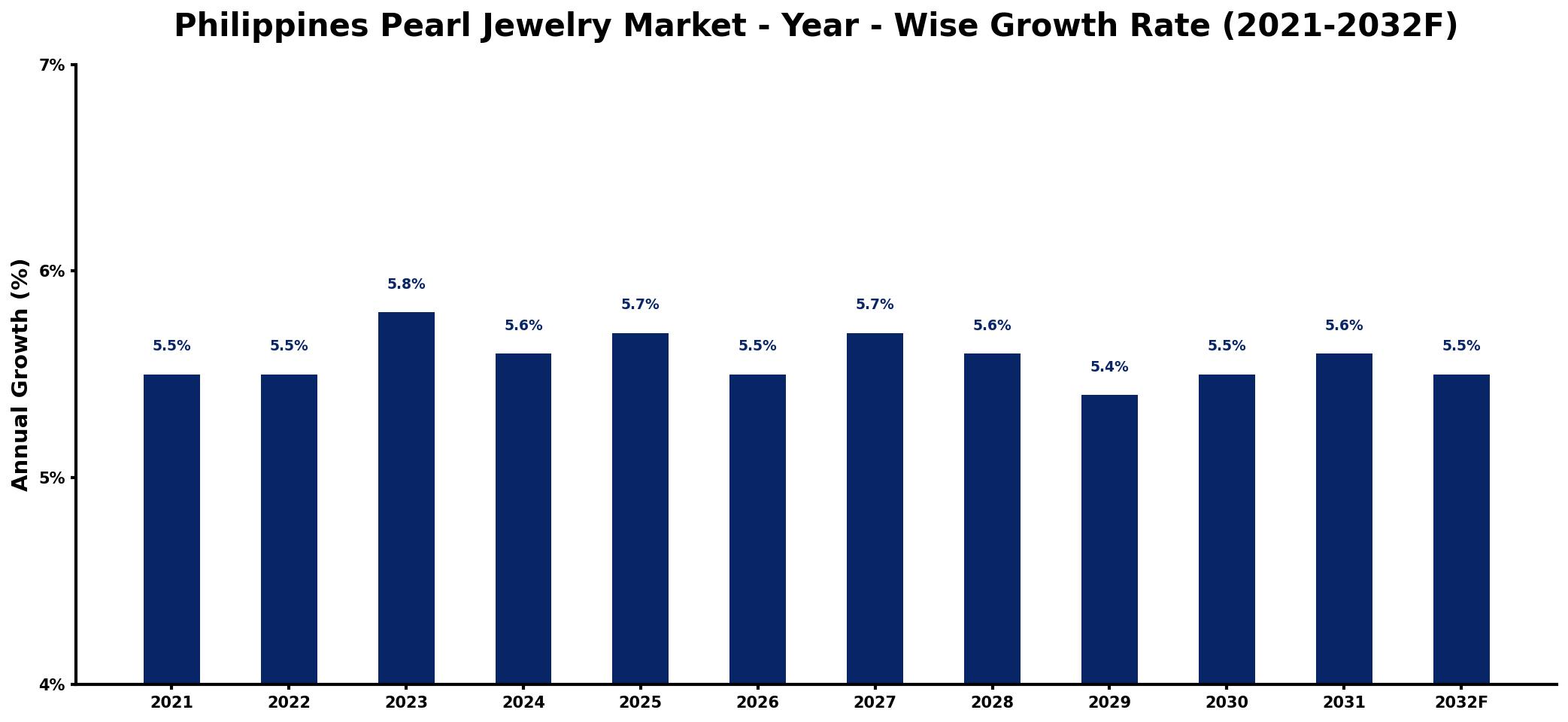
The table below presents the year‑wise growth rates along with the key drivers influencing the market
| Year | Growth Rate | Major Drivers |
| 2021 | 5.5% | Emerging luxury market demand |
| 2022 | 5.5% | Increased online retail presence |
| 2023 | 5.8% | Rising disposable income levels |
| 2024 | 5.6% | Growth in gifting trends |
| 2025 | 5.7% | Expansion of artisanal craftsmanship |
| 2026 | 5.5% | Investment in sustainable practices |
| 2027 | 5.7% | Boost in tourism spending |
| 2028 | 5.6% | Enhanced marketing strategies adopted |
| 2029 | 5.4% | Focus on unique designs |
| 2030 | 5.5% | Strengthened international trade relations |
| 2031 | 5.6% | Diversification of product offerings |
| 2032 | 5.5% | Collaboration with fashion influencers |
Note: Market size estimations and growth projections presented in this report are based on 6Wresearch's proprietary forecasting methodology, utilizing the latest available industry data, government publications, and primary research inputs.
Philippines Pearl Jewelry Market Synopsis
The Philippines pearl jewelry market showcases a vibrant landscape where tradition meets modernity. With an estimated annual valuation of around USD 1 billion, the allure of pearls remains strong, rooted deeply in Filipino culture. Freshwater pearls from Palawan are especially celebrated for their distinctive colors and luster, making them a popular choice among local and international consumers.
The market is characterized by approximately 4,000 to 5,000 retailers nationwide, offering a diverse array of pearl jewelry. Natural South Sea pearls, while significantly more expensive, are coveted for their size and brilliance, adding a luxurious dimension to the jewelry market in the Philippines. This dynamic interplay of quality and affordability positions the market favorably for continued growth.
Philippines Pearl Jewelry Market Key Takeaways
- The market is fueled by a rich cultural heritage and the availability of high-quality pearls.
- Online sales have surged, reflecting a shift in consumer purchasing behavior post-COVID-19.
- Freshwater pearls, especially from Palawan, are increasingly popular due to their unique aesthetics.
- Sustainable practices in pearl farming are becoming essential, aligning with global consumer preferences.
- The market faces competition from other pearl-producing countries, necessitating focus on quality and branding.
Evaluation of Restraints in Philippines Pearl Jewelry Market
Despite its promising outlook, the Philippines pearl jewelry market grapples with several restraints. Competition from other countries, such as Tahiti and Australia, can pressure local producers to enhance quality while keeping prices competitive. Moreover, maintaining consistent quality standards across a varied array of pearl types poses challenges to producers. The sustainability of pearl farming practices remains a critical issue, as the industry seeks to balance ecological concerns with market demands. Additionally, ever-evolving consumer preferences can introduce volatility into demand dynamics, necessitating continuous market adaptation.
Philippines Pearl Jewelry Market Trends
Several trends are shaping the Philippines pearl jewelry market. A prominent shift towards sustainable and ethically sourced materials is influencing consumer choices, driving demand for local, responsibly produced pearls. Furthermore, the rise of digital platforms and e-commerce is transforming the retail landscape, making it easier for consumers to access a broader variety of pearl jewelry. Customized and artisanal pieces are gaining traction, appealing to consumers seeking unique expressions of style. Overall, these trends are contributing to a revitalized perception of pearl jewelry as both a luxury item and a culturally significant accessory.
Philippines Pearl Jewelry Market Opportunities
The Philippines pearl jewelry market holds significant growth opportunities, particularly in the realm of sustainable practices. As consumers increasingly prioritize environmentally friendly products, companies that adopt eco-conscious farming and production methods will find a receptive market. Expanding e-commerce platforms can also tap into new demographics, enhancing accessibility and outreach. Additionally, collaborations between local artisans and international designers can further elevate the markets profile, creating a niche for high-end, unique pearl jewelry that reflects Filipino culture.
Government Initiatives in the Philippines Pearl Jewelry Market
The Philippine government has recognized the potential of the pearl jewelry market and is actively supporting the industry through various initiatives. This includes investments in research and development for sustainable pearl farming practices and grants for local businesses to enhance their export capabilities. Programs aimed at promoting local artisan skills are also in place, encouraging traditional craftsmanship while integrating modern techniques. Such efforts not only bolster the pearl industry but also aim to position the Philippines as a leading global hub for pearl jewelry.
Future Insights of the Philippines Pearl Jewelry Market
Looking ahead to 2026-2032, the Philippines pearl jewelry market is poised for substantial growth, driven by a combination of cultural significance and evolving consumer preferences. The growing emphasis on sustainability will likely continue to shape production methods and consumer purchasing decisions. Additionally, innovations in design and e-commerce strategies will enhance market reach, attracting a younger, more diverse consumer base. As the global luxury sector recovers post-pandemic, the Philippines stands ready to capture its share of the market, leveraging its rich heritage and commitment to quality.
Philippines Pearl Jewelry Market Latest Developments (2025 - 2026)
Recent developments in the Philippines pearl jewelry market indicate a robust movement towards enhanced digital marketing strategies. More brands are investing in online platforms to showcase their collections, capitalizing on the increasing trend of online shopping. There is also a growing collaboration between pearl farmers and designers to create limited-edition pieces that celebrate local culture. This period is witnessing a renewed focus on artisan craftsmanship, with efforts to revive traditional methods while integrating modern aesthetics.
Philippines Pearl Jewelry Market - Key Attractiveness of the Report
- 10 Years of Market Numbers
- Historical Data Starting from 2022 to 2025
- Base Year: 2025
- Forecast Data until 2032
- Key Performance Indicators Impacting the Market
- Major Upcoming Developments and Projects
Key Highlights of the Report:
- Philippines Pearl Jewelry Market Outlook
- Market Size of Philippines Pearl Jewelry Market, 2025
- Forecast of Philippines Pearl Jewelry Market, 2032
- Historical Data and Forecast of Philippines Pearl Jewelry Revenues & Volume for the Period 2022-2032F
- Philippines Pearl Jewelry Market Trend Evolution
- Philippines Pearl Jewelry Market Drivers and Challenges
- Philippines Pearl Jewelry Price Trends
- Philippines Pearl Jewelry Porter's Five Forces
- Philippines Pearl Jewelry Industry Life Cycle
- Historical Data and Forecast of Philippines Pearl Jewelry Market Revenues & Volume By Pearl Type for the Period 2022-2032F
- Historical Data and Forecast of Philippines Pearl Jewelry Market Revenues & Volume By Freshwater for the Period 2022-2032F
- Historical Data and Forecast of Philippines Pearl Jewelry Market Revenues & Volume By Saltwater for the Period 2022-2032F
- Historical Data and Forecast of Philippines Pearl Jewelry Market Revenues & Volume By Material Type for the Period 2022-2032F
- Historical Data and Forecast of Philippines Pearl Jewelry Market Revenues & Volume By Gold for the Period 2022-2032F
- Historical Data and Forecast of Philippines Pearl Jewelry Market Revenues & Volume By Silver for the Period 2022-2032F
- Historical Data and Forecast of Philippines Pearl Jewelry Market Revenues & Volume By Others for the Period 2022-2032F
- Historical Data and Forecast of Philippines Pearl Jewelry Market Revenues & Volume By Jewelry Type for the Period 2022-2032F
- Historical Data and Forecast of Philippines Pearl Jewelry Market Revenues & Volume By Necklace for the Period 2022-2032F
- Historical Data and Forecast of Philippines Pearl Jewelry Market Revenues & Volume By Earrings for the Period 2022-2032F
- Historical Data and Forecast of Philippines Pearl Jewelry Market Revenues & Volume By Rings for the Period 2022-2032F
- Historical Data and Forecast of Philippines Pearl Jewelry Market Revenues & Volume By Others for the Period 2022-2032F
- Philippines Pearl Jewelry Import Export Trade Statistics
- Market Opportunity Assessment By Pearl Type
- Market Opportunity Assessment By Material Type
- Market Opportunity Assessment By Jewelry Type
- Philippines Pearl Jewelry Top Companies Market Share
- Philippines Pearl Jewelry Competitive Benchmarking By Technical and Operational Parameters
- Philippines Pearl Jewelry Company Profiles
- Philippines Pearl Jewelry Key Strategic Recommendations






































