Philippines Peer-to-peer (P2P) lending Market Size, Share & Growth Rate
The Philippines Peer-to-peer (P2P) lending Market was estimated at USD 379 Million in 2025 and is projected to reach USD 505 Million by 2032, growing at a CAGR of 4.2% from 2026 to 2032. This growth trajectory is underpinned by increasing consumer preference for alternative financing options that offer quick access to funds and competitive interest rates. Moreover, the proliferation of digital payment platforms has made it easier for borrowers and lenders to connect, further propelling market expansion.
Philippines Peer-to-peer (P2P) lending Market Year-wise Growth Rate and Key Drivers
This graph highlights how the Philippines Peer-to-peer (P2P) lending Market has steadily grown over the years, supported by major growth factors.
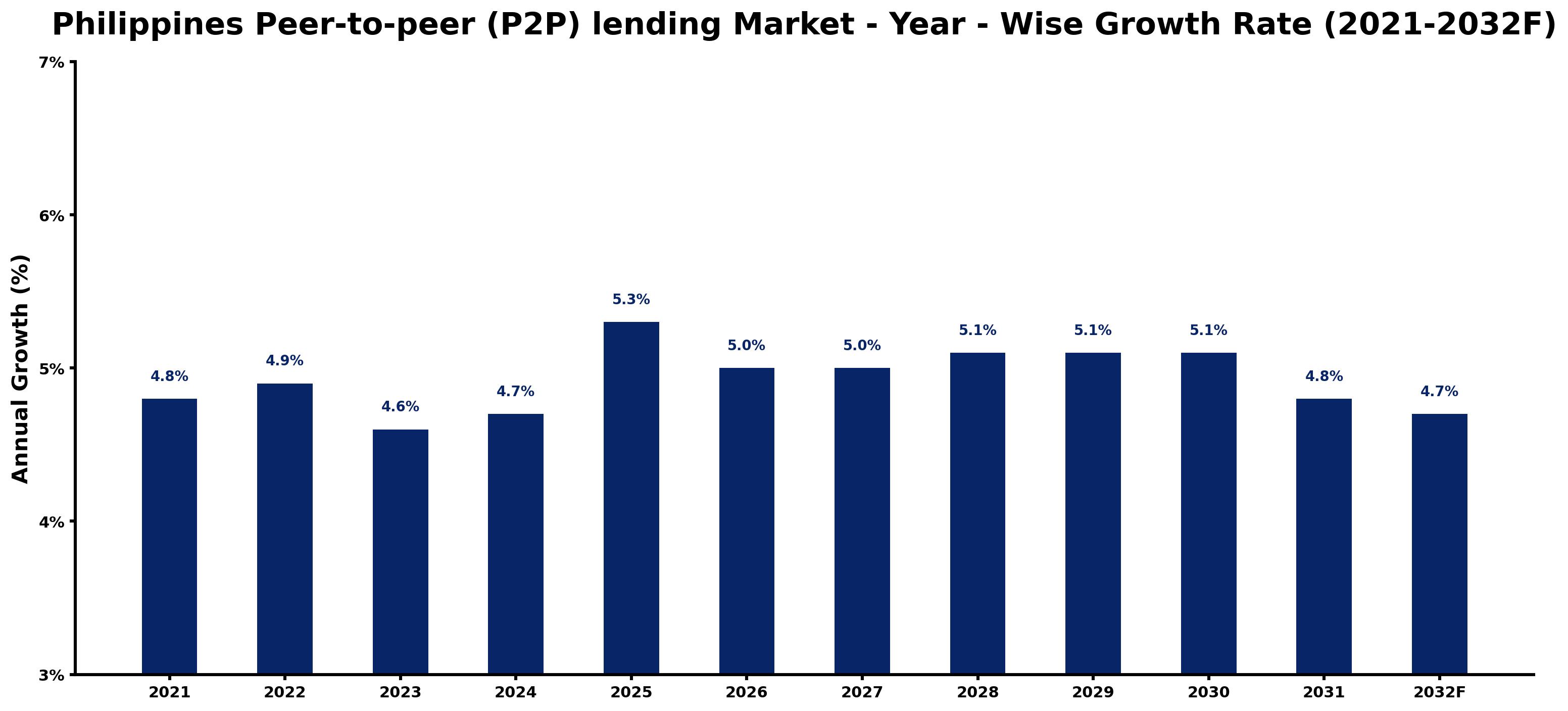
The table below presents the year‑wise growth rates along with the key drivers influencing the market
| Year | Growth Rate | Major Drivers |
| 2021 | 4.8% | Increasing smart city development projects |
| 2022 | 4.9% | Increasing adoption of advanced technologies |
| 2023 | 4.6% | Expansion of commercial construction activities |
| 2024 | 4.7% | Expansion of commercial construction activities |
| 2025 | 5.3% | Expansion of manufacturing activities |
| 2026 | 5.0% | Government infrastructure modernization initiatives |
| 2027 | 5.0% | Increasing smart city development projects |
| 2028 | 5.1% | Expansion of commercial construction activities |
| 2029 | 5.1% | Rapid growth in telecom and data center sectors |
| 2030 | 5.1% | Government infrastructure modernization initiatives |
| 2031 | 4.8% | Expansion of manufacturing activities |
| 2032 | 4.7% | Increasing industrial infrastructure investments |
Note - Market size estimations and growth projections presented in this report are based on 6Wresearch's advanced forecasting approach, validated with industry datasets as of June 2026.
Philippines Peer-to-peer (P2P) lending Market Synopsis
The Philippines P2P lending market has gained considerable momentum, marking a shift in the country's borrowing landscape. With more individuals opting for direct lending platforms over traditional banks, the market is poised for continued growth driven by favorable economic conditions and an evolving regulatory framework.
As technological advancements enhance user experience, the demand for P2P lending solutions is likely to rise. Increased awareness of the benefits—such as lower costs and faster service—coupled with improving consumer trust, positions this market for significant opportunities ahead.
Philippines Peer-to-peer (P2P) lending Market Key Takeaways
- The market is experiencing robust growth driven by a preference for lower interest rates and quicker approval processes.
- Stricter regulations have bolstered consumer trust and protection, encouraging wider adoption of P2P lending.
- Digital payment solutions are enhancing connectivity between lenders and borrowers, facilitating easier transactions.
- High compliance costs remain a barrier for new entrants, impacting the competitive landscape.
- Future innovations in fintech are expected to further transform the lending ecosystem in the Philippines.
Evaluation of Restraints in Philippines Peer-to-peer (P2P) lending Market
While the P2P lending market exhibits strong growth potential, it faces challenges that could hinder progress. One significant restraint is the inherent risk management issues tied to lending without comprehensive credit histories. Many lenders struggle to accurately assess borrower creditworthiness, which can lead to increased defaults. Additionally, the regulatory landscape is constantly evolving, and compliance with these stringent regulations often incurs high costs, affecting operational viability for newer players.
Philippines Peer-to-peer (P2P) lending Market Trends
Several trends are shaping the Philippines P2P lending market. The rapid digitalization of payment methods through e-wallets and mobile banking apps is transforming how users access and use lending services. Furthermore, there is a growing focus on improving user experience through technology, such as AI-driven credit scoring systems that enhance risk assessment. Lastly, the trend toward consumer loyalty programs is becoming more prominent, encouraging timely repayments and enhancing borrower retention.
Philippines Peer-to-peer (P2P) lending Market Opportunities
The Philippine P2P lending sector presents significant investment opportunities, particularly in underserved demographics. Small and medium enterprises (SMEs) represent a large potential market, as traditional financial institutions often overlook these borrowers. Additionally, innovations in lending platforms that integrate blockchain technology could enhance transaction transparency and security, making the market more appealing to both lenders and borrowers. Strategic partnerships with fintech firms and traditional banks can also open new avenues for growth.
Government Initiatives in the Philippines Peer-to-peer (P2P) lending Market
The Philippine government has recognized the potential of P2P lending as a vehicle for financial inclusion and economic growth. Recent initiatives have focused on establishing clearer regulatory frameworks that protect consumers while fostering innovation. Public spending has been directed towards enhancing digital infrastructure, facilitating easier access to P2P lending platforms. These efforts aim to streamline compliance processes and encourage more players to enter the market while safeguarding the interests of both lenders and borrowers.
Future Insights of the Philippines Peer-to-peer (P2P) lending Market
Looking ahead to the 2026-2032 period, the Philippines P2P lending market is expected to evolve significantly, driven by technological advancements and regulatory support. As borrowers increasingly seek flexible financing solutions, P2P platforms that leverage artificial intelligence and big data will likely gain a competitive edge in risk assessment and customer service. Additionally, with financial literacy on the rise, more individuals may embrace P2P lending, reinforcing its position as a mainstream financing option.
Philippines Peer-to-peer (P2P) lending Market Latest Developments (May 2025 - June 2026)
Recent developments in the Philippines P2P lending market have highlighted a shift towards enhanced regulatory measures aimed at protecting consumers and ensuring fair practices. The introduction of new compliance protocols has prompted many platforms to innovate in their service offerings. There has also been a growing integration of advanced data analytics in risk assessment processes, further improving the efficiency of loan approvals and borrower evaluations.
Philippines Peer-to-peer (P2P) lending Market - Key Attractiveness of the Report
- 10 Years of Market Numbers
- Historical Data Starting from 2022 to 2025
- Base Year: 2025
- Forecast Data until 2032
- Key Performance Indicators Impacting the Market
- Major Upcoming Developments and Projects
Key Highlights of the Report:
- Philippines Peer-to-peer (P2P) lending Market Outlook
- Market Size of Philippines Peer-to-peer (P2P) lending Market, 2025
- Forecast of Philippines Peer-to-peer (P2P) lending Market, 2032
- Historical Data and Forecast of Philippines Peer-to-peer (P2P) lending Revenues & Volume for the Period 2022-2032F
- Philippines Peer-to-peer (P2P) lending Market Trend Evolution
- Philippines Peer-to-peer (P2P) lending Market Drivers and Challenges
- Philippines Peer-to-peer (P2P) lending Price Trends
- Philippines Peer-to-peer (P2P) lending Porter's Five Forces
- Philippines Peer-to-peer (P2P) lending Industry Life Cycle
- Historical Data and Forecast of Philippines Peer-to-peer (P2P) lending Market Revenues & Volume By Business Model for the Period 2022-2032F
- Historical Data and Forecast of Philippines Peer-to-peer (P2P) lending Market Revenues & Volume By Alternate Marketplace Lending for the Period 2022-2032F
- Historical Data and Forecast of Philippines Peer-to-peer (P2P) lending Market Revenues & Volume By Traditional Lending for the Period 2022-2032F
- Historical Data and Forecast of Philippines Peer-to-peer (P2P) lending Market Revenues & Volume By Type for the Period 2022-2032F
- Historical Data and Forecast of Philippines Peer-to-peer (P2P) lending Market Revenues & Volume By Consumer Lending for the Period 2022-2032F
- Historical Data and Forecast of Philippines Peer-to-peer (P2P) lending Market Revenues & Volume By Business Lending for the Period 2022-2032F
- Historical Data and Forecast of Philippines Peer-to-peer (P2P) lending Market Revenues & Volume By End User for the Period 2022-2032F
- Historical Data and Forecast of Philippines Peer-to-peer (P2P) lending Market Revenues & Volume By Consumer Credit Loans for the Period 2022-2032F
- Historical Data and Forecast of Philippines Peer-to-peer (P2P) lending Market Revenues & Volume By Small Business Loans for the Period 2022-2032F
- Historical Data and Forecast of Philippines Peer-to-peer (P2P) lending Market Revenues & Volume By Student Loans for the Period 2022-2032F
- Historical Data and Forecast of Philippines Peer-to-peer (P2P) lending Market Revenues & Volume By Real Estate Loans for the Period 2022-2032F
- Philippines Peer-to-peer (P2P) lending Import Export Trade Statistics
- Market Opportunity Assessment By Business Model
- Market Opportunity Assessment By Type
- Market Opportunity Assessment By End User
- Philippines Peer-to-peer (P2P) lending Top Companies Market Share
- Philippines Peer-to-peer (P2P) lending Competitive Benchmarking By Technical and Operational Parameters
- Philippines Peer-to-peer (P2P) lending Company Profiles
- Philippines Peer-to-peer (P2P) lending Key Strategic Recommendations






































