Philippines Perchloroethylene Market Size, Share & Growth Rate
The Philippines Perchloroethylene Market was estimated at USD 162 Million in 2025 and is projected to reach USD 213 Million by 2032, growing at a CAGR of 4.0% from 2026 to 2032. This growth is primarily driven by the increasing demand from the manufacturing sector, particularly in textiles and dry cleaning, where perchloroethylene is favored for its effective solvent properties. Moreover, the push towards greener alternatives is catalyzing innovations and adaptations within the market landscape.
Philippines Perchloroethylene Market Year-wise Growth Rate and Key Drivers
This graph highlights how the Philippines Perchloroethylene Market has steadily grown over the years, supported by major growth factors.
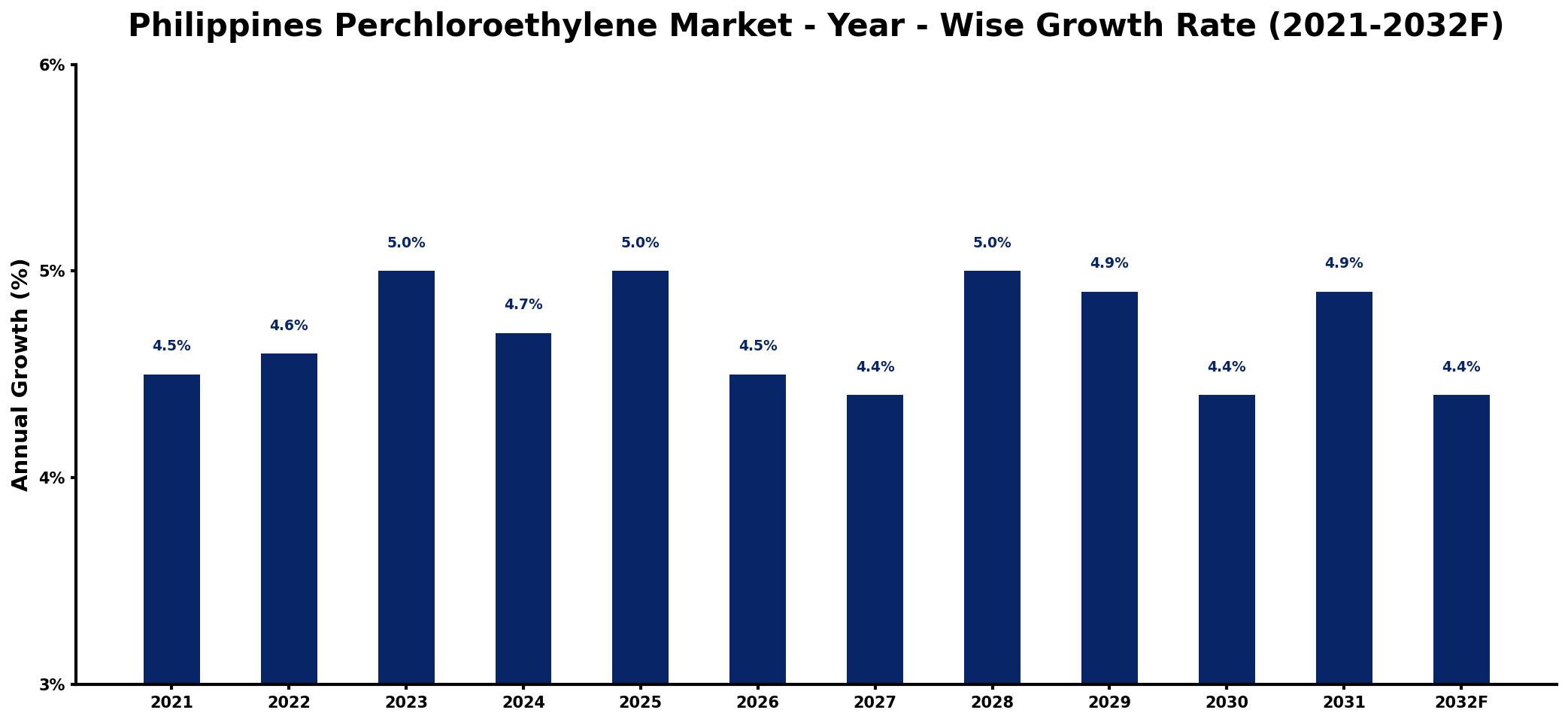
The table below presents the year‑wise growth rates along with the key drivers influencing the market
| Year | Growth Rate | Major Drivers |
| 2021 | 4.5% | Rising demand for cleaning agents |
| 2022 | 4.6% | Expansion of textile manufacturing sector |
| 2023 | 5.0% | Increased investment in industrial chemicals |
| 2024 | 4.7% | Growth in automotive repair services |
| 2025 | 5.0% | Surge in dry cleaning businesses |
| 2026 | 4.5% | Enhancements in solvent recovery technologies |
| 2027 | 4.4% | Emergence of eco-friendly alternatives |
| 2028 | 5.0% | Revitalization of electronics manufacturing |
| 2029 | 4.9% | Boost in construction industry activities |
| 2030 | 4.4% | Growing awareness of safety standards |
| 2031 | 4.9% | Increased production capacities established |
| 2032 | 4.4% | Demand from paint and coatings |
Note: Market size estimations and growth projections presented in this report are based on 6Wresearch's proprietary forecasting methodology, utilizing the latest available industry data, government publications, and primary research inputs.
Philippines Perchloroethylene Market Synopsis
In the Philippines, perchloroethylene plays a crucial role, particularly in the dry cleaning industry, where it remains a go-to solvent due to its superior cleaning ability and non-flammability. Despite the challenges posed by increasing regulations, the sector is witnessing a gradual recovery as industries ramp up operations post-pandemic.
The growing awareness of environmental sustainability is also reshaping the market. While perchloroethylene is effective, theres a notable trend toward seeking out eco-friendly alternatives, pushing companies to adapt their practices. This evolving mindset reflects a broader shift in consumer preferences and regulatory frameworks.
Philippines Perchloroethylene Market Key Takeaways
- The market is projected to grow steadily, reaching USD 213 Million by 2032.
- Demand from the textile and dry cleaning sectors drives market dynamics significantly.
- Regulatory pressures concerning environmental sustainability are shaping future business strategies.
- Awareness of and shift towards eco-friendly alternatives are influencing industry practices.
- Recovery from the COVID-19 pandemic is expected to rejuvenate the market momentum.
Evaluation of Restraints in Philippines Perchloroethylene Market
The Philippines perchloroethylene market is grappling with significant constraints related to heightened environmental regulations. Stricter policies aimed at minimizing pollution have put pressure on the industries reliant on this solvent, as regulatory bodies push for reduced emissions and safer disposal practices. This regulatory environment complicates operational frameworks, compelling businesses to pivot towards alternative solutions that align with sustainability goals, thus shaping the market's future trajectory.
Philippines Perchloroethylene Market Trends
Current trends highlight a marked inclination towards sustainability, influencing product development and operational strategies. Companies are increasingly focusing on innovation to introduce greener alternatives while maintaining the efficacy that perchloroethylene offers. Moreover, the rise of digital platforms is fostering better consumer awareness, empowering end-users to make informed decisions about the solvents they utilize, thereby pushing manufacturers to adapt swiftly to changing demands.
Philippines Perchloroethylene Market Opportunities
There exists a substantial opportunity within the Philippines perchloroethylene market for companies willing to innovate and transition towards environmentally friendly alternatives. As industries adapt to new regulations and consumer preferences, there will be a rising demand for low-impact solvents that can effectively replace perchloroethylene without compromising performance. Investments in research and development could unlock new avenues for growth, positioning businesses as leaders in a more sustainable industrial landscape.
Government Initiatives in the Philippines Perchloroethylene Market
The Philippine government is increasingly focusing on environmental sustainability, prompting several initiatives aimed at reducing chemical pollutants and promoting safer alternatives. Through various regulatory measures, the government encourages industries to comply with strict environmental standards, which are essential for both public health and ecological well-being. Such policies not only aim to mitigate the adverse effects of chemicals like perchloroethylene but also stimulate investment in green technology and sustainable practices.
Future Insights of the Philippines Perchloroethylene Market
Looking towards 2026-2032, the Philippines perchloroethylene market is anticipated to evolve significantly amidst changing consumer attitudes and regulatory landscapes. As demand for sustainable practices grows, companies that invest in alternative solvents and eco-friendly technologies may find themselves at a competitive advantage. The markets progression will be closely tied to how well stakeholders can address environmental concerns while maintaining operational efficiency.
Philippines Perchloroethylene Market Latest Developments (2025 - 2026)
Recent developments indicate a shift in industry focus towards environmental compliance and innovation in alternative solvents. Various initiatives aimed at reducing the environmental footprint of chemical usage have emerged, with companies exploring new formulations that mitigate the adverse effects of perchloroethylene. Additionally, the impact of post-pandemic recovery strategies is starting to reshape operational efficiencies across sectors traditionally reliant on this solvent, setting the stage for future growth.
Philippines Perchloroethylene Market - Key Attractiveness of the Report
- 10 Years of Market Numbers
- Historical Data Starting from 2022 to 2025
- Base Year: 2025
- Forecast Data until 2032
- Key Performance Indicators Impacting the Market
- Major Upcoming Developments and Projects
Key Highlights of the Report:
- Philippines Perchloroethylene Market Outlook
- Market Size of Philippines Perchloroethylene Market, 2025
- Forecast of Philippines Perchloroethylene Market, 2032
- Historical Data and Forecast of Philippines Perchloroethylene Revenues & Volume for the Period 2022-2032F
- Philippines Perchloroethylene Market Trend Evolution
- Philippines Perchloroethylene Market Drivers and Challenges
- Philippines Perchloroethylene Price Trends
- Philippines Perchloroethylene Porter's Five Forces
- Philippines Perchloroethylene Industry Life Cycle
- Historical Data and Forecast of Philippines Perchloroethylene Market Revenues & Volume By Type for the Period 2022-2032F
- Historical Data and Forecast of Philippines Perchloroethylene Market Revenues & Volume By Ethylene Oxychlorination for the Period 2022-2032F
- Historical Data and Forecast of Philippines Perchloroethylene Market Revenues & Volume By Acetylene Method for the Period 2022-2032F
- Historical Data and Forecast of Philippines Perchloroethylene Market Revenues & Volume By Ethylene Direct Chlorination for the Period 2022-2032F
- Historical Data and Forecast of Philippines Perchloroethylene Market Revenues & Volume By End-use for the Period 2022-2032F
- Historical Data and Forecast of Philippines Perchloroethylene Market Revenues & Volume By Dry Cleaning Agent for the Period 2022-2032F
- Historical Data and Forecast of Philippines Perchloroethylene Market Revenues & Volume By Solvent for the Period 2022-2032F
- Historical Data and Forecast of Philippines Perchloroethylene Market Revenues & Volume By Others for the Period 2022-2032F
- Philippines Perchloroethylene Import Export Trade Statistics
- Market Opportunity Assessment By Type
- Market Opportunity Assessment By End-use
- Philippines Perchloroethylene Top Companies Market Share
- Philippines Perchloroethylene Competitive Benchmarking By Technical and Operational Parameters
- Philippines Perchloroethylene Company Profiles
- Philippines Perchloroethylene Key Strategic Recommendations






































