Philippines Period Panties Market Top 5 Importing Countries and Market Competition (HHI) Analysis
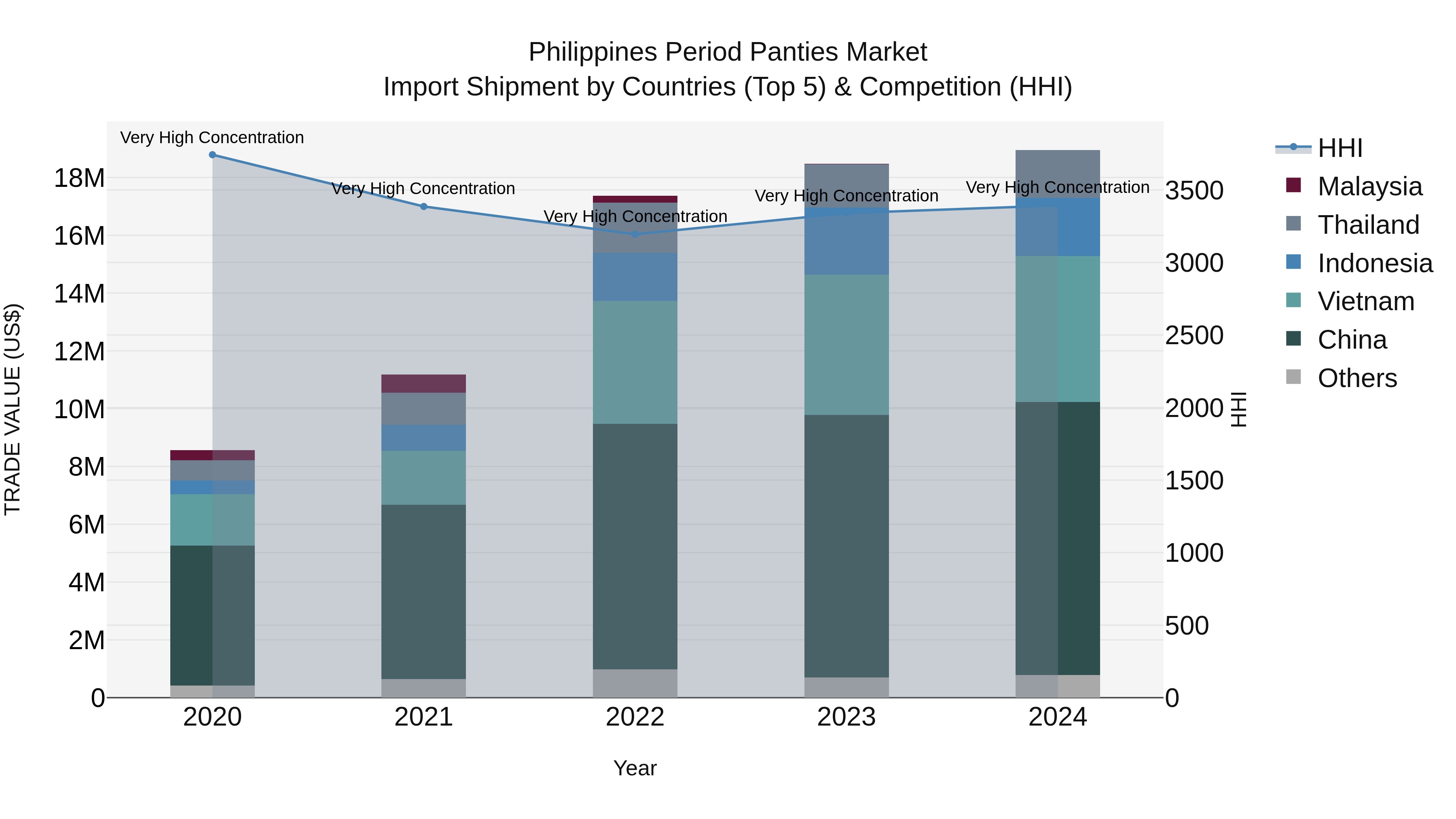
The period panties import market in the Philippines continues to see strong growth with a high concentration of shipments from top exporting countries including China, Vietnam, Indonesia, Thailand, and Sri Lanka in 2024. The high Herfindahl-Hirschman Index (HHI) indicates a concentrated market structure. With a Compound Annual Growth Rate (CAGR) of 21.94% from 2020 to 2024, the market shows significant expansion. Although the growth rate slightly decreased to 2.58% from 2023 to 2024, the overall trend remains positive, reflecting the increasing demand for period panties in the Philippines.
Philippines Period Panties Market Overview
The period panties market in the Philippines is growing due to increasing awareness of sustainable menstrual hygiene products and the rising demand for comfortable alternatives to disposable sanitary products. Eco-conscious consumers are driving market expansion, along with government and non-governmental initiatives promoting menstrual health education. The availability of various brands and styles, along with online retail expansion, has made period panties more accessible to consumers. However, higher prices compared to traditional menstrual products and cultural stigmas surrounding menstruation pose barriers to wider market adoption.
Drivers of the market
The period panties market in the Philippines is driven by growing awareness and acceptance of alternative menstrual products. With increasing focus on sustainability and eco-friendly options, period panties have gained popularity as a reusable, comfortable, and discreet option during menstruation. The rise in health-conscious consumers seeking non-toxic, chemical-free menstrual solutions is another key factor contributing to the expansion of this market in the Philippines.
Challenges of the market
The period panties market in the Philippines faces several challenges, including cultural taboos surrounding menstruation that can affect the adoption of alternative menstrual products like period panties. Many consumers remain unfamiliar with the benefits of reusable menstrual products, which can create resistance to switching from traditional sanitary pads. Additionally, the high cost of period panties compared to disposable products makes it difficult for many Filipinas, particularly those in low-income areas, to afford these sustainable options. Distribution networks are also underdeveloped in rural areas, further limiting accessibility. Moreover, the lack of robust education and awareness campaigns about menstrual health contributes to the slow growth of this market segment.
Investment opportunities in the Market
The period panties market in the Philippines offers attractive investment opportunities in sustainable and eco-friendly menstrual products. With the growing shift toward sustainability, there is increasing demand for reusable alternatives to traditional sanitary products. Companies that innovate in the design and functionality of period panties, such as those incorporating advanced fabrics for better comfort and absorbency, can capture a significant market share. Additionally, investments in e-commerce platforms and digital marketing strategies could help reach a broader customer base, especially among younger, eco-conscious consumers. Expanding manufacturing facilities locally could help reduce costs and improve product availability.
Government Policy of the market
Sustainability initiatives and menstrual health awareness campaigns influence government policies on menstrual hygiene products, including period panties. The Department of Education (DepEd) and the DOH support menstrual health education in schools, promoting reusable alternatives to disposable sanitary products. The push for tax reductions on essential hygiene products aims to make sustainable options more affordable. However, cultural stigmas surrounding menstruation and limited government subsidies for eco-friendly menstrual products slow market expansion.
Key Highlights of the Report:
- Philippines Period Panties Market Outlook
- Market Size of Philippines Period Panties Market, 2024
- Forecast of Philippines Period Panties Market, 2031
- Historical Data and Forecast of Philippines Period Panties Revenues & Volume for the Period 2021- 2031
- Philippines Period Panties Market Trend Evolution
- Philippines Period Panties Market Drivers and Challenges
- Philippines Period Panties Price Trends
- Philippines Period Panties Porter's Five Forces
- Philippines Period Panties Industry Life Cycle
- Historical Data and Forecast of Philippines Period Panties Market Revenues & Volume By Product Type for the Period 2021- 2031
- Historical Data and Forecast of Philippines Period Panties Market Revenues & Volume By Reusable Period Panties for the Period 2021- 2031
- Historical Data and Forecast of Philippines Period Panties Market Revenues & Volume By Disposable Period Panties for the Period 2021- 2031
- Historical Data and Forecast of Philippines Period Panties Market Revenues & Volume By Style for the Period 2021- 2031
- Historical Data and Forecast of Philippines Period Panties Market Revenues & Volume By Boy Shorts for the Period 2021- 2031
- Historical Data and Forecast of Philippines Period Panties Market Revenues & Volume By Bikini for the Period 2021- 2031
- Historical Data and Forecast of Philippines Period Panties Market Revenues & Volume By Briefs for the Period 2021- 2031
- Historical Data and Forecast of Philippines Period Panties Market Revenues & Volume By Hipster for the Period 2021- 2031
- Historical Data and Forecast of Philippines Period Panties Market Revenues & Volume By Others (Thongs, Shorts etc.) for the Period 2021- 2031
- Historical Data and Forecast of Philippines Period Panties Market Revenues & Volume By Age Group for the Period 2021- 2031
- Historical Data and Forecast of Philippines Period Panties Market Revenues & Volume By Below 20 Years for the Period 2021- 2031
- Historical Data and Forecast of Philippines Period Panties Market Revenues & Volume By 20-30 Years for the Period 2021- 2031
- Historical Data and Forecast of Philippines Period Panties Market Revenues & Volume By 30-40 Years for the Period 2021- 2031
- Historical Data and Forecast of Philippines Period Panties Market Revenues & Volume By Above 40 Years for the Period 2021- 2031
- Historical Data and Forecast of Philippines Period Panties Market Revenues & Volume By Size for the Period 2021- 2031
- Historical Data and Forecast of Philippines Period Panties Market Revenues & Volume By Small for the Period 2021- 2031
- Historical Data and Forecast of Philippines Period Panties Market Revenues & Volume By Medium for the Period 2021- 2031
- Historical Data and Forecast of Philippines Period Panties Market Revenues & Volume By Large for the Period 2021- 2031
- Historical Data and Forecast of Philippines Period Panties Market Revenues & Volume By Price Range for the Period 2021- 2031
- Historical Data and Forecast of Philippines Period Panties Market Revenues & Volume By Low for the Period 2021- 2031
- Historical Data and Forecast of Philippines Period Panties Market Revenues & Volume By Medium for the Period 2021- 2031
- Historical Data and Forecast of Philippines Period Panties Market Revenues & Volume By High for the Period 2021- 2031
- Historical Data and Forecast of Philippines Period Panties Market Revenues & Volume By Distribution Channel for the Period 2021- 2031
- Historical Data and Forecast of Philippines Period Panties Market Revenues & Volume By Online for the Period 2021- 2031
- Historical Data and Forecast of Philippines Period Panties Market Revenues & Volume By Company owned Websites for the Period 2021- 2031
- Historical Data and Forecast of Philippines Period Panties Market Revenues & Volume By E-commerce Websites for the Period 2021- 2031
- Historical Data and Forecast of Philippines Period Panties Market Revenues & Volume By Offline for the Period 2021- 2031
- Historical Data and Forecast of Philippines Period Panties Market Revenues & Volume By Supermarkets/ Hypermarkets for the Period 2021- 2031
- Historical Data and Forecast of Philippines Period Panties Market Revenues & Volume By Drug Stores for the Period 2021- 2031
- Historical Data and Forecast of Philippines Period Panties Market Revenues & Volume By Specialty Stores for the Period 2021- 2031
- Historical Data and Forecast of Philippines Period Panties Market Revenues & Volume By Other Retail Stores for the Period 2021- 2031
- Philippines Period Panties Import Export Trade Statistics
- Market Opportunity Assessment By Product Type
- Market Opportunity Assessment By Style
- Market Opportunity Assessment By Age Group
- Market Opportunity Assessment By Size
- Market Opportunity Assessment By Price Range
- Market Opportunity Assessment By Distribution Channel
- Philippines Period Panties Top Companies Market Share
- Philippines Period Panties Competitive Benchmarking By Technical and Operational Parameters
- Philippines Period Panties Company Profiles
- Philippines Period Panties Key Strategic Recommendations






































