Philippines Personal Computers Market Size, Share & Growth Rate
The Philippines Personal Computers Market was estimated at USD 1293 Million in 2025 and is projected to reach USD 1860 Million by 2032, growing at a CAGR of 5.3% from 2026 to 2032. This positive trajectory is driven by ongoing digital transformation initiatives undertaken by local businesses and government agencies, alongside a rise in consumer disposable income. These factors contribute to an increased demand across various segments, including gaming PCs and laptops, enhancing overall market dynamism.
Philippines Personal Computers Market Year-wise Growth Rate and Key Drivers
This graph highlights how the Philippines Personal Computers Market has steadily grown over the years, supported by major growth factors.
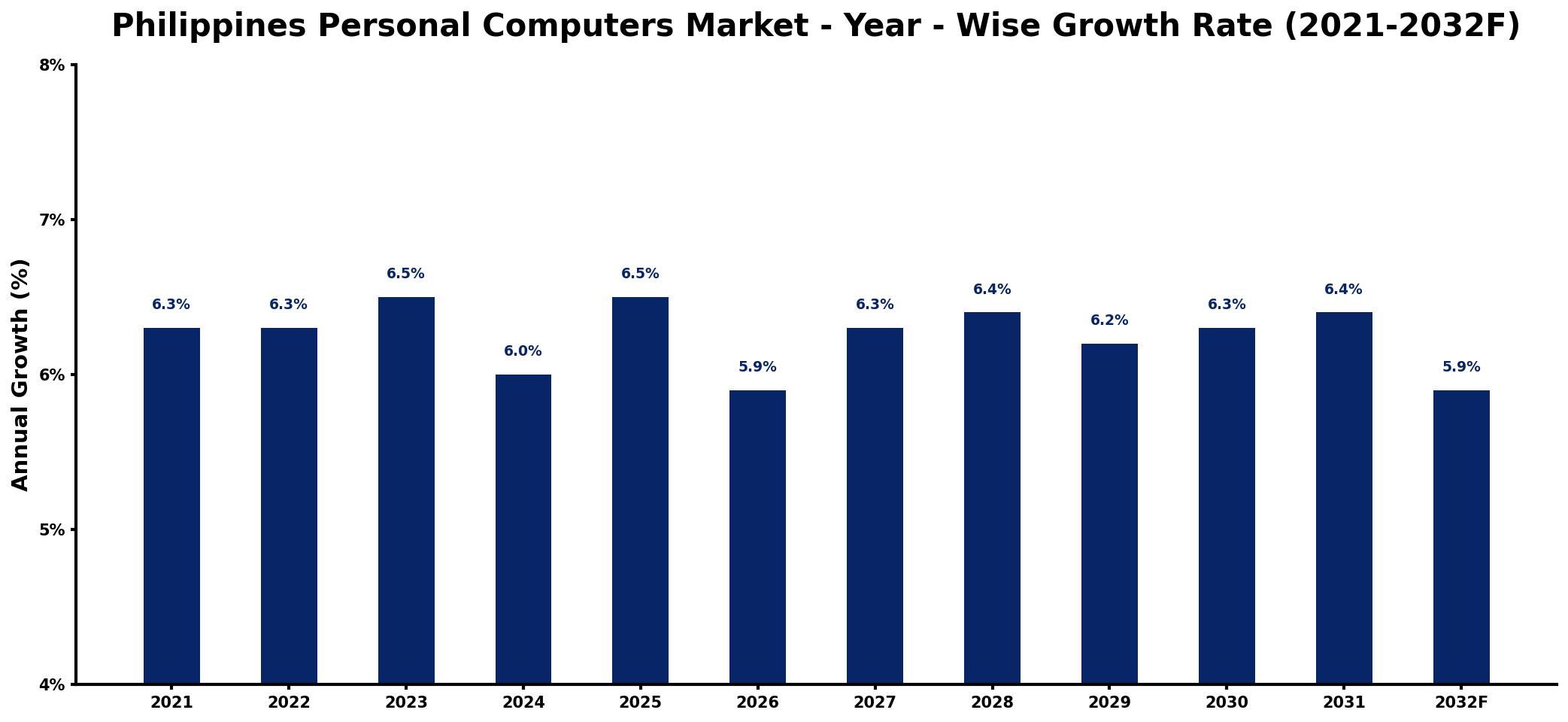
The table below presents the year‑wise growth rates along with the key drivers influencing the market
| Year | Growth Rate | Major Drivers |
| 2021 | 6.3% | Rising remote work adoption trends |
| 2022 | 6.3% | Increased digital education initiatives |
| 2023 | 6.5% | Growing demand for gaming setups |
| 2024 | 6.0% | Expansion of tech infrastructure projects |
| 2025 | 6.5% | Surge in online content creation |
| 2026 | 5.9% | Investments in cloud computing services |
| 2027 | 6.3% | Enhanced e-commerce platform development |
| 2028 | 6.4% | Rise in telehealth service utilization |
| 2029 | 6.2% | Growth in virtual collaboration tools |
| 2030 | 6.3% | Increased focus on cybersecurity solutions |
| 2031 | 6.4% | Development of smart home technologies |
| 2032 | 5.9% | growing automotive sector requirements |
Note: Market size estimations and growth projections presented in this report are based on 6Wresearch's proprietary forecasting methodology, utilizing the latest available industry data, government publications, and primary research inputs.
Philippines Personal Computers Market Synopsis
The demand for personal computers in the Philippines is bolstered by a growing trend toward remote work and online education, which have increased the necessity for reliable computing devices. Additionally, the rise in digital literacy initiatives is creating a more tech-savvy population that actively seeks advanced computing solutions.
The current landscape reflects a significant influx of affordable personal computer options, enabling a broader demographic to access modern technology. Enhanced internet connectivity further supports this growth, facilitating seamless digital interactions and encouraging more households to invest in personal computing.
Philippines Personal Computers Market Key Takeaways
- Strong growth projected from 2025 to 2032, driven by increased consumer spending and technology adoption.
- Digital transformation initiatives by local businesses and government are pivotal in boosting market demand.
- Affordability and improved internet access are key factors enabling broader market reach.
- Growing consumer segments include gaming PCs and portable devices for education and remote work.
- Government efforts in promoting digital literacy are shaping a conducive environment for market expansion.
Evaluation of Restraints in Philippines Personal Computers Market
Despite the optimistic outlook, the Philippines personal computers market faces certain restraints. Key issues include affordability barriers that prevent lower-income households from purchasing modern devices. Additionally, the rapid shift towards mobile technology poses a challenge for traditional PCs, as consumers may prioritize smartphones and tablets for their computing needs. Moreover, enhancing digital literacy remains a crucial hurdle to ensure that all demographics can fully leverage the advantages of personal computers.
Philippines Personal Computers Market Trends
Current trends in the Philippines personal computers market reveal a strong inclination toward high-performance gaming PCs, fueled by a burgeoning gaming culture. Simultaneously, the demand for lightweight laptops and notebooks continues to rise, driven by the shift towards hybrid work models. Eco-friendly technologies and energy-efficient devices are also gaining traction as consumers become more environmentally conscious, influencing product development and marketing strategies.
Philippines Personal Computers Market Opportunities
Opportunities for growth in the Philippines personal computers market are abundant, especially in e-learning solutions as the education sector continues to embrace digital tools. Moreover, potential investments in local assembly or manufacturing of PCs could reduce costs and improve market accessibility. As remote work solidifies its place in the employment landscape, services and products catering specifically to this new paradigm hold significant promise.
Government Initiatives in the Philippines Personal Computers Market
The Philippine government is actively promoting digital literacy through various initiatives aimed at enhancing technology access in education and the workforce. Programs focused on improving internet infrastructure are crucial, as they help to ensure that a wider population can benefit from digital technologies. Government spending on IT infrastructure and incentives for local businesses to invest in technology will further contribute to the growth of the personal computers market.
Future Insights of the Philippines Personal Computers Market
Looking forward to 2026-2032, the Philippines personal computers market is poised for continued growth as digitalization efforts expand across various sectors. The combination of increasing disposable incomes and technological advancements will further drive demand, particularly for versatile devices that meet both professional and personal needs. Enhanced government support and public-private partnerships are likely to stimulate innovation, making this a dynamic sector with promising prospects.
Philippines Personal Computers Market Latest Developments (2025 - 2026)
Recent developments in the Philippines personal computers market indicate a continued focus on sustainable technology and eco-friendly products. Furthermore, companies are actively exploring partnerships to improve product availability and logistics efficiency. Innovations in gaming PCs and portable workstations are also emerging, reflecting the changing demands of consumers in a post-pandemic landscape.
Philippines Personal Computers Market - Key Attractiveness of the Report
- 10 Years of Market Numbers
- Historical Data Starting from 2022 to 2025
- Base Year: 2025
- Forecast Data until 2032
- Key Performance Indicators Impacting the Market
- Major Upcoming Developments and Projects
Key Highlights of the Report:
- Philippines Personal Computers Market Outlook
- Market Size of Philippines Personal Computers Market, 2025
- Forecast of Philippines Personal Computers Market, 2032
- Historical Data and Forecast of Philippines Personal Computers Revenues & Volume for the Period 2022-2032F
- Philippines Personal Computers Market Trend Evolution
- Philippines Personal Computers Market Drivers and Challenges
- Philippines Personal Computers Price Trends
- Philippines Personal Computers Porter's Five Forces
- Philippines Personal Computers Industry Life Cycle
- Historical Data and Forecast of Philippines Personal Computers Market Revenues & Volume By Product Type for the Period 2022-2032F
- Historical Data and Forecast of Philippines Personal Computers Market Revenues & Volume By Desktop for the Period 2022-2032F
- Historical Data and Forecast of Philippines Personal Computers Market Revenues & Volume By Notebook for the Period 2022-2032F
- Historical Data and Forecast of Philippines Personal Computers Market Revenues & Volume By Workstation for the Period 2022-2032F
- Historical Data and Forecast of Philippines Personal Computers Market Revenues & Volume By Others for the Period 2022-2032F
- Historical Data and Forecast of Philippines Personal Computers Market Revenues & Volume By Distribution Channel for the Period 2022-2032F
- Historical Data and Forecast of Philippines Personal Computers Market Revenues & Volume By Business-To-Business (B2B) for the Period 2022-2032F
- Historical Data and Forecast of Philippines Personal Computers Market Revenues & Volume By Business-To-Consumer (B2C) for the Period 2022-2032F
- Historical Data and Forecast of Philippines Personal Computers Market Revenues & Volume By Application for the Period 2022-2032F
- Historical Data and Forecast of Philippines Personal Computers Market Revenues & Volume By Consumer for the Period 2022-2032F
- Historical Data and Forecast of Philippines Personal Computers Market Revenues & Volume By Commercial for the Period 2022-2032F
- Historical Data and Forecast of Philippines Personal Computers Market Revenues & Volume By Industrial for the Period 2022-2032F
- Philippines Personal Computers Import Export Trade Statistics
- Market Opportunity Assessment By Product Type
- Market Opportunity Assessment By Distribution Channel
- Market Opportunity Assessment By Application
- Philippines Personal Computers Top Companies Market Share
- Philippines Personal Computers Competitive Benchmarking By Technical and Operational Parameters
- Philippines Personal Computers Company Profiles
- Philippines Personal Computers Key Strategic Recommendations






































