Philippines Pesticides Market (2026-2032) | Companies, Outlook, Industry, Growth, Value, Revenue, Trends, Share, Analysis, Size & Forecast
Market Forecast By Product Type (Conventional Chemicals, Bio pesticides), By Application (Pre-Harvest, Post-Harvest) And Competitive Landscape
| Product Code: ETC338309 | Publication Date: Aug 2022 | Updated Date: Feb 2026 | Product Type: Market Research Report | |
| Publisher: 6Wresearch | Author: Ravi Bhandari | No. of Pages: 75 | No. of Figures: 35 | No. of Tables: 20 |
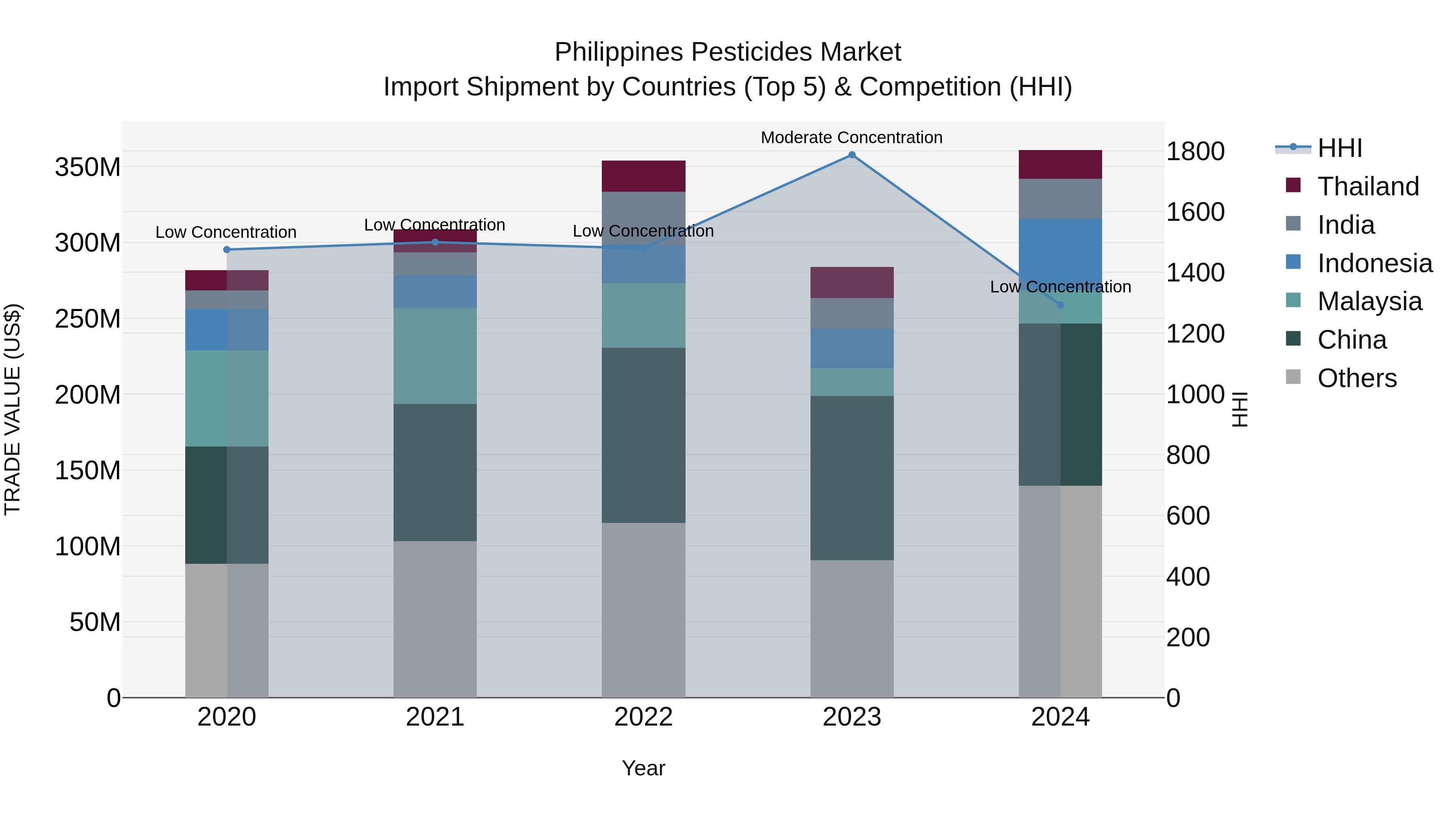
Philippines Pesticides Market Top 5 Importing Countries and Market Competition (HHI) Analysis
The Philippines experienced a significant increase in pesticides import shipments in 2024, with top exporters being China, Indonesia, India, Malaysia, and South Korea. The market showed a shift towards lower concentration levels, indicating a more diverse import market. The compound annual growth rate (CAGR) from 2020 to 2024 was strong at 6.38%, with an impressive growth rate of 27.13% from 2023 to 2024. This growth trend suggests a growing demand for pesticides in the Philippines, potentially driven by various factors such as agricultural expansion and pest management needs.
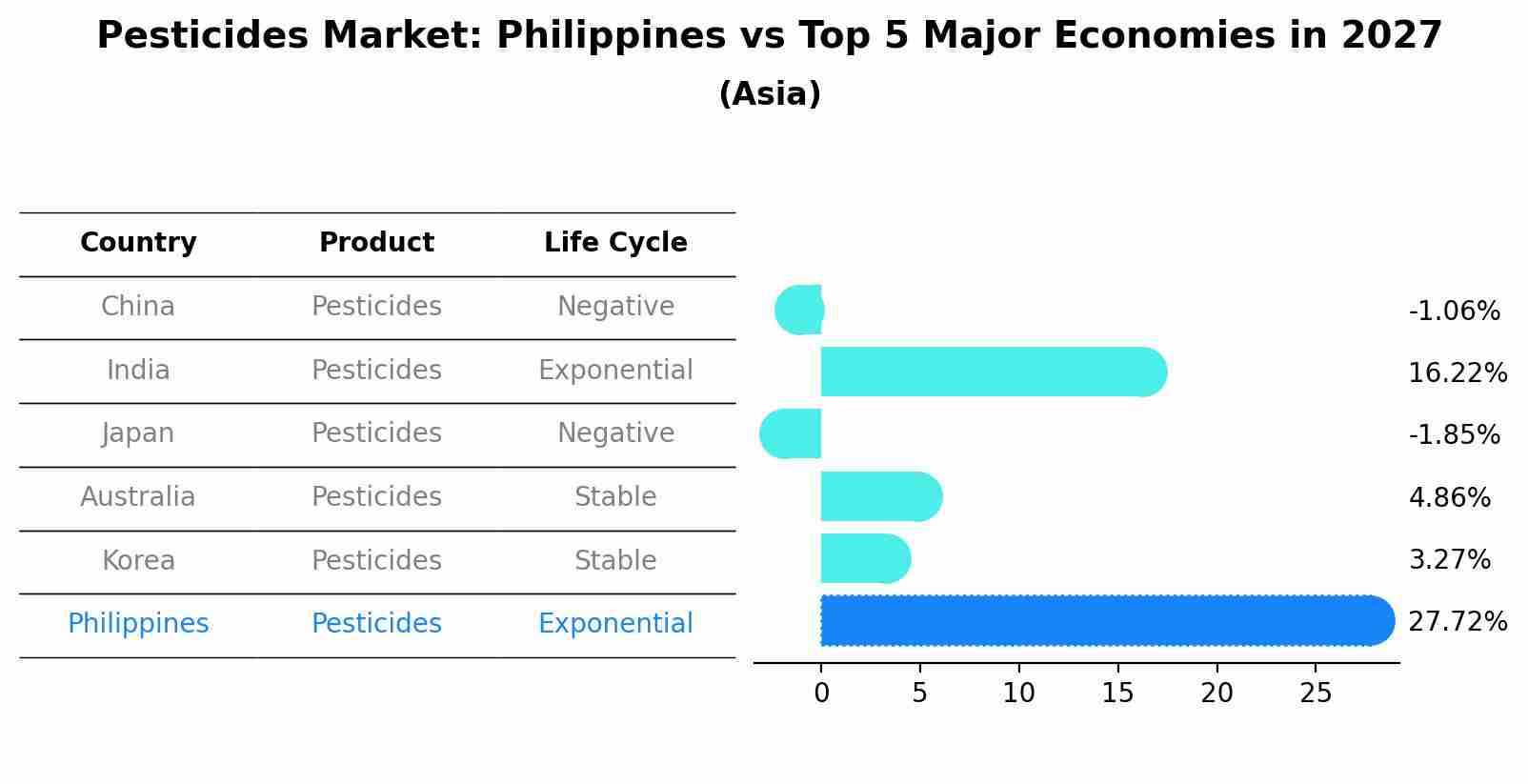
Pesticides Market: Philippines vs Top 5 Major Economies in 2027 (Asia)
By 2027, Philippines's Pesticides market is forecasted to achieve a exponential growth rate of 27.72%, with China leading the Asia region, followed by India, Japan, Australia and South Korea.
Philippines Pesticides Market Growth Rate
According to 6Wresearch internal database and industry insights, the Philippines Pesticides Market is projected to grow at a compound annual growth rate (CAGR) of 5.4% during the forecast period (2026–2032).
Topics Covered in the Philippines Pesticides Market Report
The Philippines Pesticides Market report thoroughly covers the market by product type, application, and end user. The report provides a detailed analysis of ongoing market trends, opportunities/high-growth areas, and market drivers that will help stakeholders align strategies based on current and future market dynamics.
Philippines Pesticides Market Highlights
| Report Name | Philippines Pesticides Market |
| Forecast Period | 2026–2032 |
| CAGR | 5.4% |
| Growing Sector | Bio-pesticides and Fruits & Vegetables |
Philippines Pesticides Market Synopsis
Philippines Pesticides Market is projected to attain significant expansion in the coming years due to the modernization of the agricultural sector and the rising demand for crop yield maximization. As a primarily agrarian economy, the Philippines is focusing on food self-sufficiency, which has led to the intensive use of crop protection chemicals. Growth is primarily bolstered by the integration of Integrated Pest Management (IPM) practices and the increasing export of premium fruits. Besides, the adoption of biopesticides is providing a sustainable substitute to traditional chemicals which caters to the bourgeoning organic farming movement.
Evaluation of Growth Drivers in Philippines Pesticides Market
Below are some prominent drivers and their influence on the market dynamics:
| Drivers | Primary Segments Affected | Why It Matters |
| Export Demand | By End User (Fruits & Vegetables) | Stringent phytosanitary standards for exports require advanced pest control. |
| Rice Self-Sufficiency | By End User (Cereals & Grains) | National programs promote the use of herbicides and insecticides for rice. |
| Bio-pesticide Shift | By Product Type (Bio-pesticides) | Consumer preference for chemical-free produce drives botanical pesticide sales. |
| Digital Farming | By Application (Pre-Harvest) | Drone technology allows for more precise and frequent pesticide application. |
| Pest Outbreaks | By Product Type (Insecticides) | Recurring invasive species in corn and coconut sectors necessitate quick chemical response |
Philippines Pesticides Market is projected to grow at a CAGR of 5.4% during the forecast period (2026-2032). Owing to the increasing professionalization of smallholder farmers and rising investments in climate-resilient agriculture, the growth is expected to remain steady during the projected period. The demand for specialized formulations that can withstand the tropical weather and high humidity of the archipelago is accelerating adoption to a major extent. Apart from this, major advancements in formulation stability and the entry of innovative global players are further contributing to the Philippines Pesticides Market growth across the Visayas and Mindanao regions.
Evaluation of Restraints in Philippines Pesticides Market
Below are some prominent restraints and their influence on the market dynamics:
| Restraints | Primary Segments Affected | What This Means |
| Regulatory Hurdles | By Product Type (Conventional) | Stringent FPA (Fertilizer and Pesticide Authority) registration can delay products. |
| Counterfeit Products | By Application (Pre-Harvest) | Illegitimate pesticides weaken market value and crop safety. |
| Environmental Taxes | By Product Type (Chemicals) | Potential "Green Taxes" on hazardous chemicals could upsurge retail prices. |
| Logistics Costs | By Distribution Channel | The archipelagic nature of the country makes last-mile delivery expensive. |
| Climate Sensitivity | By Application (Post-Harvest) | Extreme weather events like typhoons disrupt farming cycles and pesticide application. |
Philippines Pesticides Market Challenges
Philippines Pesticides Market is set for robust growth due to significant drivers. However, there are major challenges related to the rigorous environmental regulations enforced by the Fertilizer and Pesticide Authority (FPA). Apart from this, high costs of R&D for localized bio-pesticides act as a major barrier for local manufacturers. On the other hand, the fragmented nature of the Philippine islands makes the supply chain complex and susceptible to price volatility.
Philippines Pesticides Market Trends
Some of the new trends that are emerging within the Philippines Pesticides Market include:
- The introduction of Drone-as-a-Service (DaaS): Companies such as Aqua Aero are now providing farmers with drone spraying services to apply pesticides to bananas and pineapples grown on large scale plantation.
- The increase in the use of Botanical Formulations: There is now greater interest among farmers operating organically in Benguet and Davao region of the Philippines regarding their usage of neem oil and botanically derived pesticide products.
- The emerging presence of Smart Packaging and Traceability Options: Leading players within the Philippines Pesticides Industry are placing QR codes on pesticide containers to reduce exposure to counterfeit products and provide farmers with instructional resources for using the product.
Investment Opportunities in the Philippines Pesticides Market
The following represent potential investment opportunities available within the Philippines Pesticides Market:
- Development of Regional Distribution Hubs: Establishing blending and storage facilities within Mindanao Region to service the high overall demand for fruit exports.
- Developing Bio-pesticide Production: Invest in local production of microbial and plant extract-based pesticide products to take advantage of government incentives to promote sustainable agriculture.
- Post Harvest Protection: The need to develop advanced fungicides and preservatives used during transportation and storage of perishable products to decrease amount of food spoilage associated with inter-island shipping.
Top 5 Leading Players in the Philippines Pesticides Market
Below is a list of prominent companies leading the Philippines Pesticides Industry:
1. Syngenta Philippines Inc.
| Company Name | Syngenta Philippines Inc. |
|---|---|
| Established Year | 2002 |
| Headquarters | Makati City, Metro Manila |
| Official Website | Click Here |
A global leader focusing on high-performance crop protection for rice and corn. They are known for their integrated "Rice 60" solutions and advanced seed treatment technologies.
2. Bayer CropScience Philippines
| Company Name | Bayer CropScience Philippines |
|---|---|
| Established Year | 1962 |
| Headquarters | Taguig City, Metro Manila |
| Official Website | Click Here |
A major provider of herbicides and fungicides, Bayer is deeply involved in the "Bayer Agri-Solutions" program which provides holistic support to Filipino smallholders.
3. Leads Agricultural Products Corporation
| Company Name | Leads Agricultural Products Corporation |
|---|---|
| Established Year | 1997 |
| Headquarters | Santa Rosa, Laguna |
| Official Website | Click Here |
A 100% Filipino-owned company that has grown into a dominant local player, specializing in cost-effective insecticides and foliar fertilizers tailored for the local climate.
4. Corteva Agriscience Philippines
| Company Name | Corteva Agriscience Philippines |
|---|---|
| Established Year | 2019 (Global Spin-off) |
| Headquarters | Mandaluyong City, Metro Manila |
| Official Website | Click Here |
Focusing on science-driven crop protection, Corteva is a leader in provide hybrid seeds paired with specialized herbicides for the corn and rice sectors.
5. Jardine Distribution, Inc. (JDI)
| Company Name | Jardine Distribution, Inc. (JDI) |
|---|---|
| Established Year | 1997 |
| Headquarters | Makati City, Metro Manila |
| Official Website | - |
JDI represents various global brands and provides a wide array of agricultural pesticides and home pest control products, leveraging a massive nationwide distribution network.
Government Regulations in the Philippines Pesticides Market
The Fertilizer and Pesticide Authority (FPA) of the Philippines Government have the responsibility of regulating the importation and sale of pesticides. One of the main programs they operate is the National Integrated Pest Management (IPM) program, or Kasakalikasan, which trains farmers to prioritize biological controls over traditional pesticide usage. The Organic Agriculture Act (Republic Act 10068), a law of the Philippines, provides financial assistance to companies developing bio-pesticides as a means of reducing the environmental footprint of their production. The government has imposed maximum residue limits on export produce in line with international standards established by Japan and the EU.
Future Insights of the Philippines Pesticides Market
The future of the Philippines Pesticide Market is set to revolve around "Biological-Chemical Hybridization," where farmers utilize traditional chemical pesticides for crisis management and bio-pesticides for ongoing maintenance. The rollout of 5G technology across rural regions in the Philippines will allow for the utilization of IoT sensor technology, enabling farmers to perform real-time pest monitoring and spot-spray rather than applying pesticides to entire fields. As the population of the world becomes increasingly aware of environmental issues, the market for pesticides will increasingly shift towards "Green Label" pesticides, or biodegradable pesticides that have a lesser impact on non-target organisms (like bees).
Market Segmentation Analysis
The report offers a comprehensive study of the following market segments and their leading categories:
By Product Type – Conventional Chemicals to Lead the Market
According to Vasudha, Senior Research Analyst, 6Wresearch, Conventional Chemicals segment, including synthetic insecticides and herbicides, currently dominates the Philippines Pesticides Market share owing to their proven efficacy, immediate results, and lower cost-per-acre compared to early-stage biologicals.
By Application – Pre-Harvest to Lead the Market
Pre-Harvest segment leads the application category as it encompasses the entire growing season where crops are most vulnerable to pests and diseases. Filipino farmers invest heavily in insecticides and fungicides during the vegetative and reproductive stages of crop growth to prevent yield loss.
Key Attractiveness of the Report
- 10 Years of Market Numbers
- Historical Data Starting from 2022 to 2025
- Base Year: 2025
- Forecast Data until 2032
- Key Performance Indicators Impacting the Market
- Major Upcoming Developments and Projects
Key Highlights of the Report:
- Philippines Pesticides Market Outlook
- Market Size of Philippines Pesticides Market, 2025
- Forecast of Philippines Pesticides Market, 2032
- Historical Data and Forecast of Philippines Pesticides Revenues & Volume for the Period 2022-2032
- Philippines Pesticides Market Trend Evolution
- Philippines Pesticides Market Drivers and Challenges
- Philippines Pesticides Price Trends
- Philippines Pesticides Porter's Five Forces
- Philippines Pesticides Industry Life Cycle
- Historical Data and Forecast of Philippines Pesticides Market Revenues & Volume By Product Type for the Period 2022-2032
- Historical Data and Forecast of Philippines Pesticides Market Revenues & Volume By Conventional Chemicals for the Period 2022-2032
- Historical Data and Forecast of Philippines Pesticides Market Revenues & Volume By Bio pesticides for the Period 2022-2032
- Historical Data and Forecast of Philippines Pesticides Market Revenues & Volume By Application for the Period 2022-2032
- Historical Data and Forecast of Philippines Pesticides Market Revenues & Volume By Pre-Harvest for the Period 2022-2032
- Historical Data and Forecast of Philippines Pesticides Market Revenues & Volume By Post-Harvest for the Period 2022-2032
- Philippines Pesticides Import Export Trade Statistics
- Market Opportunity Assessment By Product Type
- Market Opportunity Assessment By Application
- Philippines Pesticides Top Companies Market Share
- Philippines Pesticides Competitive Benchmarking By Technical and Operational Parameters
- Philippines Pesticides Company Profiles
- Philippines Pesticides Key Strategic Recommendations
Market Covered
The report offers a comprehensive study of the following market segments:
By Product Type
- Conventional Chemicals
- Bio pesticides
By Application
- Pre-Harvest
- Post-Harvest
Philippines Pesticides Market (2026-2032): FAQs
The demand is driven by government subsidies for organic farming, stricter export regulations on chemical residues, and rising awareness of soil health among smallholders.
Key trends include the rise of bio-pesticides, precision agriculture, Integrated Pest Management (IPM), and smart spraying technologies.
Philippines Pesticides Market is projected to grow at a CAGR of 5.4% during the forecast period 2026-2032.
New entrants must circumnavigate the FPA’s demanding multi-year field testing requirements for agrochemical safety.
6Wresearch actively monitors the Philippines Pesticides Market and publishes its comprehensive annual report, highlighting emerging trends, growth drivers, revenue analysis, and forecast outlook. Our insights help businesses to make data-backed strategic decisions with ongoing market dynamics. Our analysts track relevent industries related to the Philippines Pesticides Market, allowing our clients with actionable intelligence and reliable forecasts tailored to emerging regional needs.
Yes, we provide customisation as per your requirements. To learn more, feel free to contact us on sales@6wresearch.com
| 1 Executive Summary |
| 2 Introduction |
| 2.1 Key Highlights of the Report |
| 2.2 Report Description |
| 2.3 Market Scope & Segmentation |
| 2.4 Research Methodology |
| 2.5 Assumptions |
| 3 Philippines Pesticides Market Overview |
| 3.1 Philippines Country Macro Economic Indicators |
| 3.2 Philippines Pesticides Market Revenues & Volume, 2022 & 2032F |
| 3.3 Philippines Pesticides Market - Industry Life Cycle |
| 3.4 Philippines Pesticides Market - Porter's Five Forces |
| 3.5 Philippines Pesticides Market Revenues & Volume Share, By Product Type, 2022 & 2032F |
| 3.6 Philippines Pesticides Market Revenues & Volume Share, By Application, 2022 & 2032F |
| 4 Philippines Pesticides Market Dynamics |
| 4.1 Impact Analysis |
| 4.2 Market Drivers |
| 4.2.1 Increasing demand for food production due to the growing population in the Philippines |
| 4.2.2 Government initiatives to promote agricultural productivity and ensure food security |
| 4.2.3 Adoption of modern farming techniques and technologies to improve crop yields |
| 4.3 Market Restraints |
| 4.3.1 Strict regulations on pesticide use and environmental concerns |
| 4.3.2 Rising awareness among farmers about the negative impacts of chemical pesticides on health and the environment |
| 5 Philippines Pesticides Market Trends |
| 6 Philippines Pesticides Market, By Types |
| 6.1 Philippines Pesticides Market, By Product Type |
| 6.1.1 Overview and Analysis |
| 6.1.2 Philippines Pesticides Market Revenues & Volume, By Product Type, 2022-2032F |
| 6.1.3 Philippines Pesticides Market Revenues & Volume, By Conventional Chemicals, 2022-2032F |
| 6.1.4 Philippines Pesticides Market Revenues & Volume, By Bio pesticides, 2022-2032F |
| 6.2 Philippines Pesticides Market, By Application |
| 6.2.1 Overview and Analysis |
| 6.2.2 Philippines Pesticides Market Revenues & Volume, By Pre-Harvest, 2022-2032F |
| 6.2.3 Philippines Pesticides Market Revenues & Volume, By Post-Harvest, 2022-2032F |
| 7 Philippines Pesticides Market Import-Export Trade Statistics |
| 7.1 Philippines Pesticides Market Export to Major Countries |
| 7.2 Philippines Pesticides Market Imports from Major Countries |
| 8 Philippines Pesticides Market Key Performance Indicators |
| 8.1 Adoption rate of integrated pest management practices |
| 8.2 Investment in research and development of biopesticides |
| 8.3 Number of partnerships between local farmers and pesticide companies for sustainable farming practices. |
| 9 Philippines Pesticides Market - Opportunity Assessment |
| 9.1 Philippines Pesticides Market Opportunity Assessment, By Product Type, 2022 & 2032F |
| 9.2 Philippines Pesticides Market Opportunity Assessment, By Application, 2022 & 2032F |
| 10 Philippines Pesticides Market - Competitive Landscape |
| 10.1 Philippines Pesticides Market Revenue Share, By Companies, 2025 |
| 10.2 Philippines Pesticides Market Competitive Benchmarking, By Operating and Technical Parameters |
| 11 Company Profiles |
| 12 Recommendations |
| 13 Disclaimer |
Global Go To Market Strategy - 2030
Export potential enables firms to identify high-growth global markets with greater confidence by combining advanced trade intelligence with a structured quantitative methodology. The framework analyzes emerging demand trends and country-level import patterns while integrating macroeconomic and trade datasets such as GDP and population forecasts, bilateral import–export flows, tariff structures, elasticity differentials between developed and developing economies, geographic distance, and import demand projections. Using weighted trade values from 2020–2024 as the base period to project country-to-country export potential for 2030, these inputs are operationalized through calculated drivers such as gravity model parameters, tariff impact factors, and projected GDP per-capita growth. Through an analysis of hidden potentials, demand hotspots, and market conditions that are most favorable to success, this method enables firms to focus on target countries, maximize returns, and global expansion with data, backed by accuracy.
By factoring in the projected importer demand gap that is currently unmet and could be potential opportunity, it identifies the potential for the Exporter (Country) among 190 countries, against the general trade analysis, which identifies the biggest importer or exporter.
To discover high-growth global markets and optimize your business strategy:
Click Here
Request Primary Research & Report
- Single User License$ 1,995
- Department License$ 2,400
- Site License$ 3,120
- Global License$ 3,795

Leadership Perspectives from Industry Events
Search
6Wresearch in the News
 Forbes
Citing 6Wresearch analytics to map global infrastructure and pharmaceutical industry trajectories.
 Bloomberg Law
Direct syndication of 6Wresearch's macro data points, capturing complex supply chain shifts.
 Reuters
Tracking industrial manufacturing adjustments and electronic security ecosystem scaling.
 Mint
Mint
Utilizing deep-tech sector market sizing to analyze global automation and robotics.
 The Economic Times
Anchoring features on industrial IoT growth metrics and connected smart-grid devices.
 Business Standard
Featuring strategic evaluations of Advanced Driver Assistance Systems (ADAS) and AI road safety.
 The Hindu
Spotlighting core commercial metrics ranging from unmanned aerial vehicles (UAVs) to consumer durables.
 Financial Express
Anchoring quarterly reviews on cross-border real estate tech and structural hardware manufacturing.
 Yahoo Finance
Syndicating the tracker's $30.1 billion untapped-market findings, spotlighting Japan, the US and China as India's top new-potential importers.
 India Today
Carrying the release on smartphones leading India's export potential to $94 billion by 2031, per 6WExportGTM data.
 Dailyhunt
Distributing the tracker findings to its regional readership, framing India's export diversification into Japan and Mexico.
 PR Newswire Original release
Publishing the full India Export Attractiveness Tracker 2026, detailing new trade corridors across iron ore, LCVs and pharmaceuticals.
 The Industrial
Highlighting the tracker's read on India's semiconductor ambitions and long-term chip-assembly export potential.
 PTI News
Reporting on the $66.81 billion pharmaceuticals export opportunity flagged in the tracker, amid looming US generic-drug tariffs.
 Tribune India
Covering the tracker's tariff-versus-regulation analysis across India's mature export markets in the US, China and UAE.
 ANI News
Amplifying the report's findings on polished diamonds, refined petroleum and medicines as India's core export engines.
 International Business Magazine
Covering the report's insight into how AEB, blind spot detection, and driver monitoring are reshaping India's ADAS market.
 Focus Gaming News
Highlighting the research forecast for Egypt's gambling market, projecting steady growth through 2032.
Thought Leadership and Analyst Meet





Our Clients








Latest Reports
- Austria X-ray Imaging Devices Market (2026-2032)
- Armenia X-ray Imaging Devices Market (2026-2032)
- Antigua and Barbuda X-ray Imaging Devices Market (2026-2032)
- Angola X-ray Imaging Devices Market (2026-2032)
- Andorra X-ray Imaging Devices Market (2026-2032)
- Albania X-ray Imaging Devices Market (2026-2032)
- Afghanistan X-ray Imaging Devices Market (2026-2032)
- United States (US) X-ray Imaging Devices Market (2026-2032)
- United Kingdom (UK) X-ray Imaging Devices Market (2026-2032)
- United Arab Emirates (UAE) X-ray Imaging Devices Market (2026-2032)
Industry Events and Analyst Meet

EV India Expo 2026

HIMTEX 2026

India Refining Summit 2026

India EV Show 2026

EV tech India Expo 2026
Whitepaper
- Middle East & Africa Commercial Security Market Click here to view more.
- Middle East & Africa Fire Safety Systems & Equipment Market Click here to view more.
- GCC Drone Market Click here to view more.
- Middle East Lighting Fixture Market Click here to view more.
- GCC Physical & Perimeter Security Market Click here to view more.


