Philippines Pharmaceutical Glass Vials and Ampoules Market Size, Share & Growth Rate
The Philippines Pharmaceutical Glass Vials and Ampoules Market was estimated at USD 235 Million in 2025 and is projected to reach USD 312 Million by 2032, growing at a CAGR of 4.1% from 2026 to 2032. This growth trajectory is driven by several factors including increased healthcare expenditure and a rising prevalence of chronic diseases, which amplify the demand for pharmaceutical products and their packaging solutions. Furthermore, government initiatives aimed at enhancing healthcare access contribute significantly to the market's expansion.
Philippines Pharmaceutical Glass Vials and Ampoules Market Year-wise Growth Rate and Key Drivers
This graph highlights how the Philippines Pharmaceutical Glass Vials and Ampoules Market has steadily grown over the years, supported by major growth factors.
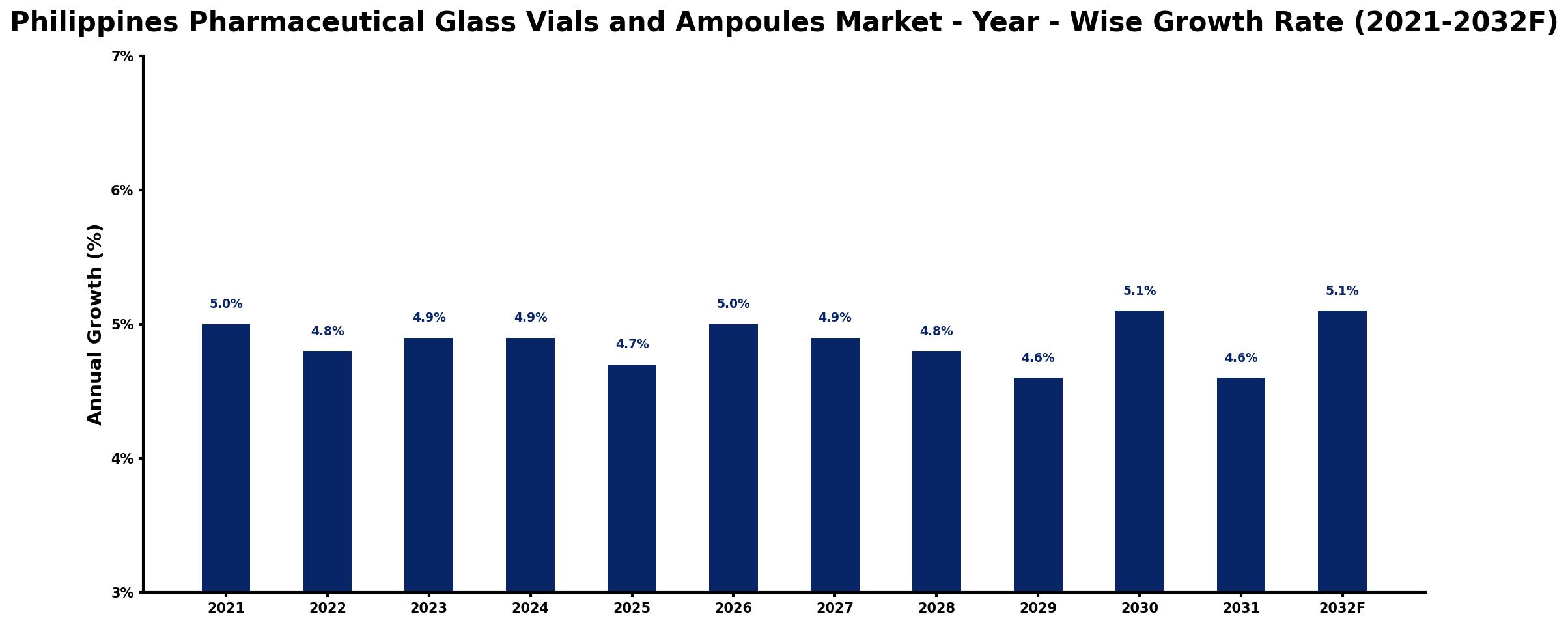
The table below presents the year‑wise growth rates along with the key drivers influencing the market
| Year | Growth Rate | Major Drivers |
| 2021 | 5.0% | Rising healthcare expenditure trends |
| 2022 | 4.8% | Increased demand for biologics |
| 2023 | 4.9% | Expansion of healthcare infrastructure |
| 2024 | 4.9% | Growing focus on safety standards |
| 2025 | 4.7% | Surge in vaccine production initiatives |
| 2026 | 5.0% | Advancements in manufacturing technology |
| 2027 | 4.9% | Increase in global trade dynamics |
| 2028 | 4.8% | Higher investment in research initiatives |
| 2029 | 4.6% | Emergence of personalized medicine approaches |
| 2030 | 5.1% | Boost in regional market accessibility |
| 2031 | 4.6% | Strengthened regulatory compliance measures |
| 2032 | 5.1% | Growing trend of sustainable practices |
Note: Market size estimations and growth projections presented in this report are based on 6Wresearch's proprietary forecasting methodology, utilizing the latest available industry data, government publications, and primary research inputs.
Philippines Pharmaceutical Glass Vials and Ampoules Market Synopsis
In recent years, the Philippines has witnessed a surge in healthcare investments and the demand for quality pharmaceutical products. As the market matures, it is poised to adapt to emerging health challenges while maintaining stringent standards in packaging. Moving forward, the emphasis on eco-friendly and sustainable packaging is likely to influence growth dynamics in the glass vials and ampoules sector.
As the country navigates post-pandemic recovery, the pharmaceutical glass vials and ampoules market stands at a pivotal juncture. With increasing government support through policies like Universal Health Care, the market is set for a robust growth phase that aligns with both consumer expectations and regulatory demands for quality and safety.
Philippines Pharmaceutical Glass Vials and Ampoules Market Key Takeaways
- The market is anticipated to experience significant growth driven by heightened healthcare investments and increased medication consumption.
- Glass vials and ampoules are favored for their inert characteristics, ensuring product integrity and safety in pharmaceutical applications.
- Government initiatives aimed at expanding healthcare access play a crucial role in stimulating market demand.
- Emerging trends towards sustainable packaging are influencing manufacturers to innovate eco-friendly solutions.
- Post-COVID recovery is expected to bolster the demand for pharmaceuticals, positively impacting the market landscape.
Evaluation of Restraints in Philippines Pharmaceutical Glass Vials and Ampoules Market
Despite the promising growth prospects, the Philippines Pharmaceutical Glass Vials and Ampoules Market faces several challenges. Ensuring compliance with stringent quality and safety standards remains paramount, as any lapses can jeopardize consumer trust. Additionally, the high costs associated with specialized glass production can hinder market expansion, especially for smaller manufacturers. Furthermore, logistical issues such as breakage during transportation necessitate improved handling practices to preserve product integrity.
Philippines Pharmaceutical Glass Vials and Ampoules Market Trends
Several key trends are shaping the Philippines Pharmaceutical Glass Vials and Ampoules Market. A marked shift towards sustainable practices is driving manufacturers to explore biodegradable and recyclable materials in packaging solutions. Additionally, as the healthcare landscape evolves, the demand for innovative vial designs tailored for specific medical applications is on the rise. These trends indicate a progressive industry that prioritizes safety, sustainability, and adaptability to changing consumer needs.
Philippines Pharmaceutical Glass Vials and Ampoules Market Opportunities
Opportunities abound in the Philippine Pharmaceutical Glass Vials and Ampoules Market as the sector gears up for expansion. The growing local pharmaceutical manufacturing base presents a significant opportunity for suppliers of glass packaging. Moreover, with an increase in research and development activities in biotechnology and pharmaceuticals, the need for specialized packaging solutions tailored to these advanced products is set to rise. Establishing partnerships with local manufacturers could provide a strategic advantage in this evolving market.
Government Initiatives in the Philippines Pharmaceutical Glass Vials and Ampoules Market
The Philippine government has implemented several initiatives aimed at enhancing the healthcare infrastructure, notably the Universal Health Care program. This initiative is designed to provide citizens with equitable access to quality healthcare services, which inherently boosts the demand for pharmaceuticals. Government funding in healthcare projects also facilitates a conducive environment for market growth, encouraging local manufacturers to invest in production capabilities and innovation.
Future Insights of the Philippines Pharmaceutical Glass Vials and Ampoules Market
Looking ahead to the period from 2026 to 2032, the Philippines Pharmaceutical Glass Vials and Ampoules Market is expected to thrive amidst evolving healthcare dynamics. The focus on quality and safety in pharmaceutical packaging will remain a key driver, while sustainable practices will reshape the competitive landscape. The anticipated rise in domestic manufacturing capabilities and technological advancements in glass production will further bolster the market, positioning it for long-term growth and resilience.
Philippines Pharmaceutical Glass Vials and Ampoules Market Latest Developments (2025 - 2026)
Recent developments in the Philippines Pharmaceutical Glass Vials and Ampoules Market reflect a trend toward modernization and efficiency. Industry stakeholders have been focusing on streamlining supply chains and adopting cutting-edge manufacturing technologies to enhance productivity. Additionally, the growing emphasis on sustainability has led several manufacturers to initiate eco-friendly practices, aligning their operations with global environmental standards.
Philippines Pharmaceutical Glass Vials and Ampoules Market - Key Attractiveness of the Report
- 10 Years of Market Numbers
- Historical Data Starting from 2022 to 2025
- Base Year: 2025
- Forecast Data until 2032
- Key Performance Indicators Impacting the Market
- Major Upcoming Developments and Projects
Key Highlights of the Report:
- Philippines Pharmaceutical Glass Vials and Ampoules Market Outlook
- Market Size of Philippines Pharmaceutical Glass Vials and Ampoules Market, 2025
- Forecast of Philippines Pharmaceutical Glass Vials and Ampoules Market, 2032
- Historical Data and Forecast of Philippines Pharmaceutical Glass Vials and Ampoules Revenues & Volume for the Period 2022-2032F
- Philippines Pharmaceutical Glass Vials and Ampoules Market Trend Evolution
- Philippines Pharmaceutical Glass Vials and Ampoules Market Drivers and Challenges
- Philippines Pharmaceutical Glass Vials and Ampoules Price Trends
- Philippines Pharmaceutical Glass Vials and Ampoules Porter's Five Forces
- Philippines Pharmaceutical Glass Vials and Ampoules Industry Life Cycle
- Historical Data and Forecast of Philippines Pharmaceutical Glass Vials and Ampoules Market Revenues & Volume By Type for the Period 2022-2032F
- Historical Data and Forecast of Philippines Pharmaceutical Glass Vials and Ampoules Market Revenues & Volume By 2ml for the Period 2022-2032F
- Historical Data and Forecast of Philippines Pharmaceutical Glass Vials and Ampoules Market Revenues & Volume By 3ml to 5ml for the Period 2022-2032F
- Historical Data and Forecast of Philippines Pharmaceutical Glass Vials and Ampoules Market Revenues & Volume By 6ml to 8ml for the Period 2022-2032F
- Historical Data and Forecast of Philippines Pharmaceutical Glass Vials and Ampoules Market Revenues & Volume By 8ml or more for the Period 2022-2032F
- Historical Data and Forecast of Philippines Pharmaceutical Glass Vials and Ampoules Market Revenues & Volume By Application for the Period 2022-2032F
- Historical Data and Forecast of Philippines Pharmaceutical Glass Vials and Ampoules Market Revenues & Volume By Pharmaceutical for the Period 2022-2032F
- Historical Data and Forecast of Philippines Pharmaceutical Glass Vials and Ampoules Market Revenues & Volume By Chemical Reagent for the Period 2022-2032F
- Philippines Pharmaceutical Glass Vials and Ampoules Import Export Trade Statistics
- Market Opportunity Assessment By Type
- Market Opportunity Assessment By Application
- Philippines Pharmaceutical Glass Vials and Ampoules Top Companies Market Share
- Philippines Pharmaceutical Glass Vials and Ampoules Competitive Benchmarking By Technical and Operational Parameters
- Philippines Pharmaceutical Glass Vials and Ampoules Company Profiles
- Philippines Pharmaceutical Glass Vials and Ampoules Key Strategic Recommendations






































