Philippines Phenol Market Top 5 Importing Countries and Market Competition (HHI) Analysis
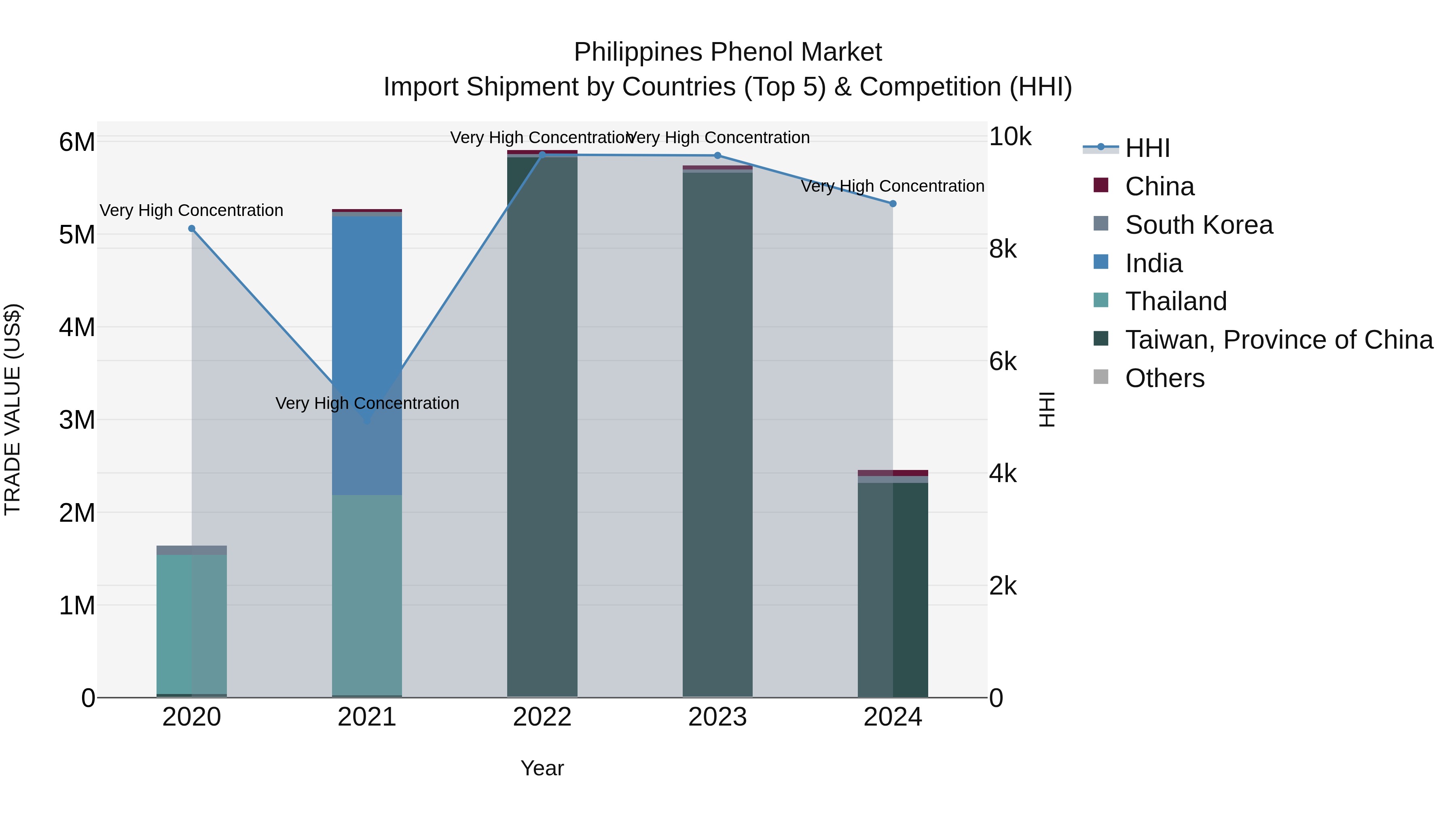
The Philippines saw a significant increase in phenol import shipments in 2024, with top exporters being Taiwan, South Korea, China, Singapore, and Germany. Despite high concentration levels indicated by the Herfindahl-Hirschman Index (HHI), the market continued to grow steadily with a compound annual growth rate (CAGR) of 10.64% from 2020 to 2024. However, there was a notable decline in growth rate from 2023 to 2024 at -57.17%, suggesting potential shifts or challenges in the market dynamics during that period.
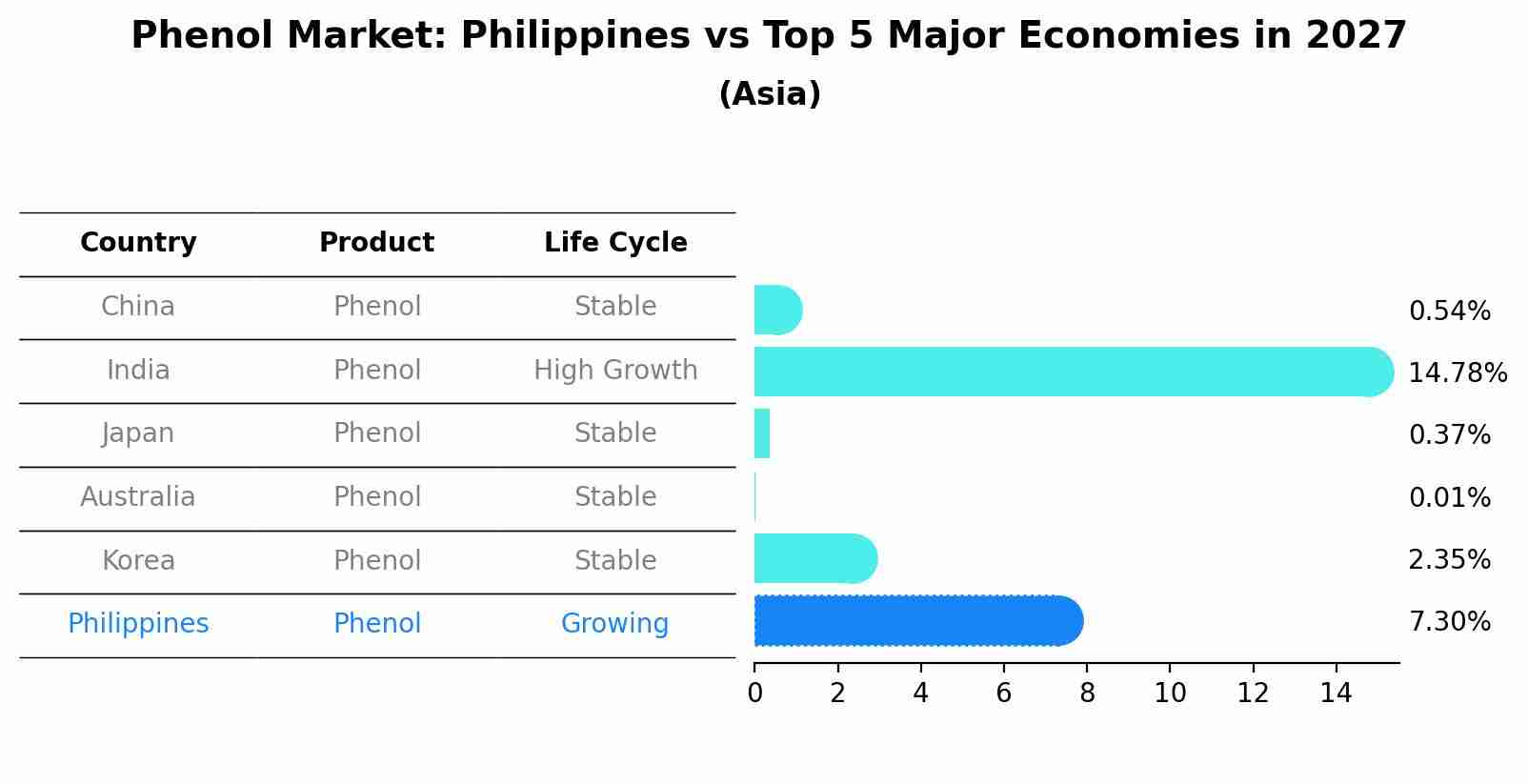
Phenol Market: Philippines vs Top 5 Major Economies in 2027 (Asia)
The Phenol market in Philippines is projected to grow at a growing growth rate of 7.30% by 2027, highlighting the country's increasing focus on advanced technologies within the Asia region, where China holds the dominant position, followed closely by India, Japan, Australia and South Korea, shaping overall regional demand.
Philippines Phenol Market Synopsis
In the Philippines, phenol is a widely used aromatic compound with applications in diverse industries like paints and coatings, consumer products, herbicides, pharmaceuticals among others. The country has seen an increasing demand for phenol over the past few years due to economic growth and increased industrialization. In 2025, the market size of phenols stood at USD 192 million and is expected to reach USD 249 million, registering a CAGR of 4.3%.
Drivers of the market
The Philippines phenol market, utilized in various sectors such as chemicals, plastics, and pharmaceuticals, is influenced by several drivers. A major driver is the growth in end-use industries that rely on phenol derivatives, such as bisphenol-A for plastics production and pharmaceutical intermediates. The expansion of the chemical and petrochemical sectors also contributes to the demand for phenol as a key raw material. Additionally, the increasing focus on industrialization and manufacturing in the Philippines, coupled with the development of downstream industries, stimulates the demand for phenol and its derivatives in the country.
Challenges of the market
The Philippines phenol market faces challenges associated with its production, environmental impact, and diverse applications. Phenol is a key chemical used in the production of plastics, resins, and other industrial products. Its production might involve hazardous chemicals and waste, requiring proper management to prevent environmental pollution. Balancing the demand for phenol-based materials with sustainable and eco-friendly practices is a challenge. Additionally, ensuring worker safety and compliance with regulations in the production process is crucial. The phenol market also needs to adapt to changing consumer preferences for greener alternatives and reduce its environmental footprint. Striking a balance between industrial applications, responsible production, and environmental sustainability is essential to address the challenges in the Philippines phenol market.
Covid-19 Impact of the market
The Philippines phenol market encountered significant disruptions due to the COVID-19 pandemic. Phenol is a crucial chemical used in various industries, including plastics, pharmaceuticals, and electronics. The disruptions in supply chains, reduced industrial activities, and challenges in transportation influenced the demand for phenol-containing products. Many manufacturing operations and construction projects were put on hold, affecting the market`s performance. However, as industries gradually recover and economic activities resume, the phenol market is expected to rebound. The market`s revival will be driven by the resumption of manufacturing and construction projects, as well as the sustained need for chemical ingredients.
Key Players of the market
The Philippines phenol market, involving industrial and chemical applications, could include key players like Advanced Process Solutions Philippines. This company offers a range of chemicals, including phenol derivatives. Another significant participant might be Anresco Philippines, contributing to the market with its chemical products and solutions, shaping the availability of phenol-related compounds for various industries.
Key Highlights of the Report:
- Philippines Phenol Market Outlook
- Market Size of Philippines Phenol Market, 2024
- Forecast of Philippines Phenol Market, 2031
- Historical Data and Forecast of Philippines Phenol Revenues & Volume for the Period 2021-2031
- Philippines Phenol Market Trend Evolution
- Philippines Phenol Market Drivers and Challenges
- Philippines Phenol Price Trends
- Philippines Phenol Porter's Five Forces
- Philippines Phenol Industry Life Cycle
- Historical Data and Forecast of Philippines Phenol Market Revenues & Volume By End-users for the Period 2021-2031
- Historical Data and Forecast of Philippines Phenol Market Revenues & Volume By Bisphenol A for the Period 2021-2031
- Historical Data and Forecast of Philippines Phenol Market Revenues & Volume By Phenolic Resins for the Period 2021-2031
- Historical Data and Forecast of Philippines Phenol Market Revenues & Volume By Caprolactam for the Period 2021-2031
- Historical Data and Forecast of Philippines Phenol Market Revenues & Volume By Alkyl Phenyls for the Period 2021-2031
- Historical Data and Forecast of Philippines Phenol Market Revenues & Volume By Others for the Period 2021-2031
- Philippines Phenol Import Export Trade Statistics
- Market Opportunity Assessment By End-users
- Philippines Phenol Top Companies Market Share
- Philippines Phenol Competitive Benchmarking By Technical and Operational Parameters
- Philippines Phenol Company Profiles
- Philippines Phenol Key Strategic Recommendations






































