Philippines Photosensitive Semiconductor Device Market Size, Share & Growth Rate
The Philippines Photosensitive Semiconductor Device Market was estimated at USD 1279 Million in 2025 and is projected to reach USD 2405 Million by 2032, growing at a CAGR of 9.4% from 2026 to 2032. This robust growth trajectory can be attributed to the increasing demand for advanced electronic devices and the rise in applications for photosensitive technologies across industries like telecommunications, automotive, and consumer electronics. Moreover, innovations in manufacturing techniques are facilitating the development of high-performance semiconductor devices that are crucial for modern technological demands.
Philippines Photosensitive Semiconductor Device Market Year-wise Growth Rate and Key Drivers
This graph highlights how the Philippines Photosensitive Semiconductor Device Market has steadily grown over the years, supported by major growth factors.
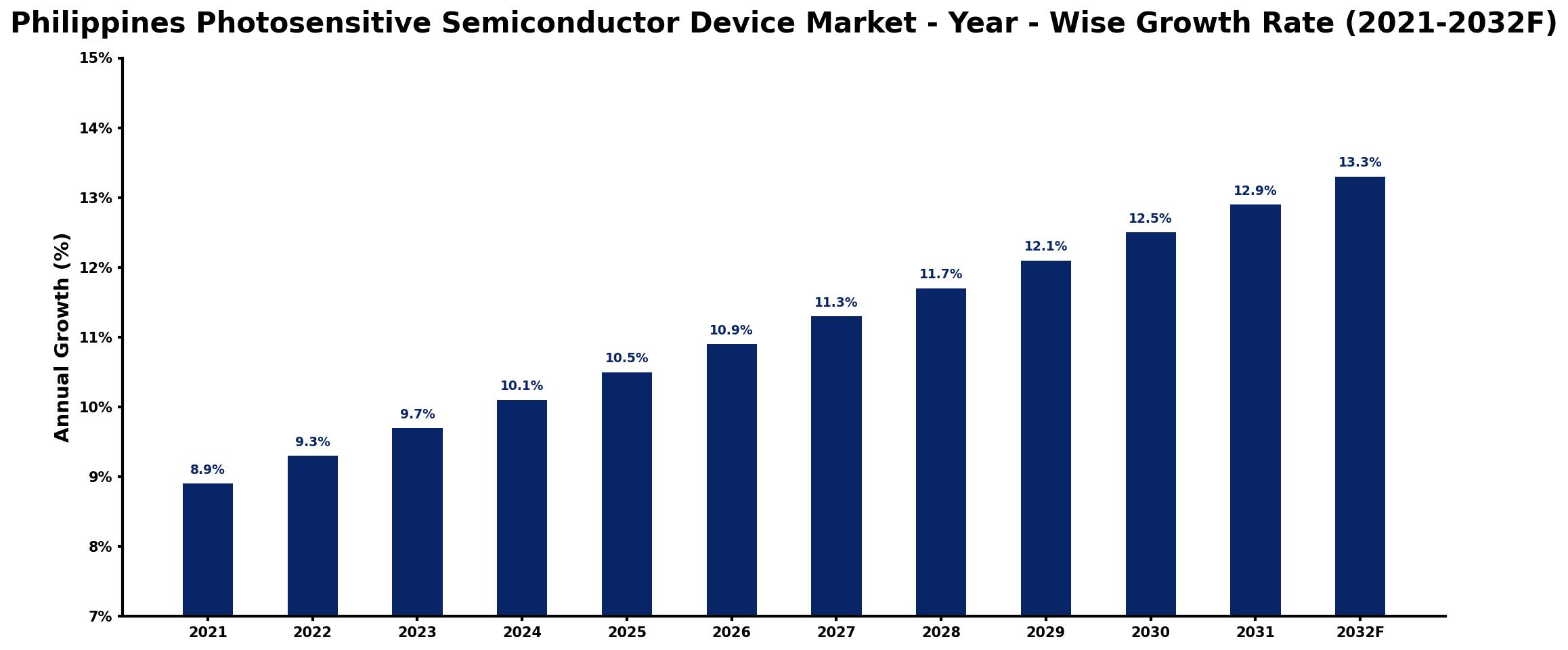
The table below presents the year‑wise growth rates along with the key drivers influencing the market
| Year | Growth Rate | Major Drivers |
| 2021 | 8.9% | Rising renewable energy investments |
| 2022 | 9.3% | Increased adoption of automation |
| 2023 | 9.7% | Growing demand for smart technology |
| 2024 | 10.1% | Expansion of telecommunications infrastructure |
| 2025 | 10.5% | Surge in automotive electronics usage |
| 2026 | 10.9% | Advancements in consumer electronics |
| 2027 | 11.3% | Growth in IoT applications |
| 2028 | 11.7% | Emergence of smart cities initiatives |
| 2029 | 12.1% | Increased focus on energy efficiency |
| 2030 | 12.5% | Boost in wearable technology market |
| 2031 | 12.9% | Development of advanced manufacturing processes |
| 2032 | 13.3% | Rising interest in sustainable solutions |
Note: Market size estimations and growth projections presented in this report are based on 6Wresearch's proprietary forecasting methodology, utilizing the latest available industry data, government publications, and primary research inputs.
Philippines Photosensitive Semiconductor Device Market Synopsis
Recent momentum in the Philippines Photosensitive Semiconductor Device Market has been impressive, driven by a surge in applications across various sectors. However, as technology continues to evolve, the market is set to experience even greater expansion, particularly as consumer preferences shift toward more efficient and compact electronic solutions.
Looking ahead, the integration of photosensitive semiconductor devices in emerging technologies such as IoT and renewable energy systems will play a significant role in shaping market dynamics. Companies are increasingly focusing on research and development to meet the growing demands for high-efficiency devices, reflecting the vital importance of this sector in the broader landscape of electronics.
Philippines Photosensitive Semiconductor Device Market Key Takeaways
- Substantial projected growth from USD 1279 Million in 2025 to USD 2405 Million by 2032.
- Robust CAGR of 9.4% indicates healthy demand for semiconductor devices.
- Increasing applications in telecommunications, automotive, and consumer electronics drive market expansion.
- Technological advancements are enabling development of high-performance devices.
- Integration with IoT and renewable energy represents future growth potential.
Evaluation of Restraints in Philippines Photosensitive Semiconductor Device Market
The Philippines Photosensitive Semiconductor Device Market faces certain constraints that may impede its overall growth. Issues such as the high cost of research and development can deter new entrants while established companies may struggle with maintaining competitive pricing. Furthermore, the complexities involved in ensuring quality and performance standards can create significant challenges. Environmental regulations regarding electronic waste also pose a concern, compelling manufacturers to innovate in sustainability practices while ensuring compliance.
Philippines Photosensitive Semiconductor Device Market Trends
A number of key trends are shaping the Philippines Photosensitive Semiconductor Device Market. The increasing miniaturization of electronic devices is prompting the demand for smaller, more efficient semiconductor solutions. Additionally, the burgeoning need for energy-efficient technologies is driving the development of innovative photosensitive materials. Notably, the rise of smart devices and automation in industries is accelerating the integration of advanced semiconductor devices, thereby enhancing overall system performance.
Philippines Photosensitive Semiconductor Device Market Opportunities
Opportunities for growth in the Philippines Photosensitive Semiconductor Device Market abound, particularly in sectors like renewable energy and IoT. With the government emphasizing sustainable development, investments in solar energy technology and smart grids present a significant avenue for expansion. Moreover, the rising trend of automation in manufacturing processes suggests a growing need for advanced semiconductor solutions, thereby creating a favorable landscape for investors and stakeholders.
Government Initiatives in the Philippines Photosensitive Semiconductor Device Market
The Philippine government has implemented various initiatives to bolster the semiconductor sector. Policies aimed at fostering innovation, such as tax incentives for R&D and technology investments, are crucial for attracting domestic and foreign investments. Additionally, public spending on infrastructure development, including telecommunications and energy projects, is expected to create demand for advanced semiconductor technologies, thereby positively influencing market growth.
Future Insights of the Philippines Photosensitive Semiconductor Device Market
From 2026 to 2032, the Philippines Photosensitive Semiconductor Device Market is anticipated to continue its upward trajectory, driven by technological advancements and increased market penetration in key applications. As manufacturers innovate to improve performance and efficiency, the integration of these devices in emerging technologies will unlock new possibilities. The growing emphasis on digital transformation in various sectors further emphasizes the critical role that photosensitive semiconductor devices will play in supporting future technological developments.
Philippines Photosensitive Semiconductor Device Market Latest Developments (2025 - 2026)
In recent months, the Philippines has seen significant industry developments related to photosensitive semiconductor technologies. Innovations in material science and manufacturing techniques have been highlighted as essential for meeting increasing market demands. Partnerships between local companies and international firms have also been formed to enhance capabilities and accelerate the adoption of advanced semiconductor solutions across various applications.
Philippines Photosensitive Semiconductor Device Market - Key Attractiveness of the Report
- 10 Years of Market Numbers
- Historical Data Starting from 2022 to 2025
- Base Year: 2025
- Forecast Data until 2032
- Key Performance Indicators Impacting the Market
- Major Upcoming Developments and Projects
Key Highlights of the Report:
- Philippines Photosensitive Semiconductor Device Market Outlook
- Market Size of Philippines Photosensitive Semiconductor Device Market, 2025
- Forecast of Philippines Photosensitive Semiconductor Device Market, 2032
- Historical Data and Forecast of Philippines Photosensitive Semiconductor Device Revenues & Volume for the Period 2022-2032F
- Philippines Photosensitive Semiconductor Device Market Trend Evolution
- Philippines Photosensitive Semiconductor Device Market Drivers and Challenges
- Philippines Photosensitive Semiconductor Device Price Trends
- Philippines Photosensitive Semiconductor Device Porter's Five Forces
- Philippines Photosensitive Semiconductor Device Industry Life Cycle
- Historical Data and Forecast of Philippines Photosensitive Semiconductor Device Market Revenues & Volume By Device for the Period 2022-2032F
- Historical Data and Forecast of Philippines Photosensitive Semiconductor Device Market Revenues & Volume By Photocell for the Period 2022-2032F
- Historical Data and Forecast of Philippines Photosensitive Semiconductor Device Market Revenues & Volume By Photodiode for the Period 2022-2032F
- Historical Data and Forecast of Philippines Photosensitive Semiconductor Device Market Revenues & Volume By Phototransistor for the Period 2022-2032F
- Historical Data and Forecast of Philippines Photosensitive Semiconductor Device Market Revenues & Volume By Photoresistor for the Period 2022-2032F
- Historical Data and Forecast of Philippines Photosensitive Semiconductor Device Market Revenues & Volume By Photo IC for the Period 2022-2032F
- Historical Data and Forecast of Philippines Photosensitive Semiconductor Device Market Revenues & Volume By End User for the Period 2022-2032F
- Historical Data and Forecast of Philippines Photosensitive Semiconductor Device Market Revenues & Volume By Automotive and Transportation for the Period 2022-2032F
- Historical Data and Forecast of Philippines Photosensitive Semiconductor Device Market Revenues & Volume By Consumer Electronics for the Period 2022-2032F
- Historical Data and Forecast of Philippines Photosensitive Semiconductor Device Market Revenues & Volume By Aerospace and Defence for the Period 2022-2032F
- Historical Data and Forecast of Philippines Photosensitive Semiconductor Device Market Revenues & Volume By Healthcare for the Period 2022-2032F
- Historical Data and Forecast of Philippines Photosensitive Semiconductor Device Market Revenues & Volume By Industrial for the Period 2022-2032F
- Historical Data and Forecast of Philippines Photosensitive Semiconductor Device Market Revenues & Volume By Security and Survelliance for the Period 2022-2032F
- Philippines Photosensitive Semiconductor Device Import Export Trade Statistics
- Market Opportunity Assessment By Device
- Market Opportunity Assessment By End User
- Philippines Photosensitive Semiconductor Device Top Companies Market Share
- Philippines Photosensitive Semiconductor Device Competitive Benchmarking By Technical and Operational Parameters
- Philippines Photosensitive Semiconductor Device Company Profiles
- Philippines Photosensitive Semiconductor Device Key Strategic Recommendations






































