Philippines Physical Security Market Size & Growth Rate (2026-2032)
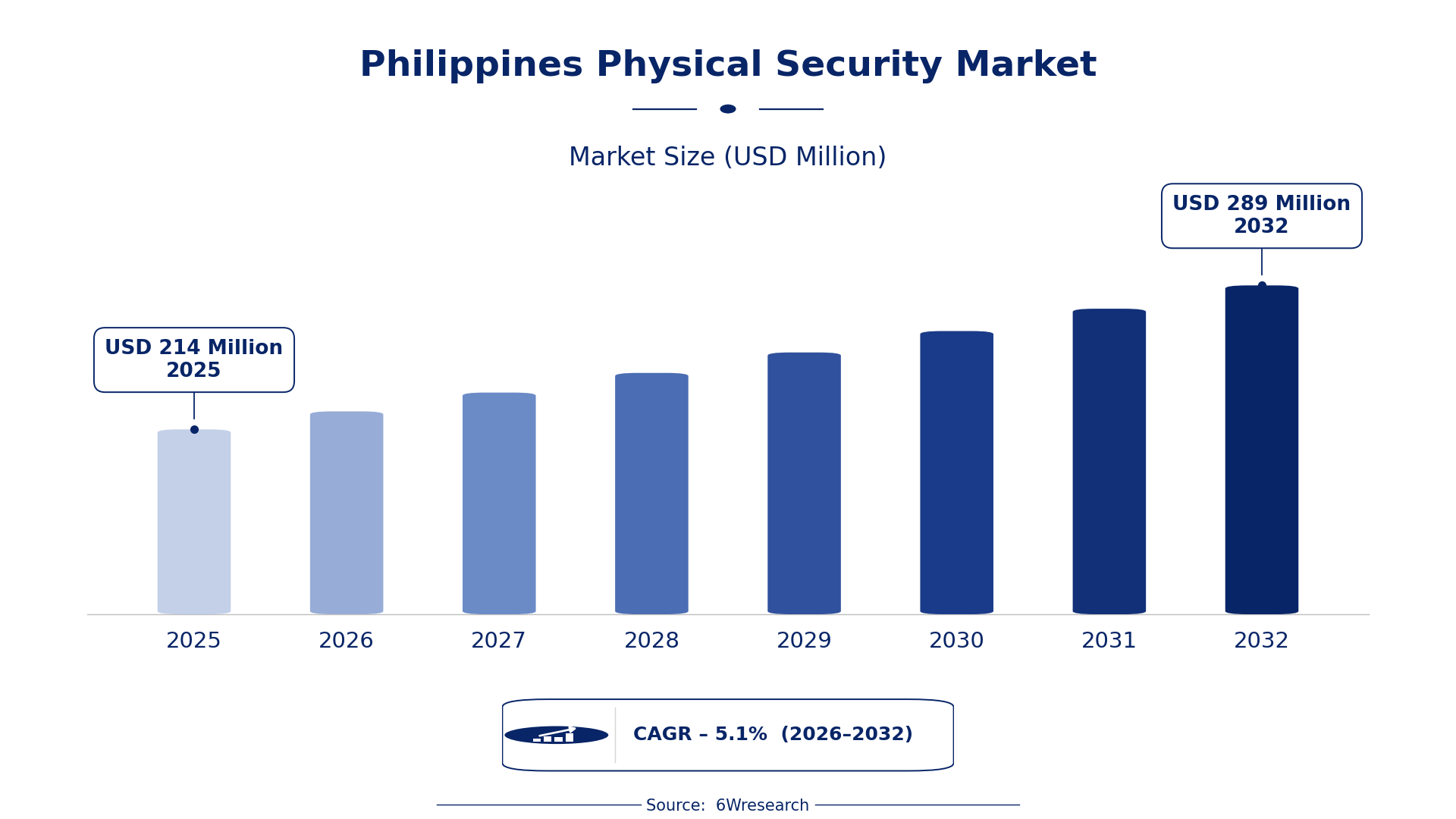
The Philippines Physical Security Market was estimated at USD 214 Million in 2025 and is projected to reach USD 289 Million by 2032, growing at a CAGR of 5.1% from 2026 to 2032.
Philippines Physical Security Market Synopsis
In recent years, the Philippines has witnessed a heightened demand for comprehensive physical security solutions. With rising concerns regarding terrorism and crime, the need to protect critical infrastructure and public spaces has never been more pronounced.
Technologies such as advanced surveillance systems, biometrics, and access control are becoming increasingly essential in both public and private sectors. As businesses and government facilities invest in these security measures, the market is set for sustainable growth over the coming years.
Philippines Physical Security Market Year-wise Growth Rate and Key Drivers
This graph illustrates the annual growth rates of the Philippines Physical Security Market from 2021 to 2032, highlighting a steady upward trajectory and projected expansion over the forecast period.
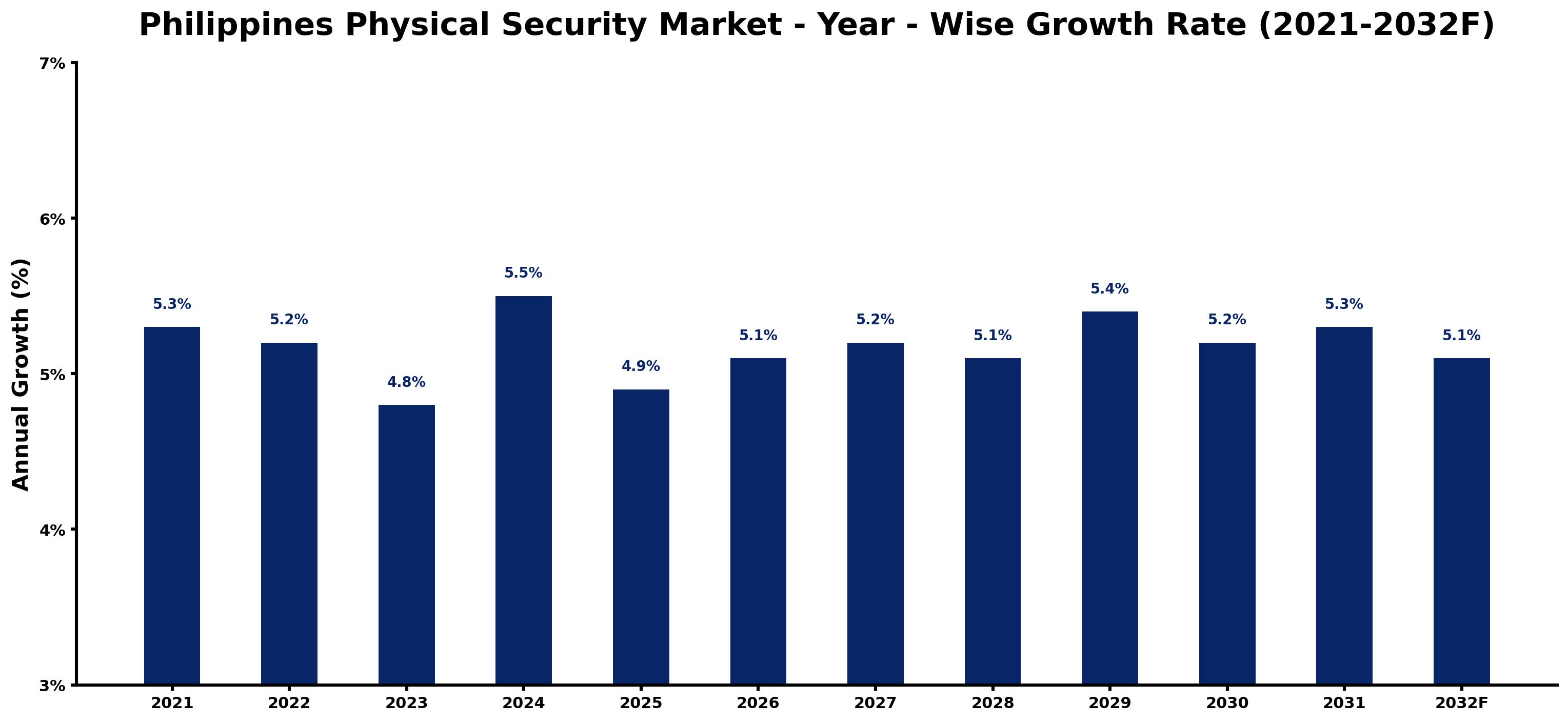
The table below presents the year‑wise growth rates along with the key drivers influencing the market
| Year | Growth Rate | Major Drivers |
| 2021 | 5.3% | Philippine police initiatives for improved public safety measures. |
| 2022 | 5.2% | Increased investments in cybersecurity leading to physical security upgrades. |
| 2023 | 4.8% | Rising theft incidents prompt stricter security regulations nationwide. |
| 2024 | 5.5% | Government funding for urban security enhancements in Metro Manila. |
| 2025 | 4.9% | Local businesses adopting biometric access control solutions rapidly. |
| 2026 | 5.1% | Heightened concerns over terrorism influence security system expansions. |
| 2027 | 5.2% | Growing expatriate population drives demand for secure residences. |
| 2028 | 5.1% | Economic recovery spurs investment in security infrastructure projects. |
| 2029 | 5.4% | Delivery services thrive, increasing need for anti-theft measures. |
| 2030 | 5.2% | Smart city initiatives enhance integration of security technologies. |
| 2031 | 5.3% | Local events prompting heightened security regulations and measures. |
| 2032 | 5.1% | Rising real estate developments require integrated security systems. |
Note: Market size estimations and growth projections presented in this report are based on 6Wresearch's proprietary forecasting methodology, utilizing the latest available industry data, government publications, and primary research inputs.
Philippines Physical Security Market Key Takeaways
Below are some of the specific key takeaways from the market, including:
- The market is significantly influenced by the need to secure critical infrastructure against threats.
- Growing urbanization drives the adoption of physical security technologies in metropolitan areas.
- COVID-19 accelerated demand for contactless security solutions and hygienic safety measures.
- Integration of digital technologies in physical security systems presents new challenges and opportunities.
- Key players are continuously innovating to meet the evolving security needs of various sectors.
Evaluation of Restraints in Philippines Physical Security Market
Despite the promising growth prospects, several restraints hinder the Philippines Physical Security Market. One major issue is the lack of integration between traditional physical security systems and emerging digital technologies. This gap often leads to inefficiencies and increased vulnerabilities. Additionally, high costs associated with implementing state-of-the-art security systems can deter smaller businesses from upgrading their security measures. Lastly, ongoing concerns about regulatory compliance and the need for skilled personnel in security management further complicate market dynamics.
Philippines Physical Security Market Trends
Key trends shaping the Philippines Physical Security Market include the increasing adoption of cloud-based security solutions, which offer scalable and cost-effective options for businesses. The use of artificial intelligence and machine learning in surveillance systems is also gaining traction, enhancing threat detection capabilities. on top of that, the emphasis on user-friendly interfaces and mobile access for security management is making these systems more accessible. The push for integrated security solutions, combining various technologies, is expected to drive innovation and investment in the sector.
Philippines Physical Security Market Opportunities
The Philippines offers numerous growth opportunities within the physical security market. The government's focus on improving public safety and infrastructure security is a primary driver. on top of that, there is significant potential in sectors such as retail, transportation, and healthcare, where advanced security measures can drastically improve safety and operational efficiency. As more organizations transition to hybrid work models, the demand for flexible security solutions tailored to remote operations is also on the rise. on top of that, public-private partnerships aimed at upgrading security infrastructure can lead to further investment opportunities.
Government Initiatives in the Philippines Physical Security Market
The Philippine government plays a vital role in shaping the physical security market through various initiatives and regulations. A focus on enhancing public safety through modernized security systems is evident in ongoing projects aimed at improving infrastructure. Recent legislative measures have prioritized funding for security upgrades in public spaces and critical infrastructure. These actions reflect a broader commitment to ensuring the safety of citizens and assets, directly impacting market growth.
- A recently completed initiative focused on upgrading CCTV systems across major urban centers to enhance surveillance capabilities.
- A current program aimed at integrating biometric systems in government facilities for improved access control and monitoring.
- A planned public-private partnership expected to develop a national security database by 2027 to streamline security operations.
- The introduction of regulatory measures in 2025 mandating security audits for large commercial establishments to enhance compliance.
- An upcoming initiative to launch a nationwide training program for security personnel to improve competency and efficiency in using advanced technologies.
Future Insights of the Philippines Physical Security Market
Looking ahead to 2026-2032, the Philippines Physical Security Market is likely to experience steady growth driven by increased security demands across sectors. Technological advancements will play a crucial role, particularly in AI and IoT integration, which will enhance the sophistication and efficiency of security systems. The growing focus on data privacy and regulatory compliance will also shape investments in security technology. As threats evolve, so too will the need for innovative solutions that can adapt to the changing security landscape.
Philippines Physical Security Market Latest Developments
Over the past year, the Philippines Physical Security Market has seen considerable activity with a surge in technology implementations and strategic partnerships. Companies are rapidly developing solutions that address both current security challenges and future needs. This momentum reflects the urgent demand for enhanced security measures across various sectors, driven by ongoing concerns about safety and security.
- A major technology vendor announced the launch of a new line of AI-powered surveillance cameras in Q1 2025, designed to improve threat detection and response times.
- An initiative that began in late 2024 focused on deploying smart access control systems in government buildings, with installations ongoing.
- A new partnership between private security firms and local governments was formed in early 2025 to develop community-based security solutions, with pilot projects expected to start soon.
- Research and development efforts kicked off in Q2 2025, aimed at enhancing cyber-physical security measures for critical infrastructures.
- A rollout of mobile security management applications is planned for late 2025 to streamline monitoring and response protocols for security teams.
Philippines Physical Security Market - Key Attractiveness of the Report
- 10 Years of Market Numbers
- Historical Data Starting from 2022 to 2025
- Base Year: 2025
- Forecast Data until 2032
- Key Performance Indicators Impacting the Market
- Major Upcoming Developments and Projects
The government’s focus on enhancing public safety through upgraded security systems has spurred various initiatives, including the integration of biometric systems and the establishment of a national security database.
Key Highlights of the Report:
- Philippines Physical Security Market Outlook
- Market Size of Philippines Physical Security Market, 2025
- Forecast of Philippines Physical Security Market, 2032
- Historical Data and Forecast of Philippines Physical Security Revenues & Volume for the Period 2022-2032F
- Philippines Physical Security Market Trend Evolution
- Philippines Physical Security Market Drivers and Challenges
- Philippines Physical Security Price Trends
- Philippines Physical Security Porter's Five Forces
- Philippines Physical Security Industry Life Cycle
- Historical Data and Forecast of Philippines Physical Security Market Revenues & Volume By Component for the Period 2022-2032F
- Historical Data and Forecast of Philippines Physical Security Market Revenues & Volume By Systems (PACS, PSIM, PIAM, Video Surveillance, Fire and Life Safety) for the Period 2022-2032F
- Historical Data and Forecast of Philippines Physical Security Market Revenues & Volume By Services for the Period 2022-2032F
- Historical Data and Forecast of Philippines Physical Security Market Revenues & Volume By Vertical for the Period 2022-2032F
- Historical Data and Forecast of Philippines Physical Security Market Revenues & Volume By BFSI for the Period 2022-2032F
- Historical Data and Forecast of Philippines Physical Security Market Revenues & Volume By Government for the Period 2022-2032F
- Historical Data and Forecast of Philippines Physical Security Market Revenues & Volume By Retail for the Period 2022-2032F
- Historical Data and Forecast of Philippines Physical Security Market Revenues & Volume By Transportation for the Period 2022-2032F
- Historical Data and Forecast of Philippines Physical Security Market Revenues & Volume By Residential for the Period 2022-2032F
- Historical Data and Forecast of Philippines Physical Security Market Revenues & Volume By Telecom and IT for the Period 2022-2032F
- Historical Data and Forecast of Philippines Physical Security Market Revenues & Volume By Other Verticals (Healthcare, Manufacturing, Energy and Utilities, and Education). for the Period 2022-2032F
- Historical Data and Forecast of Philippines Physical Security Market Revenues & Volume By Organization Size for the Period 2022-2032F
- Historical Data and Forecast of Philippines Physical Security Market Revenues & Volume By SMEs for the Period 2022-2032F
- Historical Data and Forecast of Philippines Physical Security Market Revenues & Volume By Large Enterprises for the Period 2022-2032F
- Philippines Physical Security Import Export Trade Statistics
- Market Opportunity Assessment By Component
- Market Opportunity Assessment By Vertical
- Market Opportunity Assessment By Organization Size
- Philippines Physical Security Top Companies Market Share
- Philippines Physical Security Competitive Benchmarking By Technical and Operational Parameters
- Philippines Physical Security Company Profiles
- Philippines Physical Security Key Strategic Recommendations






































