Philippines Physiological Saline Market Top 5 Importing Countries and Market Competition (HHI) Analysis
The Philippines continued to rely on imported physiological saline in 2024, with top exporters being Indonesia, China, Thailand, Germany, and India. Despite a high concentration of market share, the industry experienced a significant decline with a CAGR of -16.51% from 2020 to 2024. The negative growth rate of -6.7% from 2023 to 2024 indicates ongoing challenges in the market. It will be crucial for stakeholders to closely monitor these trends and adapt strategies to navigate the changing landscape of the physiological saline import market in the Philippines.
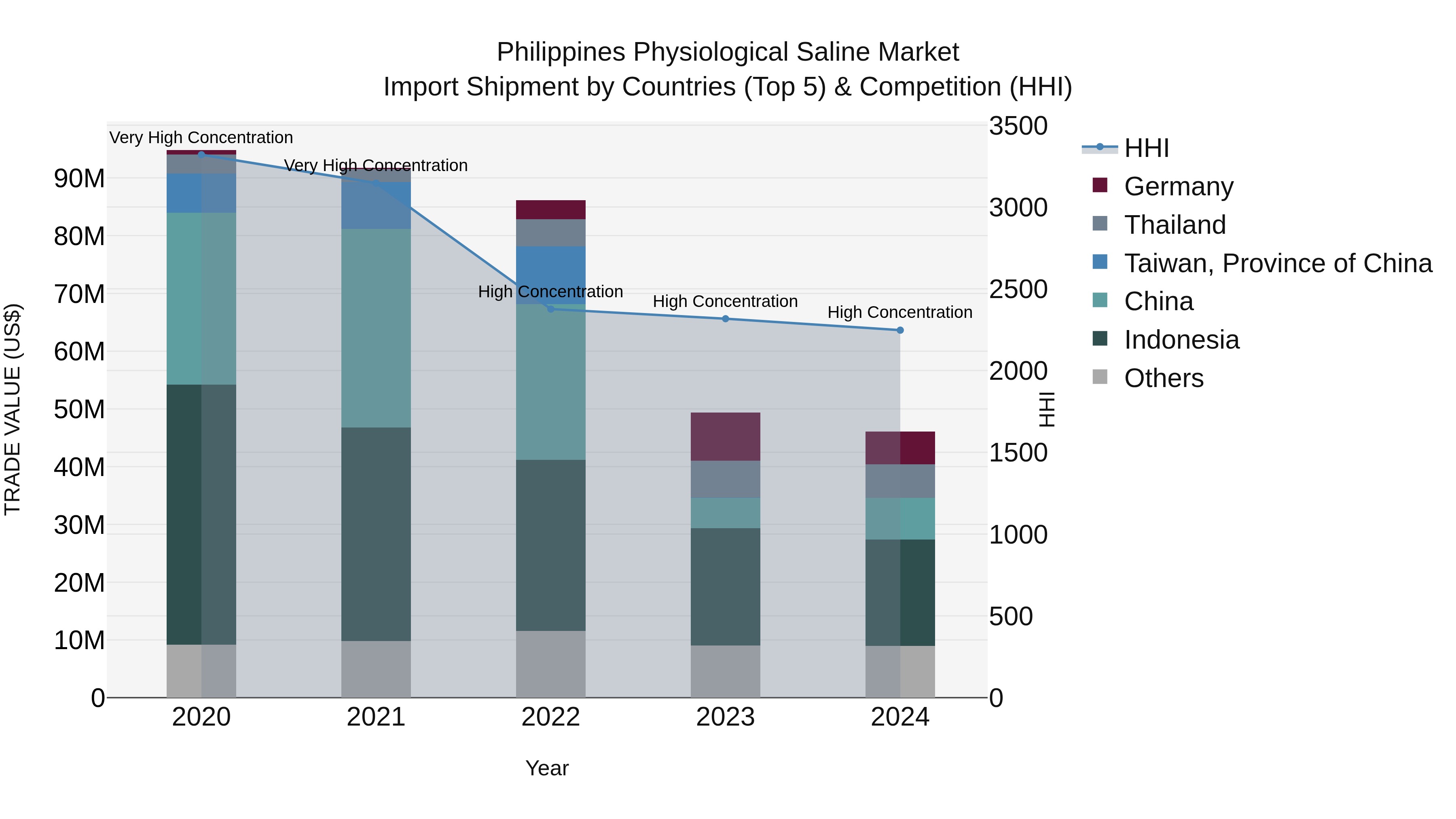
Philippines Physiological Saline Market Overview
The physiological saline market remains fundamental in the healthcare sector, used extensively in wound cleaning, IV hydration, and as a diluent for medications. Hospitals, clinics, and even home healthcare services contribute to consistent demand across the country.
Drivers of the market
The physiological saline market in the Philippines remains a healthcare staple, with strong demand in hospitals, clinics, and home care settings. It plays a critical role in fluid therapy, wound cleansing, and intravenous drug administration. Local manufacturing and distribution networks are expanding to meet the increasing needs of both public and private health sectors.
Challenges of the market
The physiological saline market in the Philippines encounters occasional supply chain disruptions, especially during health crises or import restrictions. Despite being a basic medical necessity, price volatility due to dependency on imported raw materials affects availability. Moreover, insufficient cold chain infrastructure and storage conditions in rural clinics compromise product safety.
Investment opportunities in the Market
As a staple in hospitals and clinics, physiological saline has a stable demand in the Philippines. Investment opportunities include setting up local bottling or filling plants, partnering with healthcare distributors, and ensuring compliance with sterile manufacturing standards for injectable-grade solutions.
Government Policy of the market
As a basic medical necessity, physiological saline is supported through steady procurement by public hospitals. The DOH ensures that essential medicines and solutions, including saline, are listed under the Philippine National Drug Formulary (PNDF) and procured in bulk through centralized tenders to maintain affordability and supply consistency across government health facilities.
Key Highlights of the Report:
- Philippines Physiological Saline Market Outlook
- Market Size of Philippines Physiological Saline Market, 2024
- Forecast of Philippines Physiological Saline Market, 2031
- Historical Data and Forecast of Philippines Physiological Saline Revenues & Volume for the Period 2021- 2031
- Philippines Physiological Saline Market Trend Evolution
- Philippines Physiological Saline Market Drivers and Challenges
- Philippines Physiological Saline Price Trends
- Philippines Physiological Saline Porter's Five Forces
- Philippines Physiological Saline Industry Life Cycle
- Historical Data and Forecast of Philippines Physiological Saline Market Revenues & Volume By Product Type for the Period 2021- 2031
- Historical Data and Forecast of Philippines Physiological Saline Market Revenues & Volume By Flexible Bag for the Period 2021- 2031
- Historical Data and Forecast of Philippines Physiological Saline Market Revenues & Volume By Plastic Bottles for the Period 2021- 2031
- Historical Data and Forecast of Philippines Physiological Saline Market Revenues & Volume By Glass Bottles for the Period 2021- 2031
- Historical Data and Forecast of Philippines Physiological Saline Market Revenues & Volume By Application for the Period 2021- 2031
- Historical Data and Forecast of Philippines Physiological Saline Market Revenues & Volume By Chronic Diseases for the Period 2021- 2031
- Historical Data and Forecast of Philippines Physiological Saline Market Revenues & Volume By Acute Health Conditions for the Period 2021- 2031
- Historical Data and Forecast of Philippines Physiological Saline Market Revenues & Volume By Skin Abrasions and Burns for the Period 2021- 2031
- Historical Data and Forecast of Philippines Physiological Saline Market Revenues & Volume By End Users for the Period 2021- 2031
- Historical Data and Forecast of Philippines Physiological Saline Market Revenues & Volume By Hospitals for the Period 2021- 2031
- Historical Data and Forecast of Philippines Physiological Saline Market Revenues & Volume By Clinics for the Period 2021- 2031
- Historical Data and Forecast of Philippines Physiological Saline Market Revenues & Volume By Recovery Centers for the Period 2021- 2031
- Historical Data and Forecast of Philippines Physiological Saline Market Revenues & Volume By Others for the Period 2021- 2031
- Philippines Physiological Saline Import Export Trade Statistics
- Market Opportunity Assessment By Product Type
- Market Opportunity Assessment By Application
- Market Opportunity Assessment By End Users
- Philippines Physiological Saline Top Companies Market Share
- Philippines Physiological Saline Competitive Benchmarking By Technical and Operational Parameters
- Philippines Physiological Saline Company Profiles
- Philippines Physiological Saline Key Strategic Recommendations






































