Philippines Piperonal Market Size, Share & Growth Rate
The Philippines Piperonal Market was estimated at USD 375 Million in 2025 and is projected to reach USD 512 Million by 2032, growing at a CAGR of 4.5% from 2026 to 2032. This upward trajectory is largely propelled by the burgeoning demand for perfumes and cosmetics, which rely heavily on piperonal's sweet, floral scent. Additionally, the increasing applications in the pharmaceutical and flavor industries are expected to further strengthen market dynamics, aligning with the evolving tastes of consumers seeking high-quality aromatic products.
Philippines Piperonal Market Year-wise Growth Rate and Key Drivers
This graph highlights how the Philippines Piperonal Market has steadily grown over the years, supported by major growth factors.
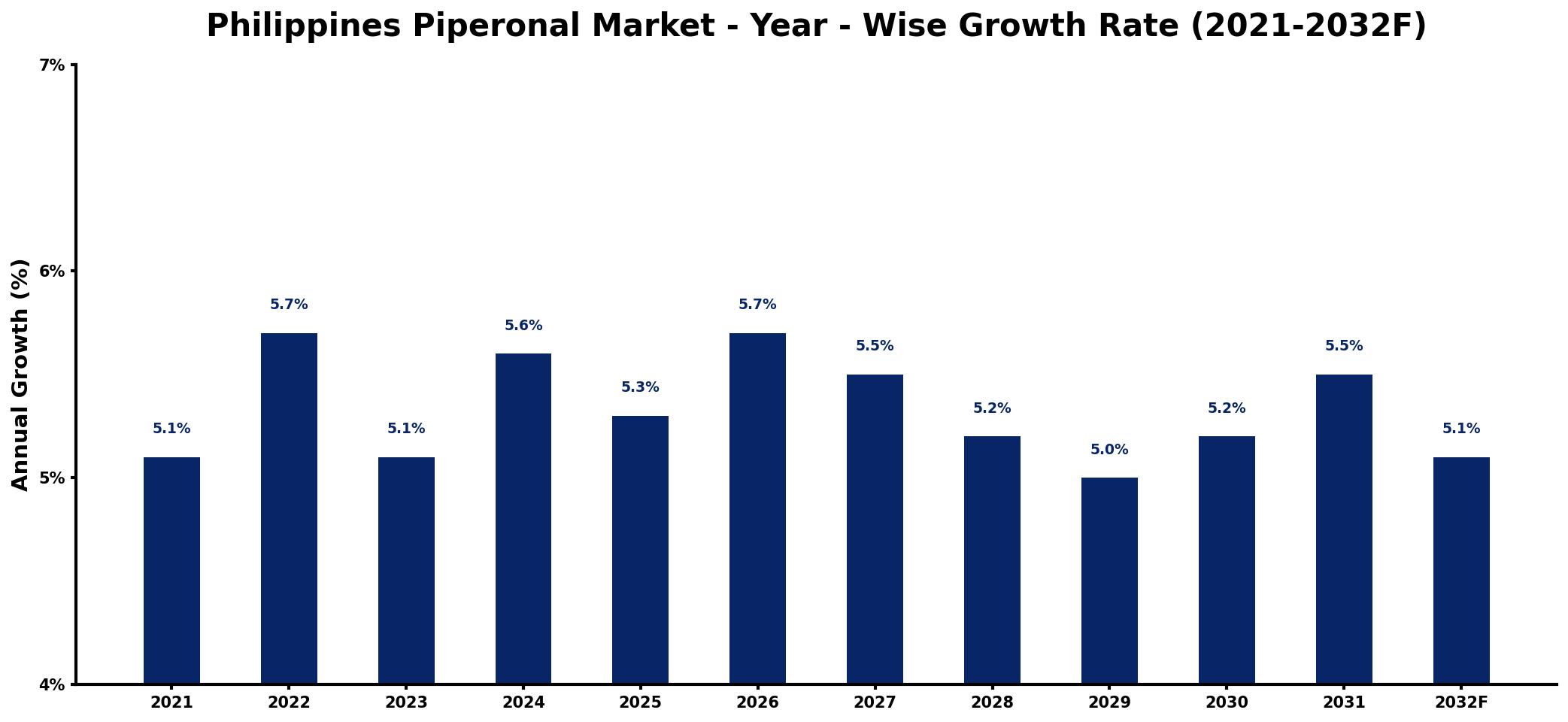
The table below presents the year‑wise growth rates along with the key drivers influencing the market
| Year | Growth Rate | Major Drivers |
| 2021 | 5.1% | Rising consumer fragrance preferences |
| 2022 | 5.7% | Expansion of natural ingredient usage |
| 2023 | 5.1% | Growth in personal care sector |
| 2024 | 5.6% | Increased demand for organic products |
| 2025 | 5.3% | Surge in flavoring applications |
| 2026 | 5.7% | Developments in food industry trends |
| 2027 | 5.5% | Higher investments in R&D |
| 2028 | 5.2% | Strengthening export opportunities globally |
| 2029 | 5.0% | Boost in sustainable sourcing initiatives |
| 2030 | 5.2% | Emergence of new market players |
| 2031 | 5.5% | Advancements in botanical extraction methods |
| 2032 | 5.1% | Wider adoption in wellness products |
Note: Market size estimations and growth projections presented in this report are based on 6Wresearch's proprietary forecasting methodology, utilizing the latest available industry data, government publications, and primary research inputs.
Philippines Piperonal Market Synopsis
Recent developments have positioned the Philippines piperonal market for steady growth, with increasing interest from both local and international players. However, while the short-term outlook appears promising, the market is projected to navigate through regulatory challenges and evolving consumer preferences, which could shape its long-term trajectory.
As the demand for personal care and culinary applications continues to rise, the role of piperonal as a critical ingredient is becoming more pronounced. Its unique scent profile not only enhances products in the fragrance and flavor segments but also paves the way for innovative uses in niche markets, propelling the overall market forward.
Philippines Piperonal Market Key Takeaways
- The market is projected to grow steadily, driven by its applications in the fragrance and flavor industries.
- Demand for piperonal is increasingly influenced by changing consumer preferences towards high-quality aromatic products.
- Regulatory challenges surrounding the trade of piperonal present potential limitations for growth.
- COVID-19 impacted demand patterns, but a resurgence in the fragrance and cosmetics sectors is anticipated as the economy recovers.
- Local producers may face challenges in achieving consistent production methods, impacting competitiveness.
Evaluation of Restraints in Philippines Piperonal Market
Despite the positive growth outlook, the Philippines piperonal market faces significant challenges that could hinder its expansion. Regulatory hurdles related to international trade, particularly concerning piperonal's use in the synthesis of controlled substances, may create barriers for local exporters seeking to penetrate global markets. Additionally, the need for cost-effective and consistent production processes presents a hurdle for manufacturers, as fluctuations in raw material costs can affect profit margins. Navigating these regulatory complexities while ensuring competitive production will be crucial for market players in the Philippines.
Philippines Piperonal Market Trends
Key trends shaping the Philippines piperonal market include a growing interest in sustainable and natural ingredients, particularly in the cosmetics and food sectors. The rising demand for organic products has prompted manufacturers to explore piperonal's role in clean beauty and culinary applications. Moreover, advancements in production technology are enabling more efficient synthesis of piperonal, potentially lowering costs and enhancing availability. As consumer preferences continue to evolve, these trends indicate a promising future for piperonal in innovative market applications.
Philippines Piperonal Market Opportunities
The Philippine market presents genuine opportunities for growth, especially for stakeholders willing to innovate. With the rise of eco-conscious consumers, there is a significant market potential for piperonal in organic and sustainable product lines. Additionally, expanding partnerships with international players seeking to establish a foothold in Southeast Asia can open new avenues for local producers. Developing niche applications in pharmaceuticals, particularly in organic synthesis, can also provide new growth areas, leveraging piperonal's unique properties.
Government Initiatives in the Philippines Piperonal Market
The Philippine government has been actively promoting local production of key aromatic compounds, including piperonal, through various policy initiatives and public spending programs. These efforts are aimed at boosting the manufacturing sector and fostering innovation in natural ingredients. Additionally, regulatory frameworks are being enhanced to facilitate the export of agricultural and chemical products, which could benefit local piperonal producers in accessing international markets.
Future Insights of the Philippines Piperonal Market
Looking ahead to 2026-2032, the Philippines piperonal market is poised for moderate growth, driven by the ongoing resurgence of the fragrance and cosmetics industries post-pandemic. As consumer demands for quality and sustainability rise, the market will need to adapt to maintain relevance. Innovations in production methods and the exploration of new applications will be critical in capturing emerging opportunities. Overall, stakeholders who effectively navigate regulatory landscapes and focus on sustainability are likely to thrive in this evolving market.
Philippines Piperonal Market Latest Developments (2025 - 2026)
Recent industry trends have highlighted a renewed focus on piperonal as manufacturers seek to enhance their product portfolios. The resurgence of the cosmetics industry is likely to lead to increased collaborations among local and international companies. Additionally, developments in production technologies are on the rise, aimed at optimizing yield and reducing costs. Market participants are also exploring new distribution channels to better reach consumers, signaling a vibrant shift in the dynamics of the piperonal landscape.
Philippines Piperonal Market - Key Attractiveness of the Report
- 10 Years of Market Numbers
- Historical Data Starting from 2022 to 2025
- Base Year: 2025
- Forecast Data until 2032
- Key Performance Indicators Impacting the Market
- Major Upcoming Developments and Projects
Key Highlights of the Report:
- Philippines Piperonal Market Outlook
- Market Size of Philippines Piperonal Market, 2025
- Forecast of Philippines Piperonal Market, 2032
- Historical Data and Forecast of Philippines Piperonal Revenues & Volume for the Period 2022-2032F
- Philippines Piperonal Market Trend Evolution
- Philippines Piperonal Market Drivers and Challenges
- Philippines Piperonal Price Trends
- Philippines Piperonal Porter's Five Forces
- Philippines Piperonal Industry Life Cycle
- Historical Data and Forecast of Philippines Piperonal Market Revenues & Volume By Type for the Period 2022-2032F
- Historical Data and Forecast of Philippines Piperonal Market Revenues & Volume By Natural Piperonal for the Period 2022-2032F
- Historical Data and Forecast of Philippines Piperonal Market Revenues & Volume By Synthetic Piperonal for the Period 2022-2032F
- Historical Data and Forecast of Philippines Piperonal Market Revenues & Volume By Application for the Period 2022-2032F
- Historical Data and Forecast of Philippines Piperonal Market Revenues & Volume By Flavors and Fragrances for the Period 2022-2032F
- Historical Data and Forecast of Philippines Piperonal Market Revenues & Volume By Food Industry for the Period 2022-2032F
- Historical Data and Forecast of Philippines Piperonal Market Revenues & Volume By Others for the Period 2022-2032F
- Philippines Piperonal Import Export Trade Statistics
- Market Opportunity Assessment By Type
- Market Opportunity Assessment By Application
- Philippines Piperonal Top Companies Market Share
- Philippines Piperonal Competitive Benchmarking By Technical and Operational Parameters
- Philippines Piperonal Company Profiles
- Philippines Piperonal Key Strategic Recommendations






































