Philippines Planes Helicopters And Spacecraft Market Top 5 Importing Countries and Market Competition (HHI) Analysis
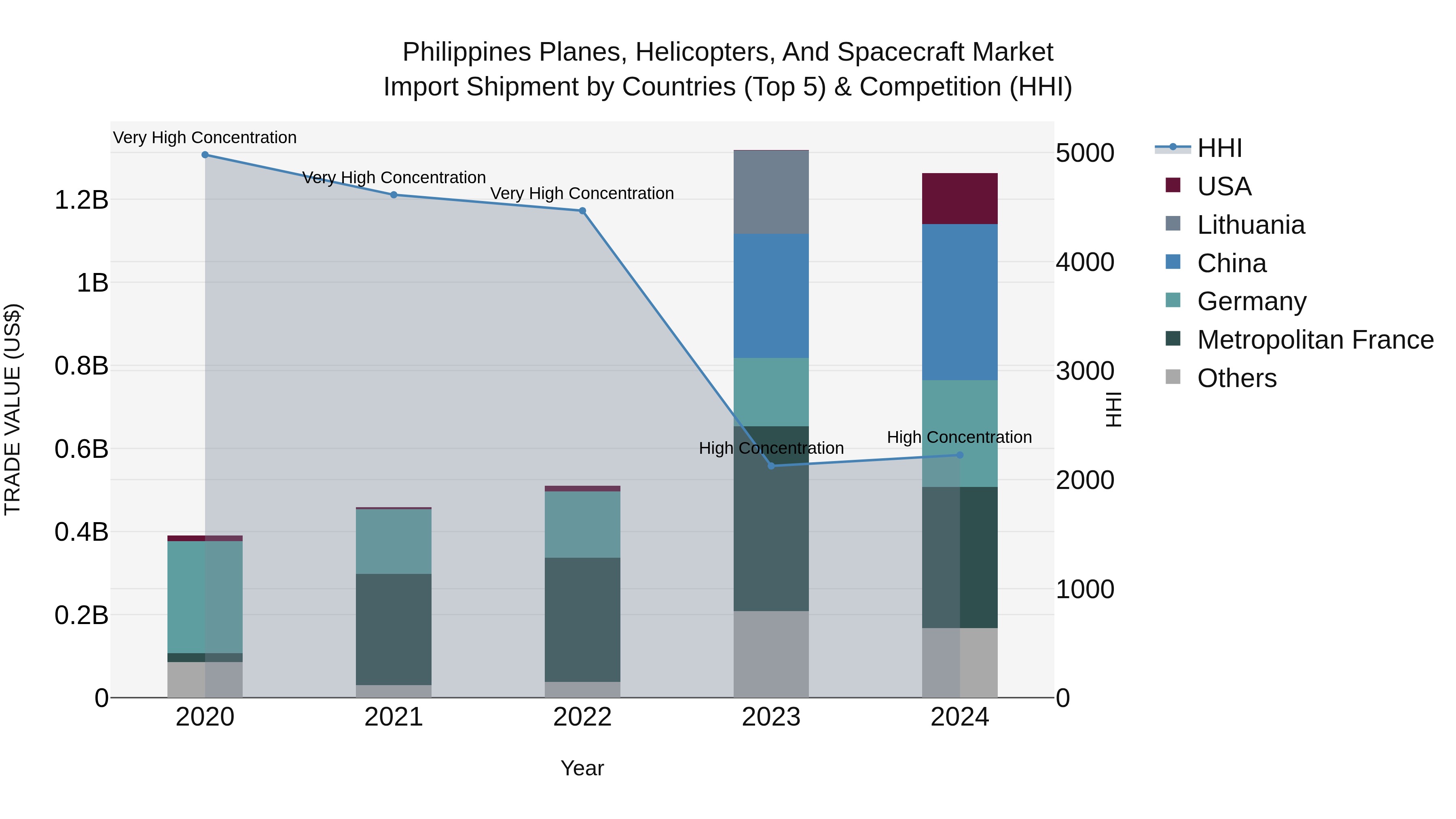
In 2024, Philippines continued to rely on key players like China, Metropolitan France, Germany, USA, and Indonesia for its planes, helicopters, and spacecraft imports. Despite a slight decline in growth rate from 2023 to 2024, the industry maintained a high Herfindahl-Hirschman Index (HHI) concentration. The impressive compound annual growth rate (CAGR) of 34.07% from 2020 to 2024 indicates a robust market expanding rapidly. This data suggests a strong demand for imported aviation and aerospace products in the Philippines, with notable contributions from leading exporting countries.
philippines planes helicopters and spacecraft market Synopsis
The Philippines` transportation and infrastructure sectors have witnessed notable developments across various markets. In the aviation industry, the Philippines` planes, helicopters, and spacecraft market has demonstrated growth in recent years. Both commercial and private aviation have expanded, with increased demand for aircraft and helicopters for various purposes, including tourism, transportation, and disaster relief efforts. Additionally, the country has shown interest in advancing its space capabilities, exploring possibilities such as satellite deployment and research collaborations.
Drivers of the Market
The growth of the planes, helicopters, and spacecraft market in the Philippines is driven by several significant drivers. The country`s geographical diversity, with numerous islands and challenging terrain, underscores the need for versatile air transportation solutions. Economic growth, tourism promotion, and connectivity initiatives have fueled the demand for commercial aircraft and helicopters. Additionally, the rise of space exploration and satellite technology has sparked interest in spacecraft development and utilization.
Challenges of the Market
While the Philippines aircraft market thrives, it encounters specific challenges. Balancing the need for reliable and technologically advanced aircraft with affordability and operational efficiency is an ongoing concern. Infrastructure development and maintenance of aviation facilities, especially in remote areas, require careful planning and investment. Regulatory compliance, safety standards, and workforce training to handle modern aircraft and spacecraft also present significant challenges.
COVID-19 Impact on the Market
The Covid-19 pandemic has had a noticeable impact on the Philippines aircraft market. Travel restrictions, reduced passenger volumes, and disruptions in the global aerospace supply chain initially affected the sector. However, the pandemic highlighted the importance of resilient air transportation and the role of aircraft in emergency response and logistics. As the aviation industry works towards recovery and adaptation, the demand for aircraft suitable for various purposes remains essential.
Key Players in the Market
Several key players have emerged as influential contributors to the Philippines planes, helicopters, and spacecraft market. Companies such as Airbus, Bell Helicopter, and SpaceX have played pivotal roles in providing a range of aerospace solutions, including commercial planes, helicopters for various purposes, and space launch systems.
Key Highlights of the Report:
- Philippines Planes, Helicopters, and Spacecraft Market Outlook
- Market Size of Philippines Planes, Helicopters, and Spacecraft Market, 2024
- Forecast of Philippines Planes, Helicopters, and Spacecraft Market, 2031
- Historical Data and Forecast of Philippines Planes, Helicopters, and Spacecraft Revenues & Volume for the Period 2021-2031
- Philippines Planes, Helicopters, and Spacecraft Market Trend Evolution
- Philippines Planes, Helicopters, and Spacecraft Market Drivers and Challenges
- Philippines Planes, Helicopters, and Spacecraft Price Trends
- Philippines Planes, Helicopters, and Spacecraft Porter's Five Forces
- Philippines Planes, Helicopters, and Spacecraft Industry Life Cycle
- Historical Data and Forecast of Philippines Planes, Helicopters, and Spacecraft Market Revenues & Volume By End User for the Period 2021-2031
- Historical Data and Forecast of Philippines Planes, Helicopters, and Spacecraft Market Revenues & Volume By Aviation for the Period 2021-2031
- Historical Data and Forecast of Philippines Planes, Helicopters, and Spacecraft Market Revenues & Volume By Military for the Period 2021-2031
- Historical Data and Forecast of Philippines Planes, Helicopters, and Spacecraft Market Revenues & Volume By Private for the Period 2021-2031
- Historical Data and Forecast of Philippines Planes, Helicopters, and Spacecraft Market Revenues & Volume By Others for the Period 2021-2031
- Philippines Planes, Helicopters, and Spacecraft Import Export Trade Statistics
- Market Opportunity Assessment By End User
- Philippines Planes, Helicopters, and Spacecraft Top Companies Market Share
- Philippines Planes, Helicopters, and Spacecraft Competitive Benchmarking By Technical and Operational Parameters
- Philippines Planes, Helicopters, and Spacecraft Company Profiles
- Philippines Planes, Helicopters, and Spacecraft Key Strategic Recommendations






































