Philippines Planting Equipment Market Size, Share & Growth Rate
The Philippines Planting Equipment Market was estimated at USD 1014 Million in 2025 and is projected to reach USD 1449 Million by 2032, growing at a CAGR of 5.2% from 2026 to 2032. This trajectory reflects a robust demand driven by an increasingly mechanized agriculture sector, which is responding to the pressures of a growing population and the necessity for enhanced food production. Government policies and initiatives designed to promote agricultural mechanization further underpin this growth, creating an environment ripe for investment and development in the planting equipment segment.
Philippines Planting Equipment Market Year-wise Growth Rate and Key Drivers
This graph highlights how the Philippines Planting Equipment Market has steadily grown over the years, supported by major growth factors.
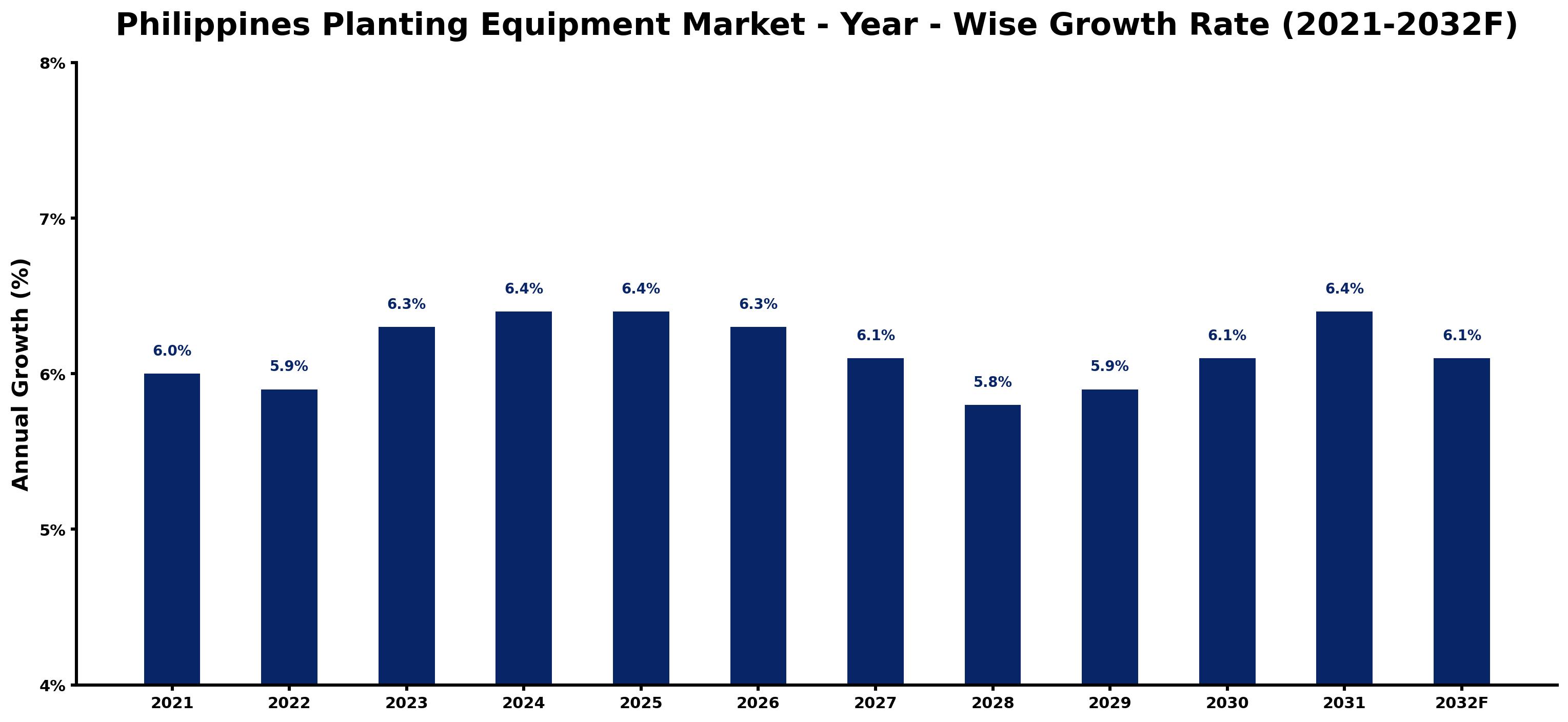
The table below presents the year‑wise growth rates along with the key drivers influencing the market
| Year | Growth Rate | Major Drivers |
| 2021 | 6.0% | Increasing adoption of advanced technologies |
| 2022 | 5.9% | Growing urbanization and commercial development |
| 2023 | 6.3% | Expansion of transportation and logistics networks |
| 2024 | 6.4% | Expansion of manufacturing activities |
| 2025 | 6.4% | Increasing smart city development projects |
| 2026 | 6.3% | Increasing smart city development projects |
| 2027 | 6.1% | Rising electricity demand across industries |
| 2028 | 5.8% | Growing renewable energy integration projects |
| 2029 | 5.9% | Expansion of manufacturing activities |
| 2030 | 6.1% | Increasing industrial infrastructure investments |
| 2031 | 6.4% | Expansion of commercial construction activities |
| 2032 | 6.1% | Growing urbanization and commercial development |
Note - Market size estimations and growth projections presented in this report are based on 6Wresearch’s advanced forecasting approach, validated with industry datasets as of June 2026.
Philippines Planting Equipment Market Synopsis
Recent trends indicate a positive shift towards the adoption of advanced planting equipment, as Filipino farmers aim to improve yield efficiency and productivity. However, the market also faces challenges related to the initial capital investment required for modern equipment, which can hinder broader adoption, particularly among small-scale farmers.
Looking ahead, the Philippines Planting Equipment Market is set for continued growth as technological advancements and research initiatives advance. With a focus on smart agriculture, such as IoT-enabled precision farming, the future landscape promises enhanced crop management and optimization, positioning the sector for significant evolution and expansion.
Philippines Planting Equipment Market Key Takeaways
- The market is projected to grow at a CAGR of 5.2% from 2026 to 2032.
- Government initiatives are significantly driving mechanization in agriculture.
- The adoption of precision farming technologies is increasing demand for advanced planting equipment.
- High initial costs remain a barrier for small-scale producers in the market.
- Favorable climate conditions support a diverse range of crops, contributing to market growth.
Evaluation of Restraints in Philippines Planting Equipment Market
While the Philippines Planting Equipment Market shows promising growth potential, several constraints persist. Chief among these is the high upfront cost associated with purchasing modern machinery. Many small-scale farmers face financial limitations, which can deter them from adopting advanced equipment. Additionally, the lack of adequate financing options and agricultural credit availability can hinder investment in necessary technological upgrades. As the market develops, addressing these financial barriers will be crucial for broadening access to mechanization across the agricultural landscape.
Philippines Planting Equipment Market Trends
A notable trend in the Philippines Planting Equipment Market is the growing emphasis on precision farming, wherein data analytics and IoT technologies facilitate efficient farm management. This approach enables farmers to make informed decisions about resource allocation, leading to optimized yields. Additionally, the rise of autonomous machinery, such as self-driving tractors, represents a significant shift towards automation, reducing labor costs while improving efficiency. Such innovations are driving demand for modern planting equipment, fostering a transformative shift in agricultural practices.
Philippines Planting Equipment Market Opportunities
Opportunities abound in the Philippines Planting Equipment Market, particularly for companies focused on developing affordable and efficient machinery tailored for smallholder farmers. The increasing availability of governmental support and subsidies aimed at promoting mechanization represents a pivotal moment for agricultural investments. Furthermore, as awareness grows around the benefits of precision agriculture, manufacturers can tap into this expanding market by offering innovative solutions that not only enhance crop yields but also reduce resource usage.
Government Initiatives in the Philippines Planting Equipment Market
The Philippine government is actively promoting agricultural modernization through various initiatives. Programs that provide subsidies and financial assistance for the purchase of planting equipment are critical components of this strategy. Furthermore, policies supporting research and development in agricultural technology aim to enhance the overall efficiency and productivity of the farming sector, thereby contributing to the growth of the planting equipment market. Such initiatives not only improve mechanization rates but also empower farmers to adopt advanced technologies more readily.
Future Insights of the Philippines Planting Equipment Market
From 2026 to 2032, the Philippines Planting Equipment Market is expected to evolve significantly, shaped by advancements in technology and increasing adoption of sustainable practices. The integration of digital solutions, including farm management software and real-time monitoring systems, will likely enhance operational efficiency. As local and global demand for food continues to surge, the drive towards mechanization and modern agriculture practices will intensify, positioning the market for sustained growth and innovation.
Philippines Planting Equipment Market Latest Developments (May 2025 - June 2026)
In recent months, the Philippines Planting Equipment Market has seen a shift towards the adoption of smart technology in farming, with increased interest in IoT solutions that aid in data-driven decision-making. Manufacturers are launching new products that emphasize sustainability and efficiency, aligning with global trends towards eco-friendly farming practices. Additionally, government-sponsored training programs have begun to emerge, equipping farmers with the skills needed to operate advanced machinery effectively.
Philippines Planting Equipment Market - Key Attractiveness of the Report
- 10 Years of Market Numbers
- Historical Data Starting from 2022 to 2025
- Base Year: 2025
- Forecast Data until 2032
- Key Performance Indicators Impacting the Market
- Major Upcoming Developments and Projects
Key Highlights of the Report:
- Philippines Planting Equipment Market Outlook
- Market Size of Philippines Planting Equipment Market, 2025
- Forecast of Philippines Planting Equipment Market, 2032
- Historical Data and Forecast of Philippines Planting Equipment Revenues & Volume for the Period 2022-2032F
- Philippines Planting Equipment Market Trend Evolution
- Philippines Planting Equipment Market Drivers and Challenges
- Philippines Planting Equipment Price Trends
- Philippines Planting Equipment Porter's Five Forces
- Philippines Planting Equipment Industry Life Cycle
- Historical Data and Forecast of Philippines Planting Equipment Market Revenues & Volume By Type for the Period 2022-2032F
- Historical Data and Forecast of Philippines Planting Equipment Market Revenues & Volume By Air seeders for the Period 2022-2032F
- Historical Data and Forecast of Philippines Planting Equipment Market Revenues & Volume By Seed drills for the Period 2022-2032F
- Historical Data and Forecast of Philippines Planting Equipment Market Revenues & Volume By Planters for the Period 2022-2032F
- Historical Data and Forecast of Philippines Planting Equipment Market Revenues & Volume By Others for the Period 2022-2032F
- Historical Data and Forecast of Philippines Planting Equipment Market Revenues & Volume By Design for the Period 2022-2032F
- Historical Data and Forecast of Philippines Planting Equipment Market Revenues & Volume By Mechanical for the Period 2022-2032F
- Historical Data and Forecast of Philippines Planting Equipment Market Revenues & Volume By Automatic for the Period 2022-2032F
- Historical Data and Forecast of Philippines Planting Equipment Market Revenues & Volume By Crop Type for the Period 2022-2032F
- Historical Data and Forecast of Philippines Planting Equipment Market Revenues & Volume By Cereals & grains for the Period 2022-2032F
- Historical Data and Forecast of Philippines Planting Equipment Market Revenues & Volume By Oilseeds & pulses for the Period 2022-2032F
- Historical Data and Forecast of Philippines Planting Equipment Market Revenues & Volume By Fruits & vegetables for the Period 2022-2032F
- Historical Data and Forecast of Philippines Planting Equipment Market Revenues & Volume By Others for the Period 2022-2032F
- Philippines Planting Equipment Import Export Trade Statistics
- Market Opportunity Assessment By Type
- Market Opportunity Assessment By Design
- Market Opportunity Assessment By Crop Type
- Philippines Planting Equipment Top Companies Market Share
- Philippines Planting Equipment Competitive Benchmarking By Technical and Operational Parameters
- Philippines Planting Equipment Company Profiles
- Philippines Planting Equipment Key Strategic Recommendations






































