Philippines Ploughing and Cultivating Machinery Market Size, Share & Growth Rate
The Philippines Ploughing and Cultivating Machinery Market was estimated at USD 794 Million in 2025 and is projected to reach USD 1128 Million by 2032, growing at a CAGR of 5.1% from 2026 to 2032. This growth trajectory is largely driven by a robust push for modern agricultural practices, where technology adoption is becoming increasingly essential. Government initiatives like the "Made In Country" campaign and the rising awareness among farmers about automation in agriculture are expected to further boost this market.
Philippines Ploughing and Cultivating Machinery Market Year-wise Growth Rate and Key Drivers
This graph highlights how the Philippines Ploughing and Cultivating Machinery Market has steadily grown over the years, supported by major growth factors.
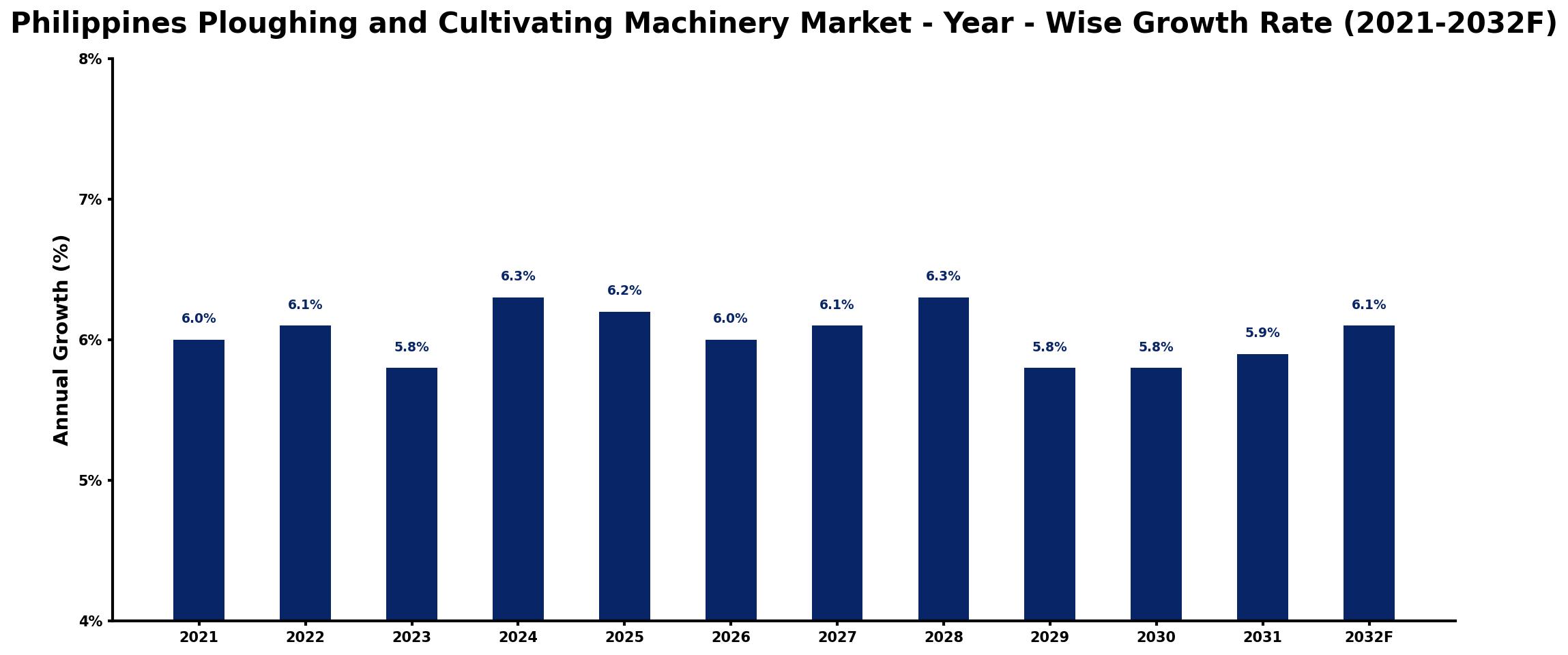
The table below presents the year‑wise growth rates along with the key drivers influencing the market
| Year | Growth Rate | Major Drivers |
| 2021 | 6.0% | Rising agricultural investment trends |
| 2022 | 6.1% | Increased crop production demand |
| 2023 | 5.8% | Technological advancements in agriculture |
| 2024 | 6.3% | Growing farmer adoption rates |
| 2025 | 6.2% | Expansion of export markets |
| 2026 | 6.0% | Enhanced government support programs |
| 2027 | 6.1% | Sustainable farming practices adoption |
| 2028 | 6.3% | Rising mechanization of farms |
| 2029 | 5.8% | Increased awareness of efficiency |
| 2030 | 5.8% | Growing rural infrastructure development |
| 2031 | 5.9% | Emergence of cooperative farming models |
| 2032 | 6.1% | Strengthened supply chain networks |
Note: Market size estimations and growth projections presented in this report are based on 6Wresearch's proprietary forecasting methodology, utilizing the latest available industry data, government publications, and primary research inputs.
Philippines Ploughing and Cultivating Machinery Market Synopsis
In recent years, the Philippines has witnessed a significant momentum in its ploughing and cultivating machinery market, propelled by a demand for efficiency and productivity in agriculture. The future of this market looks promising, as investments in technology and infrastructure are anticipated to enhance capabilities in the sector.
The emphasis on modern farming techniques is redefining the landscape, with an increasing number of farmers adopting automated solutions. By capitalizing on these advancements, the industry is set for substantial growth, leading to a better equipped agricultural sector.
Philippines Ploughing and Cultivating Machinery Market Key Takeaways
- The market is driven by increased efficiency and productivity demands in agriculture.
- Government initiatives are pivotal in boosting local manufacturing and technology adoption.
- The awareness and education surrounding modern farming practices are on the rise.
- Technological advancements play a crucial role in shaping future demand.
- Small-scale farmers face challenges that need addressing to ensure inclusive growth.
Evaluation of Restraints in Philippines Ploughing and Cultivating Machinery Market
While there are numerous growth opportunities in the Philippines ploughing and cultivating machinery market, several challenges persist. Adapting machinery to various soil types presents a significant hurdle, as does the necessity for comprehensive education on modern agricultural practices among farmers. Moreover, ensuring affordability for small-scale farmers remains a key concern, potentially limiting widespread adoption of advanced machinery. Addressing these constraints will be essential for maximizing the market's potential.
Philippines Ploughing and Cultivating Machinery Market Trends
Emerging trends in the Philippines ploughing and cultivating machinery market include the shift towards precision agriculture and smart farming technologies. These innovations are not only enhancing the efficiency of farming operations but also minimizing environmental impact. Furthermore, the increasing availability of financing options for farmers is enabling greater access to advanced machinery, which will likely accelerate the market's growth. The integration of digital platforms for equipment management and monitoring is also gaining traction, supporting the modernization of agriculture.
Philippines Ploughing and Cultivating Machinery Market Opportunities
Genuine growth opportunities exist in the form of partnerships between technology providers and local manufacturers aimed at increasing accessibility to advanced machinery. Investment in R&D to develop equipment tailored for the diverse agricultural landscapes of the Philippines can also open new market avenues. As government policies increasingly support the agricultural sector, businesses can capitalize on these initiatives to introduce innovative solutions that meet local farmers' needs.
Government Initiatives in the Philippines Ploughing and Cultivating Machinery Market
The Philippine government has implemented various policies aimed at bolstering the agricultural sector, including funding programs and subsidies for local manufacturing. Initiatives like the "Made In Country" campaign promote domestic production, encouraging investments in advanced agricultural equipment. Additionally, there are efforts to enhance farmer education and training programs, ensuring that farmers are well-equipped to adopt modern farming techniques.
Future Insights of the Philippines Ploughing and Cultivating Machinery Market
Looking ahead to the period from 2026 to 2032, the Philippines ploughing and cultivating machinery market is poised for dynamic growth. Continuous innovation and technological advancements are expected to redefine agricultural practices, leading to increased productivity and sustainability. As government support intensifies and farmers' awareness of technology grows, the demand for modern ploughing and cultivating equipment will likely accelerate, establishing a solid foundation for market expansion.
Philippines Ploughing and Cultivating Machinery Market Latest Developments (2025 - 2026)
Recent developments in the industry indicate a strong focus on adopting smart farming technologies, alongside a surge in local manufacturing initiatives. Companies are increasingly collaborating with agricultural institutions to advance research and development, ultimately enhancing product offerings. Moreover, public and private sector dialogues are promoting knowledge-sharing sessions aimed at better equipping farmers with modern practices and machinery applications.
Philippines Ploughing and Cultivating Machinery Market - Key Attractiveness of the Report
- 10 Years of Market Numbers
- Historical Data Starting from 2022 to 2025
- Base Year: 2025
- Forecast Data until 2032
- Key Performance Indicators Impacting the Market
- Major Upcoming Developments and Projects
Key Highlights of the Report:
- Philippines Ploughing and Cultivating Machinery Market Outlook
- Market Size of Philippines Ploughing and Cultivating Machinery Market, 2025
- Forecast of Philippines Ploughing and Cultivating Machinery Market, 2032
- Historical Data and Forecast of Philippines Ploughing and Cultivating Machinery Revenues & Volume for the Period 2022-2032F
- Philippines Ploughing and Cultivating Machinery Market Trend Evolution
- Philippines Ploughing and Cultivating Machinery Market Drivers and Challenges
- Philippines Ploughing and Cultivating Machinery Price Trends
- Philippines Ploughing and Cultivating Machinery Porter's Five Forces
- Philippines Ploughing and Cultivating Machinery Industry Life Cycle
- Historical Data and Forecast of Philippines Ploughing and Cultivating Machinery Market Revenues & Volume By Type for the Period 2022-2032F
- Historical Data and Forecast of Philippines Ploughing and Cultivating Machinery Market Revenues & Volume By Ploughs for the Period 2022-2032F
- Historical Data and Forecast of Philippines Ploughing and Cultivating Machinery Market Revenues & Volume By Harrows for the Period 2022-2032F
- Historical Data and Forecast of Philippines Ploughing and Cultivating Machinery Market Revenues & Volume By Others for the Period 2022-2032F
- Historical Data and Forecast of Philippines Ploughing and Cultivating Machinery Market Revenues & Volume By Application for the Period 2022-2032F
- Historical Data and Forecast of Philippines Ploughing and Cultivating Machinery Market Revenues & Volume By Soil Loosening for the Period 2022-2032F
- Historical Data and Forecast of Philippines Ploughing and Cultivating Machinery Market Revenues & Volume By Clod Size Reduction for the Period 2022-2032F
- Historical Data and Forecast of Philippines Ploughing and Cultivating Machinery Market Revenues & Volume By Clod Sorting for the Period 2022-2032F
- Historical Data and Forecast of Philippines Ploughing and Cultivating Machinery Market Revenues & Volume By Others for the Period 2022-2032F
- Philippines Ploughing and Cultivating Machinery Import Export Trade Statistics
- Market Opportunity Assessment By Type
- Market Opportunity Assessment By Application
- Philippines Ploughing and Cultivating Machinery Top Companies Market Share
- Philippines Ploughing and Cultivating Machinery Competitive Benchmarking By Technical and Operational Parameters
- Philippines Ploughing and Cultivating Machinery Company Profiles
- Philippines Ploughing and Cultivating Machinery Key Strategic Recommendations






































