Philippines Polyethylene Pe Pipes And Tubes Market Top 5 Importing Countries and Market Competition (HHI) Analysis
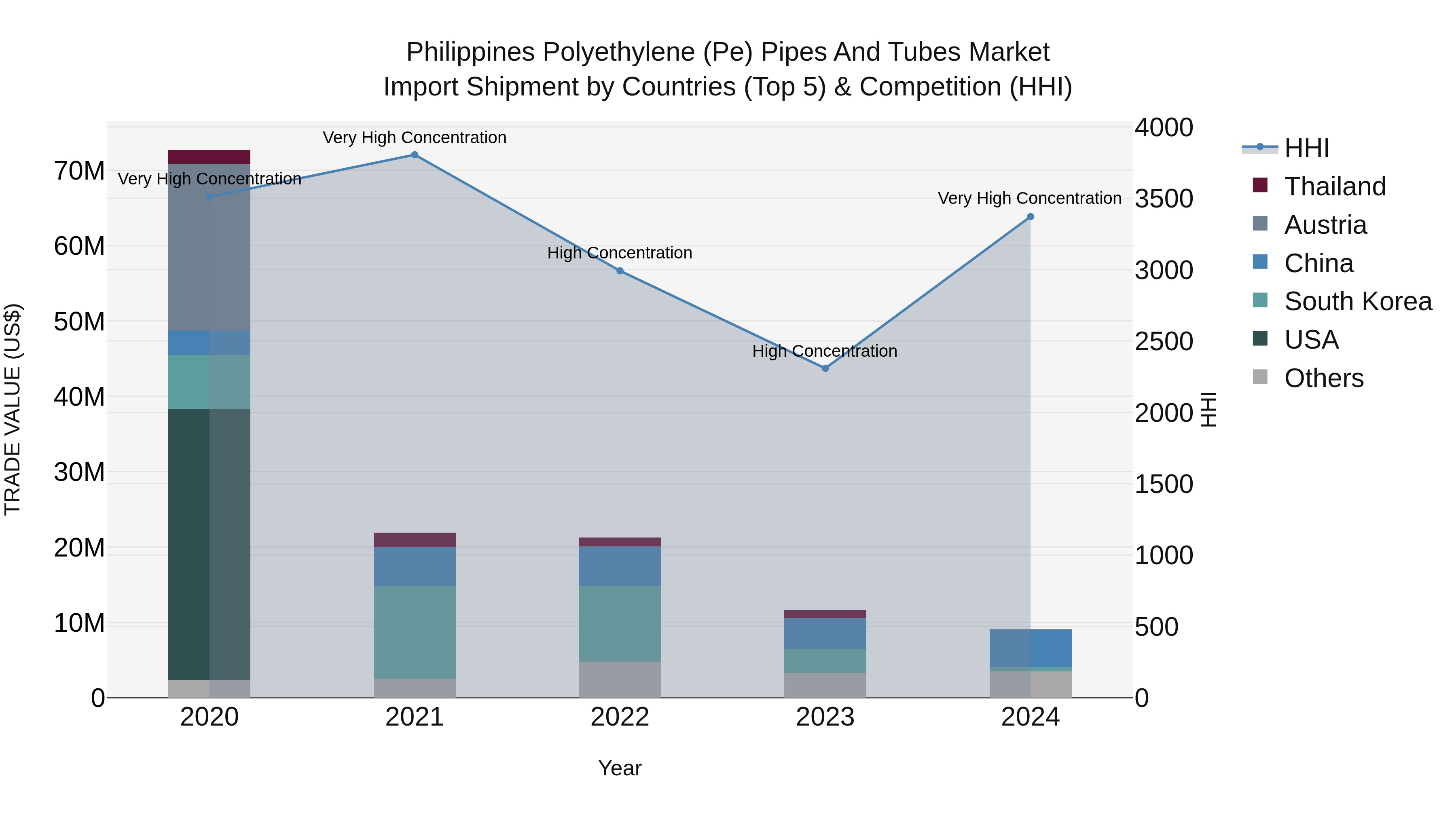
The import shipments of polyethylene (PE) pipes and tubes in the Philippines in 2024 saw a high concentration of imports from top exporting countries including China, Japan, UAE, India, and South Korea. The Herfindahl-Hirschman Index (HHI) indicated a significant increase in market concentration from 2023 to 2024. The compound annual growth rate (CAGR) from 2020 to 2024 was notably negative at -40.56%, with a further decline in the growth rate from 2023 to 2024 at -22.29%. These trends suggest a complex market landscape and evolving dynamics in the importation of PE pipes and tubes in the Philippines.
Philippines Polyethylene (PE) Synopsis
The Philippines Polyethylene (PE) Pipes and Tubes market is expected to grow at a CAGR of around 6.9% during the forecast period 2025-2031. The growing demand for PE pipes and tubes in various applications such as water supply, sewage & drainage systems, oil & gas transportation, etc., are anticipated to drive the growth of the market over the forecast period. Additionally, government initiatives for providing safe drinking water and sanitation facilities are further likely to fuel the demand for PE pipes and tubes in this region
Key Trends of The Market
Polyethylene (PE) pipes have become a popular choice among oil & gas companies due to their low weight yet high strength properties that offer greater flexibility when it comes to installation or maintenance process. As drilling activities increase in this region owing to rising crude oil prices among other factors, higher demand would be witnessed from oil & gas industry which would positively impact growth prospects of PE pipe and tube market over coming years. Additionally, growing awareness regarding advantages offered by plastic piping solutions such as corrosion resistance coupled with lower costs when compared with conventional metal piping solutions has resulted into increased preference towards plastic piping solutions across residential buildings as well industrial plants alike thus driving overall growth of polyethylene (PE) pipe and tube market size in Philippines over coming years.
Key Growth Drivers of the Market
Despite significant presence across many developed countries especially US & Canada regions, there lies considerable opportunity potential within developing countries including those located in Asia Pacific where there is currently limited penetration rates witnessed across small scale industries particularly those related with agriculture sector which present strong impetus for rapid expansion of overall global polyethylene (PE) pipeand tube marketsize going ahead. Additionally, with rising population levels accompanied by increasing urbanization resulting into contaminated waste disposal facilities leading onto health hazards , governments have initiated measures offering clean drinking water supplies along with improved sewage systems.
Key Highlights of the Report:
- Philippines Polyethylene (PE) Pipes and Tubes Market Outlook
- Market Size of Philippines Polyethylene (PE) Pipes and Tubes Market, 2024
- Forecast of Philippines Polyethylene (PE) Pipes and Tubes Market, 2031
- Historical Data and Forecast of Philippines Polyethylene (PE) Pipes and Tubes Revenues & Volume for the Period 2021-2031
- Philippines Polyethylene (PE) Pipes and Tubes Market Trend Evolution
- Philippines Polyethylene (PE) Pipes and Tubes Market Drivers and Challenges
- Philippines Polyethylene (PE) Pipes and Tubes Price Trends
- Philippines Polyethylene (PE) Pipes and Tubes Porter's Five Forces
- Philippines Polyethylene (PE) Pipes and Tubes Industry Life Cycle
- Historical Data and Forecast of Philippines Polyethylene (PE) Pipes and Tubes Market Revenues & Volume By Type for the Period 2021-2031
- Historical Data and Forecast of Philippines Polyethylene (PE) Pipes and Tubes Market Revenues & Volume By High Density Polythene (HDPE) for the Period 2021-2031
- Historical Data and Forecast of Philippines Polyethylene (PE) Pipes and Tubes Market Revenues & Volume By Low Density Polythene (LDPE) for the Period 2021-2031
- Historical Data and Forecast of Philippines Polyethylene (PE) Pipes and Tubes Market Revenues & Volume By Linear Low Density Polythene (LLDPE) for the Period 2021-2031
- Historical Data and Forecast of Philippines Polyethylene (PE) Pipes and Tubes Market Revenues & Volume By Cross Link Polythene (PEX/XLPE) for the Period 2021-2031
- Historical Data and Forecast of Philippines Polyethylene (PE) Pipes and Tubes Market Revenues & Volume By Application for the Period 2021-2031
- Historical Data and Forecast of Philippines Polyethylene (PE) Pipes and Tubes Market Revenues & Volume By Industrial for the Period 2021-2031
- Historical Data and Forecast of Philippines Polyethylene (PE) Pipes and Tubes Market Revenues & Volume By Agriculture for the Period 2021-2031
- Historical Data and Forecast of Philippines Polyethylene (PE) Pipes and Tubes Market Revenues & Volume By Underwater And Municipal for the Period 2021-2031
- Historical Data and Forecast of Philippines Polyethylene (PE) Pipes and Tubes Market Revenues & Volume By Construction for the Period 2021-2031
- Historical Data and Forecast of Philippines Polyethylene (PE) Pipes and Tubes Market Revenues & Volume By Gas Extraction for the Period 2021-2031
- Historical Data and Forecast of Philippines Polyethylene (PE) Pipes and Tubes Market Revenues & Volume By Others for the Period 2021-2031
- Philippines Polyethylene (PE) Pipes and Tubes Import Export Trade Statistics
- Market Opportunity Assessment By Type
- Market Opportunity Assessment By Application
- Philippines Polyethylene (PE) Pipes and Tubes Top Companies Market Share
- Philippines Polyethylene (PE) Pipes and Tubes Competitive Benchmarking By Technical and Operational Parameters
- Philippines Polyethylene (PE) Pipes and Tubes Company Profiles
- Philippines Polyethylene (PE) Pipes and Tubes Key Strategic Recommendations






































