Philippines Polyethylene Pipes And Fittings Market Top 5 Importing Countries and Market Competition (HHI) Analysis
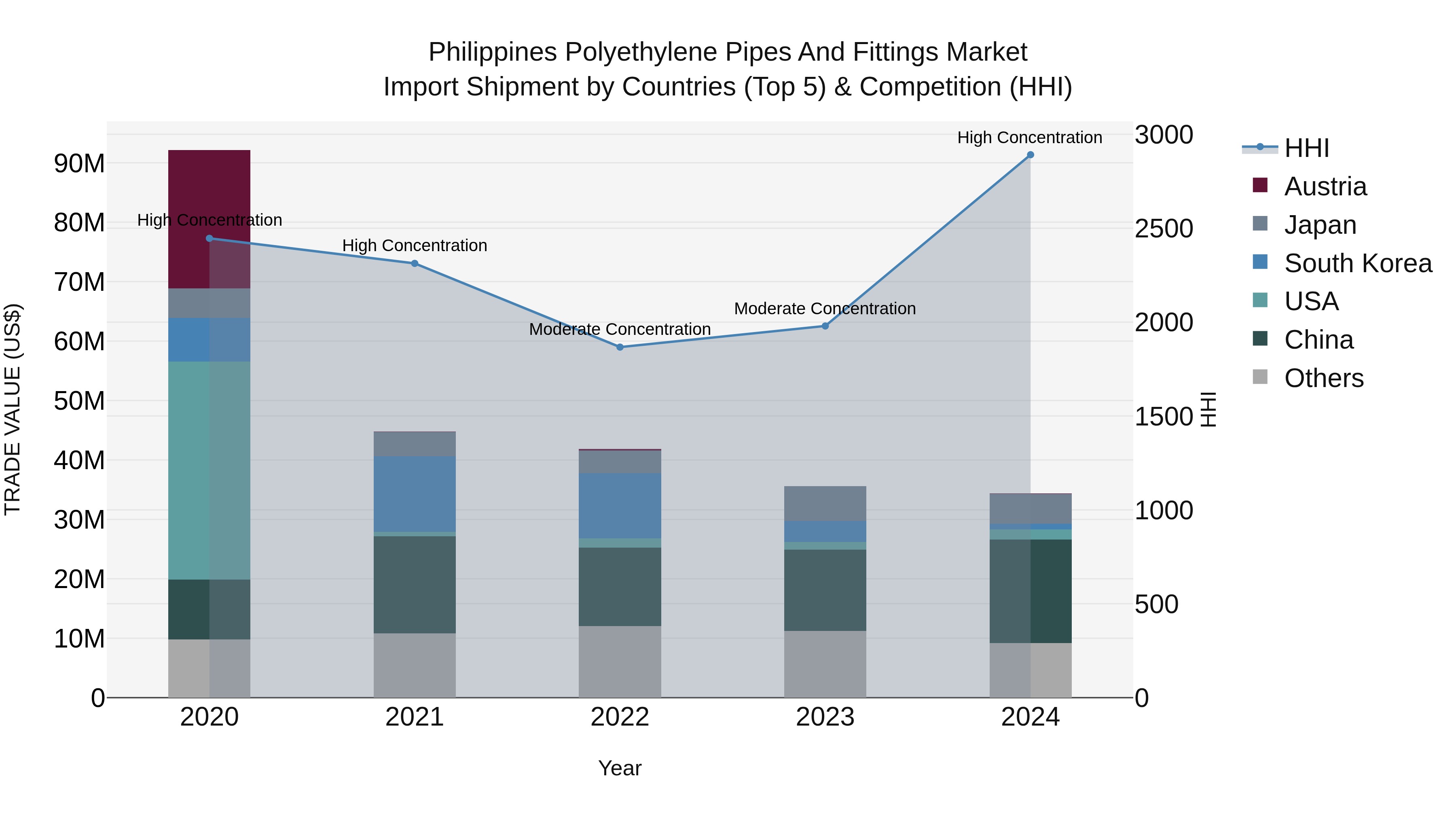
The Philippines saw a shift in polyethylene pipes and fittings import dynamics in 2024, with top exporters being China, Japan, Malaysia, USA, and Germany. The market experienced a significant increase in market concentration from moderate to high in 2024. Despite a challenging CAGR of -21.83% from 2020 to 2024, there was a slight improvement in the growth rate from 2023 to 2024, with a decrease of -3.43%. This indicates a complex market landscape that importers and stakeholders in the Philippines should closely monitor for potential opportunities and risks.
Philippines Polyethylene Pipes and Fittings Market Overview
Polyethylene pipes and fittings are essential components in construction, water management, and industrial piping systems in the Philippines. The market is expanding due to increasing demand for lightweight, leak-proof, and cost-effective piping solutions. Advances in manufacturing techniques, including the development of high-density polyethylene (HDPE) pipes, are further enhancing market growth.
Drivers of the market
The rapid urbanization and infrastructure development in the Philippines are major factors propelling the polyethylene (PE) pipes and fittings market. The increasing adoption of PE pipes in water supply, irrigation, and sewage management due to their durability, flexibility, and resistance to corrosion is boosting market demand. Government initiatives to improve sanitation and water distribution networks are also driving investment in high-quality pipe solutions. Furthermore, the growing construction and industrial sectors are increasing the need for efficient piping systems, further fueling market growth.
Challenges of the market
The polyethylene pipes and fittings market in the Philippines faces challenges related to fluctuating raw material costs and dependency on imported polyethylene resins. Infrastructure development and regulatory approvals also create hurdles, delaying large-scale adoption. Additionally, competition from alternative materials, such as PVC and metal pipes, limits the markets growth potential.
Investment opportunities in the Market
With ongoing construction and water distribution projects, polyethylene pipes and fittings are critical components for plumbing and sewage systems. Investors can benefit from government-backed infrastructure initiatives. Expanding production capacity and developing innovative pipe fittings, such as leak-proof and heat-resistant solutions, can provide a competitive edge.
Government Policy of the market
The market for polyethylene pipes and fittings is driven by government infrastructure projects and private construction developments. Strict quality standards are enforced to ensure durability and safety in water supply and sewage systems. The government provides incentives for local pipe manufacturers to boost domestic production and reduce reliance on imports. However, price fluctuations in raw materials affect market stability.
Key Highlights of the Report:
- Philippines Polyethylene Pipes and Fittings Market Outlook
- Market Size of Philippines Polyethylene Pipes and Fittings Market, 2024
- Forecast of Philippines Polyethylene Pipes and Fittings Market, 2031
- Historical Data and Forecast of Philippines Polyethylene Pipes and Fittings Revenues & Volume for the Period 2021- 2031
- Philippines Polyethylene Pipes and Fittings Market Trend Evolution
- Philippines Polyethylene Pipes and Fittings Market Drivers and Challenges
- Philippines Polyethylene Pipes and Fittings Price Trends
- Philippines Polyethylene Pipes and Fittings Porter's Five Forces
- Philippines Polyethylene Pipes and Fittings Industry Life Cycle
- Historical Data and Forecast of Philippines Polyethylene Pipes and Fittings Market Revenues & Volume By Type for the Period 2021- 2031
- Historical Data and Forecast of Philippines Polyethylene Pipes and Fittings Market Revenues & Volume By Low Density Polyethylene (Ldpe) for the Period 2021- 2031
- Historical Data and Forecast of Philippines Polyethylene Pipes and Fittings Market Revenues & Volume By Linear Low Density Polyethylene (Lldpe) for the Period 2021- 2031
- Historical Data and Forecast of Philippines Polyethylene Pipes and Fittings Market Revenues & Volume By High Density Polyethylene (Hdpe) for the Period 2021- 2031
- Historical Data and Forecast of Philippines Polyethylene Pipes and Fittings Market Revenues & Volume By Others for the Period 2021- 2031
- Historical Data and Forecast of Philippines Polyethylene Pipes and Fittings Market Revenues & Volume By Application for the Period 2021- 2031
- Historical Data and Forecast of Philippines Polyethylene Pipes and Fittings Market Revenues & Volume By Water Supply for the Period 2021- 2031
- Historical Data and Forecast of Philippines Polyethylene Pipes and Fittings Market Revenues & Volume By Oil And Gas for the Period 2021- 2031
- Historical Data and Forecast of Philippines Polyethylene Pipes and Fittings Market Revenues & Volume By Sewage Systems for the Period 2021- 2031
- Historical Data and Forecast of Philippines Polyethylene Pipes and Fittings Market Revenues & Volume By Agricultural Applications for the Period 2021- 2031
- Historical Data and Forecast of Philippines Polyethylene Pipes and Fittings Market Revenues & Volume By Others for the Period 2021- 2031
- Historical Data and Forecast of Philippines Polyethylene Pipes and Fittings Market Revenues & Volume By End User for the Period 2021- 2031
- Historical Data and Forecast of Philippines Polyethylene Pipes and Fittings Market Revenues & Volume By Building and Construction for the Period 2021- 2031
- Historical Data and Forecast of Philippines Polyethylene Pipes and Fittings Market Revenues & Volume By Oil & Gas Industry for the Period 2021- 2031
- Historical Data and Forecast of Philippines Polyethylene Pipes and Fittings Market Revenues & Volume By Municipal for the Period 2021- 2031
- Historical Data and Forecast of Philippines Polyethylene Pipes and Fittings Market Revenues & Volume By Electronics & Telecom for the Period 2021- 2031
- Historical Data and Forecast of Philippines Polyethylene Pipes and Fittings Market Revenues & Volume By Agriculture for the Period 2021- 2031
- Philippines Polyethylene Pipes and Fittings Import Export Trade Statistics
- Market Opportunity Assessment By Type
- Market Opportunity Assessment By Application
- Market Opportunity Assessment By End User
- Philippines Polyethylene Pipes and Fittings Top Companies Market Share
- Philippines Polyethylene Pipes and Fittings Competitive Benchmarking By Technical and Operational Parameters
- Philippines Polyethylene Pipes and Fittings Company Profiles
- Philippines Polyethylene Pipes and Fittings Key Strategic Recommendations






































