Philippines Polysilicon Market Top 5 Importing Countries and Market Competition (HHI) Analysis
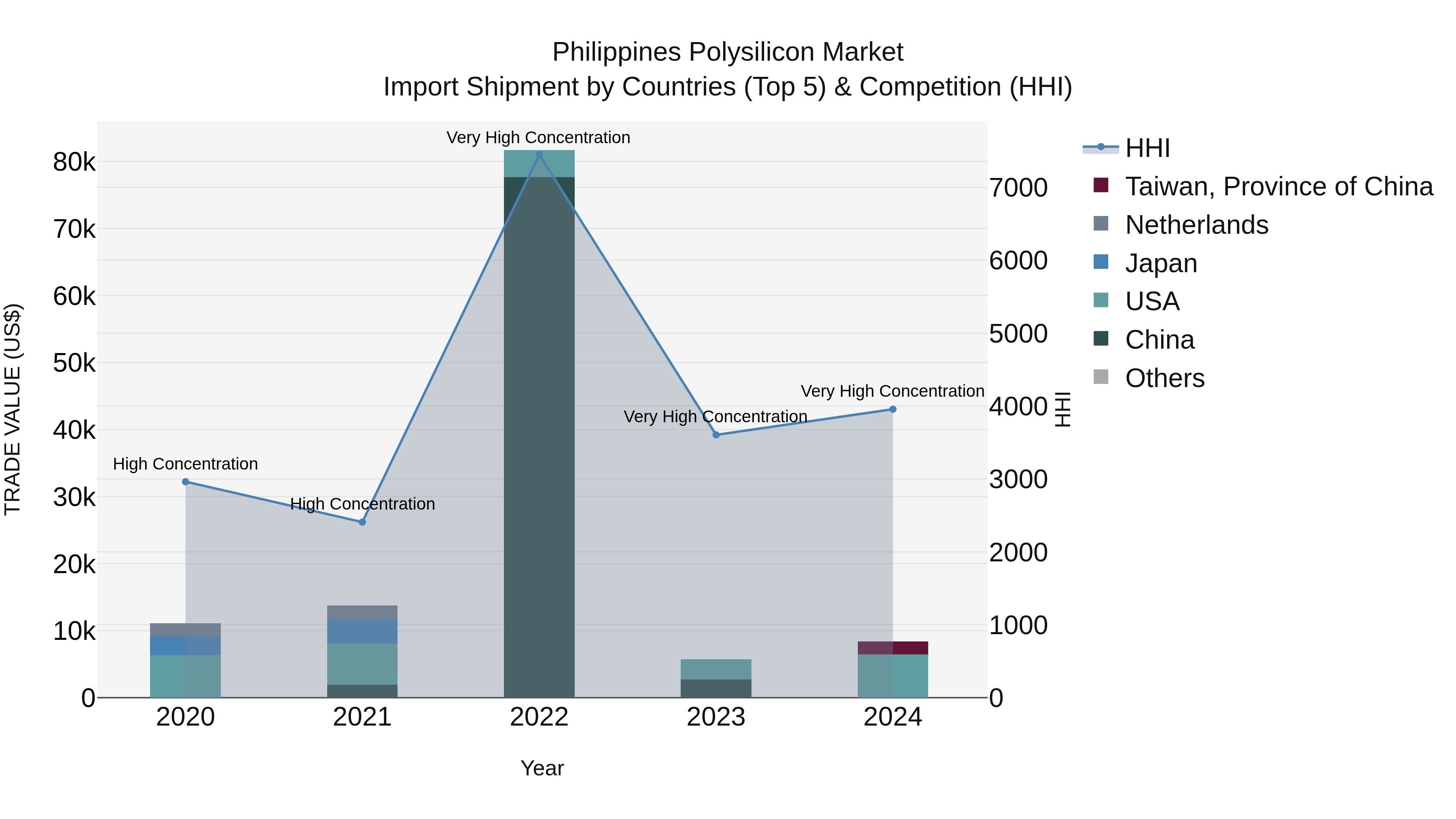
Philippines` polysilicon import market in 2024 continued to be dominated by key players such as the USA, Taiwan, China, Netherlands, and Japan. Despite a challenging CAGR of -6.83% from 2020 to 2024, there was a notable growth spike of 46.25% from 2023 to 2024. The high Herfindahl-Hirschman Index (HHI) indicates a concentrated market, emphasizing the significant presence of these top exporting countries. This data suggests a dynamic landscape for polysilicon imports in the Philippines, with opportunities for market players to capitalize on emerging trends and shifts in the industry.
Philippines Polysilicon Market Overview
The Philippines Polysilicon Market is a niche sector that primarily serves the electronics and solar energy industries. Polysilicon is a critical raw material for semiconductor manufacturing and photovoltaic solar panels. The market`s growth is closely li
Drivers of the Markets
The Philippines Polysilicon Market has been primarily driven by the growing solar energy sector. Polysilicon is a key raw material used in the production of photovoltaic cells, and with the country`s increasing focus on renewable energy sources, the deman
Challenges of the Markets
The Philippines Polysilicon Market is part of the global solar energy supply chain. It contends with price volatility and uncertainty in the renewable energy sector, which impacts demand and investments. Geopolitical factors and international trade disput
COVID-19 Impact on the Market
Polysilicon is essential in the production of solar panels. The renewable energy sector has been relatively resilient during the pandemic, as governments sought to boost clean energy. However, supply chain disruptions may have affected polysilicon availab
Key Players of the market
The Philippines Polysilicon Market features a mix of global and regional players. Leading global companies like Wacker Chemie AG and REC Silicon supply high-purity polysilicon for the solar industry. While the Philippines may not produce polysilicon local
Key Highlights of the Report:
- Philippines Polysilicon Market Outlook
- Market Size of Philippines Polysilicon Market, 2024
- Forecast of Philippines Polysilicon Market, 2031
- Historical Data and Forecast of Philippines Polysilicon Revenues & Volume for the Period 2021-2031
- Philippines Polysilicon Market Trend Evolution
- Philippines Polysilicon Market Drivers and Challenges
- Philippines Polysilicon Price Trends
- Philippines Polysilicon Porter's Five Forces
- Philippines Polysilicon Industry Life Cycle
- Historical Data and Forecast of Philippines Polysilicon Market Revenues & Volume By End Use Industry for the Period 2021-2031
- Historical Data and Forecast of Philippines Polysilicon Market Revenues & Volume By Solar PV for the Period 2021-2031
- Historical Data and Forecast of Philippines Polysilicon Market Revenues & Volume By Electronics for the Period 2021-2031
- Historical Data and Forecast of Philippines Polysilicon Market Revenues & Volume By Form for the Period 2021-2031
- Historical Data and Forecast of Philippines Polysilicon Market Revenues & Volume By Chunks for the Period 2021-2031
- Historical Data and Forecast of Philippines Polysilicon Market Revenues & Volume By Granules for the Period 2021-2031
- Historical Data and Forecast of Philippines Polysilicon Market Revenues & Volume By Rods for the Period 2021-2031
- Philippines Polysilicon Import Export Trade Statistics
- Market Opportunity Assessment By End Use Industry
- Market Opportunity Assessment By Form
- Philippines Polysilicon Top Companies Market Share
- Philippines Polysilicon Competitive Benchmarking By Technical and Operational Parameters
- Philippines Polysilicon Company Profiles
- Philippines Polysilicon Key Strategic Recommendations






































